Category Archives: Religion

The Women in Black and freedom of speech in Israel

Crinkles collected in the corner of her eyes as she smiled and said “I have been coming here for the last twenty four years. I sometimes wonder why, but I come. We have to show our belief as Israelis, as humans, in peace”. I was standing with a handful of women who were dressed in black, collected in the middle of a busy road junction in West Jerusalem. They come at same time, to the same place, every Friday. They stand with large cut out plastic hands with the message “Stop the Occupation” written on them in three languages. Collectively they are referred to as the “Women in Black”.

As the protesters began to assemble I was standing with three women, all in their seventies, all smiling and all opposed to the occupation. It was hard not to be won over by them.

The Women in Black movement started in 1988, a month or so after the first intifada broke out. The first protests began in Jerusalem but the idea spread internationally taking on local relevance. In Germany for example, Women in Black protests became active in countering the neo-Nazi movements. Everywhere they appeared they were organised by women and condemn violence in whatever its form.

Defying any stereotype around age or gender or nationality, the Women in Black are a powerful striking image on the road side making those passing by stop and take notice. Even through the smiles you could sense a steely determination which brings these women out onto the streets every Friday. This determination resonates to those around.

Before the demonstration I had been told about a ‘counter demonstration’ that occurs on the opposite side of the street to the Women in Black protest. At first this ‘counter demonstration’ played out like I would have expected. A small group of predominantly men gathered waving Israeli flags. One held a placard with the slogan, “Get an occupation and support Israel” (You have to give credit where it is due, it is a witty slogan). These two demonstrations happened alongside each other with little interaction.

Cars passed by honking their horns in support, and both protests took the noise and commotion to be in support of their cause. It was unclear to me who was honking to who but I got the feeling that most people were supporting the ‘counter demonstration’.

A taxi driver with a small Israeli flag flying from his window puts two fingers up at the women and drives off.

One passer by stopped and asked one of the Women in Black why they thought there was a counter protest. The answer showed, at the very least, an ability to understand what drives those who attend the ‘counter demonstration’. Glancing out from her black sun hat she answered, “For them, we are calling for half of Israel to be given away. Not only that, but we are asking for it to be given to a group of people who they think want Israel, and by extension their families, driven into the sea”. When the Women in Black call for an end of an occupation of a foreign land, many Israelis see it as ‘giving away’ part of greater Israel.

This back-story is important to understand as it provides a partial explanation (different to a justification) to why then the protest took a nasty and unpleasant turn.

A small group from the ‘counter demonstration’ crossed over the street and started accusing the Women in Black of being everything from ‘Nazis’ to ‘supporters of Ahmadinejad’ (Iranian leader). No slur appeared to be too extreme. To the credit of the Women in Black protesters, and perhaps because of previous experience, they showed almost no reaction to the provocation. Silently they continued to hold their signs calling for an end to the occupation.

This was until one ‘counter protestor’ approached me and accused me of being a “German, Nazi, Christian” (wrong on all three fronts). At this point one of the Women in Black came over encouraging me to ‘not talk to this man’. You can hear me at a number of points say “it’s ok” to her, trying to calm the situation as the ‘counter protester’ continued his hate speech. I only managed to record a small part of what he said and missed some of his worse comments. Still, both the recordings are truly shocking in places (see video below).

The Women in Black are on the street every Friday, keeping the Israeli opposition to the occupation in the public’s mind. Many involved in the protest want the counter demonstration banned, feeling that it is ‘threatening’. I agree it is certainly unpleasant.

For me however, Israel as a modern democratic state has to support the plurality of views and enable this ‘counter demonstration’ to take place for as long as remains peaceful and non-threatening. I did not witness any behaviour which was ‘threatening’. Of course the same has to be true for Palestinians who routinely have their right to protest violated.

As Voltaire didn’t actually ever say, “I disapprove of what you say, but I will defend to the death your right to say it”.
7 Comments

Filed under Human rights, Middle East, Politics, Religion

Cana – “Jesus was here”

A man wearing a “Jesus was Here” t-shirt strolls past me with his less than enthusiastic family in tow. In the opposite direction I see a small mob of elderly Italian tourists silhouetted in the evening sun, hobbling their collective way up through the cobbled streets of the old city. The melody of church bells play over the continuous drone of horns from the impatient tour bus operators waiting nearby. The streets are filled with an electricity that can only be found amongst those who are resolute in their faith.

I turn to a young American stood near to me and make an acknowledging smile. I wanted to share with this stranger that I wasn’t drawn into this touristic interpretation of history and religion. If Jesus did change water into wine here in Cana, then I am sure he would not have appreciated the inflatable replicas of him doing so. I was about to say something dry and snide along these lines when the young American smiles back and says, “You know, when I step on this soil, I feel like I am closer to God than in any church I have ever been into”. Such a genuine sentiment is hard to ignore.

The conflict between the crass and cultural that I experienced in Cana is not unique.  I had a comparable experience when visiting Carcassone in the south of France and it can be found in cultural, historical and religious sites around the world.

Cana is where people come to celebrate Jesus’ first miracle, the turning of water into wine at the wedding feast. For the materialists who dominate the town’s tourist trade however this results in novelty t-shirts and bottles of wine with Jesus’ face painted on them.

Cana is also recorded as the site where Jesus healed a royal official’s son. I try asking a few locals if they can show me where Jesus was supposed to have performed this second miracle. I am met with baffled looks and offers of “good price” on wedding wine.

In desperation I turn back to my American friend looking for inspiration. I ask him how long he is staying in Cana for and he tells me that he is just here for one night stopping off on the Jesus Trail. I am interested to find out what brings a 20 something from the deep south of the US to the Galilee region of Israel. “I became desperate to find what sits at the heart of a billion people’s faith. I wanted to feel it with my own hands”. I paused, desperately hoping that he would kneel down and pick up some dirt and let in run through his fingers. Instead he meets my eye, smiles and looks up at the spectacular Franciscan Wedding Church.

Cana didn’t ignite my imagination like I had hoped but I wonder how it looks through the eyes of those who have faith like my new American friend.

1 Comment

Filed under Middle East, Religion, Travel

Spending the pink pound in Israel

This is a feature piece written for OUT magazine.

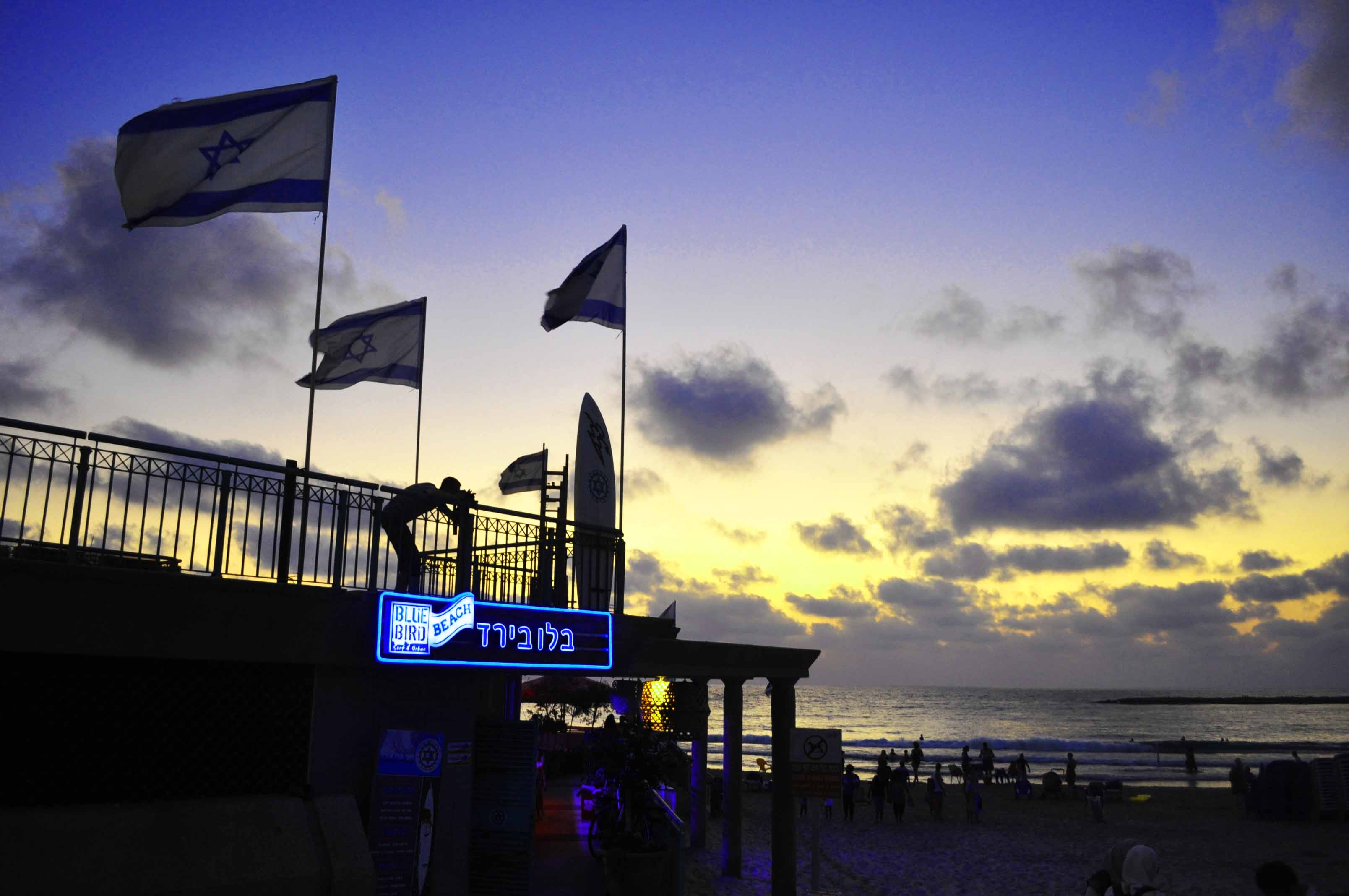
Sat in the evening sun Shaun shifts closer to Paul as the temperature drops in the fading light. I meet the couple sat on a beach in Tel Aviv, Israel. The two men in their mid thirties are on a couple of weeks vacation from their home in south London. I ask them if it is OK to talk to them about the gay scene in Israel and they happily suggest going for beer in the bar a hundred meters away on the beach front.

Sweet smelling smoke fills the air inside the bar as hookah pipes are shared between friends. We are sat with panoramic views of the now silhouetted beach front.  Passing the hookah pipe across the table to where the two men are sat side by side I start the interview by asking them why they chose Tel Aviv for their holiday. Paul exhales a plume of smoke, takes a sip from his beer and jokes, “cheap easy jet flights”. Shaun laughs and adds, “I just love the rub down at the [Ben Gurion] airport” (referring to the notoriously inhospitable welcoming foreigners receive at the airport).

With a smile I try a less subtle approach and asked if it had anything to do with the internationally renowned LGBT scene in Tel Aviv. Paul does not hesitate this time and comments, “We want to holiday somewhere that we feel relaxed and welcome. A friend of mine told me about Tel Aviv and so we thought we would check it out”. As an afterthought, as if recalling a distant memory, he adds, “everything is set up for us here”.

Tel Aviv is a well known destination for ‘gay tourism’. Last year Tel Aviv launched a $90 million campaign to present itself as, “an international gay vacation destination.” Leon Avigad, owner of the gay-friendly Brown hotel, explains the city’s popularity, “We are cosmopolitan, we’re very Western, European and American but on the other hand we’re very much into the Middle Eastern warmth and welcoming, and this combination attracts”.

Our visit to Tel Aviv coincide with the holiday of Pesach (Passover), the celebration of the story in Exodus where the ancient Israelites were freed from slavery in Egypt. As such it is very difficult to buy certain things such as beers and certain breads. I ask Shaun if this has been a problem and he responds with more depth than I was perhaps expecting. “I think it is beautiful that this society can hold onto its traditions and religious celebrations and still be so open minded”. I wondered how much Shaun had ventured much beyond the city since being here.

On cue, they ask me what I am doing in Tel Aviv and I tell them all about EAPPI and they seem genuinely interested. I ask them if they have ever been to the occupied Palestinian territories. Paul responds with a degree of defensiveness in his voice that he assumed he wasn’t allowed, “I thought there was a war there”. I explain to them, the best I can, the problems caused by the occupation and what I have experienced since living there. I elaborate my point about why I think it is bad for both Israelis and Palestinians. There is a more than awkward silence and I begin to worry that I might have pushed the conversation both metaphorically and literally too far from Tel Aviv.

As if reading my mind Paul comments, “all of that seems a long way from here”. I take this opportunity to try and relate what is happening in the conflict to their experiences here in Tel Aviv and ask if either of them have ever heard of the phrase, “pinkwash”. They respond in unison, “no”. I try my best to offer a definition of Pinkwash – the idea that Israel has created a deliberate strategy to conceal their continuing violations of Palestinians’ human rights behind an image of modernity, illustrated through the booming  gay scene. Both men looked troubled at the idea, clearly concerned that “their community” and “their choices” could somehow be linked to the troubles I had just described about the military occupation.

I try to reassure my two new friends and joke with them that they are not responsible for Israel’s occupation. For Paul however this was not enough. Playing with the beer mat in front of him he almost apologetically comments, “I guess we have only seen a part of life here”. I smile and again try to reassure them both that they are meant to be on holiday relaxing, not peacekeeping. They sheepishly smile back.

For many in the LGBT community it is an ethical dilemma whether or not to boycott Israel as a holiday destination. On one hand it is a beacon of LGBT rights in an otherwise very hostile environment. Some Palestinian activists have tried to persuade me that there is a growing gay rights movement in Palestine. If there is I have yet to stumble across it. Netanyahu told Congress last May that the Middle East was “a region where women are stoned, gays are hanged, and Christians are persecuted.” Sadly, this rhetoric may be alarmist but has also an element of truth in it.

On the other hand however Israel is accused by Amnesty International of “ill-treatment and torture of detainees, excessive use of force, the detention of conscientious objectors, and forced evictions and home demolitions” as well as having a “disregard for international law”. For anyone within the LGBT community who is concerned about equal rights and equality there are some clear moral concerns here.

As an LGBT activist who fundamentally believes in an equality of rights, I cannot settle on Israel having a progressive attitude towards LGBT rights whilst routinely violating other rights through the conflict and occupation.  As Haneen Maikay, the director of Al Qaws (a Palestinian gay rights group) recently said in the New York Times, “When you go through a checkpoint it does not matter what the sexuality of the soldier is”. The LGBT community are not separate from the rest of society who suffer from the occupation.

We are now three beers into the conversation and Shaun’s tongue as well as his sense of moral outrage has been loosened, “So what can we do to highlight all this. It’s f***ed up that people can come here and are not told about any of this s***”. Partly through tiredness I decide to avoid the minefield of BDS (boycott disinvestment and sanctions) and instead simply comment that I think it is important to make sure that everyone who comes to Tel Aviv is aware of what is happening just 20 kilometres to the east.

Paul however looks concerned. I have been talking for the last ten minutes and Paul has not spoken. “I don’t know” he says between regular slugs of beer. “there are so many f***ed up countries in the world where you can get hung for just glancing at another guy. It doesn’t feel right to be criticising a country who are opening their arms and welcoming us”. This concern reflects a very real issue within the LGBT community. To criticise Israel is to break an unspoken pact where those working on LGBT issues stand united in their struggle.

The answer to this dilemma presented itself to me in Yad Veshem, the Israeli holocaust museum. Here they have on the wall in large letters the poignant words of Martin Niemöller “First they came for the communists, and I didn’t speak out because I wasn’t a communist. Then they came for the trade unionists, and I didn’t speak out because I wasn’t a trade unionist.  Then they came for the Jews, and I didn’t speak out because I wasn’t a Jew. Then they came for me and there was no one left to speak out for me”.

If the 20th century taught us anything it is that silence can allow terrible things to happen. The LGBT community cannot stay silent while Israel uses its progressive attitude towards LGBT tourism to deflect attention from the continual violations of basic human rights standards in the occupied territories. Equally however, I believe we have to welcome Israel’s pioneering approach towards LGBT tourism, and encourage these attitudes to spread to less hospitable parts of Israeli society.

Stood outside the bar, the air is now cold and so our good-byes are short. As the two men turn to leave Paul says to me that “next time we come, I think we should spend a few nights somewhere in the West Bank”. I smile and say that they definitely should. Parts of Israeli society may be a beacon for LGBT rights in the middle east, but it is also an occupier of another land. To understand Israel, I think you have to visit that other land.

12 Comments

Filed under Human rights, Middle East, Politics, Religion, sexuality, War

A photo speaks a thousand words – Jayyus

A fellow EA monitors an agricultural gate outside of Jayyus.

Nature does not respect human divisions.

2 groups who feel connected to one piece of land.

Leave a comment

Filed under Human rights, Middle East, Politics, Religion, Social comment, War

Why the left needs to keep the faith

An edited version of this blog was first published on Liberal Conspiracy blog.

‘Politics and religion should not mix’. This is the mantra that is lazily wheeled out by self congratulating lefties as they marvel in their own enlightened wisdom. I come across well meaning social progressives who openly shun the role of faith based organisations as either an evangelical force that should be scorned, or, at best, a tool by which individuals can act out their selfish desire to please the big man upstairs. This lingering stereotype of faith based organisations not only alienates billions around the world who see their faith as their primary moral compass but also pragmatically restricts social movement’s ability to bring about the change they are so desperate to see.

Many, at this stage might assume that I am one of those rather smug Christian types who go around asking people to accept Jesus’ warm love into their hearts – I am not. I am, like many in 21st Century Britain, painfully middle class and going through and an existential crisis as I try to work out ‘what it all means’. I am as unsure about the existence of any deity as you can possibly be. So don’t worry, I am not trying to convert you, and neither do I see this article as my one way ticket to heaven. I am fairly sure that God doesn’t read blogs anyway.

I am however, excited about the truly radical potential of Christianity to bring about social change. All around the world, we can see different denominations working progressively on a range of issues. This could be The Salvation Army offering support to the homeless, The Quakers campaigning for peace or the Catholic Church fighting global poverty.

At this point, the sceptics out there will point to Christianity being used to discriminate against entire communities (LGBT for example) or the Catholic Church and their opposition to contraception. If you, dear reader, were felling particularly pernickety, you might start pointing to George Bush claiming that God told him to invade Afghanistan or wars that have been fought in the name of God. Religion, in many peoples mind is a bringer of war, the perpetrator of hatred and an opium for the ill informed masses.

My response would be to point to the fallibility of all human organisations, including organized religion.  There is nothing inherent within any faith to suggest that it will always work for a positive social agenda, neither is there to suggest it will always cause harm. If we on the left are too smug to engage, we will leave ‘doing God’ to those who want to justify oil wars, invasions or subordinating an entire gender. It is time for us then to throw off the shackles of conformity and acknowledge a very simple truth – Christianity can be really radical!

It has taken me a while to get to a position in my life where I can work comfortably and confidently with people of faith knowing full well that they believe in something that I don’t. When working for Amnesty International, I started to spot the myriad of backgrounds and experiences that had drawn people to become human rights activists. It is clear to me now that somebody’s faith is just one of those reasons. Why are many on the left happy to work with those of faith but not faith based organisations? In the past I have had a pleasure of working for The Quakers, who are just one example of a faith based organisation who are putting their faith into practice to work towards social causes.

I am excited to be (once again) putting this theory into practice. In February I will be heading out to Israel and the Occupied Palestinian Territories with the Ecumenical Accompaniment Programme in Palestine and Israel which is coordinated through the World Council of Churches. This is an organisation bringing different denominations, faiths and backgrounds together to work progressively for a non-violent solution to the conflict. It is an exciting example of a faith based organisation working inclusively with Israelis, Palestinians and the International Community to work towards the end of the occupation and for all in the region to enjoy basic human rights standards.

We on the left need to incorporate faith based groups into all of our work. They unlock the door to millions in the UK and billions around the world. We need to show we are truly inclusive by illustrating that faith can be used positively. If we fail to do this, we run the risk of George Bush and the like becoming the public face of Christianity. There are inspiring people out there from Archbishop Desmond Tutu through to the Archbishop Dr John Sentamu who are working on causes I would be proud to support. All we on the secular left need to do, is show that we can get over these outdated stereotypes of faith based organisations and embrace their progressive potential.

5 Comments

Filed under Human rights, Middle East, Politics, Religion, Social comment

Islam and Europe

In the week before the Swiss voted on banning the construction of minarets the European Conservatives and Reformists (ECR) group (which is where the UK Tories sit) and the British Council did their bit to entrench a bit of prejudice by putting on a debate in the Parliament on “Islam and Europe”.  I had the misfortune of attending this event and to come face to face with the likes of Douglas Murray. 

Douglas Murray, the widely credited political commentator, came off by far the strongest in the debate.  This is a travesty of the highest order as he presents such simplistic arguments (albeit in a clever and articulate way) that anyone with even the slightest grasp of Islam should have been able to expose him.  None of the panellists managed this.  I am by no stretch of the imagination an expert on Islam, or even a follower of the faith.  What I am, is somebody who can see that having a debate about “Islamic culture” and “European culture” is so overly simplified that it borders on being useless. 

There is clearly a debate that does need to happen, and this is how to reconcile potentially antagonistic aspects of cultures within a given geographic location.  We can see that honour killings for example are clearly incompatible with western understandings of liberalism and human rights.  Murray went to great lengths to represent some actions of some people who purport to act in the name of Islam as being representative of Islam as a whole.

This argument should be quite easy to show as being flawed.  Just as the opinions put forward by George Bush in the name of Christianity might sit uncomfortably with lots of practicing Christians, so an individual Muslim in the public eye may well act in a way that is abhorrent to many millions of Muslims.  This first point was at least partially raised, that people interpret faith in many different ways and can use it to justify all sorts of actions (from invading countries to habitually helping the poor!).

The point that was not raised (to my utter shock) however was that theologically Islam is extremely diverse.  It is a truism that Liberal Quakers and the Catholic Church represent two very different schools of Christian thought.  In the western media and in every day life however there is a lot of loose language around different schools of Islamic thought.  The most often quoted is that of Wahhabism (thanks in large to people’s connections with it and Bin Laden). Often this is blurred with inherently violent forms of Islam such as Jihadist Salafists.  It cannot be stated clearly enough that there is nothing inherently violent about Wahhabism.  There is something inherently conservative, but this is vastly different from violence.

There is nothing within Islam that suggests that it cannot be compatible with human rights and western understandings of liberalism (See the writings of An-Na’im http://www.law.emory.edu/aannaim/). What is apparent, is that an absolute understanding of Islam as one distinct religion (opposed to a series of theological schools of thought messily brought under one banner – like nearly all the world’s big religions) can be used to either justify the complete compatibility of Islam and western standards, or (if you so choose) it can be used to argue that they are inherently antagonistic. 

By arguing that any religion (including Islam) is inherently peace-loving is short-sighted and plays into the hands of those who would wish to paint a faith as intolerant (like Douglas Murray for example).  We all have a responsibility to engage with the worlds religions, even when we are starting off from a level of ignorance.  If we do not explore alternative religions and see the potential within them for moving towards a progressive future we will alienate those who wish to work for a better future through a religious framework.  Equally we leave ourselves ignorant to argue against those who wish to paint any given religion as being intolerant.

I happen to agree with Douglas Murray when he comes out with comments like “Mary was probably a Jew who told a lie” and “Mohamed probably did not write the Koran” (he actually said these things in the Parliament sessions), but I would have at least two responses to such comments :

  • Firstly I would have to question what he hopes to achieve by making such inflammatory statements and
  • Secondly I would suggest that he leaves himself alienated from billions of people who see their religion as their primary moral guide.  If Mr Murray is genuinely interested in building a better world he is going about it in a very strange way.  How can you build a better world when you have just insulted half of its population?

Instead of showing themselves to be progressive minded individuals the ECR and the British council have shown themselves to have little academic (let alone political) credibility.  If you are interested in this, do not be afraid to go and ask about it in your local mosque and be honest that you do not know much about Islam but you are interested. 

I am no expert, but even I can see that Douglas Murray is a short-sighted populist.  Let’s not stigmatise people because of the actions that are undertaken in the name of their faith.

6 Comments

Filed under EU politics, Far-right politics, Human rights, Religion