Category Archives: Uganda

A visit to Hospice Africa Uganda

This is an article that I wrote for ‘ehospice‘ about my recent visit to a hospice in Kampala.

An incongruous collection of books sit on the shelves next to hand-made jewellery and other bits of bric-a-brac. I stand and flick through the books for a minute enjoying being out of the hot Kampala sun. As I rummage around looking for a bargain the shop assistant, Joy, begins to talk to me about her role at Hospice Africa Uganda.

Joy is one of a dedicated team of volunteers who make it possible for the hospice to carry on offering palliative care services to patients with Cancer and/or HIV/AIDS. Joy, a recently retired surgical nurse, is clearly someone who is driven by the need to help others. When I ask her why she gives up five days a week to help at the hospice she explains:

Read the full article here >>

2 Comments

Filed under Health, Human rights, Uganda

Walking the Bwamba Pass with the Mountain Club of Uganda

A low level of laughter drifts in the air through the wood smoke as we crouch around the flickering campfire. Dotted around the fire are bits of bamboo that protrude from the ground. The sticks are sharpened to a point at one end and have chucks of beef skewered on them hanging over the open fire. The beef both absorbs the smell of the wood smoke and gives off a tantalising aroma.

Bottles of warm beer are passed around the circles while those who have learnt from experience sip of glasses of red wine poured from the box perched within arm’s reach. The sun has long since set on this small campsite in the northern tips of the Rwenzori mountains and the only light now comes from the flickering flames of the fire.

Sat around the fire are members of the Mountain Club of Uganda – a hodgepodge of people brought together by a passion for the mountains. The backdrop to this campfire is the highest mountain range in Africa – The Rwenzoris.

Sat next to me is Tom, a British ex-pat who spends his days working as a photographer for NGOs. He happily tears into the meat fresh from the fire and generously passes it around. I comment on how disappointing my oodles of noodles are in comparison and he laughs a knowing laugh as he takes a sip from his wine.

Opposite me I watch as Daivd, an American law graduate working in the Ugandan courts, chats happily with Manjit, a retired Indian British Doctor who is now volunteering in the International Hospital in Kampala. I catch their expressions in the fire light and their faces give away that they are evidently entering a conversation of substance, the sort of conversation that only occurs after a few beers when you are sat around a campfire.

People begin to pull jumpers on as the fire reduces to embers and the cool mountain air pushes the last of the day’s heat from the campsite. Most people head to their respective tents as the evening draws to a close leaving only the tough or the foolhardy passing around the Waragi. The knowledge of the next day’s walk acts as restraint for some but not all.

As I close up my tent door I listen for a few minutes to the conversation continuing between people who just 24 hours ago were strangers to each other. An ease of conversation created at least in part by the evenings consumption allows for jokes and jesting that would never have occurred elsewhere between such an eclectic group of people.

Despite the differences in age, nationality or anything else, we all there because of an unspoken timeless love affair between man and mountains.

I wake early the next morning before sunrise. The cool dew on the ground soaks into my flip flops as I stumble around half asleep making my preparations for the day’s walk. With a mixture of admiration and annoyance I meet the gentlemen who chose to stay the longest round the campfire and they look surprisingly sharp.

We collectively stumble into a convoy of cars and are driven for a couple of hours to the DRC side of the Rwenzoris from where we will trek over the Bwamba Pass back to the Fort Portal side of the mountain. Everyone sits in a dazed early morning silence as scenery slips pass the car window and we bump our way along increasingly pot holed roads.

We start our accent of nearly 1,400 meters with instant-grueling gradient. The group almost immediately splits into two as people begin to struggle in the now severe morning sun. Once again, with a mixture of admiration and annoyance, I note all of those who remained around the fire the longest striding away at the front. I sigh out loud and convince myself that I am at the back because I am being supportive to the others who were struggling with the heat and gradient.

Image
On the way up I walk the first couple of hours with Stephanie, an American originally from Florida who now lives in the northern Ugandan town of Gulu.  We meander together through agricultural land waving at the cries of the local children as we pass them. With good grace and admirable perseverance Stephanie walks up the unrelenting ascent listening to my equally unrelenting views on the Israel/Palestine conflict.

P1110965
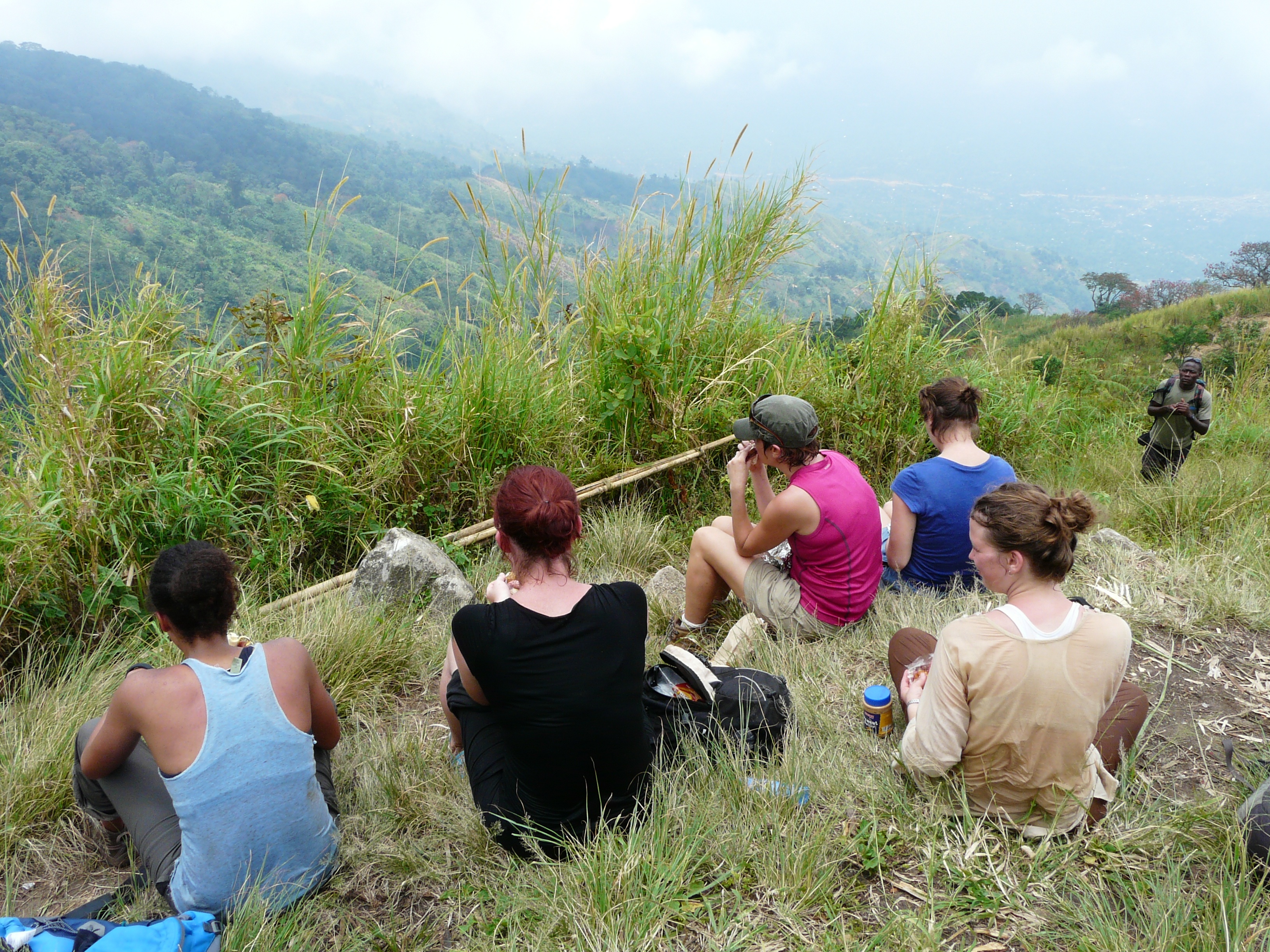
To give everyone a break from the ascent and Stephanie a break from my incessant chattering we regroup and stop for lunch. The views are breathtaking as we look down over the steep slopes onto the plains which stretch out into the Congolese rainforest. From this vantage point you can begin to see why Stanley referred the Ituri Forest as “nothing but miles and miles of endless forest.”

With stomachs filled our small group set off in the heat of mid-day sun with nothing but altitude as relief from the heat. We move out of the agricultural lands and into deep thick rainforest. Walking in these conditions is a continuous contradiction as everything is sodden in the humidity and yet the heat forces a near continuous thirst. Many began to realise that their three litres of water might not be enough to get them over the pass.

Five hours, 1,400 meters ascents and some tired looking walkers later we reach the pass surrounded by thick bamboo forest. A second wind enters the group safe in the knowledge that it is all downhill from then on.

Image
It isn’t long though until the heavens open and hamper our progress.  Heavy balls of rain hit the red earthed paths we are following and reduce them to streams of slippery clay. As I pull on my full waterproofs I watch as Manjit smiles to the sky. With a twinkle in his eye he embraces the rain in his shirt sleeves and skips through the thickening mud.

While Manjit dances his way off the mountainside, others slip and slide their way down a series of precarious paths. Red mud marks the bottoms of those who lose their grip while red faces give away that for some the decent is as hard as the way up.

Walking with now almost unrelenting rain we finish our walk on the Ugandan side of the mountain range some seven hours after we set off.

Manjit stands topless as he wrings out his sodden t-shirt while the rest of us peel off our boots. Looking back I see the cloud curl round the hills and cover the path on which we had just descended. There is no hint at how far into the cloud the path goes or how far we had just come.

This small bit of knowledge remains for those who had just walked the Bwamba Pass.


*2 photos taken from Manjit’s blog – http://manjitsuchdev.wordpress.com/ *

3 Comments

Filed under Outdoors, Sport, Travel, Uganda

A visit to Royal Pride school in Kampala

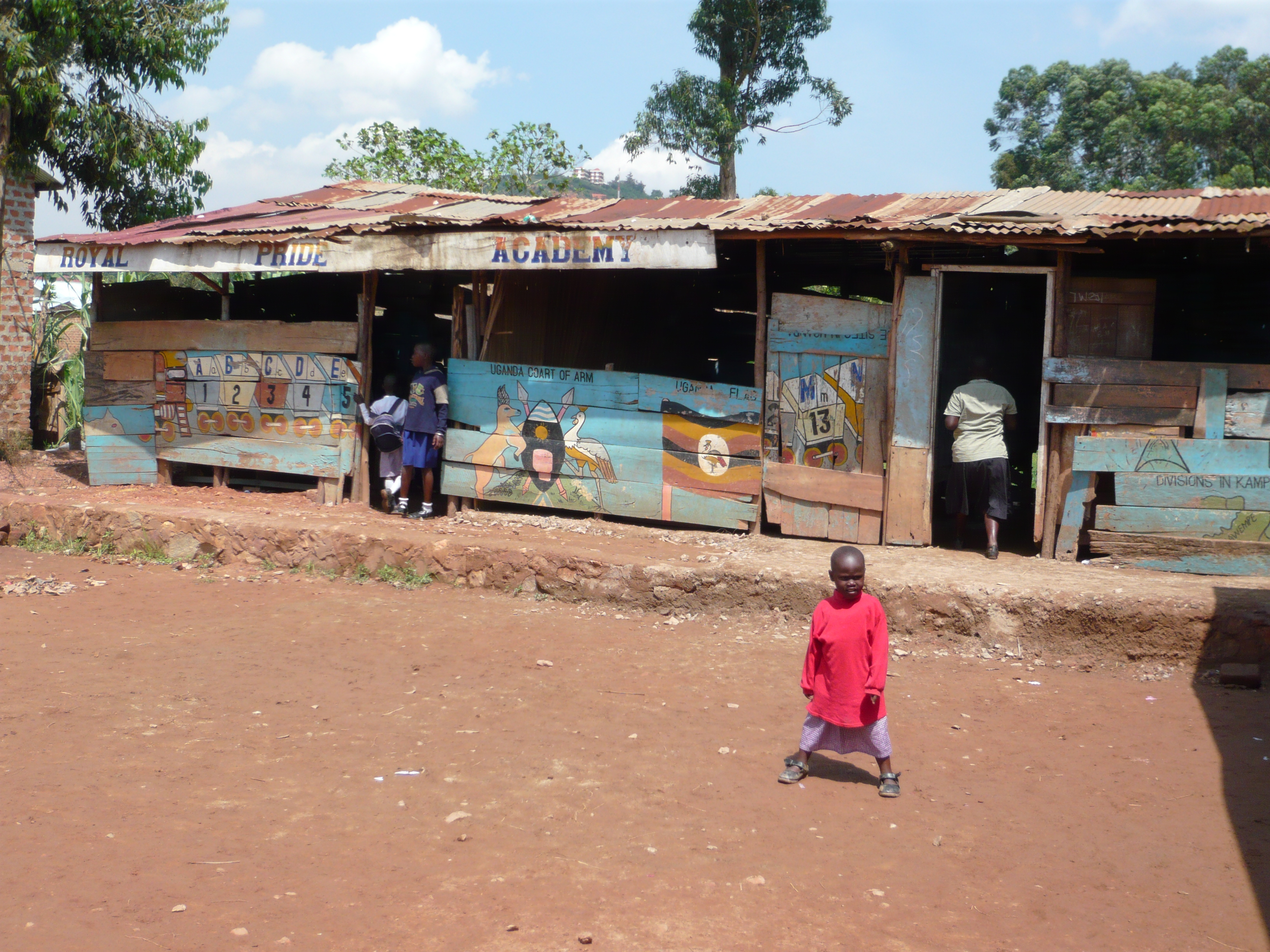
Heavy balls of rain lash down, their weight and intensity exaggerated by the tin roof under which we shelter. Looking out, the playground which minutes earlier had swarms of children playing in is now inches under water.

P1000317Godfrey, the headmaster of Royal Pride School looks out and predicts that it will “stop in 30 minutes”. I wonder to myself how he can know this, but chose not to question and stare out at the black brooding sky.

I begin to ask Godfrey about his school. He tells me that it is only eight years old and takes in about 280 children. Looking at the 8 small classrooms, 4 of which look under disrepair, it is hard to imagine that so many kids could fit into such an improbably small space.

Inside one of the small classrooms we are met by a swarm of children running and shouting, each waving their exercise books at me showing me their work. As I start to run out of unique adjectives to praise each child’s work, the teacher steps in and starts the process of trying to calm the children. It proves to be close to impossible while the ‘muzungu’ is still in the room so I follow my colleague out into the court yard leaving cries of “Muzungu muzungu” behind me.
Uganda September 009Back in the headmaster’s office I ask what the biggest challenges are to the children’s education. Without hesitation, Godfrey responds, “The biggest challenge that these children face is not education, but finding the money for their education. It costs them 30,000 Ush [£7.30] a term. I want them to come for free, but I need to pay the teachers a small salary”.

Indeed, a small salary it is. Some of the teachers earn as little as 90,000 Ush (approximately £22) per month.  Despite the small salary, all of the teachers look engaged and enthusiastic interacting with the children.

With no electricity all of the teaching is done with a blackboard at the front of the class. From the headmasters office I can just see one teacher writing, “My name is…” on the board while a hoard of youngsters eagerly copy.

For many children education of this description is nothing more than an aspiration. 18% of children don’t enrol into basic primary education. Of those that do attend, there is an average dropout rate of 66%.
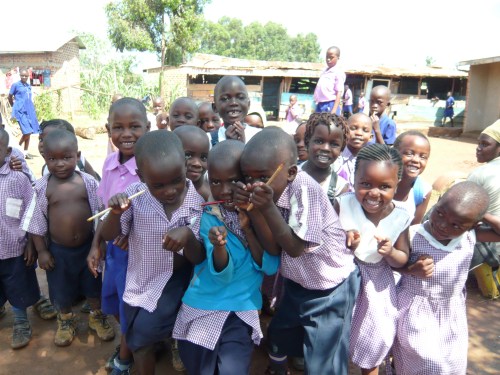
Uganda September 008I ask Godfrey about this high dropout rate and he tells me that one of the best ways to keep kids coming to school is to offer food. Twice a day at Royal Pride kids get a bowl of porridge as well as access to running water.  This enough to keep them coming back, as Godfrey explained:

Many of the children who come to the school don’t have the basics in their houses. They don’t have water, or food. We can give them that”.

Inevitably, teaching in this environment can be a challenge. The teachers have to think about basic sanitation as much as they do mathematics or English. I asked Godfrey if the teachers stayed at the school for long. He answered saying, “When a teacher comes to work here, we sit down together and discuss the types of children we have here. They have to know what kind of community we are in.  We have to put aside our own time to go and visit each family at home”.

The more I talked to Godfrey the more I became inspired by the incredible work he was doing with these kids. The place struck me as much as a social project as it did a school.

P1000314

I asked Godfrey what drove him to want to be a Head Teacher of a school. Godfrey is only 32 years old and I was curious as to what led him to Royal Pride.

With a wry smile, Basiime Godfrey looks out into the driving rain and says:

This is a long story. I have no mother, I have no father. I was with an organisation”. He breaks off for a second to compose himself before continuing, “Sorry, when I speak about this, I feel like crying”.

Tears start to dwell up in his eyes and roll down his cheeks and I tell him that we don’t have to continue. He takes a step back and says, “Where I came from, it was a sad situation. I was living under a tree. Some people came to us and paid for [me to] go to school. This is all I want to do.  I’m sorry…”.

I break off the interview at this point and let all the pieces drop into place around us. Godfrey turns away from me and wipes tears from his eyes. Water drips down onto some paper work through the tin roof as we stand in silence.

Godfrey is someone who has worked tirelessly for these kids because, as he had said to me earlier, “I know what it’s like for these kids”.

As I walk up the hill away from Royal Pride there is open sewage running down the hill to the valley bottom where the school is located. Kids who are not in school peer out at the white people walking in the rain and openly stare in amazement.

I stare back and raise a half smile. Only now does it dawn on me that the kids at that school are the lucky ones.

3 Comments

Filed under Uganda

A Sunday Morning in Kampala

“Praise the Lord, feel his love rushing though you. Feel him touch your soul. You are saved brother, you are saved”.

I wearily look up from my scrambled eggs and rather soggy toast. The church next door to my hotel has been going for over 3 hours now.

At one point there is a rather terrifying scream before there is an impressively drawn out chorus’ of ‘hallelujahs’.

I leave the last bit of soggy toast on my plate and make my way out into the mid-morning sun.

I sharply step sideways off the potholed concrete road into the red earth gutters as motorcycles and 4X4s swerve perilously close. All the time trying to keep an eye on the on-coming traffic and an eye on the fabulous views that stretch in front of me.

The sprawling city centre sits in the distance as I make my towards the notorious ‘Kabalagala’ area of town.  I pass men opening their shops opposite bars that are still going from the previous night.

The bass from a reggae bar seeps out onto the street. It feels like electricity is passing through the tarmac. As I pass each bar I peer in to watch the revellers who are still going, still enjoying the bars of Kampala – the city that truly never sleeps.

Short skirts and crumpled suits zigzag across the dance floors and prop up the bar as they refuse to accept that their night is over.

I walk on only stopping to buy some mango on the side of the road. The seller beams a smile back at me as I hand over about twenty per cent more than a local would – the ‘muzungo’ price.

With sticky fingers I finish my mango and make my way past one of Kampala’s 24/7 traffic jams. Nut sellers squeeze through improbable gaps in the traffic risking their life, quite literally, for peanuts.

These nut sellers seem to move with ease in and out of the traffic as I wait trying to find a break in the wall of traffic to cross into the shade on the other side of the street.

In the shade I am conscious of how quickly the sun has risen. On the equator sunrise is like sitting in a bath as it fills up with hot water – immersing you, the heat surrounding you.

The sun now shines hard on the red earth and strips through any pretence that the new day has yet to start.

This Sunday morning will be spent sleeping off last night’s excess for some, praising the lord for others and for me at least, exploring the maze of streets in the city centre.

As I make my way into the centre, a small minibus with its bumper hanging off stops to offer me a lift. On the front windscreen the words ‘TRUST ONLY GOD’ are printed. On this occasion I decide to take the advice and say I am happy to walk.

3 Comments

Filed under Travel, Uganda

Our house is being finished – Mpola mpola!

This is a guest post by my partner Anya Whiteside who is blogging about our time in Uganda over at ‘Anya’s Blog‘. 

Ten days ago we saw the house that FENU have found for us to live in. If you go down Kabalagala, famous in all of East Africa for its many little bars and clubs that play reggae till the early hours you turn onto the busy Ggaba road. Here minibuses, boda bodas (motorbike taxis), bikes and people weave their way in and out while stalls of avacado, mango and pineapple vie for space with shops overflowing with plastic buckets, matresses and brooms.

All the way along the Ggaba road are small side streets leading off, some tarmac, some dirt. If you turn up one of these side streets you weave your way through a mish-mash of housing. Gardened and gated houses intermingled with simple wooden shacks, and this variety is one of the things I like most about this part of Kampala.

Our house is off one of these quiet side streets. It is a single story house next to a little store that sells sweets and phone credit to anyone who happens to be pondering past. There is a patch of ground outside where are neighbours-to-be sit shelling peas while their kids run about playing. On the other side are smarter houses, painted pink with a larger, gated courtyard.

DSCN4225As soon as we see the house we like it. It’s has several rooms, including a spare bedroom for guests and a little courtyard where we hope to fit a table and chair and maybe some pots of basil. There has even been talk of a chicken, though we are yet to find out whether letting it out onto the grass outside would lead it into a neighbours pot, and we’re not sure we want to be labbled as the crazy muzungus with the chicken on the lead!

The only problem with our exciting new house is that it’s not finished. The bathroom is in disrepair, it has no floor and the kitchen is falling apart. ‘Do not worry, it will be finished mangu mangu (quickly)’ beams the builder when we first look round. I discuss the situation with FENU and we agree the house is worth waiting for, and that every day I will make the short journey from the office to see how it’s getting on.

So every day I go. As I leave the office my colleagues wish me luck. I meet my new friend the builder who explains why that day the house is hardly further along than the day before. ‘The plumber didn’t come’, ‘there was a problem with the carpenter’. ‘we had a problem with a leaking pipe’ he says. ‘But’ he adds with a huge grin ‘do not worry, it will definitelybe finished tomorrow’. When I walk back to the office my colleagues ask how the house is coming along, ‘mpola, mpola (slowly)’ I answer, to which there are peals of laughter.

On Friday, however, we saw marked improvements – not only had a toilet been installed, but it also flushed, as the builder demonstrated with pride. So to celebrate Steve and I went to buy furniture with the wonderful driver at FENU called Hudson. Hudson took us to a multitude of places – the supermarket for the fridge, the backstreets for the pans and the wonderful hand-made street furniture market for our cane sofa. We arrived back at FENU exhausted and with furniture tied to every possible part of the vehicle. Our furniture is now occuppying the meeting room at FENU, but that shouldn’t be a problem as our house will definitely be ready when I visit it tomorrow!

UPDATE:

When we arrived the builder proudly showed us his handywork. He had inexplicably painted the kitchen and bathroom bright orange! We think we’ve convinced him we are happy for him to leave the sitting room and bedrooms cream but it remains to be seen….

DSCN4215

1 Comment

Filed under Travel, Uganda