Why Sunny Hundal has got it wrong on “my tram experience”

“My Tram Experience” is an ugly snippet of life in the UK. It is an example of unashamed racism that we should all be eager to condemn. Sunny Hundal (editor of Liberal Conspiracy and comments is free columnist) was quick to join in this condemnation, that was until he saw the ferocious backlash from the tweeting masses.  In Sunny’s words, “Piers Morgan was calling for the woman to be deported, some asked for her to be locked up, while others said her child should be taken away. And those are only the printable responses”.

First on Twitter and then through a comments is free article Sunny made a valuable effort to counter this moral outrage. I won’t try and simplify his arguments but suggest you read his article in full here.

His argument though has a series of holes. Firstly, he claims the law is “an overbearing ass”. Which is true, and it is why I commented that I support this government’s move to remove word ‘insulting’ from the Public Orders Act. In light of this, I would be happy with a law that protects people from “threatening or intimidating” behaviour – not simply ‘insulting’. Sunny it would appear is not.

Sunny seemed to suggest that it was OK to be intimidated and threatened in public. I could not disagree more.  I think it is right and proper that victims of aggression be afforded the protection of the law in such a situation. In this specific circumstance, the woman was clearly intimidating. Sunny’s argument that because she was sat down she didn’t pose a threat is a weak one. This argument would suggest you cannot be verbally intimidated. This is clearly not the case. Shouting “fucking paki” in the face of a Muslim (intimidation does not need to be accurate or PC) or “fucking fag” in the face of a gay man is verbal intimidation. To suggest otherwise is to undermine the terrible experiences that people have to endure on a daily basis.

This has to be separated off from simply holding unpleasant views. I can write all sorts of rubbish, as can our friends in the BNP.  Their views play into a dangerous culture of hatred but should not be outlawed. My views play into a dangerous culture of self-righteous woolly lefties but should certainly not be outlawed. When I start sitting on trams and screaming abuse at anyone who reads the Daily Mail –that’s when my views become intimidating and are illegal. This is an important distinction.

Sunny asks in his article, “Do you really want to give police the willingness to arrest people simply for having an argument?” The answer is clearly no – but I do want to be protected from intimidating behaviour.

Secondly, he suggests the law does not help us challenge the wider problem of racism. Again, I would broadly agree – it is a blunt tool at best. What it does do however, is provide victims with recourse to justice. It can (or at least holds the potential to) give the victims as sense of closure. Although rock against racism (and the plethora of other social movements which have successfully changed attitudes) is as important as ever, suggesting a victim of race hate crime should go to a rock concert or join hope not hate is simply not sufficient. Victims, rightly or wrongly, look to the law to feel justice has been done. We have a responsibility to provide victims with the appropriate legislation. When Sunny point to the Race Relations Act and that it has only had a handful of prosecutions, we know this is a failure of the system and that legislation, not because the crimes are not being committed. The state has let down those who the Race Relations Act was designed to protect.

Finally, Sunny comments, “My fourth argument is simply this: I would rather a world where such incidents didn’t exist but the world will never be perfect. I would much prefer such racism to be open and visible because there are still far too many Westminster commentators who think racism is a thing of the past.” Again, I agree, but this does not mean we have to encourage it! I would rather these issues were in the open – but I am not going to put on a racist poetry evening for racists to come and express themselves at. In the same way, when a racist has clearly broken the law I am not going to go out of my way to argue they shouldn’t be arrested. For some reason Sunny will.
3 Comments

Filed under Far-right politics, Politics

Trans-Caspian Pipeline lives to fight another day

The Council of the European Union has today announced that it has adopted a decision authorising the Commission to negotiate an agreement with Azerbaijan and Turkmenistan on a legal framework for a Trans-Caspian (natural gas) Pipeline System.

I have blogged before about the problems this pipeline may hold. Anyone concerned with human rights and development in Central Asia should follow these developments closely. Will the EU live up to its human rights commitments in its trade deals?

Regardless it looks like the EU is committing itself down the energy road of reliance on large quantities of imported natural gas. A diversification away from Russia is a no brainer but holds with it infinite dangers. Interesting times ahead – watch this space.

Leave a comment

Filed under EU politics, Human rights, Politics, Russia

Join me outside the US embassy to stop an injustice occurring

The execution date is set. Unless something changes, Troy Davis will be put to death on the 21st September 2011. This is despite a list of doubts surrounding his case.

Troy Anthony Davis was convicted of the murder of Officer Mark Allen MacPhail in 1991. Since 2007, Amnesty international has campaigned alongside Troy’s family and other supporters for a new trial or hearing and clemency.

He was given an opportunity to prove his innocence in 2009 and despite:

  • Four witnesses admitting in court that they lied at trial when they implicated Troy Davis
  • Four witnesses implicating another man as the one who killed Officer MacPhail
  • Three original state witnesses describing police coercion during questioning, including one man who was 16 years old at the time of the murder

Despite this all this, in August 2010 the federal district court judge ruled that although executing an innocent person would be unconstitutional,Troy had not met the extraordinarily high bar for proving his innocence.

You can read more about the doubts surrounding Troy’s case in this Amnesty International briefing.

We have a chance to stop this injustice happening. There is going to be a walk in solidarity for Troy in Georgia (where he is on death row). Our aim in the UK is to illustrate the strength of feeling and international support Troy holds.

This is why I hope you will join me on Friday 16th September 2011 outside the US embassy in London between 5 and 7pm. Troy deserves a fair trial. He does not deserve any punishment, let alone the death penalty while there are such doubts surrounding his case. This is literally a matter of life and death.

Can’t make it but online? Take action here

1 Comment

Filed under Human rights

We are still haunted by the legacy of colonialism

We have to reclaim our history, however vile!

The modern western world has colonialism and imperialism entrenched into its history.  The racial and ethnic tensions that are apparent in contemporary society can be traced through history back to the time of colonialism and imperialism.  To pretend it is not there is to play into the hands of the modern far right.

Colonialism refers to the political authority of the European powers over some of the areas of Asia, Africa, Australasia and the Americas.  Broadly it is the time when there was a political economy based around the slave trade By the end of the 19th century nearly all Africa had been colonised by one or other of the Great Powers.

Modern racist discourse can be traced back to the slave trade.  Although, it is important to remember that racism and slavery did not always go hand-in-hand (think of the ancient Greeks!).  Why then, in our murky colonial history did race become such a big deal? From the earliest recordings of British involvement in Africa (large scale in 17th century) the exaggerated term “black” was used to describe the very obviously different skin colour between British and the (at first) West Africans.  However the colour ‘black’ came with some deeply ingrained values; it was associated pre 16th century with dirt and death.  It had connotations of evil and wickedness.  This is illustrated in the distinction between black and white magic and as well, the Black Death.  This all came at a time when the ideal of beauty in Britain was very much of a pale white face.

Throughout the Colonial period the appearance of the African was stretched and exaggerated through European discourse.  Their nakedness was often highlighted to illustrate their difference from the ‘civilised’ European.   To start with people were content to comment on skin colour to describe their difference; during the 17th and 18th centuries however a number of other characteristics were attributed to them.  Soon African men were considered to have potent sexuality.  The men were considered to have a larger penis and to be extremely lusty.  Some Europeans at the time speculated on the sexual intercourse that might have occurred between apes and Africans.  Indeed increasingly Europeans would compare the Africans that they ‘discovered’ to the apes that they “discovered” at a similar time. Indeed, other characteristics were recorded at this time such as laziness and superstition.  After meeting Africans as neutrals (pre slave trade), the colonial legacy slowly degenerated into a deeply racist discourse.

Towards the end of the 19th century a movement developed to legitimise Imperialism.  Social-Darwinism was used to justify the colonial power’s actions in Africa.  There was a belief that there was a natural hierarchy of races.  These were predominantly European ideas and as such Europeans were normally ranked as the ‘highest being’.  This is an almost laughable idea today, but at the time was considered gospel by many.  It is important to note that such broad biological assumptions are still made and believed in modern racist belief.  For example Charles Murray’s book ‘The Bell Curve’ (1994) is still used by extremists to argue that White people have a higher I.Q than black people. Stereotypes still persist in main stream society in many western countries as the mass of the population still see Black Afro-Caribbean’s consistently performing low skilled manual jobs (a changing but lingering phenomena).

Although the dark days of our colonial past, are just that, our past.  It is worth taking a moment to reflect the impact that they are still having on our society.  There are some very clear ethnic tensions that can be directly linked to European colonial past.  The continued conflict in the Democratic Republic of Congo demonstrates some extreme racial tensions that have a clear link to the Belgium legacy there for example.  The racism that we see most regularly today however is a lot more subtle.

Modern conflicts, especially in the West appear to be increasingly more complex than simply a reflection of race.  Ethnicity is a wider term that can describe a group of people beyond their inherent characteristics.  For example the Muslim community in the U.K could easily describe themselves as an ethnic group.  No longer does it simply describe your skin colour. This leads to a more complex system of discrimination where culture, religion and race all become intertwined.  In the UK there is no simple way of defining what it exactly is that people discriminate against. However appearance still plays a large part in social discrimination in contemporary society.  This is reflected in police stop and search figures; increasingly Arabs have been subjected to a greater number of searches.

Despite conflicts growing increasingly more complex, there are still racial elements to most conflicts in the western world.  In November 2005 large-scale riots broke out throughout France.  The BBC described these as ‘race riots’ as it was predominantly members of the black community rioting.  However a more accurate way to try and have one term to describe these riots would perhaps have been to describe them as socio-economic deprivation boiling over.  It is no coincidence that these riots took place in some of the poorest neighbourhoods across France.  However these riots were portrayed across the world more as race riots.

Today we can see the BNP riding a roller coaster of popularity (for whenever they have risen high they have very soon plunged in public opinion).  The peaks of the BNP’s popularity however should worry us.  The BNP often attack a way of life opposed to a specific “race” (although the racist undertones are clear).  For example their leader Nick Griffin was cleared of the charge ‘inciting racial hatred’ for describing Islam as a ‘wicked faith’.  In his trial he argued he did not hate Muslims or any ethnicity but purely the faith they followed.  However what the B.N.P does illustrate is that there is still interest and small support for such extreme right-wing politics.  They often play on fundamental fears that are still apparent in society; for example they argue that these ‘migrants’ are stealing British jobs.  It is apparent that there is interest in these ‘racial’ issues in the main stream even if there is not much support for it.  A lot of the discourse they use is similar to that of colonial times.  For example the B.N.P campaigned for many months about the Asian ‘sexual predators’ that were coming after ‘our girls’.  This is a clear link back to colonial stereotypes that play into the discriminative discourse that the B.N.P wishes to capitalise from.

To forget our colonial past, in all it’s ugliness, is to give the modern racist a free use of a deeply ingrained sub-conscious tool.  Regardless of whether we would like to admit it or not, racism still exists in this country.  We have to acknowledge that it has a long history.  If we do not acknowledge this history, then those outdated images of the black man as a sexual predator, or the monkey chants across football grounds will continue to be used.  We have to reclaim our history, however vile it is! At least we have the decency to acknowledge it to be vile!

4 Comments

Filed under Far-right politics, History, Politics

Turkmenistan and the Nabucco pipeline

Turkmenistan is one of those countries you may just about have heard of in the UK.  It’s in Central Asia, it borders the Caspian Sea, Kazakhstan, Uzbekistan, Iran and Afghanistan.  It was ruled until a few years ago by President for life Niyazov (aka Türkmenbaşy).  He has been replaced by former health minister,  Gurbanguly Berdimuhamedow.

Human Rights Watch has described Turkmenistan as “one of the most repressive and authoritarian” countries in the world.  Freedom House has included Turkmenistan in their 2009 “Worst of the Worst” list for social and political freedoms alongside Saudi Arabia and North Korea.  There are regular disappearances, reports of torture and harassment of journalist, environmentalist and human rights defenders.  You get the idea; it is a pretty dark place.

Despite this, the EU is going to extraordinary lengths to court Turkmenistan into trading with them. Why…? Gas!

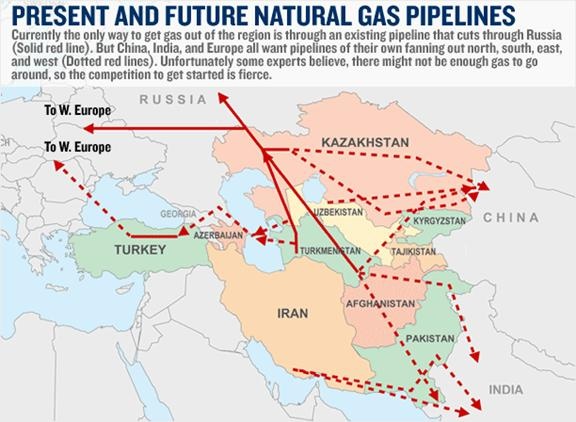
The EU’s flagship energy security project (after deciding they couldn’t trust the Russians anymore) was the Nabucco pipeline.  The pipeline is planned to traverse four countries (Turkey, Romania, Hungary and Bulgaria before terminating in Austria).  It will be over 3,000 km long and is expected to cost around 8 billion Euros (wait and watch as this figure will inevitably rise).  After sorting out some legality this summer, the only issue stopping the project going full-steam ahead is the issue of supply.  Who has gas, and is willing to sell it to the EU.  Iran is an obvious answer, but the US soon put their foot down there.  Iraq looks possible, but the internal fighting between the north and Baghdad may prove to be an issue).  Azerbaijan will almost certainly be providing some but does not have the capacity for much more than a third of the pipelines capacity.  This leaves the EU without many options other than Turkmenistan.

So this is the issue, does the EU provide wealth and fortune to a leader (who keeps his power through natural resource revenues) and secure the EU with another gas supply – this would fulfil their aim of diversifying (partially) their gas supply.  Or do they stand up for the Human Rights, development and democracy issues that they are committed to uphold? Is it possible to do both?

I feel as though it is important to approach this from a pragmatic position, what action by the EU might improve life for the average Joe in Turkmenistan?  We can see that previous attempts to isolate Turkmenistan have not bought about the sort of changes we would like to see.  Indeed, no real improvements (other than on paper) have been observed in Turkmenistan in the last two decades (despite what they would have us believe in their hearing at the UPR).  It would be very easy for the EU to sit on its high horse and criticise the Turkmens human rights record.  This however, would lose our strategic aim of securing their gas supply and secondly would probably make no difference for those who are currently suffering human rights abuses.

I am personally not sure what the answer to this is, but my former colleague Neil Endicott has just published a report (http://www.quaker.org/qcea/energysecurity/The_Nabucco_Gas_Pipeline.pdf) arguing that the EU should engage with Turkmenistan. It should do this he argues, by “seeking to engage the Turkmen government in the Extractive Industries Transparency Initiative (EITI), a scheme which addresses resource revenue management issues and provides protected space for independent civil society groups to operate”.

This scheme is still relatively young.  I feel as though it’s a long shot at best.  It is however, by far the most appealing prospect when the other options are to engage and sell out, or to isolate and tacitly accept the human rights situation in Turkmenistan.  I cannot see any other option which is more likely to improve life for the population of Turkmenistan. I think it could be worth a shot.

1 Comment

Filed under Central Asia, EU politics, Human rights

La Bresse – Probably the best ski resort in the world!

The Vosges mountains! Photo thanks to archi-bald (flickr)

Interested in doing a weekends skiing for less than 120 pounds all inclusive? If so, this is the blog for you.

La Bresse Hohneck, in the Vosges “mountains” in France, I think is probably one of the best ski resorts in the world.  A controversial choice, I will admit that, but give me a second to explain why I think La Bresse can provide you with the perfect ski holiday!

Firstly, lets clarify what I think makes a good ski holiday.  For me, a ski holiday has to be cheap, friendly, involve beer and involve a lot of skiing (both on and off piste).

La Bresse, is not, and will never be a major resort.  With just 32 ski runs (some quite short), it is small by most of Europe’s standard.  You will not find classic runs such as the Black run down from Mont Fort, the Combe Saulire, or Courchevel in the Three Valleys.  What you will find however, is a cheap, friendly resort that will not leave too big a hole in your pocket.

The “main” resort (there are a number of mini resorts accessible by car), has 4 green runs, 11 blue, 11 red and just 1 black.  Let me assure you though, that the one black run (that they cleverly named “Noire”), will excite any ski enthusiast.  It starts with a short plateau that soon drops off the side of the world.  It is a piste that is never bashed, but simply left to wreak havoc with your knees and skiing technique. It is 5 minutes of unadulterated immensity.  Dropping at the sort of speed you should not feel comfortable at; you are left with a sporadic covering of moguls (that vary in shape and size) and snow drifts covering the ice sheets that are left on the exposed sections of the slope.  Getting down it is a challenge, looking good is out of the question. It is a skiing enthusiasts dream, and the sort of slope most sane skiers will avoid at all costs.  At best, it is a technical challenge of a slope, at worst it is a trip to the hospital.

This said, with 9 interesting and varied red runs, there is plenty to keep the more normal intermediate – advanced skier amused.  Equally, there is extensive off-piste to be enjoyed in an area which in the summer is famed for its mountain biking and walking.  Take a 1:25,000 walking map with you, and you can stay entertained for hours. Equally, nearly the whole mountain is accessible by blue and green runs, allowing the beginners and those who lack confidence a chance to explore the whole area.

Hopefully, this will have whetted your appetite.  Now, let me now explain how it is possible to enjoy all this for less than 120 pounds.

Travel:

La Bresse is just 4 and half hour drive away from Brussels (a similar distance from Calais) or an hour or so from Strasbourg (a lot closer than the Alps).  This means it is very possible to go for just two days skiing (meaning no holiday taken from work).  A car however, is a must if you are going to take advantage of my accommodation recommendations later which are 8km from the main slopes. Get a car full of you together and you are looking at 5-10 euro’s of fuel each (double if you are going with just one other).

Ski hire:

For a weekends ski hire, expect to pay around 30 Euro’s from ‘Bol d’air’ – where you get a 10% discount if you stay in my recommended hotel.  Here you can get good quality service, without the queuing that you would experience if you tried to hire the skis from the bottom of the ski slope.  Bol d’air is based about 2 km from the ski slope (you pass it on the way there each morning).

Lift pass:

Thanks to the construction of a new ski station, they have increased the lift pass this year.  It will cost you 45 Euro’s for two days.  This however, puts it on a similar level to ski resorts across Europe.  Lift passes and ski hire are just those “unavoidable” costs that every ski holiday has.

Accommodation;

Here is the real winner, let me introduce you to the L’Angleus in Saulxures Sur Moselotte.  It is a family owned hotel, bar and restaurant. I cannot recommend it to you enough.  It is a really down to earth and charming place with everything you could ever need.

Firstly, a double bedroom will set you back just 37 Euro’s a night (this is almost unheard of for ski accommodation).  That’s 18.50 per person per night (assuming you have someone who is willing to share a bed with you).  It is a warm and friendly hotel.  It is nothing posh, but it serves the purpose of having somewhere warm with beer to come back to in the evenings.  On top of this they serve up an amazing selection of burgers in the restaurant (this is coming from someone who is almost a veggie).  The burgers vary from a 4 Euro “beef burger” through to an 8 Euro “Cheese monster burger”.  Add a portion of chips on the side for 2 Euro’s and you have the biggest meal any hungry skier could ever wish for.  This combined with a liter of very drinkable house red for just 6 Euros (yes that’s right…6 Euors!!!) makes for very enjoyable evenings.

The owners are also really nice people (they have lent me maps, let my girlfriend who was feeling under the weather stay in bed all day on the day we were checking out, and have generally just been really nice to us).  Please, do not get put off by the web-site and go to this hotel!

Food:

See above comment on the burgers and combine it with a few cold pasta salads and you are away.

In the Alps the “cheap option” is shivering outside in the snow, or eating sandwiches under the table whilst trying to not get thrown out by an overly efficient waiters.  Here at La Bresse, they provide you with a very civilized heated “Salle de pique-nique” that sells hot drinks.  Bring your own bread, cheese and chocolate from home (resort shops are always expensive) and you are one well fed skier. For Breakfast, call in at one of the bakeries on the way to the slope for a quick croissant and some bread (bring your own chocolate spread).

Voila! This is how it breaks down:

Travel – 10 Euros
Accommodation – 37 Euros
Ski Hire – 30 Euros
Lift pass – 45 Euros
Food – 15 Euros

Total – 137 euro’s (120 pound sterling!) – Minus 30 Euros if you have your own skies and you drop to below 100 pounds for a weekends skiing. That is how you ski on a budget – and enjoy it.

6 Comments

Filed under Sport

The UK and the EU

This is an issue which affects my daily life.  I am a Brit working and living in Brussels.  I have got used to the usual jibes about not caring, about being arrogant and such forth.  I accept the fact that the UK is politically isolationist, and to its own detriment.  What I do not accept though, is the level of the debate which continues to rage throughout the British Isles and fails to hold our politicians to account.  Are you pro or anti EU? What a bloody stupid question!

Am I opposed to the introduction of the Social Charter that bought with it basic societal protection like the minimum wage, no.  Am I opposed to the increasing shift towards joint military operations such as Operation Atalanta (that smacks of safe-guarding oil), yes! 

Hopefully you get my point.  The EU is a complex beast with fingers in many pies.  To suggest you are either “pro” or “anti” it is clearly daft. 

Firstly let’s expel a myth.  The EU is not separate to the UK.  The UK is part (a disproportionally powerful part at that) of the EU.  Our elected national government has to agree to all legislation that is passed (in the European Council).  So when you hear…”it was forced onto us by Brussels”… you can be safe in the knowledge that this is scapegoating.  Equally, the UK is represented by 72 Members of European Parliament (which makes up the second part of the bicameral legislative branch of the EU – along with the Council).  On top of this, we have just had Baroness Cathy Ashton appointed as the new High Representative for Foreign and Security Policy (a sort of EU foreign minister).  To suggest that the UK is not an integral part of the EU is nonsense. 

Why then, if the UK plays such an integral role in Europe do I get constantly mocked for being a “Brit” (apart from my obsessive tea drinking)?  Why is the UK not seen as a “real” part of the EU? This question is a complex one and I do not suggest I hold the full answer.  Here though are two possible ideas that might shed some light.

Firstly, there is a historical significance of how we came about to become a member of the EU and how this contrasts with others accession process.  We can see that membership of the EU is something all other countries have strived for (in the current Enlargement programme the Balkan states are jumping through hoop after hoop to get in).  The UK however, eventually joined the Union in 1973 with a massive sense of feet dragging.  Whilst most nations joined with an optimistic sense of opportunity, the UK slouched in to the back of the class to play the disruptive role from the beginning.  Ever since then, the UK has been plagued by this concept that we might somehow be losing out.  This is something uniquely British.  Even other Member States who have tricky domestic politics have the ideological commitment to an integrated Europe to fall back on. 

Secondly, New Labour in the early 2000’s, chose a series of policy choices that scuppered their commitment to improve relations with the EU (after 18 years of disastrous relations jerking from one crisis to another).  New Labour came into power with a strong commitment to play a key role in the EU. Blair, by all accounts demanded respect within council meetings and for a short while a British voice was taken seriously.  In Blair’s own words, he saw himself as a bridge between Europe and the US. 

This position however was only successful in the short term.  Geo-politics soon meant that Blair had to decide to between Europe and the US.  With both France and Germany opposing the American neo-cons war mongering, Blair was left with an opportunity of great strategic importance.  At this time of decision between being Bush’s poodle and his strategic commitments within Europe, Blair sat on his metaphorical bridge for so long that the path back to the EU was soon cut off.  His inability to criticise the US meant that he lost all credibility and support within the EU (this was all dragged up again recently with him being linked to the position of President of the EU). 

Blair, back tracked on his personal enthusiasm for the euro, he smashed any concept of a common position on foreign and security policy within the EU and most of all he isolated himself from all “socialists” across Europe. 

Enough about the past though…what does the future hold for us?

In all likelihood a Conservative led government headed by Cameron.  This is a man who has chosen to remove his MEP’s from the most powerful block in the European Parliament in favour of teaming up in a marginal group with radicals from central and Eastern Europe (The European Conservative and Reformists Group).  This has annoyed nearly all major centre-right figures across the EU.  A Cameron UK government will not be taken seriously by their conservative counter parts (who now make up the main power houses across the EU).  This EU observer article gives you an idea of how the UK Tories are viewed (http://euobserver.com/9/28783). 

The only ray of European hope in British Politics is represented by Greens and Nationalist (Plaid Cymru) who sit in the Greens/EFA group.  Both the UK Greens and Plaid Cymru representatives have played a progressive integrationist role in Brussels.  This however, is only reflected in the European Parliament and not in the European Council (which has national governments in…i.e. Labour or Conservatives). 

The EU is facing a defining two years as it entrenches the changes that the Lisbon treaty has put in place.   I welcome the introduction of a progressive British politician into the position of High Representative for Foreign and Security Policy.  I worry however, that the level of debate in the UK around European politics removes any sense of accountability to our flailing politicians.  Cameron should not be able to ruin the UK’s strategic interests in Europe and not be held to account.  Browns work to repair relations with the EU should be applauded (opposed to the usual Brown bashing we experience in our media).  More to the point, I should not have to endure daily jibes because my fellow countrymen are blind to one of the most powerful influences on their lives and cannot hold their politicians to account.

The UK is lost in Europe but it is not dead.  We still (just about) have the economic and political stature to be welcomed back by other Member States.  I do not know whether this will still be the case in 5 years after a Cameron premiership!

21 Comments

Filed under Balkans, EU politics

Copenhagen and the 2 degree guard-rail, the wrong goal missed

We are constantly told that if we want to avoid “serious” climate change then we have to stick to below two degrees. Have you ever wondered though where this mysterious 2 degree figure came from or who came up with it? In the next couple of weeks at Copenhagen anyone with any grasp on climate change will be trying to beg, borrow and steal their way to an agreement that would result in us (humans) limiting the average global temperatures to below 2 degrees from 1990 levels. Anything above this and we are doomed! It is thus slightly important to explain why even this target is wholly inadequate.

In 2001 the IPCC (Inter-governmental Panel on Climate Change) came up with the 2 degrees figure using a very sensible method. Simply, they looked at the bad stuff that was likely to happen because of climate change (species extinction through to run-away climate change – this is when tipping points cause further tipping points (http://www.youtube.com/watch?v=WkUaAltxUpg) and worked out how likely at different temperatures it was to happen. At 2 degrees they figured there was very little chance of runaway climate change occurring. There was however still a significant chance of species extinction (there were then events in between that varied in their likelihood of occurring). They considered this to be a “safe” level to aim for.

This all seems very sensible (what’s a few species in the grand scheme of things?). In the run-up to Copenhagen however, the University of Copenhagen produced a report (http://www.pik-potsdam.de/news/press-releases/files/synthesis-report-web.pdf) authored by many of the original IPCC authors highlighting why, in the light of the latest science since 2001, this 2 degree guardrail is wholly insufficient. Essentially they were saying that they had underestimated the temperature at which these reactions to temperature rise would occur. This is hugely problematic.

According to their latest estimates, sticking to 2 degrees would leave us with a moderate chance of experiencing run-away climate change. I cannot emphasize how scary this is. A moderate chance of plunging our entire species into starvation, mass migration, probable war and potential extinction! Why are we not in a state of emergency? Why have I been blogging about the death of the local pub, when soon we will not be able to grow the crops needed for brewing (let alone to feed ourselves)?

This is IF we meet our 2 degree target. What do you think…will our leaders unite together to make the sort of agreement that is needed to make lasting cuts in carbon emissions? I suggest not. Will our leaders buckle to economic and political pressure rather than scientific reality? I suspect so. What does this mean for us as a species…as a civilized society…a community…a family or even as an individuals?

It means that we are facing very very tough times ahead. How tough depends on how we (as a species) act now! How prepared we are for these tough times depends more on how we act as a community, family and individuals. To tackle this issue we need a collective effort like never before (think WW2 and multiply it…the enemy we face now is far scarier than the threat fascism ever posed to humanity…the millions that Hitler wiped out might look like small numbers if we do not act on climate change).

Think of climate change though not as something that is either happening or not happening but as something that is on a scale. I have no doubt that we will witness the extinction of many more species, but how far down this scale towards run-away climate change we slip is really up to us.

British Green MEP Caroline Lucas recently summed the situation up by stating that if we meet the EU’s most ambitious targets then we will leave ourselves a 50:50 chance of experiencing the worst consequences of climate change.  These are odds I am not willing to accept.

We can act now to limit to the consequences of climate change or we can go down in history as the only species that monitored itself into extinction.

5 Comments

Filed under Climate Change, EU politics

Islam and Europe

In the week before the Swiss voted on banning the construction of minarets the European Conservatives and Reformists (ECR) group (which is where the UK Tories sit) and the British Council did their bit to entrench a bit of prejudice by putting on a debate in the Parliament on “Islam and Europe”.  I had the misfortune of attending this event and to come face to face with the likes of Douglas Murray. 

Douglas Murray, the widely credited political commentator, came off by far the strongest in the debate.  This is a travesty of the highest order as he presents such simplistic arguments (albeit in a clever and articulate way) that anyone with even the slightest grasp of Islam should have been able to expose him.  None of the panellists managed this.  I am by no stretch of the imagination an expert on Islam, or even a follower of the faith.  What I am, is somebody who can see that having a debate about “Islamic culture” and “European culture” is so overly simplified that it borders on being useless. 

There is clearly a debate that does need to happen, and this is how to reconcile potentially antagonistic aspects of cultures within a given geographic location.  We can see that honour killings for example are clearly incompatible with western understandings of liberalism and human rights.  Murray went to great lengths to represent some actions of some people who purport to act in the name of Islam as being representative of Islam as a whole.

This argument should be quite easy to show as being flawed.  Just as the opinions put forward by George Bush in the name of Christianity might sit uncomfortably with lots of practicing Christians, so an individual Muslim in the public eye may well act in a way that is abhorrent to many millions of Muslims.  This first point was at least partially raised, that people interpret faith in many different ways and can use it to justify all sorts of actions (from invading countries to habitually helping the poor!).

The point that was not raised (to my utter shock) however was that theologically Islam is extremely diverse.  It is a truism that Liberal Quakers and the Catholic Church represent two very different schools of Christian thought.  In the western media and in every day life however there is a lot of loose language around different schools of Islamic thought.  The most often quoted is that of Wahhabism (thanks in large to people’s connections with it and Bin Laden). Often this is blurred with inherently violent forms of Islam such as Jihadist Salafists.  It cannot be stated clearly enough that there is nothing inherently violent about Wahhabism.  There is something inherently conservative, but this is vastly different from violence.

There is nothing within Islam that suggests that it cannot be compatible with human rights and western understandings of liberalism (See the writings of An-Na’im http://www.law.emory.edu/aannaim/). What is apparent, is that an absolute understanding of Islam as one distinct religion (opposed to a series of theological schools of thought messily brought under one banner – like nearly all the world’s big religions) can be used to either justify the complete compatibility of Islam and western standards, or (if you so choose) it can be used to argue that they are inherently antagonistic. 

By arguing that any religion (including Islam) is inherently peace-loving is short-sighted and plays into the hands of those who would wish to paint a faith as intolerant (like Douglas Murray for example).  We all have a responsibility to engage with the worlds religions, even when we are starting off from a level of ignorance.  If we do not explore alternative religions and see the potential within them for moving towards a progressive future we will alienate those who wish to work for a better future through a religious framework.  Equally we leave ourselves ignorant to argue against those who wish to paint any given religion as being intolerant.

I happen to agree with Douglas Murray when he comes out with comments like “Mary was probably a Jew who told a lie” and “Mohamed probably did not write the Koran” (he actually said these things in the Parliament sessions), but I would have at least two responses to such comments :

  • Firstly I would have to question what he hopes to achieve by making such inflammatory statements and
  • Secondly I would suggest that he leaves himself alienated from billions of people who see their religion as their primary moral guide.  If Mr Murray is genuinely interested in building a better world he is going about it in a very strange way.  How can you build a better world when you have just insulted half of its population?

Instead of showing themselves to be progressive minded individuals the ECR and the British council have shown themselves to have little academic (let alone political) credibility.  If you are interested in this, do not be afraid to go and ask about it in your local mosque and be honest that you do not know much about Islam but you are interested. 

I am no expert, but even I can see that Douglas Murray is a short-sighted populist.  Let’s not stigmatise people because of the actions that are undertaken in the name of their faith.

6 Comments

Filed under EU politics, Far-right politics, Human rights, Religion

Anna Politkovskaya – A letter to Anna

Anna Politkovskaya was an investigative journalist who was shot dead on the 7th October 2006.  A few nights ago, I went to see “A letter to Anna”, a documentary film about the work and death of Anna.  She had written extensively on torture and human rights abuses across Russia but particularly in the North Caucasus.  Often her writing would have a member of authority as the villain in the story exposing scandals within the highest enclaves of society. 

She knew that she worked in constant danger but continued because of her belief in telling the truth.  She was a truly remarkable person who lived in truly remarkable danger.  In 2004 on her way to cover the Beslan hostages situation she fell mysteriously ill on the flight on the way there.  She came close to dying that day and many of her friends suspected poisoning.  The threats and attacks she suffered and her eventual death, is unfortunately, not a rarity amongst journalists in the Russian Federation (http://en.wikipedia.org/wiki/List_of_journalists_killed_in_Russia).  This Wikipedia page highlights the point. 

The problem does not stop at individual cases such as Anna’s.  There is wide spread de facto impunity for the perpetrators of these crimes.  This has left an environment where journalists and human rights defenders work in constant danger.  Irene Khan of Amnesty International directly correlated the impunity that is allowed for these crimes with many recent deaths, including the death of Natalia Estemirova (http://www.amnesty.org/en/news-and-updates/news/human-rights-activist-natalia-estemirova-murdered-in-russia-20090716). 

The Russian and Chechnayan authorities need to highlight in the public domain how they intend to investigate these politically sensitive crimes in an impartial and thorough manner.  We cannot allow such impunity to go unchallenged in the 21st century.

If you think that this has nothing to do with you, I ask you to do one thing, Watch “A letter to Anna” and tell me that you were not moved by her incredible outlook on life.  Tell me that you could not feel the incredible injustice in her life and death. 

Anna Politkovskaya’s spirit lives on through the work of all the journalists she inspired.  It is imperative, in my opinion, that we let her life be remembered by not letting her colleagues be forgotten now as they face the same challenges she did. 

Please, make an effort to watch the film.

2 Comments

Filed under EU politics, Human rights, Russia