Category Archives: Politics

No man is an island

The English poet John Donne once wrote, “No man is an island entire of itself”. This assertion has never faced a more literal challenge however than through the story of Haney Ameer.

Mr Ameer lives on the outskirts of Mas-ha just outside of Qalqiliya in the West Bank. Back in 2003 his house was situated on the path of the proposed separation barrier, 80% of which is built on Palestinian land. When he refused to leave his house and his land the Israeli government decided to build the barrier around him. His house is now surrounded on all four sides by either walls, fences or the separation barrier. He lives in what looks like a high security prison except he now holds the keys for the one small gate that provides access to his property.

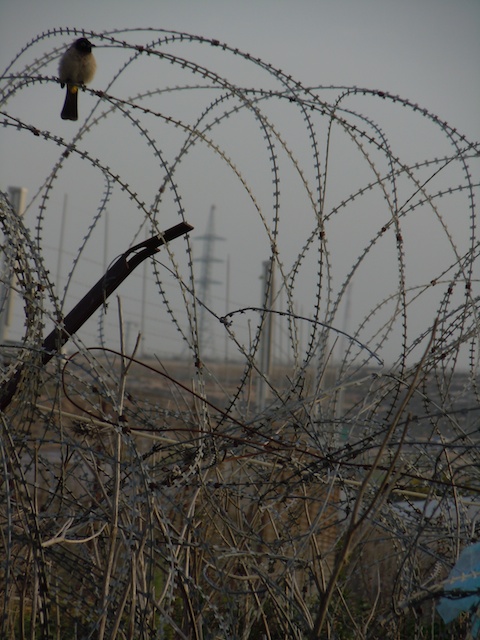
On one side of his house is the 8 meter high concrete separation barrier that scars the landscape for as far as the eye can see. All over the wall there is battle between local graffiti artists and the Israeli Defence Force’s (IDF) censoring white paint. On the other side of his house there is an illegal Israeli settlement which is cut off from him by a barbed wire fence. Flanking each end of his property are locked security gates leading to the military road that track the separation barrier. He is hemmed into his small plot of land on all sides.

On the approach to his house our driver and translator rings ahead for him to come and meet us. We pull up alongside the 8 meter high concrete slabs to walk the last few meters. Next to the barrier there is a small rusted metal door from where Mr Ameer emerges. Between 2003 and 2006 he lived in his property not owning these keys to access his own property. For three years he relied on the IDF to let him through the security gate each day to return to his own property. It was not uncommon in those days for friends to throw food parcels over the wall so he could feed his wife and children.

We sit outside his broken and bruised property in the fading evening sun. He explains he cannot fix any of the broken windows, crumbling walls or holes in the roof as he cannot get a permit off the Israelis to ‘build’ on his own land.

I ask him if he ever considered leaving. He responds with a story of isolation and incredible courage which is characterised by a lack of options. The Israelis offered him a lot of money and a chance to rebuild a bigger and better house on more land wherever he wanted in return for his land. He refused. Why he refused is a mixture of a connection to a family home that has been with him for years, and a slightly more harsh reality. The Palestinians who lived nearby warned him that if he sold up to the Israelis he would no longer be considered a ‘Palestinian’, he would be isolated. An ironic threat given his circumstances.

Regardless of his motives, Mr Ameer now finds himself in a physical limbo, not on either side of the separation barrier. He insists that if he could turn back the clock then he would do nothing differently. I ask what he hopes for the future and he bleakly responds, “nothing, I will die like this”. This response sends a shiver down my spine as I realise that this is quite possible. The occupation has come to a point where a family can be living in 60 by 40 meter virtual quarantine and the world does not bat an eyelid.

Mr Ameer has the look of a man who has told his story a million times before. He sits back in his chair as if this is a day to day occurrence for people all around the world as he recalls the details of his isolation. I wonder whether this is just his way of dealing with what is an unimaginable daily infringement on his personal liberty.

The meeting comes to a close and he walks us back to the rusted metal gate. Unlocking the padlock he looks up at the separation barrier and then at the floor. His body forgets what he is doing for a brief moment but his hands are still unlocking the door they have unlocked everyday for the last 6 years.

We leave him on the other side of the barrier. I cannot decide whether I have extreme admiration for this man, or if I just want to shake him by the scruff of the neck and tell him to move with his family to a new house. I suspect if I did the latter, he would sit me down, light a cigarette and tell me to not be so impatient. I am impatient though, I don’t want to think of this man sitting in his house, his virtual prison, until the day dies. There has to be an alternative ending to this tragic story.

The occupation restricts peoples movement, freedoms and lives on a day to day basis. Mr Ammer’s story is unique only because of his physical proximity to the separation barrier.

Haney Ameer will sleep tonight though knowing no one can tell him to leave his family house, not the IDF and certainly not a foreign human rights monitor like myself.
2 Comments

Filed under Human rights, Middle East, Politics, War

Administrative detention on the West Bank

This article was written by my colleague Bjoern Gunnar and was originally published in Norwegian and English on his blog.

By invitation from the Qalqiliya branch of Prisoners’ Club, the EAPPI team at Jayyus attended the demonstration against the administrative detention of Khader Adnan who has been detained since 18 December. Adnan is now on his 64th day of hunger strike and has lost a third of his body weight. According to Al Jazeera, the 33 year old baker was arrested in his home in the middle of the night and ‘sentenced’ to four months of administrative detention,  “World leaders have expressed growing concern over the fate of the prisoner, who is being held without charge under a procedure known as “administrative detention”. There are currently more than 300 Palestinians being held in administrative detention by Israel, without charge or trial, for renewable periods of six months, without any way of defending themselves.”

EAPPI teams do not actively participate in demonstrations, but attend to show sympathy and talk with people. Sometimes we find eloquence without the use of words.

In the small town of Qalqiliya, more than two hundred attended the demo. Not bad!
Mothers and sisters with husbands, sons and brothers in administrative detention; faces showing the destructive effects of the use of illegal imprisonment.
There is beauty to be found on the West Bank. Administrative detention is not among these. The life of Khader Adnan is on the line; a very thin line. Should he die in illegal detention, scenarios including disruptive, violent response are more than probable. Israel’s Supreme Court will hear an appeal for Khader’s release today.

Leave a comment

Filed under Human rights, Middle East, Politics, Social comment, War

The lasting legacy of child detention in the West Bank

This article was published on WeSpeakNews – an alternative grass-roots led news service.

It is becoming a regular event but I am far from being able to normalise it. Having sound grenades go off meters from you whilst being caught in a shower of stones is not, and should not, be understood as normal. Increasingly however for the village of Jayyus it is. In the last 7 days there have been 4 Israeli Defence Force (IDF) incursions into Jayyus and its neighbouring village of Azzun.

Last night we saw three vehicles tear through the village. What follows is typical of villages across the West Bank. Children who are already on the streets start nervously at first, but soon with collective confidence, throwing stones at the IDF vehicles. We were caught out of position (between the IDF and some stone throwing kids) and so take cover in a shop. The IDF then lets off a couple of sound grenades before tearing out the village, leaving a cloud of dust behind them.

In the aftermath of this relatively small incident I talked to some of the young men on the street. One, who proudly boasts that the IDF ‘questioned him’ comments, “they asked me if I threw stones and I said no”. A stone slips out of his hand. Mostly the boys and young men are excited and exhilarated by the whole episode.

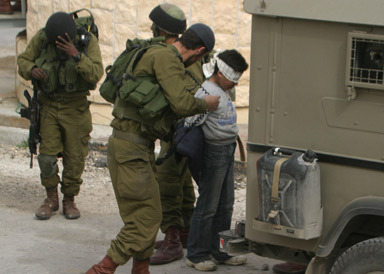
This however is in stark contrast to the Mayor of the village who I visited a few days previously. His son had been arrested during the raid on the village the night before. There is no excitement in his eyes, no exhilaration, just tired resignation. The sight of his children being taken away blindfolded and bound is all too familiar. His house had been broken into and turned upside down in search of weapons that were never found.

One ex-IDF soldier told me recently that in hundreds of house raids he conducted, he only ever found one gun. In his words, “This is about power and intimidation, not arms”.

These arrests have both immediate and long term consequences. Firstly, the children are detained, normally in the early hours, by being blindfolded and bound by armed soldiers. This is a terrifying experience by itself. The NGO Defence for Children International however describe in detail the procedure which arrested children can experience, including, no access to legal help, reports of torture and forced confessions. This treatment leaves a lasting legacy on the attitudes of these children.

The detention of minors, in this manner, clearly violates the UN Convention on the Rights of the Child (article 3) and the UN Convention against Torture. What is most concerning however, is the lack of accountability throughout this system. It is often a battle to ascertain the location of any prisoner, let alone their welfare. There are entire organisations established just to help people track the whereabouts of those detained.

Those who are left in villages like Jayyus are left to hope and pray to their God to protect the children they could not. Not knowing where their children are and when (or if) they will be released, is something no parent should have to go through. As NGOs such as Yesh Din work to protect the basic rights of these children, all that is left to do for those in the village is to start sweeping up the broken glass and to keep praying to their God.

3 Comments

Filed under Human rights, Middle East, Politics, War

A photo speaks a thousand words – Jayyus

A fellow EA monitors an agricultural gate outside of Jayyus.

Nature does not respect human divisions.

2 groups who feel connected to one piece of land.

Leave a comment

Filed under Human rights, Middle East, Politics, Religion, Social comment, War

Why the left needs to keep the faith

An edited version of this blog was first published on Liberal Conspiracy blog.

‘Politics and religion should not mix’. This is the mantra that is lazily wheeled out by self congratulating lefties as they marvel in their own enlightened wisdom. I come across well meaning social progressives who openly shun the role of faith based organisations as either an evangelical force that should be scorned, or, at best, a tool by which individuals can act out their selfish desire to please the big man upstairs. This lingering stereotype of faith based organisations not only alienates billions around the world who see their faith as their primary moral compass but also pragmatically restricts social movement’s ability to bring about the change they are so desperate to see.

Many, at this stage might assume that I am one of those rather smug Christian types who go around asking people to accept Jesus’ warm love into their hearts – I am not. I am, like many in 21st Century Britain, painfully middle class and going through and an existential crisis as I try to work out ‘what it all means’. I am as unsure about the existence of any deity as you can possibly be. So don’t worry, I am not trying to convert you, and neither do I see this article as my one way ticket to heaven. I am fairly sure that God doesn’t read blogs anyway.

I am however, excited about the truly radical potential of Christianity to bring about social change. All around the world, we can see different denominations working progressively on a range of issues. This could be The Salvation Army offering support to the homeless, The Quakers campaigning for peace or the Catholic Church fighting global poverty.

At this point, the sceptics out there will point to Christianity being used to discriminate against entire communities (LGBT for example) or the Catholic Church and their opposition to contraception. If you, dear reader, were felling particularly pernickety, you might start pointing to George Bush claiming that God told him to invade Afghanistan or wars that have been fought in the name of God. Religion, in many peoples mind is a bringer of war, the perpetrator of hatred and an opium for the ill informed masses.

My response would be to point to the fallibility of all human organisations, including organized religion.  There is nothing inherent within any faith to suggest that it will always work for a positive social agenda, neither is there to suggest it will always cause harm. If we on the left are too smug to engage, we will leave ‘doing God’ to those who want to justify oil wars, invasions or subordinating an entire gender. It is time for us then to throw off the shackles of conformity and acknowledge a very simple truth – Christianity can be really radical!

It has taken me a while to get to a position in my life where I can work comfortably and confidently with people of faith knowing full well that they believe in something that I don’t. When working for Amnesty International, I started to spot the myriad of backgrounds and experiences that had drawn people to become human rights activists. It is clear to me now that somebody’s faith is just one of those reasons. Why are many on the left happy to work with those of faith but not faith based organisations? In the past I have had a pleasure of working for The Quakers, who are just one example of a faith based organisation who are putting their faith into practice to work towards social causes.

I am excited to be (once again) putting this theory into practice. In February I will be heading out to Israel and the Occupied Palestinian Territories with the Ecumenical Accompaniment Programme in Palestine and Israel which is coordinated through the World Council of Churches. This is an organisation bringing different denominations, faiths and backgrounds together to work progressively for a non-violent solution to the conflict. It is an exciting example of a faith based organisation working inclusively with Israelis, Palestinians and the International Community to work towards the end of the occupation and for all in the region to enjoy basic human rights standards.

We on the left need to incorporate faith based groups into all of our work. They unlock the door to millions in the UK and billions around the world. We need to show we are truly inclusive by illustrating that faith can be used positively. If we fail to do this, we run the risk of George Bush and the like becoming the public face of Christianity. There are inspiring people out there from Archbishop Desmond Tutu through to the Archbishop Dr John Sentamu who are working on causes I would be proud to support. All we on the secular left need to do, is show that we can get over these outdated stereotypes of faith based organisations and embrace their progressive potential.

5 Comments

Filed under Human rights, Middle East, Politics, Religion, Social comment

The day I was ashamed to be a Cheltenham Town fan

This article was published on the Tattooed Football blog.

We were 2-0 down. The collective voice had slipped out of our supporters. We were silent. Spurs fans responded in the only way they knew, to start mocking our silence. They finished with a collective ‘shhhhhhh’ to illustrate the resonating silence coming from us. What happened next shocked me. It shouldn’t have done, but it did. Someone behind me shouted in a thick West Country accent, ‘you’re not in gas chambers now!’

Read the full article here

2 Comments

Filed under Far-right politics, Football, Gloucestershire, Politics, Social comment, Sport

Why Sunny Hundal has got it wrong on “my tram experience”

“My Tram Experience” is an ugly snippet of life in the UK. It is an example of unashamed racism that we should all be eager to condemn. Sunny Hundal (editor of Liberal Conspiracy and comments is free columnist) was quick to join in this condemnation, that was until he saw the ferocious backlash from the tweeting masses.  In Sunny’s words, “Piers Morgan was calling for the woman to be deported, some asked for her to be locked up, while others said her child should be taken away. And those are only the printable responses”.

First on Twitter and then through a comments is free article Sunny made a valuable effort to counter this moral outrage. I won’t try and simplify his arguments but suggest you read his article in full here.

His argument though has a series of holes. Firstly, he claims the law is “an overbearing ass”. Which is true, and it is why I commented that I support this government’s move to remove word ‘insulting’ from the Public Orders Act. In light of this, I would be happy with a law that protects people from “threatening or intimidating” behaviour – not simply ‘insulting’. Sunny it would appear is not.

Sunny seemed to suggest that it was OK to be intimidated and threatened in public. I could not disagree more.  I think it is right and proper that victims of aggression be afforded the protection of the law in such a situation. In this specific circumstance, the woman was clearly intimidating. Sunny’s argument that because she was sat down she didn’t pose a threat is a weak one. This argument would suggest you cannot be verbally intimidated. This is clearly not the case. Shouting “fucking paki” in the face of a Muslim (intimidation does not need to be accurate or PC) or “fucking fag” in the face of a gay man is verbal intimidation. To suggest otherwise is to undermine the terrible experiences that people have to endure on a daily basis.

This has to be separated off from simply holding unpleasant views. I can write all sorts of rubbish, as can our friends in the BNP.  Their views play into a dangerous culture of hatred but should not be outlawed. My views play into a dangerous culture of self-righteous woolly lefties but should certainly not be outlawed. When I start sitting on trams and screaming abuse at anyone who reads the Daily Mail –that’s when my views become intimidating and are illegal. This is an important distinction.

Sunny asks in his article, “Do you really want to give police the willingness to arrest people simply for having an argument?” The answer is clearly no – but I do want to be protected from intimidating behaviour.

Secondly, he suggests the law does not help us challenge the wider problem of racism. Again, I would broadly agree – it is a blunt tool at best. What it does do however, is provide victims with recourse to justice. It can (or at least holds the potential to) give the victims as sense of closure. Although rock against racism (and the plethora of other social movements which have successfully changed attitudes) is as important as ever, suggesting a victim of race hate crime should go to a rock concert or join hope not hate is simply not sufficient. Victims, rightly or wrongly, look to the law to feel justice has been done. We have a responsibility to provide victims with the appropriate legislation. When Sunny point to the Race Relations Act and that it has only had a handful of prosecutions, we know this is a failure of the system and that legislation, not because the crimes are not being committed. The state has let down those who the Race Relations Act was designed to protect.

Finally, Sunny comments, “My fourth argument is simply this: I would rather a world where such incidents didn’t exist but the world will never be perfect. I would much prefer such racism to be open and visible because there are still far too many Westminster commentators who think racism is a thing of the past.” Again, I agree, but this does not mean we have to encourage it! I would rather these issues were in the open – but I am not going to put on a racist poetry evening for racists to come and express themselves at. In the same way, when a racist has clearly broken the law I am not going to go out of my way to argue they shouldn’t be arrested. For some reason Sunny will.

3 Comments

Filed under Far-right politics, Politics

Trans-Caspian Pipeline lives to fight another day

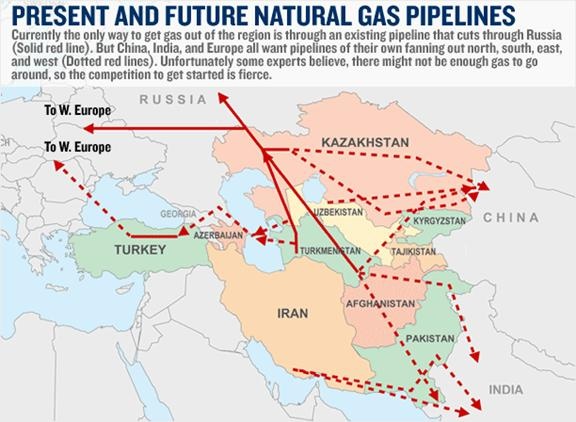
The Council of the European Union has today announced that it has adopted a decision authorising the Commission to negotiate an agreement with Azerbaijan and Turkmenistan on a legal framework for a Trans-Caspian (natural gas) Pipeline System.

I have blogged before about the problems this pipeline may hold. Anyone concerned with human rights and development in Central Asia should follow these developments closely. Will the EU live up to its human rights commitments in its trade deals?

Regardless it looks like the EU is committing itself down the energy road of reliance on large quantities of imported natural gas. A diversification away from Russia is a no brainer but holds with it infinite dangers. Interesting times ahead – watch this space.

Leave a comment

Filed under EU politics, Human rights, Politics, Russia

We are still haunted by the legacy of colonialism

We have to reclaim our history, however vile!

The modern western world has colonialism and imperialism entrenched into its history.  The racial and ethnic tensions that are apparent in contemporary society can be traced through history back to the time of colonialism and imperialism.  To pretend it is not there is to play into the hands of the modern far right.

Colonialism refers to the political authority of the European powers over some of the areas of Asia, Africa, Australasia and the Americas.  Broadly it is the time when there was a political economy based around the slave trade By the end of the 19th century nearly all Africa had been colonised by one or other of the Great Powers.

Modern racist discourse can be traced back to the slave trade.  Although, it is important to remember that racism and slavery did not always go hand-in-hand (think of the ancient Greeks!).  Why then, in our murky colonial history did race become such a big deal? From the earliest recordings of British involvement in Africa (large scale in 17th century) the exaggerated term “black” was used to describe the very obviously different skin colour between British and the (at first) West Africans.  However the colour ‘black’ came with some deeply ingrained values; it was associated pre 16th century with dirt and death.  It had connotations of evil and wickedness.  This is illustrated in the distinction between black and white magic and as well, the Black Death.  This all came at a time when the ideal of beauty in Britain was very much of a pale white face.

Throughout the Colonial period the appearance of the African was stretched and exaggerated through European discourse.  Their nakedness was often highlighted to illustrate their difference from the ‘civilised’ European.   To start with people were content to comment on skin colour to describe their difference; during the 17th and 18th centuries however a number of other characteristics were attributed to them.  Soon African men were considered to have potent sexuality.  The men were considered to have a larger penis and to be extremely lusty.  Some Europeans at the time speculated on the sexual intercourse that might have occurred between apes and Africans.  Indeed increasingly Europeans would compare the Africans that they ‘discovered’ to the apes that they “discovered” at a similar time. Indeed, other characteristics were recorded at this time such as laziness and superstition.  After meeting Africans as neutrals (pre slave trade), the colonial legacy slowly degenerated into a deeply racist discourse.

Towards the end of the 19th century a movement developed to legitimise Imperialism.  Social-Darwinism was used to justify the colonial power’s actions in Africa.  There was a belief that there was a natural hierarchy of races.  These were predominantly European ideas and as such Europeans were normally ranked as the ‘highest being’.  This is an almost laughable idea today, but at the time was considered gospel by many.  It is important to note that such broad biological assumptions are still made and believed in modern racist belief.  For example Charles Murray’s book ‘The Bell Curve’ (1994) is still used by extremists to argue that White people have a higher I.Q than black people. Stereotypes still persist in main stream society in many western countries as the mass of the population still see Black Afro-Caribbean’s consistently performing low skilled manual jobs (a changing but lingering phenomena).

Although the dark days of our colonial past, are just that, our past.  It is worth taking a moment to reflect the impact that they are still having on our society.  There are some very clear ethnic tensions that can be directly linked to European colonial past.  The continued conflict in the Democratic Republic of Congo demonstrates some extreme racial tensions that have a clear link to the Belgium legacy there for example.  The racism that we see most regularly today however is a lot more subtle.

Modern conflicts, especially in the West appear to be increasingly more complex than simply a reflection of race.  Ethnicity is a wider term that can describe a group of people beyond their inherent characteristics.  For example the Muslim community in the U.K could easily describe themselves as an ethnic group.  No longer does it simply describe your skin colour. This leads to a more complex system of discrimination where culture, religion and race all become intertwined.  In the UK there is no simple way of defining what it exactly is that people discriminate against. However appearance still plays a large part in social discrimination in contemporary society.  This is reflected in police stop and search figures; increasingly Arabs have been subjected to a greater number of searches.

Despite conflicts growing increasingly more complex, there are still racial elements to most conflicts in the western world.  In November 2005 large-scale riots broke out throughout France.  The BBC described these as ‘race riots’ as it was predominantly members of the black community rioting.  However a more accurate way to try and have one term to describe these riots would perhaps have been to describe them as socio-economic deprivation boiling over.  It is no coincidence that these riots took place in some of the poorest neighbourhoods across France.  However these riots were portrayed across the world more as race riots.

Today we can see the BNP riding a roller coaster of popularity (for whenever they have risen high they have very soon plunged in public opinion).  The peaks of the BNP’s popularity however should worry us.  The BNP often attack a way of life opposed to a specific “race” (although the racist undertones are clear).  For example their leader Nick Griffin was cleared of the charge ‘inciting racial hatred’ for describing Islam as a ‘wicked faith’.  In his trial he argued he did not hate Muslims or any ethnicity but purely the faith they followed.  However what the B.N.P does illustrate is that there is still interest and small support for such extreme right-wing politics.  They often play on fundamental fears that are still apparent in society; for example they argue that these ‘migrants’ are stealing British jobs.  It is apparent that there is interest in these ‘racial’ issues in the main stream even if there is not much support for it.  A lot of the discourse they use is similar to that of colonial times.  For example the B.N.P campaigned for many months about the Asian ‘sexual predators’ that were coming after ‘our girls’.  This is a clear link back to colonial stereotypes that play into the discriminative discourse that the B.N.P wishes to capitalise from.

To forget our colonial past, in all it’s ugliness, is to give the modern racist a free use of a deeply ingrained sub-conscious tool.  Regardless of whether we would like to admit it or not, racism still exists in this country.  We have to acknowledge that it has a long history.  If we do not acknowledge this history, then those outdated images of the black man as a sexual predator, or the monkey chants across football grounds will continue to be used.  We have to reclaim our history, however vile it is! At least we have the decency to acknowledge it to be vile!

4 Comments

Filed under Far-right politics, History, Politics