Category Archives: Politics

An unemployed mother, 11 children and a council ‘eco-mansion’ – the true cost to society

My home village, Churchdown, has become the centre of a media storm. Blowing in from middle England this storm is causing lasting damage. Not just to Britain’s poorest families but to each and every one of us.

Just round the corner from the Hare and Hounds in Churchdown, one of my old haunts, lives Heather Frost. Heather is unemployed and is currently living in temporary council accommodation with her 11 children.

Cue the tabloid hysteria…

The Sun reports “A JOBLESS mum on benefits is having a £400,000 council house built for her — and her brood of ELEVEN children”

The Daily Mail goes with, “mother of 11 to get six-bedroom eco-house after moaning her TWO council homes are cramped”

While The Express analysed the events saying, “The result has instead been to create powerful incentives for irresponsible people to bring into the world very large numbers of children they cannot possibly support”

I am not here to argue the morality of having 11 children, but to comment on the media storm surrounding this story.

I hope to show how it’s inaccuracies and how it causes lasting damage not just to some of the poorest in our society but to each and every one of us.

So where to start in this quagmire of misinformation?

Virtually all media reporting of the story goes to great length to try and generalise Heather’s quite extraordinary story into an attack on our benefits system in general.  The Daily Mail reports that there are over 190 families with more than 10 children and this is costing us, the taxpayer, over £11 million a year.

Of course, what the Mail describes is a fraction of the overall benefits system.  These 190 households sit alongside 1.35 million other households where at least one parent claims an out of work benefit.

Ally Fogg in the Guardian points out that the £11 million that these families receive, constitutes less than one hundredth of 1% of the total benefits bill of £100bn (excluding pensions).

The cost to us…the taxpayer? Small change.

The Express tries to score come political points with it’s analysis that we now have a ‘powerful incentive’ for people to have more children.

This ‘powerful incentive’ the Express describes is referring to child benefit. This currently stands at just £20.30 a week for your first child and then an additional £13.40 a week for any further children you have.

To put this into context. Krishna News in Churchdown paid me more money per week for doing a paper round than Heather Frost gets for each of her additional children.

Additionally, two of her children are between 16 and 20 so she would only receive child benefit if they are still in full time education. Her oldest child is now 21 so is not eligible for child benefit.

Who needs facts when you write for the Express though? Little inconvenient facts like the average reproduction rate of 1.9 children for families on benefit. The almost identical reproduction rate to those not on benefits.

If there is a ‘powerful incentive’ to have children on benefits (which there isn’t)  then those on benefits have yet to spot it.

Ah, but she is having a brand new £400,000 house built for her and her ‘brood’ The Sun reports. Well, keep reading and in paragraph 7 of that same story it explains how Tewksbury Council could afford this. It states, “Tewkesbury Borough Council sold a plot of land…to Severn Vale Housing association…A condition of the sale was that one of the 15 affordable properties they built on the site would be a six-bedroom home”.

The penny drops. When The Sun quotes Robert Oxley from the TaxPayers Alliance saying, “It’s scandalous that so much time and money is being spent on one custom-built house” he doesn’t actually say whether or not it is ‘tax payer’s money’ that is being spent.

These stories fuel a hatred for some of the poorest families in Britain. Regardless of how many times tabloids but the word ‘struggling’ mockingly in inverted commas, it won’t effect the fact that 1 in 5 Brits live in poverty and are struggling.

These stories though act as smokescreens. They force us to focus on how the poor are costing us rather than how poverty is costing all of us.

As we worry about the £11 million being spent on people with large families we learn to ignore the £25 billion that child poverty is costing the UK every year.

The people who suffer? Not just the 4.5 million at risk of homelessness who are currently on the housing waiting list or the 3.6 million children that are living in poverty in the UK.

In times of austerity, this media storm is costing all of us.

UPDATE: New Research out today suggest that in many UK cities over 40% of kids live in poverty.

11 Comments

Filed under Gloucestershire, Homelessness, Politics, Social comment

The removal of ‘insulting’ from Public Order Act is a victory for free speech

This article was written for Left Foot Forward.

Rowan

MPs have confirmed that the word ‘insulting’ will be removed from Section 5 of the Public Order Act 1986.

This is a major victory for an unlikely alliance of free speech campaigners including The Christian InstituteThe National Secular Society and Rowan Atkinson.

Last month the home secretary Theresa May announced that the government was ‘not minded to challenge a House of Lords amendment removing the word ‘insulting’ from Section 5 of the Public Order Act.

In the past Section 5 had been used against street preachers ‘insulting’ homosexuals and LGBT activists ‘insulting’ religious groups.

As Rowan Atkinson commented, “The clear problem of the outlawing of insult is that too many things can be interpreted as such. Criticism, ridicule, sarcasm, merely stating an alternative point of view to the orthodoxy, can be interpreted as insult”

This change in law is a victory for freedom of speech in the UK.

There remains, however, an important limiting role for the law to play. That role is to provide protection to those who are victims of threatening or abusive behaviour.

In 2011 I blogged saying that, “We all hold the right to live without fear or intimidation. This has to be legally separated, however, from being ‘insulted”.

The distinction has finally been acknowledged by the government and the change in the law later in the year is now just a formality.

It is worth noting, though, that even with this change in law, the discussion about what constitutes threatening behaviour compared to ‘insulting’ behaviour will remain. There is a considerable grey area around what the law should interpret to be ‘threatening’ and what it should view as merely ‘insulting’.

For example, ‘My Tram Experience’ – a video showing a vile torrent of racist abuse on a south London tram – sparked two very different interpretations.

thought her behaviour was threatening and therefore called for her arrest, while bloggerSunny Hundal argued that she was simply being insulting.

With the change in law however, the police are some way towards having a clear distinction to follow. We are no longer asking them to be the judge of what behaviour is deemed ‘insulting’, at least.

Leave a comment

Filed under Celebrity, Human rights, Media, Politics, Social comment

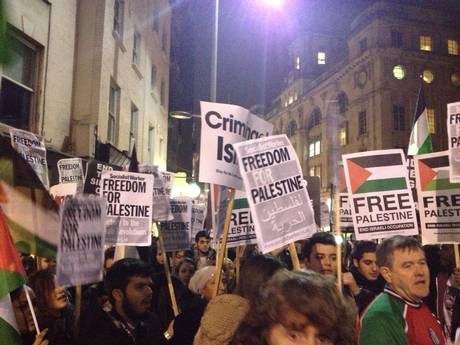
As Gaza burns Londoners take to the streets

Hundreds of miles away, families are huddled up inside their houses fearing the next explosion. Across the south of Israel and throughout Gaza, civilians are suffering the anxiety of a war that they cannot escape.  The second day of fighting in Gaza has left a mounting death toll and an unknown number of people with life changing injuries.

This bloodshed seems a long way away from the Israeli embassy in north London. It is though, ultimately why around 1000 people gathered here on a cold November night.

As I approach the planned protest I am met first by a sea of blue and white – mainly in the form of the Israeli flags but also Union Jacks. A few hundred people had gathered to offer support for Israel. I quickly have two leaflets thrust into my hand; one entitled “Defending Israel from Terror” and the other urging me to donate to “Rocket Aid”.

I dither on the pavement as I read the leaflets. Some of the language on the leaflets attracts my attention. The first leaflet states “Operation Pillar of Defence is aimed at removing the threat to Israeli citizens. No innocent civilians will be targeted” and I think about how this aspiration seems to so routinely not be lived up to. Amnesty International has stated that two Israeli airstrikes in the last week alone have failed to distinguish between civilian and military targets and as such constitute a violation of International Humanitarian Law.

My attention though shifts to a woman who is draped in an Israeli flag handing a small child a leaflet whilst saying, “it’s important everyone knows the truth”. I decide that now was not the time to discuss the philosophy of ‘truth’. Instead I start a conversation.

It would be fair to say that we don’t always see eye to eye on every issue. At times though we find common ground, “Israel’s external security threat is not to be underestimated” she says. At times though we had to agree to disagree, “I don’t know what more Israel could be doing to get peace”. I offer her a list. At times I am left speechless by some of her analogies – the bombing of Gaza, she said is like having children “you talk to them and you talk to them but sometimes you just lose your rag”. I bit my lip.

Despite at times finding her views unpalatable, she was friendly and engaging and our conversation attracted other around us. A young Londoner called Harry was hanging around the edge of the protest and soon we were having a good conversation. Harry is a 17 year old student who wants to study International Relations and oozes confidence and intelligence.

I asked Harry why he was there and he responded passionately about schooling and how he thought that every kid should have access to it without being scared of rocket attacks. Indeed, Harry who has family in Israel had none of the anger or angst that can sometimes be found in these situations and I believed him when he said “I’m also here for the Palestinians, I’m here because I want them to be free from Hamas, a terrorist government”.

As I worked my way through the crowd trying to make my way to the much larger “pro-Palestine” demonstration I briefly met a man whose son had gone and joined the IDF, a spokesman for the ZF and a young girl of about 6 who “just wanted there to be peace”- a diverse crowd.

All the time though I kept being distracted by snippets of less guarded conversations in the crowd. “Fuck human rights” “Those Arabs, they would kill each of us if we turned our backs” “Why do Arabs always smell like they’ve shit themselves”. I couldn’t help but to be appalled and I wondered what someone like Harry would have made of some of these comments.

As I made my way through the lines of police between the protests, one stopped me and asked, “Are you one of them?” I gave an oddly constrained answer as if under interrogation and said “I was looking to get into the Palestine demonstration”. To seek clarification the officer asked “Are you Jewish”? I answered honestly, “no”. This seemed to be enough to let me walk freely between the demonstrations.

Once through I was met with the swaying force of 1,000 people all shouting and chanting. There were Socialist Worker Party banners everywhere.  Almost immediately someone approached me and said “solidarity brother” and held out his fist. I replicated and we did, what I thought to be, a slightly awkward fist tap (like a high five but with your fist clenched). He looked at me smiled and said, “Yeah fuck the Jews man” and walked off.

With no sense of irony he turned and immediately started talking to a group of Jews who are anti-Zionist and can often be seen on ‘pro-Palestinian’ demonstrations. Language is used and abused but I still found the flippancy in which he muttered the phrase “fuck the Jews” to be deeply disturbing.

A wee scuffle broke out at one point between a young activist called Joe and a portly policeman. I approached Joe afterwards and asked what the problem was. Angrily at first he said, “They won’t let me confront them…the fascist scum. The EDL are down there and these pigs won’t let me through”. He looks through the policeman who is still hovering over us and says, “The Zionists are standing side by side with the fucking EDL”.

I asked around and indeed even went back to check, and couldn’t see any sign that the EDL had been at either demonstration.

All around me the crowd is loud. They chant in slogans that have been used for as long as the occupation and the mass of people seem to move with a collective pulse. The atmosphere is intense and the police numbers grow around the edges of the swelling crowd.

A young man with a scarf around his face sees me making notes and winds his way up to me. He tells me above the ambient noise that he is Indian and this is the reason why he has come here today. “I am here for myself because my country was occupied for hundreds of years. I’m here standing up for myself but also for the Palestinians – the oppressed”.

I ask him if he thinks it will work, if this demonstration will make any difference and he responds simply, “we have to try”. Even though he has a scarf over his face I can see his cheeks lifting and some wrinkles appear in the corner of his eyes. He exudes a sense of optimism.

Just as I finish speaking to him a small fight breaks out and two protestors are taken away by the police whilst chanting defiantly “Free free Palestine, from the river to the sea, free free Palestine”. The whole evening feels electric as if at any moment it could spill over.

After a gradual decline though, the cold takes most people back to their warm houses. Only a handful of anarchists and activist are left. One proclaims proudly “I’m only leaving in handcuffs” to which a policeman responds “did you bring any with you”?

As I arrived back to the warm of my south London flat, I turn on my computer and I am virtually reminded of the reason why we had all trekked across London on this cold November night. The Palestinian news agency, Ma’an News has on its front page a story that is grimly entitled “Teen brothers among 3 killed in Israeli airstrike”.

It states, “An Israeli airstrike killed three Palestinians in the northern Gaza Strip on Thursday evening…bringing the death toll to 19 on the second day of fighting.”

No amount of goodwill on either side will bring back the dead and only the Israeli government and Hamas have the power to stop further bloodshed. Let’s hope the leadership was listening to some of the moderate voices out on the streets of north London  on this chilly November evening.

8 Comments

Filed under Human rights, Middle East, Politics, War

Leo McKinstry should be glad there isn’t a fit for work test for journalists. If there was, he’d fail

This is a guest article from Eugene Grant. Eugene works in the third sector as a public policy advisor on poverty and welfare, and comments regularly on disability and issues of social policy. He blogs at Dead Letter Drop.

Over the last few months we have seen a continuous drip-feed of stories which have promoted a range of inaccurate and generalised accusations against disabled people with long term health conditions. As a result disabled people have faced greater hostility from the public, with many claiming that they have experienced hostility, discrimination and even physical attacks from strangers.”

So starts the National Union of Journalists’ opening statement on media coverage of disabled people.

Last summer, a report strongly criticised some sections of the media for the way in which they reported stories on disability benefits. Specifically, the pejorative language such as the use of terms like ‘work shy’ or ‘scrounger’. The fact that this report came, not from a ‘usual suspect’ disability charity or campaign organisation, but from the respected, cross-party Work and Pensions Select Committee is an indication as to just how serious the problem has become.

The 2012 London Paralympics is a wonderful opportunity to openly celebrate disability and difference. But, a change in our social narrative is badly needed. As I have written before, disability hate crime – which itself is under-reported and often ignored by police – remains a vile and stubborn stain on our social fabric.

This goes not just for adults, but children too; a recent academic study of disabled children found a fifth of them had been attacked physically, sexually, abused emotionally or neglected.

It is worth bearing this all in mind, when you read this spiteful, professionally weak and woefully misleading article, titled, ‘The Paralympics show up a corrupt benefits system’ by Leo McKinstry in the Daily Express. It is not that Mr McKinstry’s view of the welfare state differs to mine, which vexes me most; I fully accept that people will have different views on what the role of the state should be in providing disabled and vulnerable people with financial support. It is the fact that Mr McKinstry’s tendentious argument is based on un-checked, un-picked and inaccurate assumptions; he presents fiction as fact and fact as fiction.

Let the dissection begin.

He says: “One particular target of the activists’ fury is the international firm ATOS, which, under the coalition’s new, more rigorous, benefits regime, carries out assessments to decide if individuals are fit to work and what level of support they might require.”

He is correct in so far as Atos – which, with a note of sad irony, also sponsors the Paralympic games – does conduct the government’s fit-for-work assessment, the WCA. But this is a test that is not fit for purpose. Were it fully functioning it would not have been the subject of several internal and independent reviews; nor would experts like Paul Gregg – who designed some of the welfare-to-work support packages connected to the test – have spoken out against it; nor would almost a third of those decisions that are appealed then be successfully overturned in favour of the claimant. But no matter. Let’s move on.

He writes: “[Benefit] claims have rocketed in recent decades because the system is so lax. In fact, the definition of incapacity has been remorselessly expanded to widen the scope for dependency.”

I presume he means when in 2005 the Disability Discrimination Act was expanded to include conditions like Multiple Sclerosis, cancer and HIV? So, none of these conditions could have adverse impact on a person’s ability to work or give rise to any additional costs? Right. There’s a reason you’re not a doctor, Leo.

He goes on “claims for incapacity benefit are dominated, not by the physically disabled, but by those with mental health problems like depression, stress and behavioural disorders.

Read this again. What he’s suggesting is that people with mental health issues should not be entitled to state support, or that they’re all fakers who should just snap out of it. I myself am not an expert in mental health conditions but I’m pretty sure my colleagues over at Mind and Rethink would know of some people who would take serious issue with this.

He goes on:

“In this chaotic world, it is no surprise, that the total number of people on Disability Living Allowance has gone up from 1.1 milllion in 1992, when the benefit was first introduced, to 3.2 million today…”

See what he’s done here? All he’s done is point out that the caseload for DLA (a vital benefit that acts as a contribution to the extra costs disabled people have to pay as a result of living in our society with an impairment or condition) has increased. The ‘chaotic world’ and ‘no surprise’ bits helps frame it in a way that leaves readers with the impression that the only explanation for this rise in claims for DLA must be because people are fraudulently claiming it. Not because, oh I don’t know, that it’s well established that our society is getting progressively older and disability increases with age? Or that more people with critical needs are surviving into later life? Or that medical advancements are enabling many disabled people to live longer? Or that academic research shows that survival rates of very premature babies are, thankfully, improving, which suggests the number of people born with severe disability has increased. But these things are of no consequence right?

But wait, here comes the best bit. McKinstry writes:

AND the anti-reform campaigners are in denial about the extent of this costly failure. They are fond of telling us that fraud represents just 0.5 per cent of disability claims, but that is a completely bogus figure.

In the courts there is a constant parade of cases involving serious benefits fraud, like the conviction last week of serial cheat Barry Brooks, who grabbed £1.8 million from the taxpayer by pretending to be confined to a wheelchair

First, is the claim that the 0.5% fraud rate for DLA is “bogus…” Funny that, when you consider the figure comes from – wait for it – the Department for Work and Pensions. But more to the point, his only evidence for his claim that a Government statistic is ‘bogus’ is that there have been court cases of benefits fraud brought to his attention – of which he cites just one. And even then he fails to pick a case of DLA fraud. A quick Google search of Barry Brooks shows that he was jailed for fraudulently claiming support from Access to Work, and not DLA.

Mr McKinstry, you can lambast the welfare benefits system all you like. All that I ask is that, as a journalist, you do it accurately and check your line of argument. It’s a shame there isn’t a fit for work test for journalists and social commentators. If there was, you would fail it miserably.

12 Comments

Filed under Health, Media, Politics

Fighting on two fronts: A farmer’s fight with the Palestinian Authority and the Israeli Occupation

“We are always looking at the Israeli guns pointing at us and we don’t notice the Palestinian knives in our back”. Bazem, the mayor of Tawayel has been waiting now for “over two years” for funding promised to him from the Nablus governorate. Today he faces unimaginable hardship but he insists the problem that annoys him the most is “being completely ignored” by the PA (Palestinian Authority). From talking to a number of local officials now I know that this sentiment is shared by many but often people also use the PA as a scapegoat to vent their frustrations.

I had gone back to visit Bazem as his community had received another two demolition orders since I last visited a few weeks ago. Tents that offer accommodation were due to be ripped down as they were built in the Israeli controlled Area C of the West Bank. This subject however takes up just a fraction of our meeting as he keeps turning the conversation back to the “real problem” – the PA. “We are on the front line against the soldiers, we are the ones defending Palestinian land by staying here, so why do those people sat on chairs under air conditioners cause us so much problem”.

I ask him if he is just referring to the money he has been promised and he looks at me scornfully, “not only do they not give, but they take. The price of barley for our sheep has gone up fifty percent because of PA tax. And where does the money go”? He leaves the hypothetical question to linger in the air and it remains hovering over us for the rest of the meeting.

I have heard from other sources that this common story around PA tax is a popular myth. Another local contact when asked about this subject commented, “the increase in the price is not caused by the PA and there is no increase in tax, it is caused by the increase in global prices of these items”. I did not know enough either way to challenge him.

I had been told previously that the road going into their community was so bad because they live in Area C and as such the Israelis would not give them permission to put tarmac down and so I asked if there had been any progress. Again, the Mayor was not interested in Israel but turned the question back to the PA, “They [The PA] agreed months ago to lay loose stones down on our road to make sure it is passable, still I hear nothing from them”. Although Bazem remains good humoured throughout our meeting I can feel his frustration building.

I ask Bazem what he will do if in a month he still has not received any of the money or help he has been promised, “first I will meet them, if I still get nothing I cannot promise what I will do. I have many ways to choose, hunger strikes, talking to the media or international friends. We cannot continue to suffer like this”. He pauses before sighing the word, “khallas” (finished).

Being the mayor of such a troubled community is clearly taking its toll on Bazem both personally but also emotionally. I ask him about his personal expenditure, how he affords to travel to Nablus and the phone calls to try and sort out these problems. He answers matter-of-factly “I spend maybe 1,200 NIS every month [about £240]” before immediately twisting the answer towards the problems his neighbours face. “A few days ago with the UN I visited some families that I had not spoken to for a while, I could not believe what I saw. One family needed 25,000 NIS [£5,000] just for their sheep food. What do the PA offer…nothing”. I didn’t ask why he thought the PA should pay for a families sheep food.

I took the decision to enter a subject area I had in the past chosen to avoid, Palestinian politics. I was keen to know whether this resentment towards the PA was synonymous with a resentment towards Fatah so I asked if he thought life would be different if Hamas was in power. Bazem pauses and leans towards me despite speaking through a translator and says, “When you build a house, the foundations have to be right or the whole house will be bad. Hamas lays bad foundations. Fatah just don’t know how to keep their house tidy”. I sought clarity and asked if he was happy then Fatah are still in control and he answered shaking his head, “All the party are no good. They are fighting each other, not looking to help the people. They think about their salaries not the people”.

A number of different village and town officials have expressed similar sentiments to me in the past but all have asked not to be named. All have hinted at corruption at a systemic level. I ask Bazem if it is OK to tell this story and he says, “I don’t want to get into trouble but I speak the truth. People must hear the truth so yes, tell your people how we Palestinians treat each other”. I knew as he said these words this story would be met with quiet support from many Palestinians but also vocal criticism. A united Palestinian voice is often stated as their most “important weapon”. Bazem later commented, “if we fraction then we lose our fight”.

I ask Bazem if the land that he is fighting for is important to him because it is his or because he sees it as his national duty to defend Palestine’s land. “This land is not mine, it is Palestine’s. I am lucky to be Palestinian and so I can look after the land. This is why I must support my Palestinian neighbours”.

I ask about its many ‘Jewish neighbours’ (in the illegal settlements) and he pauses for a considerable amount of time. It was clear he was not going to rush into this answer. Finally he responds, “Settlers are a cancer”. Again he paused and I looked at him, he clearly was not happy with his first answer. “If I have good neighbours then maybe, but at the moment it is like having your enemy as a neighbour. I cannot live beside someone who wants to swallow me whole”.

I asked him if he had ever had a good Israeli neighbour and he smiled and responded as if this was a stupid questions, “of course. In Gittit [a close by settlement] I have many friends and we visit each other and help each other”. Again he pauses and I wonder how those in the PA would respond to a man who so openly criticised them whilst talking about having settler friends. Bazem brings me back from my own thoughts though with the clarification, “They understand my problems but they cannot do anything to help because of the religious settlers. They control everything”.

I leave Bazem convinced that his community faces a plethora of problems, but non-the-wiser about the source of these problems. Is it the Israeli state, the settlers, the extreme settlers, the PA or who? I suspect it is a cocktail of the above. Regardless of whether or not the accusations against the PA hold up to scrutiny the stories are widely accepted in many villages I have visited. Is it a PR problem or fundamental lack of support from the PA? The straight answer is I do not know.

1 Comment

Filed under Human rights, Middle East, Politics

The Women in Black and freedom of speech in Israel

Crinkles collected in the corner of her eyes as she smiled and said “I have been coming here for the last twenty four years. I sometimes wonder why, but I come. We have to show our belief as Israelis, as humans, in peace”. I was standing with a handful of women who were dressed in black, collected in the middle of a busy road junction in West Jerusalem. They come at same time, to the same place, every Friday. They stand with large cut out plastic hands with the message “Stop the Occupation” written on them in three languages. Collectively they are referred to as the “Women in Black”.

As the protesters began to assemble I was standing with three women, all in their seventies, all smiling and all opposed to the occupation. It was hard not to be won over by them.

The Women in Black movement started in 1988, a month or so after the first intifada broke out. The first protests began in Jerusalem but the idea spread internationally taking on local relevance. In Germany for example, Women in Black protests became active in countering the neo-Nazi movements. Everywhere they appeared they were organised by women and condemn violence in whatever its form.

Defying any stereotype around age or gender or nationality, the Women in Black are a powerful striking image on the road side making those passing by stop and take notice. Even through the smiles you could sense a steely determination which brings these women out onto the streets every Friday. This determination resonates to those around.

Before the demonstration I had been told about a ‘counter demonstration’ that occurs on the opposite side of the street to the Women in Black protest. At first this ‘counter demonstration’ played out like I would have expected. A small group of predominantly men gathered waving Israeli flags. One held a placard with the slogan, “Get an occupation and support Israel” (You have to give credit where it is due, it is a witty slogan). These two demonstrations happened alongside each other with little interaction.

Cars passed by honking their horns in support, and both protests took the noise and commotion to be in support of their cause. It was unclear to me who was honking to who but I got the feeling that most people were supporting the ‘counter demonstration’.

A taxi driver with a small Israeli flag flying from his window puts two fingers up at the women and drives off.

One passer by stopped and asked one of the Women in Black why they thought there was a counter protest. The answer showed, at the very least, an ability to understand what drives those who attend the ‘counter demonstration’. Glancing out from her black sun hat she answered, “For them, we are calling for half of Israel to be given away. Not only that, but we are asking for it to be given to a group of people who they think want Israel, and by extension their families, driven into the sea”. When the Women in Black call for an end of an occupation of a foreign land, many Israelis see it as ‘giving away’ part of greater Israel.

This back-story is important to understand as it provides a partial explanation (different to a justification) to why then the protest took a nasty and unpleasant turn.

A small group from the ‘counter demonstration’ crossed over the street and started accusing the Women in Black of being everything from ‘Nazis’ to ‘supporters of Ahmadinejad’ (Iranian leader). No slur appeared to be too extreme. To the credit of the Women in Black protesters, and perhaps because of previous experience, they showed almost no reaction to the provocation. Silently they continued to hold their signs calling for an end to the occupation.

This was until one ‘counter protestor’ approached me and accused me of being a “German, Nazi, Christian” (wrong on all three fronts). At this point one of the Women in Black came over encouraging me to ‘not talk to this man’. You can hear me at a number of points say “it’s ok” to her, trying to calm the situation as the ‘counter protester’ continued his hate speech. I only managed to record a small part of what he said and missed some of his worse comments. Still, both the recordings are truly shocking in places (see video below).

The Women in Black are on the street every Friday, keeping the Israeli opposition to the occupation in the public’s mind. Many involved in the protest want the counter demonstration banned, feeling that it is ‘threatening’. I agree it is certainly unpleasant.

For me however, Israel as a modern democratic state has to support the plurality of views and enable this ‘counter demonstration’ to take place for as long as remains peaceful and non-threatening. I did not witness any behaviour which was ‘threatening’. Of course the same has to be true for Palestinians who routinely have their right to protest violated.

As Voltaire didn’t actually ever say, “I disapprove of what you say, but I will defend to the death your right to say it”.

7 Comments

Filed under Human rights, Middle East, Politics, Religion

Scorched earth and shootings, as the Israeli military stand by

This article was originally published on Liberal Conspiracy.

Scorched earth stretched out before me. To my right the fire was still burning across the hillside spreading through olive trees. To my left all that remained was charred black earth.

All around me, men were moving, unable to rest but also unable to access their land to tackle the fire. All they could do was to stand watching as their livelihoods and land burnt.

An hour earlier, 22 year old Najeh al-Safadi had tried to put out the fire on his land and had been shot in the stomach by the private security staff from the overlooking settlement. At the time of writing it is unknown if he will walk again after the bullet damaged his spine.

I was stood with some residents from Urif, a small village in the West Bank close to Nablus. Urif stands on the opposite side of the valley to the illegal settlement of Yitzhar which is described in the New York Times as, “an extremist bastion on the hilltops”.

Violent action from the settlers directed at both the Israeli Defence Force (IDF) and local Palestinians is not uncommon in the area. The International Solidarity Movement reported back in April 2012 that, “that hundreds of villagers [from Urif] have been injured since 2000 [by settlers from Yitzhar], with as many as 40 serious injuries (many of which were gunshot wounds) and one murder”.

Stood on the hillside opposite me, above the one hundred and fifty dunums of burning land but below the settlement of Yitzhar, were a collection of about forty to fifty settlers. A small group of them were still lighting fresh fires, hours after the original fires had been started.

Parked up and stood alongside these settlers were the IDF. The Israeli Army stood by and watched as these crimes unfolded.

A few hours later however, the IDF did intervene. Just as a small number of settlers were on the outskirts of Urif the IDF stepped in. Their contribution? To fire fifty to sixty tear gas canisters at the villagers and international observers who were monitoring the events.

The IDF has said that they, “regard this incident [the shooting] as severe and will thoroughly investigate it”. Between September 2000 to November 2011, B’Tselem sent fifty-five complaints to the Military Advocate General’s Corps regarding cases that raised the suspicion that security forces did not intervene to stop settler violence.

In only five cases was an investigation opened; two of the five were closed without any measures being taken against the soldiers involved. In eighteen cases, no investigation was opened at all. In eleven cases, B’Tselem did not receive any response.

In a flash the ambulances were gone and the only traces that were left of the violence that had just occurred were the smouldering fields and the talk of whether Najeh would make a full recovery.

I left the mayor promising him that I would do what I could to tell the world what I had seen in his village that day.

Leave a comment

Filed under Human rights, Middle East, Politics, War

Spending the pink pound in Israel

This is a feature piece written for OUT magazine.

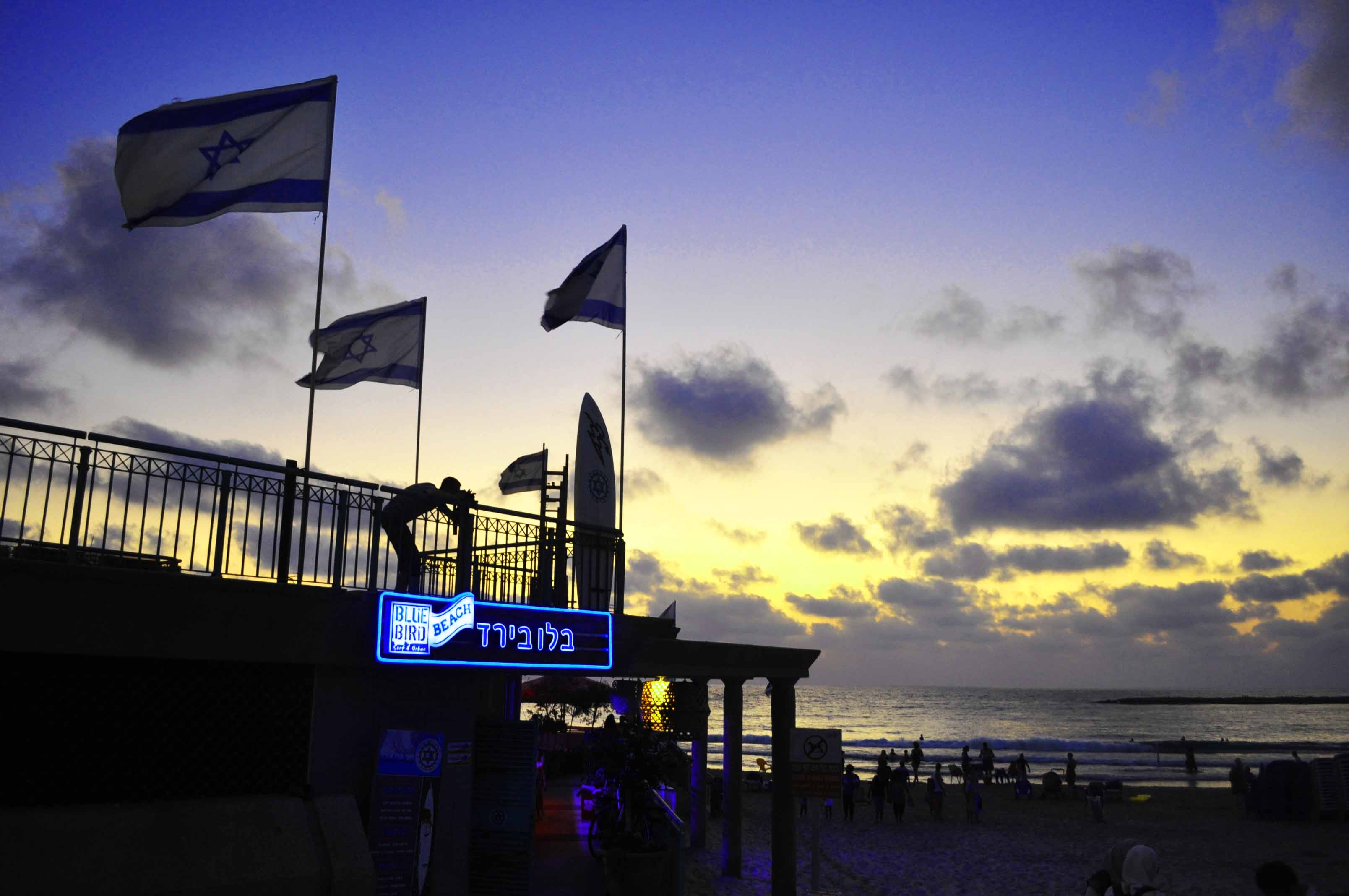
Sat in the evening sun Shaun shifts closer to Paul as the temperature drops in the fading light. I meet the couple sat on a beach in Tel Aviv, Israel. The two men in their mid thirties are on a couple of weeks vacation from their home in south London. I ask them if it is OK to talk to them about the gay scene in Israel and they happily suggest going for beer in the bar a hundred meters away on the beach front.

Sweet smelling smoke fills the air inside the bar as hookah pipes are shared between friends. We are sat with panoramic views of the now silhouetted beach front.  Passing the hookah pipe across the table to where the two men are sat side by side I start the interview by asking them why they chose Tel Aviv for their holiday. Paul exhales a plume of smoke, takes a sip from his beer and jokes, “cheap easy jet flights”. Shaun laughs and adds, “I just love the rub down at the [Ben Gurion] airport” (referring to the notoriously inhospitable welcoming foreigners receive at the airport).

With a smile I try a less subtle approach and asked if it had anything to do with the internationally renowned LGBT scene in Tel Aviv. Paul does not hesitate this time and comments, “We want to holiday somewhere that we feel relaxed and welcome. A friend of mine told me about Tel Aviv and so we thought we would check it out”. As an afterthought, as if recalling a distant memory, he adds, “everything is set up for us here”.

Tel Aviv is a well known destination for ‘gay tourism’. Last year Tel Aviv launched a $90 million campaign to present itself as, “an international gay vacation destination.” Leon Avigad, owner of the gay-friendly Brown hotel, explains the city’s popularity, “We are cosmopolitan, we’re very Western, European and American but on the other hand we’re very much into the Middle Eastern warmth and welcoming, and this combination attracts”.

Our visit to Tel Aviv coincide with the holiday of Pesach (Passover), the celebration of the story in Exodus where the ancient Israelites were freed from slavery in Egypt. As such it is very difficult to buy certain things such as beers and certain breads. I ask Shaun if this has been a problem and he responds with more depth than I was perhaps expecting. “I think it is beautiful that this society can hold onto its traditions and religious celebrations and still be so open minded”. I wondered how much Shaun had ventured much beyond the city since being here.

On cue, they ask me what I am doing in Tel Aviv and I tell them all about EAPPI and they seem genuinely interested. I ask them if they have ever been to the occupied Palestinian territories. Paul responds with a degree of defensiveness in his voice that he assumed he wasn’t allowed, “I thought there was a war there”. I explain to them, the best I can, the problems caused by the occupation and what I have experienced since living there. I elaborate my point about why I think it is bad for both Israelis and Palestinians. There is a more than awkward silence and I begin to worry that I might have pushed the conversation both metaphorically and literally too far from Tel Aviv.

As if reading my mind Paul comments, “all of that seems a long way from here”. I take this opportunity to try and relate what is happening in the conflict to their experiences here in Tel Aviv and ask if either of them have ever heard of the phrase, “pinkwash”. They respond in unison, “no”. I try my best to offer a definition of Pinkwash – the idea that Israel has created a deliberate strategy to conceal their continuing violations of Palestinians’ human rights behind an image of modernity, illustrated through the booming  gay scene. Both men looked troubled at the idea, clearly concerned that “their community” and “their choices” could somehow be linked to the troubles I had just described about the military occupation.

I try to reassure my two new friends and joke with them that they are not responsible for Israel’s occupation. For Paul however this was not enough. Playing with the beer mat in front of him he almost apologetically comments, “I guess we have only seen a part of life here”. I smile and again try to reassure them both that they are meant to be on holiday relaxing, not peacekeeping. They sheepishly smile back.

For many in the LGBT community it is an ethical dilemma whether or not to boycott Israel as a holiday destination. On one hand it is a beacon of LGBT rights in an otherwise very hostile environment. Some Palestinian activists have tried to persuade me that there is a growing gay rights movement in Palestine. If there is I have yet to stumble across it. Netanyahu told Congress last May that the Middle East was “a region where women are stoned, gays are hanged, and Christians are persecuted.” Sadly, this rhetoric may be alarmist but has also an element of truth in it.

On the other hand however Israel is accused by Amnesty International of “ill-treatment and torture of detainees, excessive use of force, the detention of conscientious objectors, and forced evictions and home demolitions” as well as having a “disregard for international law”. For anyone within the LGBT community who is concerned about equal rights and equality there are some clear moral concerns here.

As an LGBT activist who fundamentally believes in an equality of rights, I cannot settle on Israel having a progressive attitude towards LGBT rights whilst routinely violating other rights through the conflict and occupation.  As Haneen Maikay, the director of Al Qaws (a Palestinian gay rights group) recently said in the New York Times, “When you go through a checkpoint it does not matter what the sexuality of the soldier is”. The LGBT community are not separate from the rest of society who suffer from the occupation.

We are now three beers into the conversation and Shaun’s tongue as well as his sense of moral outrage has been loosened, “So what can we do to highlight all this. It’s f***ed up that people can come here and are not told about any of this s***”. Partly through tiredness I decide to avoid the minefield of BDS (boycott disinvestment and sanctions) and instead simply comment that I think it is important to make sure that everyone who comes to Tel Aviv is aware of what is happening just 20 kilometres to the east.

Paul however looks concerned. I have been talking for the last ten minutes and Paul has not spoken. “I don’t know” he says between regular slugs of beer. “there are so many f***ed up countries in the world where you can get hung for just glancing at another guy. It doesn’t feel right to be criticising a country who are opening their arms and welcoming us”. This concern reflects a very real issue within the LGBT community. To criticise Israel is to break an unspoken pact where those working on LGBT issues stand united in their struggle.

The answer to this dilemma presented itself to me in Yad Veshem, the Israeli holocaust museum. Here they have on the wall in large letters the poignant words of Martin Niemöller “First they came for the communists, and I didn’t speak out because I wasn’t a communist. Then they came for the trade unionists, and I didn’t speak out because I wasn’t a trade unionist.  Then they came for the Jews, and I didn’t speak out because I wasn’t a Jew. Then they came for me and there was no one left to speak out for me”.

If the 20th century taught us anything it is that silence can allow terrible things to happen. The LGBT community cannot stay silent while Israel uses its progressive attitude towards LGBT tourism to deflect attention from the continual violations of basic human rights standards in the occupied territories. Equally however, I believe we have to welcome Israel’s pioneering approach towards LGBT tourism, and encourage these attitudes to spread to less hospitable parts of Israeli society.

Stood outside the bar, the air is now cold and so our good-byes are short. As the two men turn to leave Paul says to me that “next time we come, I think we should spend a few nights somewhere in the West Bank”. I smile and say that they definitely should. Parts of Israeli society may be a beacon for LGBT rights in the middle east, but it is also an occupier of another land. To understand Israel, I think you have to visit that other land.

12 Comments

Filed under Human rights, Middle East, Politics, Religion, sexuality, War

Another crackdown on the protest in Kafr Qaddum

My head started swimming and I couldn’t open my eyes. I could feel broken stones crunch beneath my feet and I knew I was moving away from the protest. For a terrifying 30 seconds I lost track of what was happening. An autopilot sense of self preservation kicked in that my conscious self had little control over. Just as my senses started to return I felt a colleagues hand rest on my lower back and lead me to the side of the street. Here I crouched in the small amount of shade offered by the shop-front from the midday sun. My stomach had tied itself into a knot and my head felt like it had split in two. Only then did I realise that I must have walked away from my colleague who was now stood in front of me with her camera in hand. I glanced up an offered what I hoped was a reassuring smile.

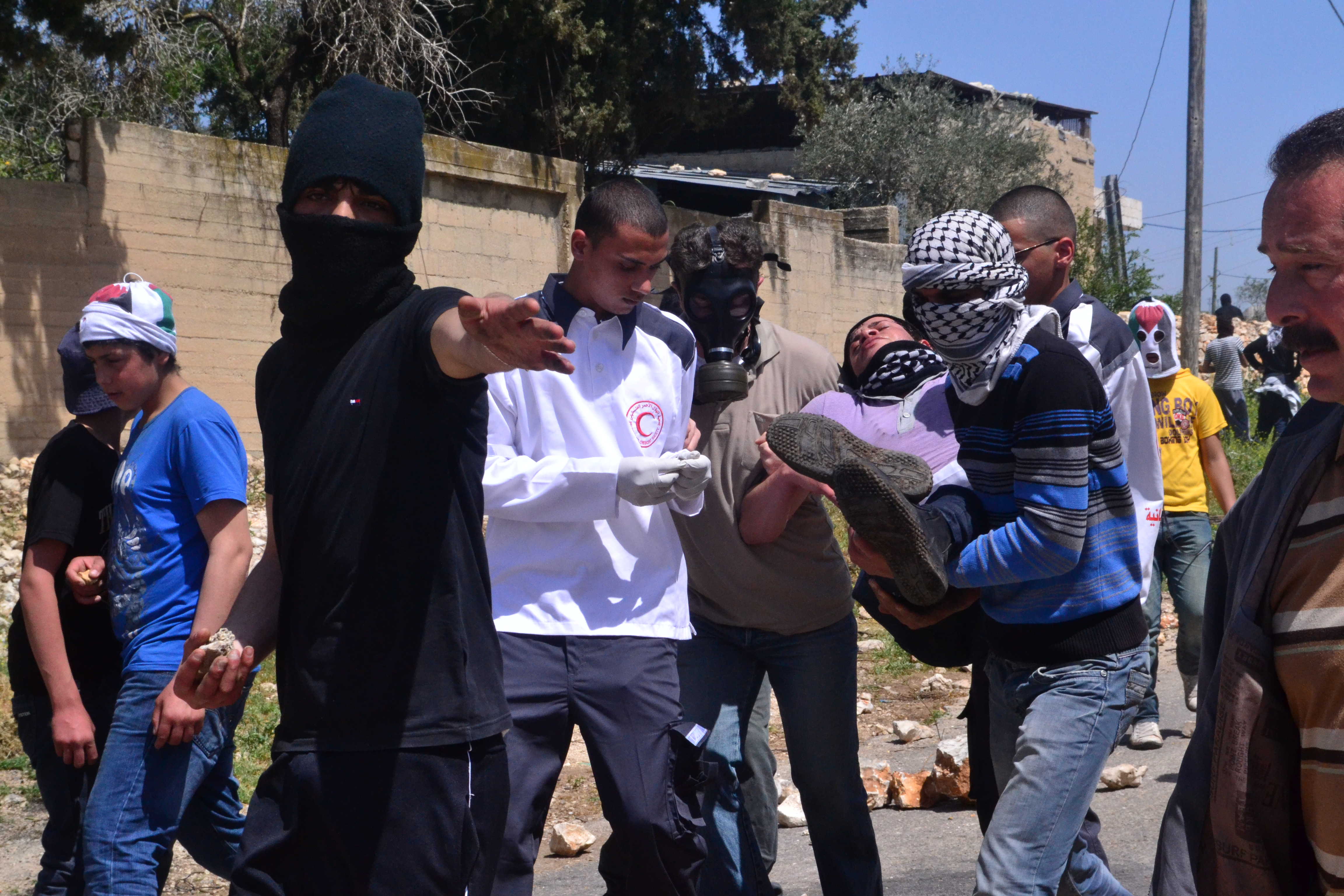
A few minutes earlier I had been stood at the back of a demonstration in Kafr Qaddum, a small village in the West Bank. I was there to monitor the proceedings and reporting on any human rights violations I witnessed. In the minuets preceding I had filmed a number of ‘warning shots’ being fired over the crowd and whiffed the faintest smell of tear gas. I believed I was far enough back though to avoid the worse of what was to inevitably come. I was stood on the side of the street next to a large wall that could also offer me protection, should it have been needed, from any direct fire. My colleague was nearby and I felt in control of situation.

Seconds later the Israeli army fired a volley of tear gas canisters (some directly into the crowd) that filled the streets with a penetrating thick gas. At first I stayed in position as it appeared the soldiers were aiming just for the front of the protest. As the crowd turned to run however, the tear gas landed closer and closer to me. At this point one canister landed a few yards away and filled my lungs with the gas. What happened next is a blur. I remember a man kicking the canister away down the hill but little else.

On the approach to the village earlier that day there were some clear signs that the protest was not going to pass peacefully. The Israeli Army had set up a series of checkpoints cutting off the only main entrance to village. I approached as part of a mini convoy of human rights monitors. I was travelling with others from EAPPI and the Israeli human rights organisation B’Tselem. As we approached the checkpoint it became abundantly clear that international human rights monitors were not being allowed into the village. Later I would find out that the same restrictions were being applied to media outlets.

I already had reasonable suspicion to believe that this week’s protest at Kafr Qaddum was going to witness an escalation of violence on previous weeks. The day before the village had seen 19 of its residents arrested in an IDF raid. “It was a clear illustration of strength aimed to intimidate us and to stop us making protest” one villager suggested. There were reports that a large amounts jewellery had also been stolen during the raid. This combined with the checkpoints only heightened our unease about the protest.

After meeting a series of other journalists, news agencies and human rights monitors who had also been turned away we decided to collectively head across the fields and enter the village “through the back door”. As the representative from B’Tselem put it, “if we do not reach the village today I am sure some very bad things will happen and they will go unreported”.

Sadly, his prediction of violence proved to be true. Both the Israeli Army and boys and young men from the village once again illustrated their willingness to take part in acts of violence against one another. Before being ‘tear gassed’ myself I saw stones the size of my fist being flung through sling shots at the soldiers who then responded with the brutality that I am coming all to use to seeing.

It is important, however distressing these scenes of violence are, that the world hears about them. Today I saw a large number of boys throwing stones before the Israeli Army fired tear gas directly at the crowd as a whole.  The obvious difference in these actions is that one was undertaken by a professional army and the other by young boys in an occupied village.

2 Comments

Filed under Human rights, Middle East, Politics, War

Jerusalem is encircled by violence as another Land Day comes and goes under occupation

Stood just outside of the historic Old City in Jerusalem I witnessed scenes of panic as the Israeli army, special forces and police force used rubber bullets, riot horses and sound grenades on Palestinian protesters at this year’s ‘Land Day’ protests.

Meanwhile, resident’s in and around Jerusalem saw violence erupt on their streets. Haaretz reported that, at “Qalandiyah checkpoint [protesters] hurled rocks at soldiers, who responded with stun grenades and tear gas” while Ma’an News reported from Bethlehem that “Israeli forces fired tear gas and rubber bullets at protesters”. Al-Jazeera reported that “over 120 people have been injured at Qalandiyah checkpoint”.

Before any of the protests started news reached those on the streets that the civil authority in Israel has been covertly setting outside land for settlement expansion in the West Bank. A particularly hard report to hear on ‘Land Day’ of all days. Haaretz ran the headline ‘Israel Defense Ministry plan earmarks 10 percent of West Bank for settlement expansion’. This did nothing to calm the tensions.

After the mid-day prayers a few hundred protestors gather outside of Damascus gate in the old city. They were met by a comparable number of soldiers, policemen and special forces. News spread that all men under the age of 40 were banned from entering Al Aqsa mosque. Again, a move that did nothing to ease the tensions. Soon after this, no one was allowed to enter or leave Damascus Gate that leads to  the old city. At this stage, the gathering crowd was peaceful (despite reports coming in about injuries and rioting at Qalandiyah checkpoint).

With a rising noise level the tension also grew. Early on in the protest the occasional plastic bottle was thrown from within the crowd. This acted as justification for the Israeli Army and special forces to go in with a series of heavy handed tactics including charging with riot horses and letting off sound grenades. Throughout the protest I saw the occasional act of violence from a protester (such as a stone being thrown) which was then responded to with disproportionate force imposed on the crowd as a whole.

At one stage, I witnessed a Palestinian throw a stone towards a soldier (and miss). The soldier saw who threw the stone, chased after him and fire what I was told was rubber bullets directly at him (they are designed to be fired at the floor to rebound into legs, not directly at a person). On another occasion I saw soldiers beating men who were simply standing, watching and taking photographs. An international who was with me at the protest commented that she saw, “A soldier head butting a protestor in the face using his helmet. Luckily an Israeli policeman was there to pull the soldier away before anything worse happened”. Throughout the protest riot horses were used to charge at protestors who were not showing any visible threat or security concern.

Sadly, I know all too well that this disproportionate use of force at protests occurs all too often throughout the West Bank. A few weeks ago I reported on how the Israeli army breached their own regulations in the way they ‘policed’ a protest at the village of Kafr Qaddum.

I left the protest feeling exhausted. I walked back past ambulance workers treating minor injuries and shop keepers attempting to carry on trading. This Land Day has once again seen injuries, arrests and limitations on the basic right to peacefully protest. Outside of Jerusalem there were reports coming in that a protestor had died in Gaza.

What I saw in Jerusalem was an unnecessary and disproportionate use of violence against an overwhelmingly peaceful protest. This event however is not unique, it remains the impossible reality for those who are attempting to oppose the occupation through non-violent means.

1 Comment

Filed under Human rights, Middle East, Politics, War

Still here, still occupied

This article was written for the Occupied Times newspaper.

On BBC 5 live, Michael Richmond (also of OT fame) was debating the Occupy movement when one of his opponents shrilly suggested, “no one suffers in this country, we have a welfare state”. I felt like I had just ran into a brick wall. This sort of view could only come from someone who has never spent time with the homeless, the destitute or the desperate. The comment oozed a certain complacency that is replicated across middle England. I passionately believe that the challenge for us is to help people understand issues that are alien to their existence. Issues that they have not, and possibly never will, personally experienced. This is no easy task.

I am currently sat in my house pondering the very same conundrum regarding a very different type of occupation. I am currently living in Jayyus, a small farming village in the West Bank which has been living under occupation now for over 45 years. Every aspect of life here is controlled, restricted and made unreliable. Whether we are talking about access to water, employment or education; it can all be taken away at a snap of the fingers.

I passionately believe that part of the problem that enables this occupation to continue rests in European and Israeli citizens inability to imagine what life is really like for Palestinians living here. This is part of the reason why I am here – to try and tell the stories of those living under occupation to those who can affect change, you!

Equally, I believe we face a similar challenge within the Occupy movement. Most people cannot feel what it is like to be on the negative end of our unfair, unequal and deeply discriminatory economic and social system. When we try to reach out to suburbia and tell them the system is falling apart around their ears, they look through their double glazed windows and wonder what on earth we are talking about. We have no choice, it is time to get personal!

It is in light of this that I wanted to share with you a recent experience I have had. Through this experience I hope that I can explain to you the devastating affect that the occupation here in the West Bank is having on ordinary people’s lives throughout the occupied territories. I hope to get you to open up your European double glazed windows and to see the occupation for what it is.

I met with Haney Ameer just a few days ago. Mr Ameer lives on the outskirts of Mas-ha just outside of Qalqiliya in the West Bank. Back in 2003 his house was situated on the path of the proposed separation barrier, 80% of which is built on Palestinian land. When he refused to leave his house, the Israeli government decided to build the barrier around him. His house is now surrounded on all four sides by either walls, fences or the separation barrier. He lives in what looks like a high security prison except he now holds the keys for the one small gate that provides access to his property.

On one side of his house is the 8 meter high concrete separation barrier that scars the landscape for as far as the eye can see. On the other side of his house there is an illegal Israeli settlement which is cut off from him by a barbed wire fence. Flanking each end of his property are locked security gates leading to the military road that track the separation barrier. He is hemmed into his small plot of land on all sides.

Between 2003 and 2006 he lived in his property not owning these keys to access his own property. For three years he relied on the IDF to let him through the security gate each day to return to his own property. It was not uncommon in those days for friends to throw food parcels over the wall so he could feed his wife and children.

I sat outside his broken and bruised property in the fading evening sun just a few days ago. He explained to me he cannot fix any of the broken windows, crumbling walls or holes in the roof as he cannot get a permit off the Israelis to ‘build’ on his own land.

The Israelis offered him a lot of money and a chance to rebuild a bigger and better house on more land wherever he wanted in return for his land. He refused. Why he refused is a mixture of a connection to a family home that has been with him for years, and a slightly more harsh reality. The Palestinians who lived nearby warned him that if he sold up to the Israelis he would no longer be considered a ‘Palestinian’, he would be isolated. An ironic threat given his circumstances.

The meeting comes to a close and he walks us back to the rusted metal gate in the wall. Unlocking the padlock he looks up at the separation barrier and then at the floor. His body forgets what he is doing for a brief moment but his hands are still unlocking the door they have unlocked everyday for the last 6 years.

Mr Ameer lives in the most unimaginable conditions. And this is the point. They are unimaginable. The occupy movement now faces a challenge, to make the unimaginable a reality. We have to make all those who sit behind their double glazing understand that there are people across the UK who are suffering unimaginably because of the gross inequalities in our society. Just as most of you dear readers will struggle to give two hoots about Haney, so most of suburbia will struggle to give two hoots about you! This is our challenge. We have to make people care.  This challenge is not related to the degree to which people are suffering, but our ability to enable people empathise with those that are experiencing the suffering.

Leave a comment

Filed under Human rights, Middle East, Politics, Social comment

No father, no food and an unknown future

When I was at school I did a sponsored fast – nothing was to go between my lips for the entire school day. I was raising money for something, a cancer charity maybe. During the morning break-time I remember pushing a doughnut into my porky little face. I scoffed it down and never told a soul about it. Licking my sausage fingers I can remember not feeling even the slightest crack of guilt.

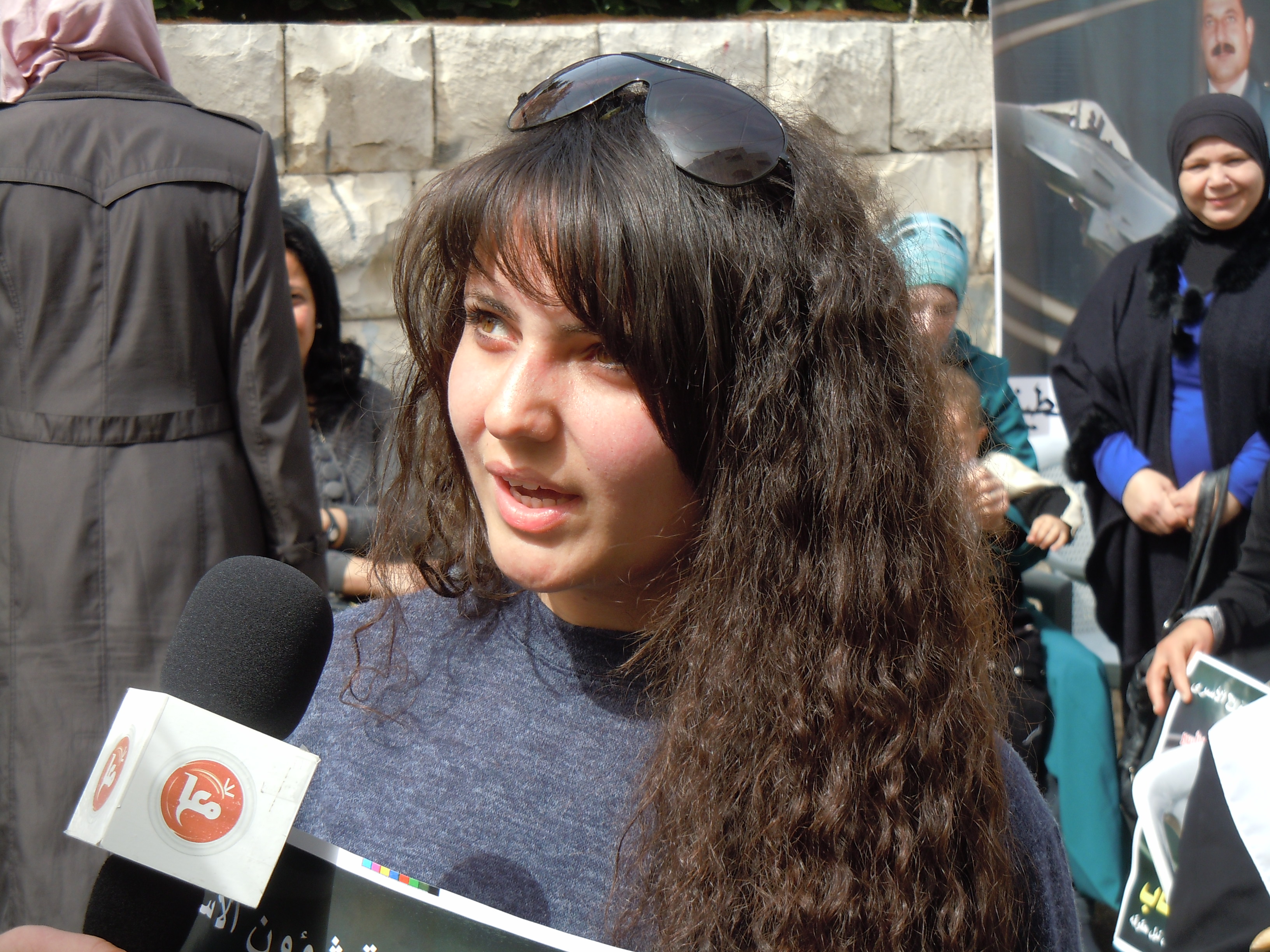
Today, for this first time since that fateful event, I felt guilty. I felt guilty because stood in front of me in the mid-day sun was Hallah Hattab. Hallah is one week into her hunger strike. She is standing in solidarity with her father, Kifah Hattab who is 3 weeks into his hunger strike in an Israeli prison. Kifah is just one of a number who have chosen to go on hunger strike in recent months in protest of Israel’s continued use of administrative detention.

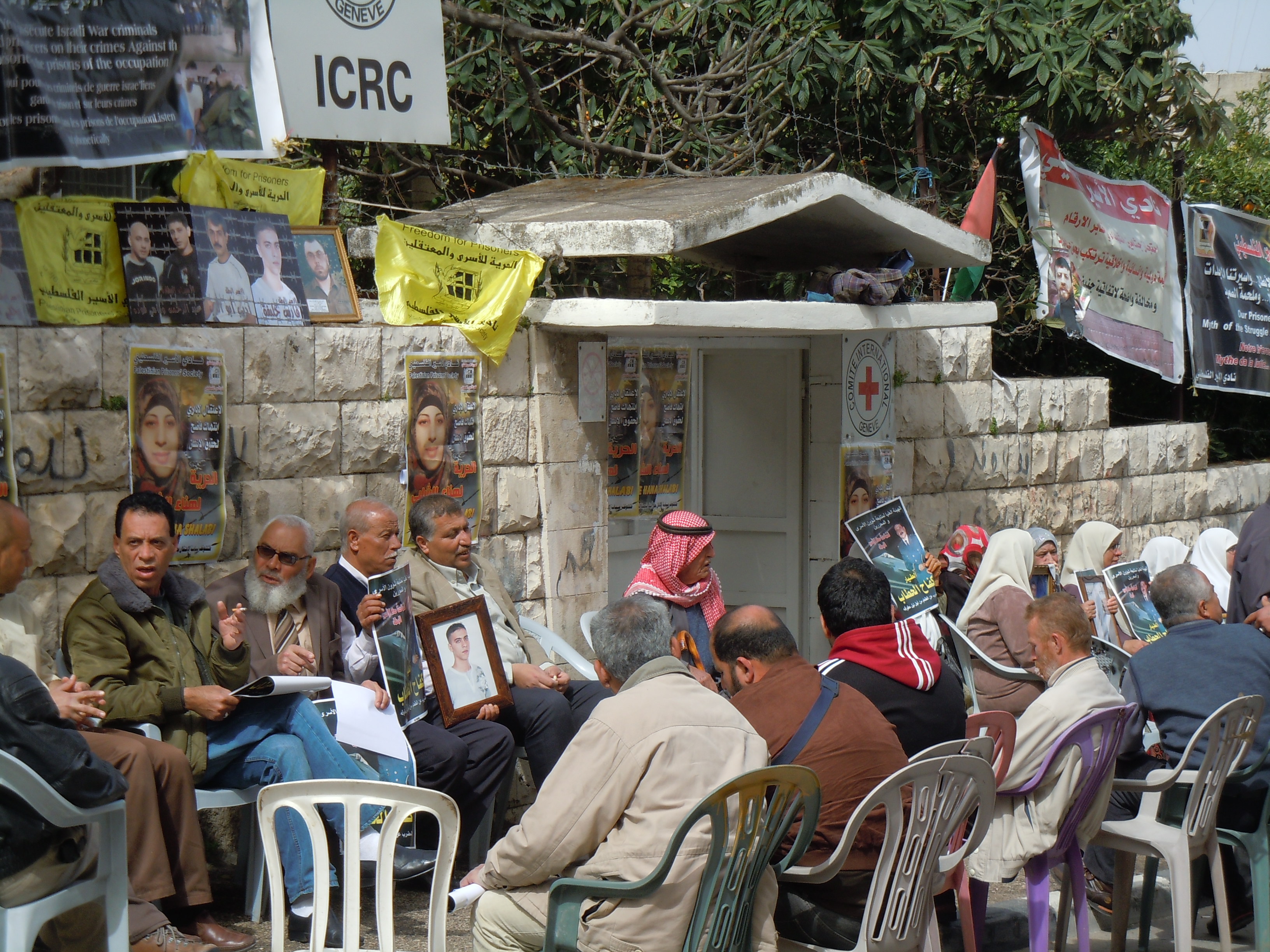
Hallah Hattab is a beautiful 20 something year old that oozes intelligence and holds herself with a confidence which conceals her age.  She has joined others today outside of the International Red Cross in Tulkarm to protest about the conditions that Palestinian prisoners are being held under. Specifically they are looking to highlight Israel’s on-going use of administrative detention. As the Israeli human rights organisation B’tselem states, “according to international law, administrative detention can be used only in the most exceptional cases, as the last means available for preventing danger that cannot be stopped by less harmful means. Israel’s use of administrative detention blatantly violates these restrictions”.

Both men and women gather on the pavement outside of the International Red Cross building sitting on plastic chairs in large circles. Each person holds a photo or a poster of a loved one who is languishing in an Israeli jail. Each of those attending the protest hold their own story of how someone close to them, a son, a brother or a father have been taken away from them. For Hallah it is her father.

I catch Hallah in between interviews with various local, national and international news agencies and ask her how she is feeling. She has the answer to this question down to a fine art, “I am trying to keep my spirits up, I know what I am feeling is nothing compared to what my father is experiencing, but it is still hard”.  Her hazelnut eyes blink at the end of her sentence and then fix themselves on me, attentive and focused on the interview at hand.

After a few seconds silence I ask Hallah how long she will be willing to carry on her hunger strike for and she responds saying that she will continue for “as long as it takes…I want to support my father”. She says these words with real determination. I wonder how far she will be pushed. Khader Adnan recently went on hunger strike for 66 days and very nearly paid the ultimate price. The undertaking that Hallah has taken on is no small one. I am eager to find out what fuels this fire inside of her but we are interrupted at this moment by someone introducing Hallah’s mother.

Her mother stands with us and insists (in perfect English) that she does not speak very good English.  I wonder whether she is just comparing herself to the English that flows from her daughter. Unlike her daughter she looks tired, both physically as well as mentally exhausted. She may not be on her hunger strike but you can see that the situation is taking its toll on her. When I ask her if she is worried about her daughter however her face lights and up she says that she feels ‘nothing but pride’. I half turn back to Hallah to ask about her studies at university and I catch her mother’s proud smile in the corner of my eye.

Frustratingly Hallah is whisked away as some other news agency is wanting to speak to her. I watch on as she gives another interview in another language. I look at her in admiration. I marvel at all she is doing with no father to support her, no food to sustain her and an unknown future to look to. I wonder if I would be able to do what she is doing and I think back to my pathetic failed attempt to fast for one school day.

On the walk back to the house where I am staying I talk to other EAs about Hallah. One colleague rationalises all that she is doing with the simple comment, “it is just her way of coping”.


1 Comment

Filed under Human rights, Middle East, Politics, War

The last 24 hours – an extract from my diary.

This is a short extract from my diary (with the naughty bits removed) covering the last 24 hours.

18:25 – I get a text message from one of our local contacts asking if I want to play football in the village with some of the other guys. It sounds like a laugh so I pull on my Arsenal shirt (staying neutral in the Barcelona/Real Madrid turf war) and head out. The two guys I meet are wearing jeans, jackets and leather shoes and I wonder whether my tracksuit trousers and football shirt looks a bit eager. This feeling is confounded when we stop and eat freshly made falafel (it’s hard to say no to Palestinian food). We arrive at the pitch (floodlights and all) and I start to get the feeling that something is not quite right.

18:45 – We spend over an hour warming up (I say we, the two guys who I arrive with are sat on the side – of course they are not playing, they’ve just eaten). This warm up is more exercise than I have done for a very long time. Apparently F.C Jayyus take their warm ups (and football in general) very seriously. I try to cover up my inherent lack of ability and my self-created lack of fitness by making jokes. The guys I came with laugh, everyone else looks on with growing concern at the amount of sweat dripping down this English boy’s face.

The coach barks instructions at players and I occasionally hear my name mentioned (that’s right, this village football team has a coach, and he barks). I try my best not to mess up but get the feeling that I am not the foreign super signing that F.C Jayyus had been looking out for.

21:00 – I survived it, just. One shoulder in the face, and only the occasional noticeable mistake and I think I survived my first (and possibly last) training session with F.C Jayyus. I walk off the pitch knowing full well that my legs will be stiff tomorrow but pretending that this sort of exercise is par for the course for me. It was great to meet some new faces in the village and to have a kick around with them – I wonder if that feeling is mutual? Either way, they are eager for me to come back to the coffee shop with them to watch Champions League football. I excuse myself, miming that I have to get up early tomorrow for checkpoint monitoring (I always thought the Jungle Book was hard but this take charades to a whole new level). I walk away from the group feeling proud that I have turned down the chance to watch football in favour of getting to bed on time – perhaps this whole experience is making me grow up.

23:30 – It’s pathetic and I know it. I have to be up in four and half hours but I could not resist watching Arsenal play (second leg trying to come back from a 4-0 first leg deficit against A.C Milan). Arsenal go 3-0 by half time and I am on cloud nine…and then…nothing. We (because when you support a club you are a part of the collective) crash out of the Champions League and any thought of silverware for the season goes out the window with it. To top it off, my home club, Cheltenham Town drop 3 crucial points in the race for League 2 promotion. I go to bed with my mind swarming with football. How can I love something that consistently causes me so much misery?

But anyway, if you’re looking to support Arsenal or Cheltenham Town I came across these useful coupons for Amazon. Take a look!

1:20 – I am awoken (2 hours after I went to sleep – not that I am bitter) with a phone call to say the IDF are in the village making an arrest (possible arrests – plural). After a quick assessment we decide it is too dangerous to be wandering the streets so we decide to monitor the situation from our rooftop staying in mobile contact with others around the village. It is an eerie feeling to see these silhouettes of men on roof tops in the early hours, all whispering reports to each other. It does however work as an informal information network.

2:30 – An hour later we receive confirmation that a local has been arrested. We can see IDF jeeps buzz around the outskirts of the village but only occasionally see them in the village. These late night visits (often not to make arrests) are happening far too often. I go back to bed, my mind now buzzing not with triviality of football, but of the guy who has just been bundled out of his house in the middle of the night – where will he end up, what will happen to him, what (if anything) will he be charged with?

4:55 – Alarms, I hate alarms. It does its job though and I am up to monitor the agricultural gate to the North of the village which open 5:30 – 6:30 every morning. I arrive and the IDF are parked with their headlights on full beam facing straight at where I monitor the gate from. I stand there, centre stage, performing the worst solo performance they are likely to ever see (essentially a tired Englishman staring blankly at them). After a while a small trickle of farmers flow past and I mutter a few good mornings. The Israelis have made a concerted effort to encourage farmers not to use this gate (as the road on the other side runs straight through a bit of land marked for settlement expansion) but still the locals use it. I wander back to the house feeling cold and tired.

08:45 – A Palestinian with an Israeli ID is coming to pick us up and to drive us to the other side of the separation barrier. We pass through the checkpoint and our bags are x-rayed and a sniffer dog sniffs every nook and cranny of the car. The young girl behind the desk has a staring competition with my passport photo (my photo wins every time) and I am asked why I visited Egypt (A: “I was on holiday”…my mind runs through potential comedy answers and I stop myself from laughing by making a sort of snorting noise). She looks at me and waves me through.

09:30 – We meet a local farmer and he walks us around his land showing the problems that they face (settlement expansion, military activity, water rationing etc). Inside a hut on his land we drink sweet tea and point at maps laid out in front of us. He shows us how the access to his land is being controlled (you need to have a permit to access your own farmland), restricted (they have built a massive separation barrier through the middle of his land – twice) and made unreliable (he had been waiting for months to get a permit). Worst of all, it can be taken away at any minute. We are shown his neighbours land which has been literally blown away – it is now a stone quarry providing material for massive ‘settler only’ road upgrading schemes. Areas all around his land have been claimed by the Israeli government as state property (using British mandate laws I should add – sigh…I love the BBC, tea and cake at 4pm and The Beatles but I sometimes struggle to find anything else to be patriotic about and being in Israel/oPT is not helping this).

We are joined during the day by a Dutch delegation who have decided to spend their free time working as unforced free labour on the land. For some this might seem an odd choice for a holiday but I think I ‘get it’. It is beautiful land they are working on and it is rewarding work. At the very least I ‘get it’ more than those fighting for sun beds in Magaluf.

17:00 – After a long day in the sun in the fields this is exactly what I don’t want. I am sat on a concrete bench in the seam zone (the area in between the separation barrier and the Green Line) waiting for a taxi driver who is over 1 hour late staring at the backend of a checkpoint I am not allowed to enter (it is for workers only). When the taxi does show up (with no explanation for the delay) I need to be driven in a huge loop around and through a car terminal. No one checks any of my nooks and crannies on the way back through.


I am currently serving as an Ecumenical Accompanier in the West Bank – follow the hyperlink for more information.

5 Comments

Filed under Human rights, Middle East, Politics, Social comment

The missing pieces of Jayyus’ jigsaw

Children are running wild around my feet, unable to decide which is more exciting, the strange foreigner holding a digital camera, or the prospect of finally seeing Ashraf Khaled.

The atmosphere almost reaches fever pitch as rumours spread like wild fire of Ashraf’s imminent return. A car alarm goes off and people break out into a short lived hysteria. The occasional firework flies into the air, the explosion resonates through the narrow village streets and leaves the children delirious with anticipation. For the last week the village of Jayyus in the West Bank has been expecting Ashraf to return. On each anticipated release day, his family would drive to Jenin only to find out at the last minute that they would have to wait for another day or two.

For many of the young boys flittering around my feet they have no memory of Ashraf – many were still in their mothers arms when he was detained eight years previous.  Perhaps this only adds to the excitement – the prospect of the unknown.

The wait is stretched out with small snippets of information being fed to the growing crowd. Someone is sure that he has left the neighbouring village, another comments that he will be here any second. I have no idea what to expect but even I am starting to feel excited.

All of a sudden the suspense spills into carnival jubilance; a procession of cars start to pour into the village. Each car has Palestinian flags and jubilant young men hanging out of the windows, sunroofs and out of places you wouldn’t believe that it was possible to hang. One man leans out of the window holding a box of fireworks firing them into the air. Soon we are encircled with loud explosions as houses all around the village let off fireworks from their flat roofs. Car horns are on permanently, men are shouting trying to be heard over the car horns and feeble stereos try their best to compete. The children, for the first time since I came out onto the street, stand still and watch the spectacle in amazement. The street fills with firework smoke, music, explosions, laughter, and giddy men embracing.

As I stand in the middle of this all, breathing the fresh evening air, I watch a community come together in a public embrace to welcome home a missing piece of their jigsaw. I have long given up asking the reason why anyone is arrested (invariably it is either for ‘security’ or ‘stone throwing’) but on this occasion I venture down this delicate line of questioning. The answer comes back with a cynical sneer. I am told that his brother was killed and he was arrested as a precautionary measure in case his brother’s death ‘radicalised’ him.

In most modern democratic countries this story would be an impossibility or at least it would be considered to be unusual. Sadly, in Israel and the occupied Palestinian territory we know that at least 308 people are currently being held in administrative detention[1]. This is a clear violation of International Human Rights standards. Article 9 of the International Covenant on Civil and Political Rights (ICCPR) clearly states that no person should be subject to , “arbitrary arrest or detention”.

Some men are arrested for genuine security concerns, some are arrested for stone throwing, many however are held without charge or trial.

As the parade of clapped out 1980 Subaru Leones file past for the third or fourth time, I start to look beyond the explosions and the loud music and catch the occasional eye wandering into the near distance. On this night one piece of this village’s jigsaw has been returned but many more remain scattered across Israel languishing in prisons. In the last few weeks at least three of the village’s young men have been detained including the Mayor’s son. Each one leaves a hole in the fabric of this close knit community.

It remains to be seen whether Ashraf will fit back into place here or whether his body and mind has been permanently bent out of shape. Tonight the community will welcome him back with a celebration that will go onto the early hours. Tomorrow the sun will rise and cast its light into the homes of all those who have relatives in one of Israel’s prisons. For as long as the occupation continues and Israel pursues its policy of arbitrary detention the jigsaw of villages like Jayyus will remain incomplete.

2 Comments

Filed under Human rights, Middle East, Politics, War

No man is an island

The English poet John Donne once wrote, “No man is an island entire of itself”. This assertion has never faced a more literal challenge however than through the story of Haney Ameer.

Mr Ameer lives on the outskirts of Mas-ha just outside of Qalqiliya in the West Bank. Back in 2003 his house was situated on the path of the proposed separation barrier, 80% of which is built on Palestinian land. When he refused to leave his house and his land the Israeli government decided to build the barrier around him. His house is now surrounded on all four sides by either walls, fences or the separation barrier. He lives in what looks like a high security prison except he now holds the keys for the one small gate that provides access to his property.

On one side of his house is the 8 meter high concrete separation barrier that scars the landscape for as far as the eye can see. All over the wall there is battle between local graffiti artists and the Israeli Defence Force’s (IDF) censoring white paint. On the other side of his house there is an illegal Israeli settlement which is cut off from him by a barbed wire fence. Flanking each end of his property are locked security gates leading to the military road that track the separation barrier. He is hemmed into his small plot of land on all sides.

On the approach to his house our driver and translator rings ahead for him to come and meet us. We pull up alongside the 8 meter high concrete slabs to walk the last few meters. Next to the barrier there is a small rusted metal door from where Mr Ameer emerges. Between 2003 and 2006 he lived in his property not owning these keys to access his own property. For three years he relied on the IDF to let him through the security gate each day to return to his own property. It was not uncommon in those days for friends to throw food parcels over the wall so he could feed his wife and children.

We sit outside his broken and bruised property in the fading evening sun. He explains he cannot fix any of the broken windows, crumbling walls or holes in the roof as he cannot get a permit off the Israelis to ‘build’ on his own land.

I ask him if he ever considered leaving. He responds with a story of isolation and incredible courage which is characterised by a lack of options. The Israelis offered him a lot of money and a chance to rebuild a bigger and better house on more land wherever he wanted in return for his land. He refused. Why he refused is a mixture of a connection to a family home that has been with him for years, and a slightly more harsh reality. The Palestinians who lived nearby warned him that if he sold up to the Israelis he would no longer be considered a ‘Palestinian’, he would be isolated. An ironic threat given his circumstances.

Regardless of his motives, Mr Ameer now finds himself in a physical limbo, not on either side of the separation barrier. He insists that if he could turn back the clock then he would do nothing differently. I ask what he hopes for the future and he bleakly responds, “nothing, I will die like this”. This response sends a shiver down my spine as I realise that this is quite possible. The occupation has come to a point where a family can be living in 60 by 40 meter virtual quarantine and the world does not bat an eyelid.

Mr Ameer has the look of a man who has told his story a million times before. He sits back in his chair as if this is a day to day occurrence for people all around the world as he recalls the details of his isolation. I wonder whether this is just his way of dealing with what is an unimaginable daily infringement on his personal liberty.

The meeting comes to a close and he walks us back to the rusted metal gate. Unlocking the padlock he looks up at the separation barrier and then at the floor. His body forgets what he is doing for a brief moment but his hands are still unlocking the door they have unlocked everyday for the last 6 years.

We leave him on the other side of the barrier. I cannot decide whether I have extreme admiration for this man, or if I just want to shake him by the scruff of the neck and tell him to move with his family to a new house. I suspect if I did the latter, he would sit me down, light a cigarette and tell me to not be so impatient. I am impatient though, I don’t want to think of this man sitting in his house, his virtual prison, until the day dies. There has to be an alternative ending to this tragic story.

The occupation restricts peoples movement, freedoms and lives on a day to day basis. Mr Ammer’s story is unique only because of his physical proximity to the separation barrier.

Haney Ameer will sleep tonight though knowing no one can tell him to leave his family house, not the IDF and certainly not a foreign human rights monitor like myself.

2 Comments

Filed under Human rights, Middle East, Politics, War

Administrative detention on the West Bank

This article was written by my colleague Bjoern Gunnar and was originally published in Norwegian and English on his blog.

By invitation from the Qalqiliya branch of Prisoners’ Club, the EAPPI team at Jayyus attended the demonstration against the administrative detention of Khader Adnan who has been detained since 18 December. Adnan is now on his 64th day of hunger strike and has lost a third of his body weight. According to Al Jazeera, the 33 year old baker was arrested in his home in the middle of the night and ‘sentenced’ to four months of administrative detention,  “World leaders have expressed growing concern over the fate of the prisoner, who is being held without charge under a procedure known as “administrative detention”. There are currently more than 300 Palestinians being held in administrative detention by Israel, without charge or trial, for renewable periods of six months, without any way of defending themselves.”

EAPPI teams do not actively participate in demonstrations, but attend to show sympathy and talk with people. Sometimes we find eloquence without the use of words.

In the small town of Qalqiliya, more than two hundred attended the demo. Not bad!
Mothers and sisters with husbands, sons and brothers in administrative detention; faces showing the destructive effects of the use of illegal imprisonment.
There is beauty to be found on the West Bank. Administrative detention is not among these. The life of Khader Adnan is on the line; a very thin line. Should he die in illegal detention, scenarios including disruptive, violent response are more than probable. Israel’s Supreme Court will hear an appeal for Khader’s release today.
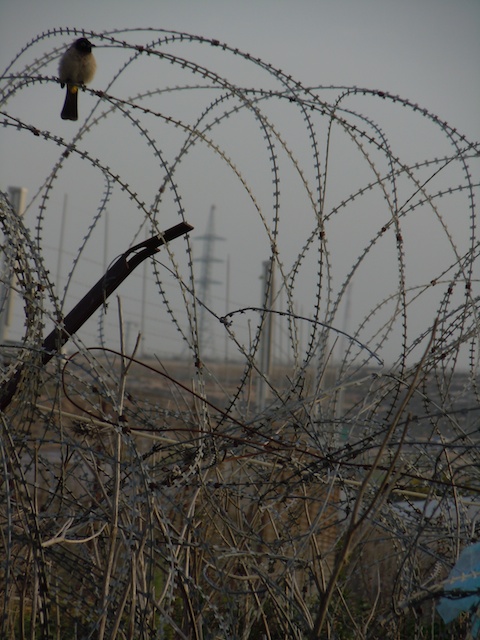
Leave a comment

Filed under Human rights, Middle East, Politics, Social comment, War

The lasting legacy of child detention in the West Bank

This article was published on WeSpeakNews – an alternative grass-roots led news service.

It is becoming a regular event but I am far from being able to normalise it. Having sound grenades go off meters from you whilst being caught in a shower of stones is not, and should not, be understood as normal. Increasingly however for the village of Jayyus it is. In the last 7 days there have been 4 Israeli Defence Force (IDF) incursions into Jayyus and its neighbouring village of Azzun.

Last night we saw three vehicles tear through the village. What follows is typical of villages across the West Bank. Children who are already on the streets start nervously at first, but soon with collective confidence, throwing stones at the IDF vehicles. We were caught out of position (between the IDF and some stone throwing kids) and so take cover in a shop. The IDF then lets off a couple of sound grenades before tearing out the village, leaving a cloud of dust behind them.

In the aftermath of this relatively small incident I talked to some of the young men on the street. One, who proudly boasts that the IDF ‘questioned him’ comments, “they asked me if I threw stones and I said no”. A stone slips out of his hand. Mostly the boys and young men are excited and exhilarated by the whole episode.

This however is in stark contrast to the Mayor of the village who I visited a few days previously. His son had been arrested during the raid on the village the night before. There is no excitement in his eyes, no exhilaration, just tired resignation. The sight of his children being taken away blindfolded and bound is all too familiar. His house had been broken into and turned upside down in search of weapons that were never found.

One ex-IDF soldier told me recently that in hundreds of house raids he conducted, he only ever found one gun. In his words, “This is about power and intimidation, not arms”.

These arrests have both immediate and long term consequences. Firstly, the children are detained, normally in the early hours, by being blindfolded and bound by armed soldiers. This is a terrifying experience by itself. The NGO Defence for Children International however describe in detail the procedure which arrested children can experience, including, no access to legal help, reports of torture and forced confessions. This treatment leaves a lasting legacy on the attitudes of these children.

The detention of minors, in this manner, clearly violates the UN Convention on the Rights of the Child (article 3) and the UN Convention against Torture. What is most concerning however, is the lack of accountability throughout this system. It is often a battle to ascertain the location of any prisoner, let alone their welfare. There are entire organisations established just to help people track the whereabouts of those detained.

Those who are left in villages like Jayyus are left to hope and pray to their God to protect the children they could not. Not knowing where their children are and when (or if) they will be released, is something no parent should have to go through. As NGOs such as Yesh Din work to protect the basic rights of these children, all that is left to do for those in the village is to start sweeping up the broken glass and to keep praying to their God.

3 Comments

Filed under Human rights, Middle East, Politics, War

A photo speaks a thousand words – Jayyus

A fellow EA monitors an agricultural gate outside of Jayyus.

Nature does not respect human divisions.

2 groups who feel connected to one piece of land.

Leave a comment

Filed under Human rights, Middle East, Politics, Religion, Social comment, War

Why the left needs to keep the faith

An edited version of this blog was first published on Liberal Conspiracy blog.

‘Politics and religion should not mix’. This is the mantra that is lazily wheeled out by self congratulating lefties as they marvel in their own enlightened wisdom. I come across well meaning social progressives who openly shun the role of faith based organisations as either an evangelical force that should be scorned, or, at best, a tool by which individuals can act out their selfish desire to please the big man upstairs. This lingering stereotype of faith based organisations not only alienates billions around the world who see their faith as their primary moral compass but also pragmatically restricts social movement’s ability to bring about the change they are so desperate to see.

Many, at this stage might assume that I am one of those rather smug Christian types who go around asking people to accept Jesus’ warm love into their hearts – I am not. I am, like many in 21st Century Britain, painfully middle class and going through and an existential crisis as I try to work out ‘what it all means’. I am as unsure about the existence of any deity as you can possibly be. So don’t worry, I am not trying to convert you, and neither do I see this article as my one way ticket to heaven. I am fairly sure that God doesn’t read blogs anyway.

I am however, excited about the truly radical potential of Christianity to bring about social change. All around the world, we can see different denominations working progressively on a range of issues. This could be The Salvation Army offering support to the homeless, The Quakers campaigning for peace or the Catholic Church fighting global poverty.

At this point, the sceptics out there will point to Christianity being used to discriminate against entire communities (LGBT for example) or the Catholic Church and their opposition to contraception. If you, dear reader, were felling particularly pernickety, you might start pointing to George Bush claiming that God told him to invade Afghanistan or wars that have been fought in the name of God. Religion, in many peoples mind is a bringer of war, the perpetrator of hatred and an opium for the ill informed masses.

My response would be to point to the fallibility of all human organisations, including organized religion.  There is nothing inherent within any faith to suggest that it will always work for a positive social agenda, neither is there to suggest it will always cause harm. If we on the left are too smug to engage, we will leave ‘doing God’ to those who want to justify oil wars, invasions or subordinating an entire gender. It is time for us then to throw off the shackles of conformity and acknowledge a very simple truth – Christianity can be really radical!

It has taken me a while to get to a position in my life where I can work comfortably and confidently with people of faith knowing full well that they believe in something that I don’t. When working for Amnesty International, I started to spot the myriad of backgrounds and experiences that had drawn people to become human rights activists. It is clear to me now that somebody’s faith is just one of those reasons. Why are many on the left happy to work with those of faith but not faith based organisations? In the past I have had a pleasure of working for The Quakers, who are just one example of a faith based organisation who are putting their faith into practice to work towards social causes.

I am excited to be (once again) putting this theory into practice. In February I will be heading out to Israel and the Occupied Palestinian Territories with the Ecumenical Accompaniment Programme in Palestine and Israel which is coordinated through the World Council of Churches. This is an organisation bringing different denominations, faiths and backgrounds together to work progressively for a non-violent solution to the conflict. It is an exciting example of a faith based organisation working inclusively with Israelis, Palestinians and the International Community to work towards the end of the occupation and for all in the region to enjoy basic human rights standards.

We on the left need to incorporate faith based groups into all of our work. They unlock the door to millions in the UK and billions around the world. We need to show we are truly inclusive by illustrating that faith can be used positively. If we fail to do this, we run the risk of George Bush and the like becoming the public face of Christianity. There are inspiring people out there from Archbishop Desmond Tutu through to the Archbishop Dr John Sentamu who are working on causes I would be proud to support. All we on the secular left need to do, is show that we can get over these outdated stereotypes of faith based organisations and embrace their progressive potential.

5 Comments

Filed under Human rights, Middle East, Politics, Religion, Social comment

The day I was ashamed to be a Cheltenham Town fan

This article was published on the Tattooed Football blog.

We were 2-0 down. The collective voice had slipped out of our supporters. We were silent. Spurs fans responded in the only way they knew, to start mocking our silence. They finished with a collective ‘shhhhhhh’ to illustrate the resonating silence coming from us. What happened next shocked me. It shouldn’t have done, but it did. Someone behind me shouted in a thick West Country accent, ‘you’re not in gas chambers now!’

Read the full article here

2 Comments

Filed under Far-right politics, Football, Gloucestershire, Politics, Social comment, Sport