Category Archives: War

The tale of an Israeli smile

“Do you know what the best thing about tonight is?”. I answered honestly, “No”. The soldier pushes his helmet back up his forehead with the butt his gun and says, “I get to drive these British Land Rovers”. I am not sure how to respond to this and so I sheepishly smile back. My coy response does not deters the soldier, who I later find out is called John, from continuing. “The Palestinians are really suffering you know”. I sensed an old IDF trick coming on, luring lefty NGO types into a false sense of security so I volunteered, “so are the Israelis”. John’s response was telling, “Are you crazy man? You really think the Israelis are suffering in comparison to the Palestinians?”

By this point I will admit that a certain degree of surrealism had been entrenched into the proceedings. I had been called by a local Palestinian at around 1:00 in the morning. He said that the IDF were in his house and they going to arrest his brothers and I should come quickly. As I turned the corner to his house I was met by at least 3 jeeps and an unknown number of soldiers. At first I negotiated a compromise about where my colleague and I could stand to monitor the proceedings. A few minutes later though one of the soldiers beckoned me over and at first started to interrogate me before letting himself slip into casual conversation.

Ignoring the growing sense of irony I pushed on with John, “A lot of Israelis are living in fear, they feel scared all the time, it is not good to live your life in fear”. The IDF soldier, now the voice of rationality in this increasingly bizarre conversation chirped back, “I know that but this fear cannot justify what we are doing here in the West Bank”. I trailed off, “No…of course not”. John was either a master at using reverse psychology or he was an Israeli soldier who was genuinely concerned about the Palestinians.

In the following 5 minutes we talked about the London bombings and how this had fuelled a growing suspicion of Muslim communities in London and what steps could be taken to breakdown this divide. I talked about multi faith projects I have been involved in and he listened with genuine interest. Our conversation meandered easily through politics and religion. After a while I tried to steer the conversation back to the reality in which we found ourselves.

As casually as one can ask an occupying soldier I said, “so, what are you guys up to this evening?”. I was meant to be getting answers to why they were terrorising a community in the middle of night for no apparent reason. Instead I sounded like I was flirting. I clarified, “what are you’re…ummm…objectives?”. The soldier laughed, smiled and said, “We are here for security, I think you know what that means”. I smiled and nodded as if this sort of response comes up all the time and I knew exactly what he meant. Of course I didn’t really know but I guessed this either meant they were there for no reason at all, or there was some super secret army reason for them being there that he couldn’t let on about. I suspected the former.

I glanced around and watched a collection of silhouettes on the roof tops. Men looking on to try and see what the IDF were doing. John caught my glances and reassured me, “they are just curious, there is nothing to be afraid of”. My colleague was stood 20 yards back nervously trying to work out what on earth I could be still talking about after 10 minutes or so of conversation. I knew it was time to draw this surreal conversation to a close. To do this, you would ordinarily ask a closed question like, “Is there anything else?” (a standard way to close what was meant to be an interrogation). On this night though I pushed my thumb into the palm of my hand and said, “I am really sorry, I don’t want to appear to be rude or anything, but if I stay and chat to you here for too long everyone will want to know what I was talking to the soldier about. It might cause some problems tomorrow. I hope you understand”. I was apologising to an occupying soldier for having to break off our nice little midnight chat. Once again, a big smile spreads across John’s face and he beams, “of course, I hear the Israelis have got a bit of bad reputation around these parts”.

As I walked back to my colleague, I felt two completely contradictory emotions. I could feel the cold metal being aimed at my back as I walked away, soldiers poised with suspicion ready to strike at any moment. The cold harsh reality of occupation – soldiers storming houses in the middle of night, interrogating, harassing and intimidating. Then, in complete contrast to this I felt John’s warmth. In my mind’s eye I saw his smile and could hear his soft laughter. Within a few minutes John had shown me a sign a hope and optimism that I know will stay with for days to come.

What will stay with the villagers however is another night time incursion, another family traumatised by interrogation. Mothers and fathers terrified at the prospect of their sons being arrested. Young men having another sleepless night living under the constant threat of arrest. They know too well that being a young male is enough to have you dragged from your house in the middle of the night with no explanation. This will stay with them for longer than just a few days, this will be with the for the rest of their lives.

7 Comments

Filed under Human rights, Middle East, War

The missing pieces of Jayyus’ jigsaw

Children are running wild around my feet, unable to decide which is more exciting, the strange foreigner holding a digital camera, or the prospect of finally seeing Ashraf Khaled.

The atmosphere almost reaches fever pitch as rumours spread like wild fire of Ashraf’s imminent return. A car alarm goes off and people break out into a short lived hysteria. The occasional firework flies into the air, the explosion resonates through the narrow village streets and leaves the children delirious with anticipation. For the last week the village of Jayyus in the West Bank has been expecting Ashraf to return. On each anticipated release day, his family would drive to Jenin only to find out at the last minute that they would have to wait for another day or two.

For many of the young boys flittering around my feet they have no memory of Ashraf – many were still in their mothers arms when he was detained eight years previous.  Perhaps this only adds to the excitement – the prospect of the unknown.

The wait is stretched out with small snippets of information being fed to the growing crowd. Someone is sure that he has left the neighbouring village, another comments that he will be here any second. I have no idea what to expect but even I am starting to feel excited.

All of a sudden the suspense spills into carnival jubilance; a procession of cars start to pour into the village. Each car has Palestinian flags and jubilant young men hanging out of the windows, sunroofs and out of places you wouldn’t believe that it was possible to hang. One man leans out of the window holding a box of fireworks firing them into the air. Soon we are encircled with loud explosions as houses all around the village let off fireworks from their flat roofs. Car horns are on permanently, men are shouting trying to be heard over the car horns and feeble stereos try their best to compete. The children, for the first time since I came out onto the street, stand still and watch the spectacle in amazement. The street fills with firework smoke, music, explosions, laughter, and giddy men embracing.

As I stand in the middle of this all, breathing the fresh evening air, I watch a community come together in a public embrace to welcome home a missing piece of their jigsaw. I have long given up asking the reason why anyone is arrested (invariably it is either for ‘security’ or ‘stone throwing’) but on this occasion I venture down this delicate line of questioning. The answer comes back with a cynical sneer. I am told that his brother was killed and he was arrested as a precautionary measure in case his brother’s death ‘radicalised’ him.

In most modern democratic countries this story would be an impossibility or at least it would be considered to be unusual. Sadly, in Israel and the occupied Palestinian territory we know that at least 308 people are currently being held in administrative detention[1]. This is a clear violation of International Human Rights standards. Article 9 of the International Covenant on Civil and Political Rights (ICCPR) clearly states that no person should be subject to , “arbitrary arrest or detention”.

Some men are arrested for genuine security concerns, some are arrested for stone throwing, many however are held without charge or trial.

As the parade of clapped out 1980 Subaru Leones file past for the third or fourth time, I start to look beyond the explosions and the loud music and catch the occasional eye wandering into the near distance. On this night one piece of this village’s jigsaw has been returned but many more remain scattered across Israel languishing in prisons. In the last few weeks at least three of the village’s young men have been detained including the Mayor’s son. Each one leaves a hole in the fabric of this close knit community.

It remains to be seen whether Ashraf will fit back into place here or whether his body and mind has been permanently bent out of shape. Tonight the community will welcome him back with a celebration that will go onto the early hours. Tomorrow the sun will rise and cast its light into the homes of all those who have relatives in one of Israel’s prisons. For as long as the occupation continues and Israel pursues its policy of arbitrary detention the jigsaw of villages like Jayyus will remain incomplete.

2 Comments

Filed under Human rights, Middle East, Politics, War

No man is an island

The English poet John Donne once wrote, “No man is an island entire of itself”. This assertion has never faced a more literal challenge however than through the story of Haney Ameer.

Mr Ameer lives on the outskirts of Mas-ha just outside of Qalqiliya in the West Bank. Back in 2003 his house was situated on the path of the proposed separation barrier, 80% of which is built on Palestinian land. When he refused to leave his house and his land the Israeli government decided to build the barrier around him. His house is now surrounded on all four sides by either walls, fences or the separation barrier. He lives in what looks like a high security prison except he now holds the keys for the one small gate that provides access to his property.

On one side of his house is the 8 meter high concrete separation barrier that scars the landscape for as far as the eye can see. All over the wall there is battle between local graffiti artists and the Israeli Defence Force’s (IDF) censoring white paint. On the other side of his house there is an illegal Israeli settlement which is cut off from him by a barbed wire fence. Flanking each end of his property are locked security gates leading to the military road that track the separation barrier. He is hemmed into his small plot of land on all sides.

On the approach to his house our driver and translator rings ahead for him to come and meet us. We pull up alongside the 8 meter high concrete slabs to walk the last few meters. Next to the barrier there is a small rusted metal door from where Mr Ameer emerges. Between 2003 and 2006 he lived in his property not owning these keys to access his own property. For three years he relied on the IDF to let him through the security gate each day to return to his own property. It was not uncommon in those days for friends to throw food parcels over the wall so he could feed his wife and children.

We sit outside his broken and bruised property in the fading evening sun. He explains he cannot fix any of the broken windows, crumbling walls or holes in the roof as he cannot get a permit off the Israelis to ‘build’ on his own land.

I ask him if he ever considered leaving. He responds with a story of isolation and incredible courage which is characterised by a lack of options. The Israelis offered him a lot of money and a chance to rebuild a bigger and better house on more land wherever he wanted in return for his land. He refused. Why he refused is a mixture of a connection to a family home that has been with him for years, and a slightly more harsh reality. The Palestinians who lived nearby warned him that if he sold up to the Israelis he would no longer be considered a ‘Palestinian’, he would be isolated. An ironic threat given his circumstances.

Regardless of his motives, Mr Ameer now finds himself in a physical limbo, not on either side of the separation barrier. He insists that if he could turn back the clock then he would do nothing differently. I ask what he hopes for the future and he bleakly responds, “nothing, I will die like this”. This response sends a shiver down my spine as I realise that this is quite possible. The occupation has come to a point where a family can be living in 60 by 40 meter virtual quarantine and the world does not bat an eyelid.

Mr Ameer has the look of a man who has told his story a million times before. He sits back in his chair as if this is a day to day occurrence for people all around the world as he recalls the details of his isolation. I wonder whether this is just his way of dealing with what is an unimaginable daily infringement on his personal liberty.

The meeting comes to a close and he walks us back to the rusted metal gate. Unlocking the padlock he looks up at the separation barrier and then at the floor. His body forgets what he is doing for a brief moment but his hands are still unlocking the door they have unlocked everyday for the last 6 years.

We leave him on the other side of the barrier. I cannot decide whether I have extreme admiration for this man, or if I just want to shake him by the scruff of the neck and tell him to move with his family to a new house. I suspect if I did the latter, he would sit me down, light a cigarette and tell me to not be so impatient. I am impatient though, I don’t want to think of this man sitting in his house, his virtual prison, until the day dies. There has to be an alternative ending to this tragic story.

The occupation restricts peoples movement, freedoms and lives on a day to day basis. Mr Ammer’s story is unique only because of his physical proximity to the separation barrier.

Haney Ameer will sleep tonight though knowing no one can tell him to leave his family house, not the IDF and certainly not a foreign human rights monitor like myself.

2 Comments

Filed under Human rights, Middle East, Politics, War

The good news story of Aref Sameer Chbieteh

At 25 years of age, he has spent nearly a quarter of his life in prison. Despite his tender age, he has the look of a man who has already seen too much. Sat in a plastic garden chair Aref looks into the near distance as he answers our questions. Surrounding him are his friends and family who have not seen him since his arrest 6 years previous. The room holds a feeling of collective cohesion, together they are strong, but alone I suspect anyone of them could fall apart. Six years ago, the Israeli Defence Force (IDF) took him from his house in the middle of the night and he was charged him with possession of a weapon – a charge that he denies but for which he was found guilty.

I ask Aref about his experiences inside the four different Israeli prisons where he was kept. What he does not say tells a story in itself. His gaunt and clearly underfed body sits slumped in his chair as he struggles through his mind for details that he is not comfortable recalling. He was moved between different prisions after making formal complaints about the conditions in which he was kept. When I tentatively ask him to expand, he simply replies, “they were bad”.

Aref has been a free man for only a few hours when we are ushered to his house. They wanted us to see a ‘good news’ story – a young man returned to his mother. What I heard and saw however was that of a life reduced to distant stares and painful memories.

Aref was detained inside of Israel despite living in the occupied Palestinian territory (oPt), this meant that he was cut off from his family. This is a clear violation of international law.  As Malcolm Smart of Amnesty International said, “International human rights standards and international humanitarian law guarantee every person deprived of liberty the right to humane and dignified conditions of detention…and regular family visits”.  What Aref described to me was a breach of these rights.

His case however is not unique. 6 years is a standard punishment for being caught in possession of a weapon. Equally, Aref was just one of the 5,200 Palestinians from the West Bank – including East Jerusalem – and the  Gaza Strip,  who are currently detained in facilities run by the Israel Prison Service. The vast majority are detained inside Israel. For Aref, years went past where he was not allowed to receive any visitors at all.

I ask him, perhaps through naivety, if he suffered any physical punishment inside prison and for the first time in the meeting a flicker of life passes through his eyes as he snorts before muttering, “of course”.  There is an awkward silence as all we all stare at the floor – I feel embarrassed for asking such a crass question. Aref breaks the silence by explaining that he will never forget what happened to him inside prison. I do not have the nerve or inclination to ask him to expand.

His family around him are buzzing with excitement to see him again after all these years. Before I go, I turn to his mother and ask a question which I hoped would encompass the ‘good news story’ that we had come to see. I ask her what it feels like to have her son back. She looks at me and smiles as a tear forms in the corner of her eye and she says in clear English, “very happy”. My professionalism drops and I meet her smile.

On the way out, Hassan who had arranged the meeting for us moves the conversation onto the 7 other young men who were arrested last night. My heart sinks as I imagine each of their mothers sitting out the years waiting for their sons to be returned. Tomorrow we will try to meet with some of the families of those newly arrested.

3 Comments

Filed under Health, Human rights, Middle East, War

Administrative detention on the West Bank

This article was written by my colleague Bjoern Gunnar and was originally published in Norwegian and English on his blog.

By invitation from the Qalqiliya branch of Prisoners’ Club, the EAPPI team at Jayyus attended the demonstration against the administrative detention of Khader Adnan who has been detained since 18 December. Adnan is now on his 64th day of hunger strike and has lost a third of his body weight. According to Al Jazeera, the 33 year old baker was arrested in his home in the middle of the night and ‘sentenced’ to four months of administrative detention,  “World leaders have expressed growing concern over the fate of the prisoner, who is being held without charge under a procedure known as “administrative detention”. There are currently more than 300 Palestinians being held in administrative detention by Israel, without charge or trial, for renewable periods of six months, without any way of defending themselves.”

EAPPI teams do not actively participate in demonstrations, but attend to show sympathy and talk with people. Sometimes we find eloquence without the use of words.

In the small town of Qalqiliya, more than two hundred attended the demo. Not bad!
Mothers and sisters with husbands, sons and brothers in administrative detention; faces showing the destructive effects of the use of illegal imprisonment.
There is beauty to be found on the West Bank. Administrative detention is not among these. The life of Khader Adnan is on the line; a very thin line. Should he die in illegal detention, scenarios including disruptive, violent response are more than probable. Israel’s Supreme Court will hear an appeal for Khader’s release today.

Leave a comment

Filed under Human rights, Middle East, Politics, Social comment, War

The universal language of Messi

This article was originally published on Tattooed Football.

In the dusty streets of Jayyus in the West Bank, the language that children use cuts through adult constructed divisions. The names of Abbas or Netanyahu are alien. What rolls off the lips of the children here are the names of Messi, Fabregas and Puyol.

Jayyus is a small farming community situated near the town of Qalqiliya in the West Bank. It has been devastated by the construction of the separation barrier (which is universally acknowledged to be illegal under international law). 75% of the village’s farmland is now on the wrong side of the barrier. Recently, the village has seen a number of Israeli Defence Force incursions that have resulted in a number of local boys arrested.

These events however are just distractions for the children from the more serious business of street football. The challenge is simple – who can get as close to mastering Messi’s majesty as possible. To this goal, the children spend hours trying to match his touch, skill and athleticism. There is one coffee shop in the village where every Barcelona game is watched religiously and you can see every detail being gulped down with enthusiasm. The attendance, dedication and passion given to this cause is unwavering.

In a situation so bleak, it is heartening to see children throw their enthusiasm into football. I am sure it is a more productive use of time than throwing stones at the IDF. Equally, in a time when football seems so personified by casual racists, materialists and playboys, I find it heartening to see Messi being held up as a role model.

Messi manages, both on and off the pitch to balance his enthusiasm with a calm composure.  Messi also represents the dream that every child holds onto. He was taken from his home in Argentina at the age of 13. It is said he was only 4 foot 7 inches when he signed for Barcelona. From this he has developed into undoubtedly the greatest footballer of a generation. Messi has gone from being a small shy boy playing street football to be earning and inspiring millions.

It is this romance that drives children all over the world. Messi provides each child with a chance to dream. Cut off from life chances, it is this hope that keeps children going. This hope is communicated through the language of Barcelona. Football connects the children on the streets of Jayyus to billions around the world. Whatever the language their government or the occupying government speaks – these children will always be fluent in the language of football. No one can take that away from them.

Steve Hynd is currently an EA with EAPPI and is living in Jayyus, West Bank.

1 Comment

Filed under Football, Human rights, Middle East, Sport, War

The lasting legacy of child detention in the West Bank

This article was published on WeSpeakNews – an alternative grass-roots led news service.

It is becoming a regular event but I am far from being able to normalise it. Having sound grenades go off meters from you whilst being caught in a shower of stones is not, and should not, be understood as normal. Increasingly however for the village of Jayyus it is. In the last 7 days there have been 4 Israeli Defence Force (IDF) incursions into Jayyus and its neighbouring village of Azzun.

Last night we saw three vehicles tear through the village. What follows is typical of villages across the West Bank. Children who are already on the streets start nervously at first, but soon with collective confidence, throwing stones at the IDF vehicles. We were caught out of position (between the IDF and some stone throwing kids) and so take cover in a shop. The IDF then lets off a couple of sound grenades before tearing out the village, leaving a cloud of dust behind them.

In the aftermath of this relatively small incident I talked to some of the young men on the street. One, who proudly boasts that the IDF ‘questioned him’ comments, “they asked me if I threw stones and I said no”. A stone slips out of his hand. Mostly the boys and young men are excited and exhilarated by the whole episode.

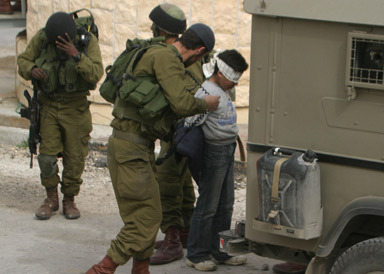
This however is in stark contrast to the Mayor of the village who I visited a few days previously. His son had been arrested during the raid on the village the night before. There is no excitement in his eyes, no exhilaration, just tired resignation. The sight of his children being taken away blindfolded and bound is all too familiar. His house had been broken into and turned upside down in search of weapons that were never found.

One ex-IDF soldier told me recently that in hundreds of house raids he conducted, he only ever found one gun. In his words, “This is about power and intimidation, not arms”.

These arrests have both immediate and long term consequences. Firstly, the children are detained, normally in the early hours, by being blindfolded and bound by armed soldiers. This is a terrifying experience by itself. The NGO Defence for Children International however describe in detail the procedure which arrested children can experience, including, no access to legal help, reports of torture and forced confessions. This treatment leaves a lasting legacy on the attitudes of these children.

The detention of minors, in this manner, clearly violates the UN Convention on the Rights of the Child (article 3) and the UN Convention against Torture. What is most concerning however, is the lack of accountability throughout this system. It is often a battle to ascertain the location of any prisoner, let alone their welfare. There are entire organisations established just to help people track the whereabouts of those detained.

Those who are left in villages like Jayyus are left to hope and pray to their God to protect the children they could not. Not knowing where their children are and when (or if) they will be released, is something no parent should have to go through. As NGOs such as Yesh Din work to protect the basic rights of these children, all that is left to do for those in the village is to start sweeping up the broken glass and to keep praying to their God.

3 Comments

Filed under Human rights, Middle East, Politics, War

A photo speaks a thousand words – Jayyus

A fellow EA monitors an agricultural gate outside of Jayyus.

Nature does not respect human divisions.

2 groups who feel connected to one piece of land.

Leave a comment

Filed under Human rights, Middle East, Politics, Religion, Social comment, War

Qalqiliya checkpoint and the impossible question – why?

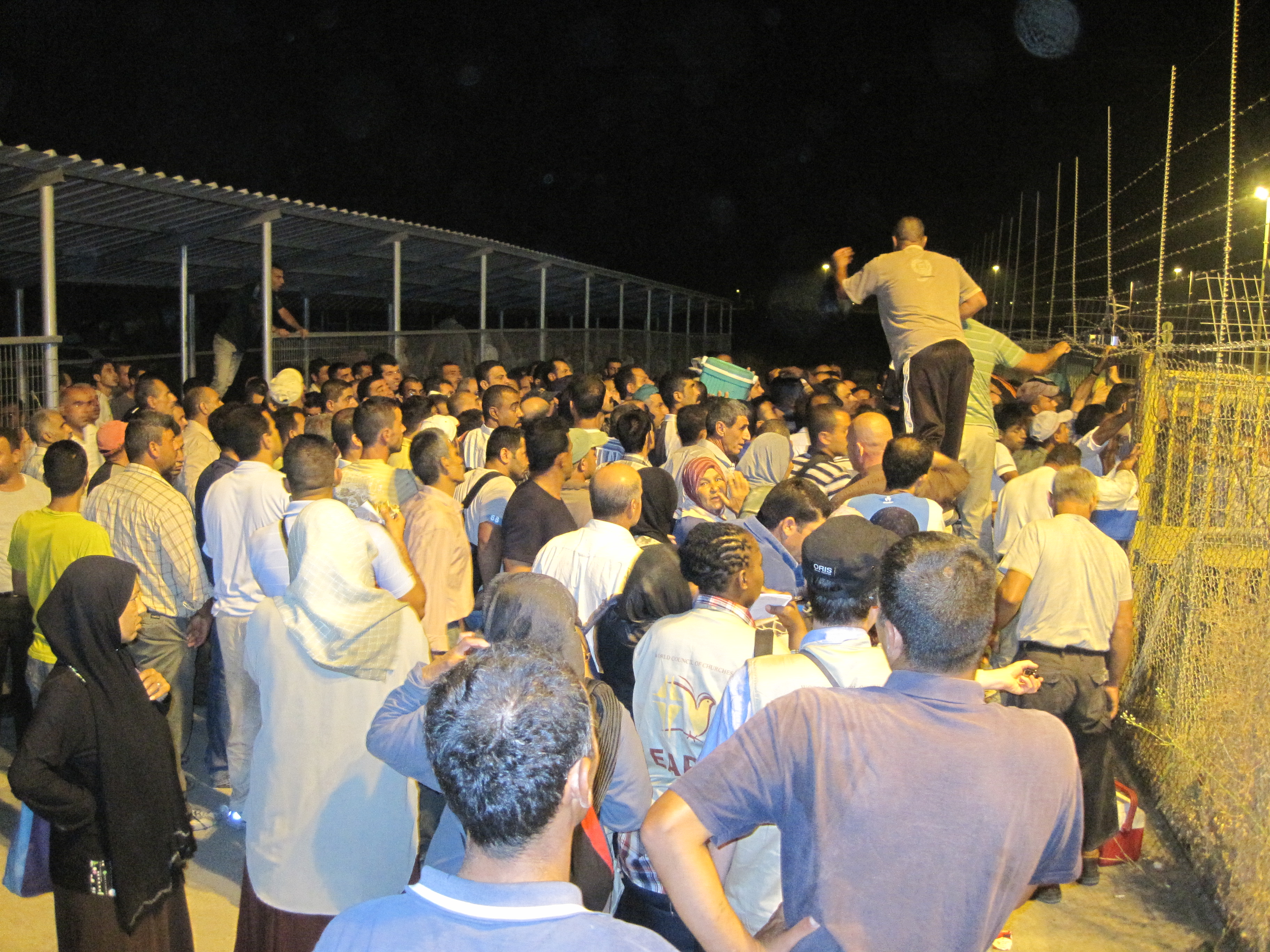
When you awake at 3:00am everything is a blur. The edges of your vision slip away to nothingness, your eyelids drop with every slip of the mind and your senses are numbed. Unless that is, you are stood at Qalqiliya checkpoint in the West Bank. Here your senses are heightened from the cooking meat, the brewing coffee and the mass of humanity. The harsh strip lighting rips through any thought of sleep and ensures you stay with the present, however much you and all around you wish to escape it. What cannot be so easily explained however are the emotions that sit so heavily on the pit of your stomach as you stand in the early hours counting people through the entrance of the checkpoint.

Qalqiliya checkpoint is situated to the north of the city and in the first few hours of opening it will see thousands pass through its gates. On this particular morning I watch 3,000 bodies slip past me, all on their way to try and make a day’s living on the other side of the barrier. Mostly the faces of these men look to me with a registering smile but little else. I am not sure what I expect from my endless cheery “good mornings” but I certainly do not get it. On occasions I get nods, mutters and silent acknowledgments.

I cannot, and do not blame them for this response. For them, it is another freezing morning where they have had to awake well before 3:00am to queue to get past a barrier that an occupying power has built across their land. For them, they have seen little improvements in condition or speed of transit since the international community started monitoring the checkpoint. My EAPPI colleagues and I provide invaluable data to the UN, but for them we are now part of the whole degrading process. I am shocked by the lack of humanity, but they are the victims of it. I am appalled by the humiliation of passing through the checkpoint but they have to endure it. I am saddened to the point of tears building behind my eyes by every one of them not being able to lift their gaze from the floor but it is their reality, not mine.

Cutting into this reality is the continuous voice that is devoid of any sense of irony when it keeps demanding “Yallah yallah” move move. A never ending list of impossible demands reverberates from the PA system above our heads. They keep reminding anyone who is listening that they must move faster. How they expect people to do this is never elaborated upon. A faceless voice demanding the impossible.

This is the reality of my first session monitoring Qalqiliya checkpoint. When you report on human rights violations and how International Humanitarian Law is being violated, the first rule is to show the victim with agency – the ability to influence and change the situation they find themselves in. Here, every aspect of life is controlled. Whether we are talking about access to land, water or food, or the ability to build, work, learn or get medical treatment. Everything is controlled, restricted and made unreliable. In light of this, all I can offer now are the harsh realities of passing through Qalqiliya checkpoint the best as I can recall them.

As I stamp my feet in the bitter cold I try one last “Good Morning” to another body slipping past me. This time though he stops, looks at me, raises a wry smile, and responds “leish?”…. why? Why is it a good morning? For this I have no answer.

Tomorrow I am getting up a few hours later to monitor an agricultural gate that opens before sunrise. At the same time, many of the same men will be starting the same humiliating regime all over again.

8 Comments

Filed under Human rights, Middle East, War