Tag Archives: Human rights

Jayyous – one year on

Kate Cargin, who served as a human rights monitor with EAPPI just after me, writes about going back to Jayyous a year after we served there. 

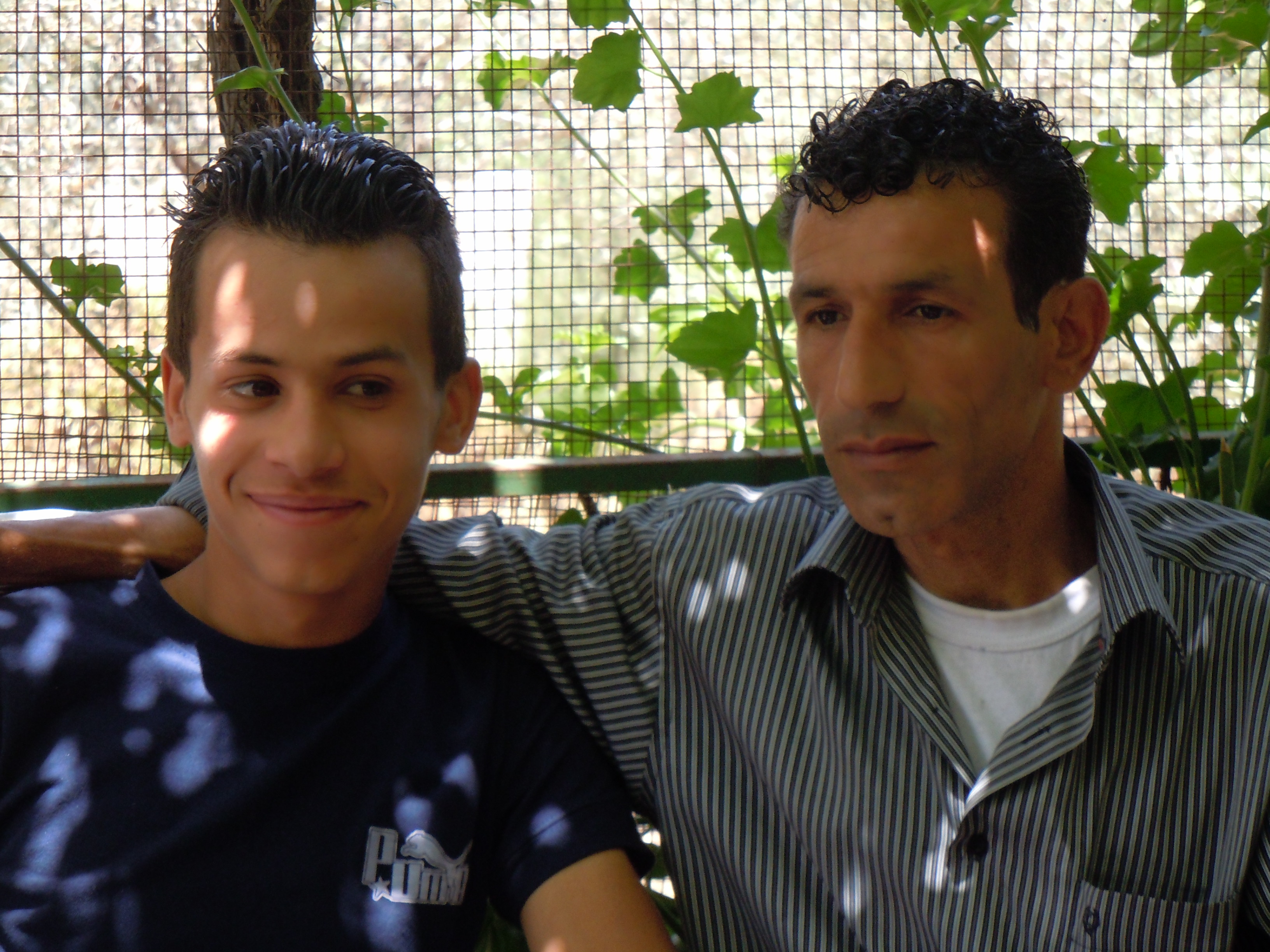
Abu Azzam, welcomed us back to Jayyous like members of his own family and his wife Sehan laid on a lavish meal. I had met Juliane, my team-mate from EAPPI last year, in Jerusalem and the two of us were invited by the current team to stay in our old placement house.

Supper with Abu Azzam. Photo: Per-Ake Skagersten

Photo: Per-Ake Skagersten

Now, as then, the most serious problem for people living in Jayyous is the ‘separation barrier’ or ‘separation fence’, which divides the village from 75% of its agricultural land. All other problems stem from that: increasing poverty, emigration, demonstrations and arrests.

The impact of the fence and accompanying restrictions on the village is profound and life-changing. Farmers have to pass through ‘agricultural gates’ to access their land and permits to do so are often not forthcoming. It is a precarious way to live. Not only are people cut off from their farming income, but because of demonstrations against building the fence many have also been denied permits to work in Israel. Breadwinners and young people emigrate; students are pulled out of university. Regular army incursions with exchanges of stone-throwing and tear gas result in arrests, many of them of children. The prevailing emotion is loss and grief. Jayyous used to be a prosperous place to live. Now it is estimated that up to half its inhabitants receive food aid.

When the fence in this area was completed in 2003, the case for Jayyous was taken to the Israeli high court to contest its route. In September 2009, the Israeli High Court handed down a judgement to reroute the barrier to return some land to the village. Yet the farmers were not represented subsequently when the new route was determined which would return only a third of the farmland to the village. The villagers did not accept this, pointing out that all of the land belonged to them. They organised demonstrations which resulted in many arrests and increased army presence in the village. As Abu Azzam put it ‘We are expected to welcome the return of 2,488 dunums (1 dunum = 1,000 m2) and one underground well to the village. However, more than 5,000 dunums and four underground wells remain behind the fence.’ When the new fence is complete, most of the farmers will still have to pass through agricultural gates and some will even have to take a longer route.

Fence showing re-routing in progress

Photo: Fence showing re-routing in progress

Water is a huge issue in Palestine. While I was in Jayyous, villagers were suffering from a chronic lack of water because the fence cut them off from their main water supply. We had a very small well in our garden with a back-up supply from the next door village of Azzun and were warned not to drink it. There had been an agreement to pipe water from some of Jayyous’s own wells back through the fence. This was to be implemented and financed by the International Red Cross. Like many agreements it was taking its time and nothing happened during our time there. After a shaky start when the settlers destroyed the initial pipes, a pipeline is now established from three wells behind the fence to the Jayyous reservoir. However, the villagers have not been given planning permission to lay electricity cables to run the pump. They have been told to use diesel which would increase the cost eightfold. Currently there is a stalemate.

Israel says that the separation barrier is necessary for security. They claim that it has prevented suicide bombings in Israel (the last suicide bomb in Israel was in 2006). However, we remained sceptical. We were told last year ‘everyone knows where the holes are’. All of our team had seen people going through a hole in the fence near one of the checkpoints. Sometimes soldiers went down to guard the hole and sometimes they did nothing. We were very surprised, returning a year later, to see that the same hole was still in operation and had not been blocked. We were even more surprised to be told by a local man that there are eight holes in this section of the fence.

men detained at checkpoint for attempting to go through a hole in the fence

Photo: Men detained at a checkpoint for attempting to go through a hole in the fence

Nevertheless Jewish Israelis are clearly afraid of their Palestinian neighbours and believe that the fence makes them safer. I saw several manifestations of this fear. Last year, when my daughter came to visit me, the border guards tried to stop her entering the West Bank for her own safety. ‘You will be kidnapped and robbed’ they said. On another occasion, an Israeli woman warned me against getting on an ‘Arab’ bus in Jerusalem. ‘Aren’t you afraid?’ she exclaimed in surprise when I asked why that would be a problem. The fear is undoubtedly genuine but it is cynically manipulated by politicians to justify theft of Palestinian land and in the process all Palestinians are demonised. The sad truth is that the separation barrier will not make Israel more secure and does not bring about the end to fear.

My British MP, a reasonable man, was unimpressed when I pointed out the deviation of the separation fence from the Green Line and told him how it represented the livelihood of an entire village. He described it as a small bump on the map. When people talk about a two-state solution they blithely talk of ‘land swaps’ allowing some settlements to remain and Palestinians to be given land elsewhere. This is what ‘land-swaps’ can look like on the ground. Where else can Jayyousi farmers farm if not on the land next to where they live which their families have farmed for generations?

The settlement outpost caravans, which we used to monitor, have been moved from the area designated for return to Jayyous and are now on land next to Abu Azzam’s largest farm. This land was confiscated in 1988 from the Khaled family when Abdul Latif Mohammed al Khaled went to work in Jordan and the land was classified as owned by an absentee. Planning permission has been granted for 40 new houses to be built there and as with all settlements, the houses will be for Jewish Israelis only.  According to official Israeli data, Palestinians have been given only 0.7 percent of confiscated land in the West Bank; around 38 percent has been allocated to illegal Israeli settlements.  Abu Azzam told us that someone from the settlement council comes down to look at his land every day. On one occasion, he told Abu Azzam’s workers: ‘Tell Sharif (Abu Azzam’s given name) this is our land and the shed is our shed.’

Abu Azzam is a naturally cheerful man but he was more worried than I had seen him before. The Israeli army had given him a map showing the re-routed fence. There were also strange yellow lines marked on it going across his land. He said, ‘I do not know what the lines on the map mean. Are they going to take my land? Have they already confiscated my land and I do not know about it?’ This is not without precedent. Sometimes land is declared forfeit but nothing happens on the ground until some years later.

Remembering also that two sizeable plots of Abu Azzam’s land are still behind the rerouted fence, I asked him if he was afraid that village access to land behind the fence would be more difficult now that some of the land had been handed back.

His answer was to tell me a story about a melon farm which had belonged to his extended family. It was situated between the nearby town of Qalqilya, on the Green Line, and the railway, in what is now Israel. The area was designated as a buffer zone when the 1949 armistice line was drawn up, to be neither Palestinian nor Israeli. At first they were assured that they would be allowed to continue farming; then the Israelis simply sealed it off.

I looked at Abu Azzam and wondered how he could bear it. It has been his life’s work to defend his village’s land. He just shrugged and replied quietly, ‘For the moment, they say they will allow us to go there’.

Kate no longer work as an Ecumenical Accompanier and the views contained in this blog entirely her own.

1 Comment

Filed under Human rights, Middle East, War

Intervening in New Delhi for International Women’s Day

This is a guest post by Angelique Mulholland. Angelique is a tireless human rights campaigner, articulate social commentator and a very good friend of mine. Please read, comment and share.

As part of my trip around Asia to find out more about women’s human rights at ground level, I have spent a week in New Delhi in the lead up to the big event in every activists’ calendar- International Women’s Day.

Within 72 hours of arriving in New Delhi, I was sexually harassed twice, both times on the Metro. With the “New Delhi gang rape” fresh in my mind, I can honestly tell you, I have felt a number of extreme emotions over this past week. Fear and anger are just two of them.

Both times, I said nothing to these men who presumed they had a right to touch me without my permission. In your head, when you imagine this happening to you, you always think you’ll fight back and give them hell. But in the reality of harassment – it doesn’t always work that way.

sexual harrassment on metro
I am fortunate though. I am fortunate because all week I have been working for a human rights charity called Breakthrough. They understand better than anyone why it can be hard for the victim to speak up. That’s why they encourage intervention from others; both men and women. Their most successful campaign here in India is called “Bell Bajao” which in Hindi means “Ring the Bell”.

India’s biggest women’s human rights problem is not in public spaces, it’s actually in the home. The objective of the campaign is clear and effective; if you hear a woman being subjected to violence next door, then “Bell Bajao.” Get up, go next door and #RingTheBell. Intervene. Stand up for that woman. Here is one of the powerful videos, created by Breakthrough which shows how the people of India can do just that.

As I have learnt, intervening is an extremely important part of ending violence and harassment against women. Why? Because very often it is too difficult for the victims of violations just to speak out for themselves.

Why is it so hard to speak out? Why did I say nothing to these men?

I said nothing because I was shocked – beyond belief – both times. You may think I would have been prepared after all the reading I had done on the daily harassment that many women face in New Delhi – but no – I assure you, nothing prepares you for a man grabbing your breast when you innocently get off at your stop, or a man pushing himself up against you after he glimpses your shoulder when your top slips down by accident. Nothing prepares you for either of these things and shock is definitely the first emotion.

I said nothing because I was scared of the repercussions. I estimate that there is a ratio of 100 men to 1 women on the streets of Delhi. If I had shouted at either of these guys on the train, would the other men have stood up for me? Would they have laughed? Would they have understood? Would I have put myself in more danger? Would they have given a shit? I don’t know. I really don’t know…

I hope that Breakthough’s new campaign “One million men, One million promises” will galvanize men into standing up and intervening. The campaign aims to get men in India and around the world to make a promise to stand up for women’s human rights. Make a promise to intervene if they see a woman being harassed. Make a promise to tell other men who are behaving inappropriately to start behaving appropriately and with respect. Putting it simply, it’s about getting the good guys, and there are so many of them, to stand up and tell the bad guys where to go…

“One Million Men, One Million Promises” was launched on International Women’s Day at the British High Commission in New Delhi. I was there and tweeting with the digital team. Please do follow both @LeakyM and the Twitter account for the event which is @bell_bajao for updates. The hash tag is #RingTheBell.

For the women of India who are harassed and subjected to violence on a daily basis – I ask you to join the campaign and make your promise to help end this.

http://breakthrough.tv/ringthebell/

1 Comment

Filed under Human rights, Social comment

CHILDREN OF PEACE INTERVIEW

This is a copy of an interview I did for charity Children of Peace.  Children of Peace is a UK based charity that works with both Israeli and Palestinian children to build positive relationships for a future generation, whose communities might live and work in peace, side-by-side.

“Steve is a human rights worker who spent five months in 2012 in the occupied Palestinian territories as part of the Ecumenical Accompaniment Programme in Israel and Palestine. He is currently working in Kampala, Uganda.

Sarah Brown (Sarah): Could you tell us what sparked your interest in Israel/Palestine?

Steve Hynd (Steve): A mixture of design and chance is the straight answer.

My sister studied ancient Hebrew at the University of Jerusalem and was living in West Jerusalem in 2001 and experienced first-hand the impact suicide bombers had on the community in which she was living. I was at secondary school when this was happening and it challenged me to think about the conflict. My sister was moved deeply by what she saw, but will openly admit, she only saw one side of the story. This was my very first introduction to the conflict.

Since then I have been actively involved with human rights issues and organisations for a long time. Invariably Israel/Palestine came up – especially during my time at Amnesty International in the aftermath of Operation Cast Lead.

At first though, I chose to work on other issues and countries and took an active interest in countries such as Turkmenistan (described by Freedom House as ‘the worst of the worst’) thinking that there were others with more knowledge and better placed to work on the Israel/Palestine conflict. I thought to myself ‘what could I contribute?’

Only after getting involved with EAPPI, almost by chance, I have come to think that I do actually have a role to play and something to contribute.

Sarah: What made you decide to work with EAPPI?

Steve: I became interested in a model of human rights work that combined impartial monitoring with the concept of ‘protective presence’. This was being practiced by organisations like Peace brigade International (PBI) and the Ecumenical Accompaniment Programme for Israel and Palestine (EAPPI). PBI worked mainly in South America and EAPPI worked in the West Bank. In the end I chose to apply for EAPPI for a range of reasons including being interested in positive examples of faith based organisations – this led me, in many ways by chance, to Israel and the occupied territories.

I had also come across EAPPI as I had previously worked for the Quakers (who coordinate EAPPI in the UK and Ireland) and had heard very positive feedback from people I respected. Before I applied I contacted Symon Hill (author of the No-Nonsense Guide to Religion) who at the time worked at Friends House in London and he had nothing but praise for the organisation.

Sarah: EAPPI has faced some recent criticism. Would you like to comment on that, or, more generally, on the assertion that Israel, as a comparatively accessible and open society, comes in for a disproportionate amount of scrutiny?

Steve: In the lead up to the Church of England synod vote (to endorse the EAPPI) they did come under a lot of criticism. A small amount of which I felt was valid, but a lot I felt was not valid and indeed was often inaccurate or misleading.

As with all conflicts, EAPPI as a human rights organisation challenges some vested interests and gets attacked because of it.

In terms of Israel more generally…

Israel is paradoxical in its human rights record. In one sense, as the question suggests, it is open and free. It consistently does well in terms of press freedoms and is a beacon of hope, in stark contrast to its neighbours, on issues such LGBT rights.

You cannot however, examine Israel’s human rights policy, without looking at their foreign policy and their on-going occupation of the territories and their continued disregard for International Humanitarian Law.

I have no doubt that some people use these violations as a tool to attack Israel – either because of regional politics or because of anti-Semitic values. Equally however, from my experience, most people working on the conflict are doing so because they care passionately about the victims. I know a number of good people working hard for peace that have been lazily labelled ‘anti-Semites’ – this cheapens a very serious problem.

Equally, sometimes the criticisms of human rights organisations are unfounded. For example, Human Rights Watch is often accused of ‘attacking Israel’ and focusing disproportionately on Israel. In reality, Human Rights Watch works on 17 countries in the Middle East and North Africa. Israel accounts for about 15 percent of published output on the region. The Middle East and North Africa division is one of 16 research programs at Human Rights Watch and receives 5 percent of total budget.

I accept that Israel has more focus on it than most other countries (such as Turkmenistan), but I still maintain that we need more focus on these neglected countries rather than less on Israel. In my opinion it is a disgrace how few people care about, or are willing to work for the people in Turkmenistan.

This why, whenever I speak to people about Israel/Palestine I insist that we can all be doing more and working harder.

Sarah: Could you tell us about some moments which most stick in your mind from your time with EAPPI?

Steve: It is hard to pull out a couple of moments. There was not a day that went by where I didn’t hear about how people’s lives were being affected by the occupation.

Perhaps the best place to start would be the occasion when I felt the most hope. I was in Sderot in Israel on the border with Gaza and we met with representatives from the peace group ‘Other Voice’.

Every house in Sderot has a built in ‘safe room’. I was told residents have just 14 seconds to get to it should they hear the warning siren before rockets from Gaza might hit. This is a physical impossibility for many such as Sderot’s elderly residents. People live in fear. Nearly all of Sderot’s residents have been affected by rocket attacks.

Despite this reality, I found people who were looking to work creatively with Palestinians to find a lasting peace. I passionately believe that change needs to come, at least in part, from within Israel. Groups like Other Voice might provide the seeds from which this change grows.

A second example that sticks in my mind highlights the complicity of the Israeli Defence Force in some of what is happening. I was in the village of Urif and settlers had set fire to a large section of Palestinian farmland. When Palestinians went to put the fire out, the IDF fired teargas at them and the settlement security shot a Palestinian in the spine. When Palestinians went to help the man, the IDF continued to fire tear gas at them. The whole time they watched on as the settlers continued to undertake acts of arson.

This is just one of many examples where the IDF were not fulfilling their responsibilities to protect the occupied population!

Sarah: Is there anything which really surprised you in Israel/Palestine? And anything which you have changed your mind about?

Steve: It surprised me quite how the occupation affects every part of life for so many people. Before I went, I understood that terrible things happened. I didn’t understand that not a day would go by in the West Bank without either a demolition, a midnight raid of a village, some arbitrary arrests, detentions, excessive use of teargas, child detention, etc. The reality of everyday life for an ordinary Palestinian shocked me.

I was lucky, and unusual, in that before I went I didn’t hold many preconceptions about the conflict. In that sense I would say that the experience was a steep learning curve for me.

Sarah: Which commentators (journalists, writers or bloggers) on Israel/Palestine would you recommend to someone wishing to learn more about the region?

Steve: This question has a catch in it. One of my biggest gripes is that too many people approach the conflict from a partisan side-taking perspective. If you follow bloggers, journalists and writers, you have to take 90% of them with the assumption that they are pushing an agenda. In light of that, I feel more comfortable naming a few organisations (with the understanding that I might not agree with everything that they say/do)

  • B’Tselem – The Israeli Human Rights organisation.
  • Breaking the Silence – The Israeli organisation of ‘veteran combatants who have served in the Israeli military since the start of the Second Intifada, and have taken it upon themselves, to expose the Israeli public to the reality of everyday life in the Occupied Territories’.
  • Al Hac – Palestinian Human Rights organisation.
  • EAPPI – They provide regular on-the-ground accounts of what is happening.

I would encourage everyone to explore and read on this issue as widely as possible – trying to empathise with what has been written.

Sarah: Can you tell us something about your hopes/fears for the future?

Steve: The same as most people I think – I hope for lasting peace that enables Israelis and Palestinians to live side by side feeling safe and secure.

My fear? That the detrimental spiral of violence and mistrust will continue and people will continue to suffer.

1 Comment

Filed under Human rights, Middle East, War

The removal of ‘insulting’ from Public Order Act is a victory for free speech

This article was written for Left Foot Forward.

Rowan

MPs have confirmed that the word ‘insulting’ will be removed from Section 5 of the Public Order Act 1986.

This is a major victory for an unlikely alliance of free speech campaigners including The Christian InstituteThe National Secular Society and Rowan Atkinson.

Last month the home secretary Theresa May announced that the government was ‘not minded to challenge a House of Lords amendment removing the word ‘insulting’ from Section 5 of the Public Order Act.

In the past Section 5 had been used against street preachers ‘insulting’ homosexuals and LGBT activists ‘insulting’ religious groups.

As Rowan Atkinson commented, “The clear problem of the outlawing of insult is that too many things can be interpreted as such. Criticism, ridicule, sarcasm, merely stating an alternative point of view to the orthodoxy, can be interpreted as insult”

This change in law is a victory for freedom of speech in the UK.

There remains, however, an important limiting role for the law to play. That role is to provide protection to those who are victims of threatening or abusive behaviour.

In 2011 I blogged saying that, “We all hold the right to live without fear or intimidation. This has to be legally separated, however, from being ‘insulted”.

The distinction has finally been acknowledged by the government and the change in the law later in the year is now just a formality.

It is worth noting, though, that even with this change in law, the discussion about what constitutes threatening behaviour compared to ‘insulting’ behaviour will remain. There is a considerable grey area around what the law should interpret to be ‘threatening’ and what it should view as merely ‘insulting’.

For example, ‘My Tram Experience’ – a video showing a vile torrent of racist abuse on a south London tram – sparked two very different interpretations.

thought her behaviour was threatening and therefore called for her arrest, while bloggerSunny Hundal argued that she was simply being insulting.

With the change in law however, the police are some way towards having a clear distinction to follow. We are no longer asking them to be the judge of what behaviour is deemed ‘insulting’, at least.

Leave a comment

Filed under Celebrity, Human rights, Media, Politics, Social comment

Another Friday, another protest in Kafr Qaddum

This is a guest article by my friend and colleague David Heap who is currently based in Tulkarm. It was originally published on the EAPPI website.

For the Abu Ihab family, Friday wasn’t too bad. Admittedly there were Israeli soldiers on their roof firing tear gas, they couldn’t leave the house, the sons had been chased down the stairs by armed soldiers and the stink of tear gas and burning car tyres drifted through the room. But Isra’a, the youngest daughter, said they weren’t really afraid today.

Kafr Qaddum is a pleasant Palestinian hillside village of some four thousand people. It has a mayor, a mosque, an elementary school. It had a road joining it to the next village one and a half kilometres away – but not anymore.

Between the two villages are two Israeli settlements, legal under Israeli law, but illegal according to UN Resolutions, which expressly forbid the civilian settlement of lands occupied as a result of conflict. The road was closed for security reasons by the Israeli authorities in 2003. The only security problems the townspeople were aware of were some damage to their crops and olive trees in the early days of the settlement, but all had been peaceful for a good while. Israeli authorities had reportedly promised to re-open the road at the same time as the main road beyond it to Nablus re-opened. This happened two years ago, but their road remained closed.

Since the first of July 2011 the people of Kafr Qaddum have held a demonstration every Friday against the closure, which means a 20 kilometre detour to get to families and friends and a six-fold increase in bus fares for students. It can get very angry, as it had on the 15th of June this year, because the Israeli army had raided the village in the middle of the night before and detained 20 young men. They can be held in administrative detention inside Israel, many kilometres away from their families for hours, days, weeks, months or years, often without trial. If they admit to the claims against them (often stone-throwing) they can be released upon payment of a fine that is around 10,000 shekels (€2000.) A Palestinian going to work in Israel as a labourer or farmhand earns 120-180 shekels per day.

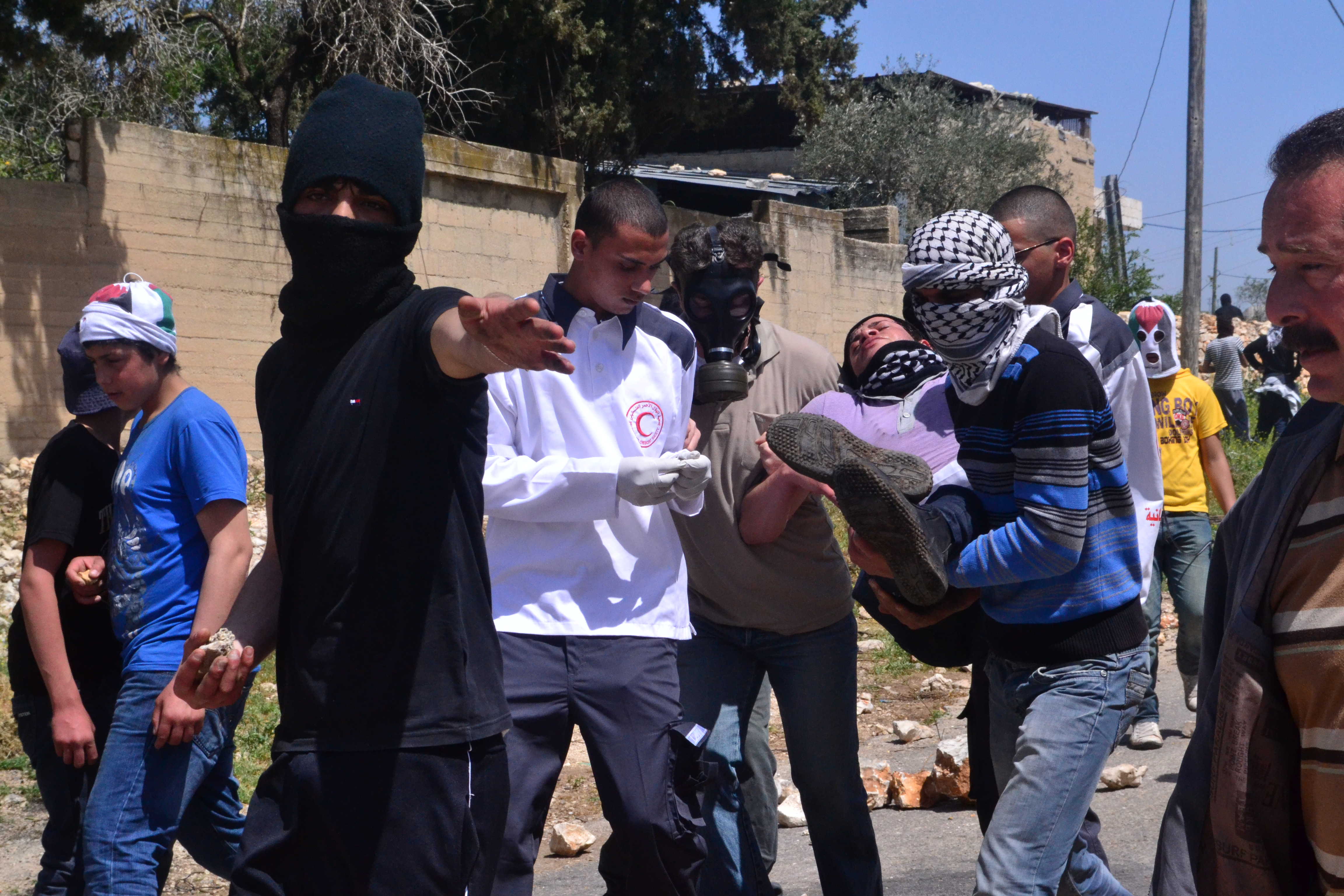
That Friday, it was a game of kids advancing and throwing stones, soldiers dashing forward threateningly with the guns, kids running back, soldiers withdrawing, kids advancing again went on till the main adult procession came up the hill. Tyres had been set alight and were now billowing smoke. The same pattern of ebb and flow was repeated, only now tear gas was being lobbed regularly. Mostly into a field to the side of the demo, but some skittering along the road into the crowd. Men were regularly brought back choking and temporarily blinded and a Red Crescent ambulance zoomed up and down giving aid to the worst affected. One man was hurt more seriously as it seemed his shirt had caught fire and he was burned.

Things quietened down after an hour or so and the procession came back chanting slogans. A quiet enough day we were told. Unlike the previous week there had been no chemically-created “Skunk” water shot from water cannons and no sound bombs, which disorientate and nauseate as well as deafen.

Back in the Abu Ihab house, which is at the outer limit of the village and always caught up in the midst of things, things were now quite calm. The soldiers had left the roof and for once had not cut the television cable. The mother was preparing a huge and delicious meal of chicken, rice, vegetables, pickles, pitta bread, tea and coffee.

Leave a comment

Filed under Human rights, Middle East

Walking in the (Occupied) Golan Heights

“This really is paradise” said Ziv, a twenty four year old Israeli ranger working in the Yehudiya National Park. He flicks back his dreadlocks and smiles at us looking for confirmation. My colleague, good friend and fellow hiker, Helene responds, “It really is”. We were stood overlooking the impressive Zavitan waterfall which cuts into the incredible landscape that’s rich in fauna and wildlife. In the immediate vicinity of the waterfalls it is hard to disagree with either of their assessments.

Helene and I walked for hours through deep gorges, stopping only occasionally to swim in the natural pools. Sporadically however we would hear in the background the unmistakable sound of explosions. A reminder that the Yehudiya National Park is surrounded by Israeli military areas. At one point as we were sat by a pool side a flock of birds flew from the tree in which they were perched at the sound of an especially loud explosion.

With every explosion, I was reminded that we were enjoying ourselves in an Occupied Territory. This mixture of unworldly beauty combined with occupation followed by an illegal annexation is what I spent three days thinking about as I walked in the Occupied Golan Heights.

The Golan Heights were occupied by Israel during the 1967 war and as such they were internationally considered to be “Occupied Territories”. In 1981 Israel formally annexed the territory and argued this changed the territory’s legal status. Despite this annexation and subsequent claim, the law of belligerent occupation continues to apply until the international community acknowledges a political-legal settlement between the parties. This did not happen in 1981 and has not occurred since.

The UN Security Council Resolution 497 of December 17, 1981 summarises the international community’s response to the annexation stating, “(The UN) Strongly condemns Israeli annexationist policies and practices in the occupied Syrian Golan Heights, the establishment of settlements, the confiscation of lands, the diversion of water resources, the intensification of repressive measures against the Syrian citizens therein and the forcible imposition of the Israeli citizenship on Syrian nationals, and declares all these measures as null and void as they constitute violations of the Geneva Convention relative to the Protection of Civilian Persons in Time of War”

As such, as an Occupying Power, Israel is obligated to adhere to the principles of international humanitarian law, notably the Fourth Geneva Convention Relative to the Protection of Civilian Persons in Time of War, and must also adhere to the principles of the international human rights law. This position has been repeatedly upheld by the UN and international human rights organisations.

Despite this clear status the occupied Golan Heights is often ignored by the media covering the “Israel/Palestine conflict”. Journalist and author Mya Guarnieri commented on this saying, “Perhaps it’s easier for journalists to talk about ‘Israel and the Occupied Palestinian Territories’ or the ‘Israeli-Palestinian conflict.’ But to do so is an oversimplification that ignores the broader regional context that includes the Golan Heights”. Living in the West Bank, reporting on what I see, this is a criticism that I am acutely aware of. To understand the current struggle for the realisation of human rights in the oPT you must also have an understanding of the Golan Heights.

After the occupation of 1967 130,000 Syrians were forcibly displaced from the territory leaving only 6,000 behind. A report by The Arab Centre for Human Rights in the Occupied Syrian Golan, highlights human rights abuses from expropriation of land and water resources through to settlement expansion. A report well worth reading.

What troubled me during my time in the Golan however was that all of this that I had read about human rights before visiting the Golan seemed a million miles from what I actually saw. Visiting the Golan Heights felt, as a tourist, to be no different from visiting any other part of Israel.

Hitch hiking to start a walk one day an Israeli picked us up, drove us no more than 5 minutes and insisted we take her number in case we were in the area and wanted to spend Shabbat with her family. I was met with a well maintained tourist industry and extreme kindness and hospitality – this was comparable to my experience in the rest of Israel.

My time in the Golan left me confused, it didn’t feel as oppressive as the oPT but I knew, in many ways, that it was comparable. My resolve from the trip is to return, to speak to more Israelis living in the Golan and to search out the small number of Syrians still living there, still resisting the occupation. What I witnessed, mainly from an Israeli perspective, was a complete normalisation of life, including the military presence. I left wondering what I would have experienced if I had spent time with the remaining Syrian communities in the area.

3 Comments

Filed under Human rights, Middle East

The silence in Kafr Qaddum

The silence was the most telling part of the whole meeting. The silence was intermittently punctured by the muttering of an occasional word. These words though, when they came, held the weight of a thousand. In this silence I could feel the presence of Waseam Barahem next to me throughout the meeting. Even when others were speaking I was conscious of his silence next to me.

Just over three weeks ago, seventeen year old Waseam was struck in the head by a tear gas canister, nearly died and momentarily lost his ability to speak. Today he is only able to say a few words. His father, Abu Walid remembers the day painfully, “I saw it all, I saw the soldier aim directly at my child”. Accounts vary, but most report the soldiers being fifty to one hundred meters away. All accounts that I have heard agree that the soldiers were firing directly into the crowd. This is something I have seen too many times before and is something that the IDF’s own regulations prohibit.

Waseam was struck directly on his head and suffered large amounts of internal bleeding. He was taken first to Nablus but then to a hospital in Jordan for a life saving operation.

His father described to me the moments after the shooting, “At first I didn’t think it was serious, just some blood on his head. Then the man who works with the ambulance told me it was bad. I wanted to go through the olive trees [to avoid the Israeli flying checkpoint] because I was worried they would try to arrest Waseam [on the way to the hospital]. The man who works with the ambulance though told me we had to go straight through the checkpoint because we didn’t have time to go through the trees. The soldiers also knew it was serious because when we come they open the checkpoint for us. They telephoned ahead to the hospital because they knew every minute counted”.

By any account Waseam is lucky to be alive.

Less than six months ago Mustafa Tamimi died after being struck by a tear gas canister. It is a very real danger that both internationals and Palestinians face when they attend protests.

Regardless of the dangers, the villagers of Kafr Qaddum continue to protest every Friday. I asked Waseam if he was worried about this coming Friday’s demonstration and the possibility of soldiers coming into the village. His answer was short but clear, “next Friday, I will go to the demonstration”. I looked at Waseam trying to read him, to distinguish the macho pride of a seventeen year old boy from what he was really feeling. Did he really not feel any fear after having such a close brush with death?

I turned to his father and asked if he was happy with his son being on the streets during the demonstration. His answer was framed in the context of the impossibility of criticising anyone who is ‘opposing the occupation’. He half shrugged and said “I always knew he would protest”.

I tried once more to frame a question in a way that would allow them to perhaps partly express their feelings. I asked Waseam if he was worried about his friends who go to the front of the demonstration. His silence stretched out for what felt like minutes before he finally replied, “I do worry about my friends”. His gaze fell to the floor and once again we were absorbed into his silence.

The sound of scraping chairs marked the end of our meeting. I left wishing Waseam a full recovery and I asked him to promise to “stay safe”. It felt ridiculous saying these words considering the context. Living in Kafr Qaddum, even if you avoid the weekly demonstration, is anything but “staying safe”.

4 Comments

Filed under Health, Human rights, Middle East

24 hours in Hebron

18:00 I arrived in Hebron repeating the simple instruction over in my head “get out of the bus at Happy Bunny Restaurant”. However many times I said it in my head I just couldn’t quite bring myself to mutter these words out loud. Inevitably the time came when the driver turns and questions, “where”? I respond, “Err…Happy…Bunny…restaurant”. He beams a smile, “of course”. I am whisked to my destination and my nights’ accommodation (a house close to the restaurant, not the restaurant itself).

22:00 Stood in the centre of the closed part of the old city in Hebron I look at some 3,000 year old remains of ‘ancient Hebron’. It looks like rocks to me, but I will concede that they look like slightly more useful rocks than the really old ones by my house in the UK (Stonehenge).

We are stood a few meters from one of the settlements in the middle of Hebron and just down the road from a Israeli family who are due to be evicted in the coming weeks (tensions are high). A soldier approaches us and asks where we are going and before I can answer looks over his shoulder and says, “oh the cave”? (or it could have been “grave”, I wasn’t sure). I, possibly foolishly, replied “yeah the crave” (hedging my bets between a cave and a grave). He then radio’s in to see if it is ok for us to go and look at the cave/grave.

After a few minutes of the soldiers having a ‘boy competition’ (defined universally as making a competition out of something that really shouldn’t be a competition, eg – hitting a balloon to each other becomes “can we hit it to each other 100 times with just our left hand” or in this case “who can shine their lazer on their rifles the furthest”) they decide that it is OK to go look at the cave/grave. We smile and walk to the dead end.

25 meters up the road and we see 6 soldiers waiting outside a military base next to the before mentioned settlement. I tried to casually scan where I was as if I of course know exactly where the cave/grave is. One soldier nods his head towards the far corner. Two options present themselves, the first is the military base and the second is a Palestinian families house. My colleague takes control and walks confidently into the Palestinian house where she knows the family. We stop and say our hellos to the family and ask about this cave/grave…apparently it is where someone from the old testament is buried and it is inside the military base. I leave the house still not sure if it is a cave or a grave but figured I had bigger fish to fry. I didn’t have the nerve or inclination to walk back out onto the street so we slump off down the path at the back of the house.

If nothing else it is nice to see the IDF trust us enough to enter into a military base unaccompanied at ten o’clock at night.

On the way home we see three Palestinians being held up at the checkpoint at the top of Shuhada Street. We stop and monitor the situation. If they are held for over 20 minutes we call the Temporary International Presence in Hebron (TIPH) for support before calling the ICRC. Inevitably the soldiers releases the men after 18 minutes. As we pass the soldiers there is an awkward acknowledgement that these were the same soldiers who had just given us permission to enter their base to see the cave/grave. I try to keep it nice and ask “is it ok to go into the ‘crave’ anytime”?. The soldier looks at me alarmed, “you want to go into the grave”?

23:00 – I fall asleep under a purple Disney duvet.

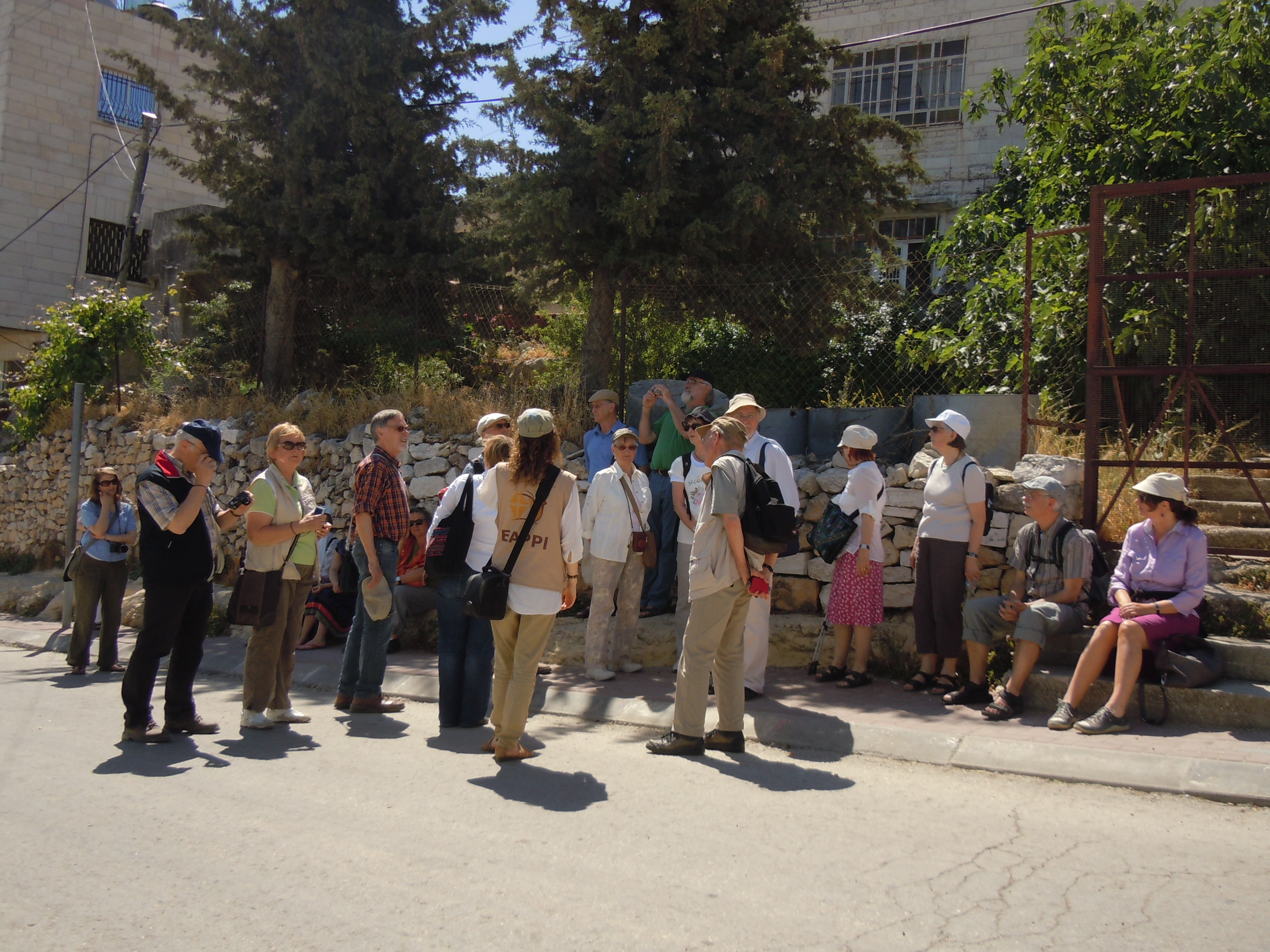
08:00 – We are up at the crack of sparrows to meet a German delegation who want to be shown around Hebron. I stay mainly quiet as my colleague waxes lyrical about Hebron in what I felt to be an impressively neutral manner. We show them around the mainly closed and divided parts of Hebron. There is one street divided by concrete bollards less than a meter high where Palestinians walk one side and Israelis the other. I wondered what on earth this form of division had to do with security.

12:30 –  After everything that could be said about Hebron has been said we left the German’s to make their way pass a checkpoint into the old souq. I see at least three of them tut at the soldier on the way past. I make a conscious note that I need to work on my middle class indignation.

13:00 –  I see a character walking towards me down Shuhada Street. He looks Israeli, but doesn’t look like one of the settlers living in Hebron (he’s smiling to start with). My inner suspicions are aroused though when he asks where we have just been. I pull out the leaflet I picked up by Abrahams grave (although interestingly he was also meant to have been buried in a ‘cave’ – all very confusing) and thrust it into his hands. Triumphant in the fact that I had not only been to a tourist hot spot but I had proof that I had been into the “Jewish half” of the mosque/synagogue/holy site (don’t ask…Jews and Muslims go in separate doors and can see the same grave/cave but from different sides and are separated by bullet proof glass). He looks at it and mutters he hasn’t been there yet. I am a little disappointed but crack on with conversation.

He turns out to be called Michael and lives just to the South of Tel Aviv. Apart from being a bloody nice guy he also enjoyed liberally sprinkling in words like ‘Plato’ and ‘Power Dynamics’ into conversation. In other words, he was my sort of chap.  He described himself as “on the left” of Israeli politics before he rubbished the very concept of ‘left and right politics’ in Israel. He was passionately ‘Jewish’ (and trust me when I say we didn’t use this term lightly, about half of our conversation was on how to define ‘being Jewish’) and to say he was well read was an understatement. About three hours of conversation in the heat of the day later we decide to go and grab some food…he chooses the Gutnick Centre (a Jewish cafe and community centre in the centre of Hebron that is known to the International community as being ‘pro-settlers’).

On the way to lunch Michael wants to walk on the ‘Palestinian side’ of the divided street. I am interested to see what happens so don’t stop him. When we get to the soldier at the top, the soldier tells him he is “lucky to escape with his life”. Michael smiles and we go and drink coffee with some ‘dangerous’ Palestinian shop keepers. We take off our EAPPI jackets in the shop and leave them there before going into the Gutnick centre. This was to avoid provocation but we are also not allowed in wearing the vests. Dangerous pacifist peace workers? We sit down on a table opposite some soldiers and have a nice lunch.

Sometimes the word ‘surreal’ just doesn’t quite cover it.

16:30 We walk together after lunch and are about to say our goodbyes to Michael when in the distance we spot two soldiers who were completely covered in white paint. They stride past a ‘normal’ soldier who tries to stop them. The ‘white soldier’ tells him to “check with command, this operation is cleared”. I had no idea what was going on. A soldier stood with the ‘white soldiers’ turns to me and says, “it’s art…it is up to you how you interpret it”. I liked the idea and so walked with a growing crowd of both Palestinians and Israelis. The soldier now turns to me and asks if I have ever been to Jayyus, I say “yes”. He gets his phone out and shows me a picture of myself from one of the day time raids of the village I used to be based in. He smiles and clearly thinks this situation is hilarious. He asks as if reuniting with an old school mate, “how you been keeping dude”? I smile, “yeah good cheers”.

By this point we have walked to the outskirts of one of the settlements. I ask the soldier if it is ok for us to be there and the soldier and Michael respond in unison “of course”. The ‘white soldiers’ are now pretending to search a playground and I watch on in fascination. This was not something I had expected from Hebron but I was enjoying myself.

In a split second however this whole jubilant atmosphere was shattered by the one and only Anat Cohen – a notoriously aggressive settler. She came out of a house and started screaming at me (ignoring the Israelis I was with) and stamping on my ankles. As she screamed at me I felt flecks of her saliva land on my face. I consciously decide not to wipe it off because I don’t want to be accused of ‘raising my hand’. I looked over her tiny angry shoulders to the soldier looking on. He gives me a comic shrug and looks helpless. I say it is OK, and we will go. The four of us (three internationals and Michael) walk off. She (Anat Cohen) follows me pushing me in my back and shouting. The soldier walks on behind and signals to his colleague in the distance to come. The new soldier asks, “did you do anything”? I smiled and said “of course not”. The soldier tuts a knowing tut and we walk for another 200 meters with Anat Cohen following me stamping on my ankles and screaming at me. While the soldier does nothing. When we stop to enter into a ‘Palestinian only’ part of town we finally say goodbye to Michael and Anat Cohen stares at us both and takes our photos.

I feel really sad that someone could feel that much anger and hatred to a stranger that she has never met or spoken to. I feel worse though for anyone that has to put up with her day in day out.

Michael, the soldier, Anat Cohen, the history, the conflict, the division…all just 24 hours in Hebron.

9 Comments

Filed under Middle East, Social comment

From the West Country to the West Bank – an interview with Steve Hynd, in Jayyus, Occupied Palestinian Territory

I was interviewed by Eugene Grant (of Dead Letter Drop fame). Have a read!

“Have I seen awful things? Completely.” Only a few weeks ago, Steve Hynd was observing a protest near Jayyus – a small village in the West Bank, Israel – when the army fired tear gas canisters directly at the crowd as they were running away. One of the three inch-long steel canisters struck a protestor – standing a few feet away from him – in the neck.

For Hynd, the words ‘police tactics’ are a complete misnomer. “Why would you have soldiers stewarding a protest?.” He says such tactics constitute not so much a policing strategy as “an aggressive attack on protest”. Since then, he’s stopped using the term Israeli Defence Force (IDF) – the military wing of the country’s security forces. The phrase, he says, suggests the force is there for defensive purposes, “but I’ve seen it overwhelmingly used for acts of aggression… when you say ‘army’ people understand that armies can be aggressive.”

You can read the full interview here.

Leave a comment

Filed under Beer, Human rights, Middle East

Another crackdown on the protest in Kafr Qaddum

My head started swimming and I couldn’t open my eyes. I could feel broken stones crunch beneath my feet and I knew I was moving away from the protest. For a terrifying 30 seconds I lost track of what was happening. An autopilot sense of self preservation kicked in that my conscious self had little control over. Just as my senses started to return I felt a colleagues hand rest on my lower back and lead me to the side of the street. Here I crouched in the small amount of shade offered by the shop-front from the midday sun. My stomach had tied itself into a knot and my head felt like it had split in two. Only then did I realise that I must have walked away from my colleague who was now stood in front of me with her camera in hand. I glanced up an offered what I hoped was a reassuring smile.

A few minutes earlier I had been stood at the back of a demonstration in Kafr Qaddum, a small village in the West Bank. I was there to monitor the proceedings and reporting on any human rights violations I witnessed. In the minuets preceding I had filmed a number of ‘warning shots’ being fired over the crowd and whiffed the faintest smell of tear gas. I believed I was far enough back though to avoid the worse of what was to inevitably come. I was stood on the side of the street next to a large wall that could also offer me protection, should it have been needed, from any direct fire. My colleague was nearby and I felt in control of situation.

Seconds later the Israeli army fired a volley of tear gas canisters (some directly into the crowd) that filled the streets with a penetrating thick gas. At first I stayed in position as it appeared the soldiers were aiming just for the front of the protest. As the crowd turned to run however, the tear gas landed closer and closer to me. At this point one canister landed a few yards away and filled my lungs with the gas. What happened next is a blur. I remember a man kicking the canister away down the hill but little else.

On the approach to the village earlier that day there were some clear signs that the protest was not going to pass peacefully. The Israeli Army had set up a series of checkpoints cutting off the only main entrance to village. I approached as part of a mini convoy of human rights monitors. I was travelling with others from EAPPI and the Israeli human rights organisation B’Tselem. As we approached the checkpoint it became abundantly clear that international human rights monitors were not being allowed into the village. Later I would find out that the same restrictions were being applied to media outlets.

I already had reasonable suspicion to believe that this week’s protest at Kafr Qaddum was going to witness an escalation of violence on previous weeks. The day before the village had seen 19 of its residents arrested in an IDF raid. “It was a clear illustration of strength aimed to intimidate us and to stop us making protest” one villager suggested. There were reports that a large amounts jewellery had also been stolen during the raid. This combined with the checkpoints only heightened our unease about the protest.

After meeting a series of other journalists, news agencies and human rights monitors who had also been turned away we decided to collectively head across the fields and enter the village “through the back door”. As the representative from B’Tselem put it, “if we do not reach the village today I am sure some very bad things will happen and they will go unreported”.

Sadly, his prediction of violence proved to be true. Both the Israeli Army and boys and young men from the village once again illustrated their willingness to take part in acts of violence against one another. Before being ‘tear gassed’ myself I saw stones the size of my fist being flung through sling shots at the soldiers who then responded with the brutality that I am coming all to use to seeing.

It is important, however distressing these scenes of violence are, that the world hears about them. Today I saw a large number of boys throwing stones before the Israeli Army fired tear gas directly at the crowd as a whole.  The obvious difference in these actions is that one was undertaken by a professional army and the other by young boys in an occupied village.

2 Comments

Filed under Human rights, Middle East, Politics, War

Crossing the separation barrier daily – one day honey, one day onions

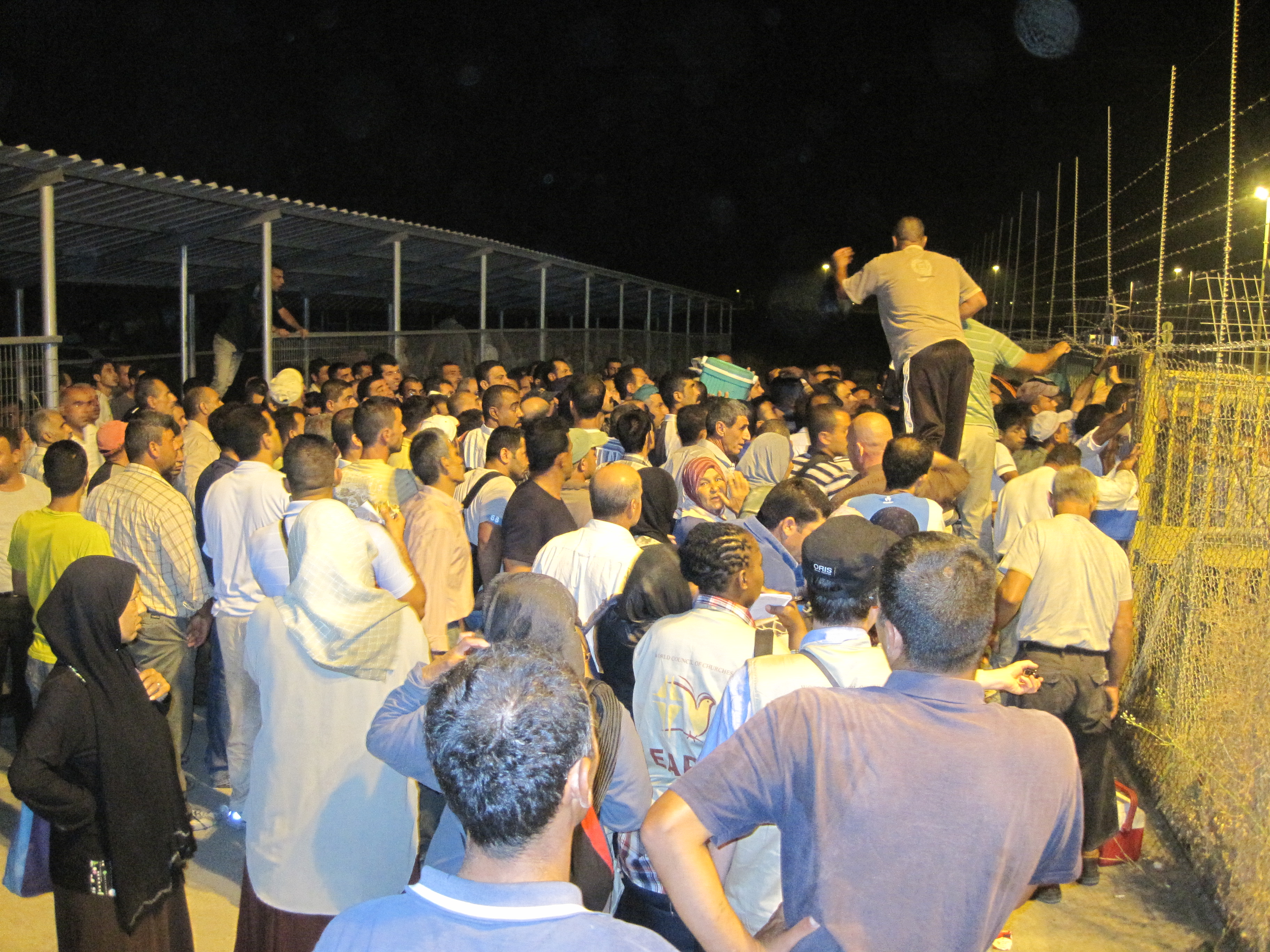
Stood squinting into the early morning sun a young Israeli soldier leans against the heavy metal gate that is separating the two of us and sighs. The gate is padlocked closed for what he had described to me earlier as ‘security concerns’. The soldier looks tired, worn down and wanting nothing more than a sit down. Instead he is stood talking to me. I ask him (again) why it is taking so long for the workers to pass through the agricultural gate this morning. He answers me in elaborate, almost performed Arabic, “yaum ‘asal, yaum basal” – “One day honey, one day onions”. He stares at me and meets my eye for as long as the strengthening sun will allow before retreating back to the solitude of the shade.

For the two hours preceding this conversation I had been stood watching frustrated agricultural workers waiting to cross the separation barrier to access their own farmland. The separation barrier is built predominantly through the middle of Palestinian farm land and as such was ruled to be illegal by The International Court of Justice at The Hague (in 2004).

The men are grouped in small circles, one circle lit a small fire out of rubbish and wood they have collected. Others are pacing the width of the road promenading up and down discussing the matters of the world. Others however wait with less patience.

All of the men hand in their permits to one Palestinian who has the unofficial job of keeping the peace and trying to organise what order people will pass in. The men pass in groups of 5 past the first turnstile before entering into a cabin where there papers are checked for what seems like an impossibly long time. One man who was waiting (patiently) nodded to the Palestinian holding the pile of permits and said, ‘He plays cards with those permits. You never know if you will wait 10 minutes or 2 hours”. I asked if there was any favouritism and the man responds, “it is good if we are friends”.

The first few groups of Palestinians emerge from the far side of the checkpoint and go their separate ways to their small plots of land. I look up sporadically to see what the soldiers are doing. There are normally four on duty that I can see (one to check vehicles, 2 to ‘control the crowd’ and one to stand their pointing his gun at people – or this is what I have deduced from previous times). Soldier one (who in previous groups has made an effort to look menacing) is stood in a concrete pillar box resting his chin on his semi-automatic weapon making little effort to keep his eyes open. The second (there to check vehicles) is  sitting with feet up on what I have seen in the past used as a second inspection point (which doubles the speed of transit for the workers trying to cross). The final two spend most of their time talking but occasionally tell the men waiting to take a step or two back.

The four soldiers barely look up as a small fist fight breaks out over what I presumed to be a disagreement about who got to pass through the checkpoint next. The soldiers take a couple of steps closer but allow the men waiting to sort themselves out. One of the Palestinians around the fire looks up and sucks air in through his teeth. For the majority of men waiting, they stand patiently looking out at their land to the west. Staring back at them are the soldiers who wait patiently as the minuets left on their shift slip away.

What was notable about this gate monitoring was the lack of anything specific happening. The Palestinians were not tear gassed nor were the soldiers pelted with stones. There was however a low level lack of respect that materialised itself in different forms depending on what side of the locked gate you were stood. There was a understood sub-text that they were not going to make life easy for each other. This is where the power dynamics shine through.

I noticed the Palestinian men would often pretend not to hear the soldiers when they were giving orders or would take a long time to move when they were asked. The response from the soldiers is no less petty but has far more serious repercussions. As I mentioned the power dynamics between the occupied and the occupiers is not equal.

To illustrate, as the workers leave the cabin where there permits are checked the soldiers normally wave on the next group of five men through the turnstile. Today, for no explicable reasons, they waited until the workers were well clear of the gate before allowing others to come forward. This wasted crucial minuets and added to the feeling of frustration.

These small actions (or sometimes lack of actions) meant that at the end of the two hours (the gates opening times) there were over 50 men (and 40 sheep) still waiting to pass when I left the gate at 9:00am. This has serious repercussions on those who do not make it through (loss of income in a desperately poor society). I have monitored this gate many times before and have seen that proactive friendly soldiers can ensure that all men (and animals) pass through without problem and with minimal delay. Today the soldiers did their jobs, but with the minimal possible effort you can imagine.

The tired soldier at the end said that one day is like honey, while another is like onions. He made this  comment with a certain fatalistic edge to his voice. What today has taught me is that if some days are like honey while others are like onions as the soldier suggests, then it is because of his choosing. Soldiers (often young conscripts) have an extraordinary amount of power and control over ordinary people’s lives. For the men who have to wake in the early hours of the morning clutching their permits to pass to their own land, days are rarely like honey.

1 Comment

Filed under Middle East, Social comment

Abuse in Qalandia Checkpoint

“You clearly don’t understand f****** Hebrew so let’s try in f****** English – you do not have a permit to enter so why don’t you f*** off back to whatever village you have come from”. My ears pricked up at this sudden harsh use of my mother tongue. I had for the last 15 minutes been sat in the middle of Qalandia checkpoint letting the mix of Arabic and Hebrew wash over me as I waited patiently for the man in front of me to pass through. The Palestinian man who stood with me turned a full 360 degrees looking at the ceiling before breathing heavily and saying to the young soldier on the  other side of the glass, “I understand f****** English, I do have a f****** permit to pass and I would appreciate it if you showed some respect and didn’t use such f****** foul language”. The swelling queue behind me laughed. The young female soldier stared him straight in the eye.

Qalandia checkpoint is on the outskirts of Jerusalem and is one of the largest in the occupied Palestinian territories (oPt). It is not near any border between Israel and the oPt but rather divides the Palestinian cities of Ramallah and Jerusalem. The man in front of me I would later find out was an orthodox Palestinian Christian wanting to go and pray at his church in Jerusalem.

The Palestinian man was at this point demanding to see the young soldier’s supervisor. Both parties were shouting and screaming. They both seemed to hold opposite opinions about this one piece of paper – his permit. Despite the close vicinity of the two, the man was shouting at the top of his voice, “I have a permit to cross 24 hours – why do you not let me through?!”. The soldier on the other side of the glass was matching his volume screaming, “You do not have the right permit so you cannot pass – it is that simple”. At this stage I had no way of telling who was right. Was the man confused about the terms of his permit or was the soldier mistaken? Without marching up and asking to look at the permit I had no way of really knowing. The following series of events however gave me a strong idea.

I had been stood waiting for just under half an hour listening to these two go round and round in their never ending argument. Back and forth with little variation they would shout, “I have a permit”…“no you f****** don’t”. Finally the soldier looked at her colleague and they both started laughing. The man did not. The young soldier (I guess aged between 18 and 20) turned to the man laughing and said, “Fine you can go through…you’re pathetic”. I was taken aback. The man scowled at her, picked up his belongings and turned on his heel to pass through the final turnstile. I watched him enter into the mid-day sun and temporarily out of sight.

I approached the young soldier with my passport in hand and with all the correct visas in place. I was a little worried though that she was going to cause me problems as well. I half smiled at her on my approach to the glass screen. She looked up and asked what my name was and so I nervously responded, “erm…Steve”. She smiled at me and said, “I hope you have a nice stay in Jerusalem, it’s a beautiful city. Sorry about the delay”. She then waved me through without looking at my visa or passport.

Outside, the Palestinian Christian apologised to me saying that he was sorry I had to witness him shouting but “they only listen to me if I shout”. I said it was no problem. I then asked him what the issue was with his permit. He laughed a bitter laugh and said, “nothing, look [he hands me the permit]…Everything is fine, they just do this to make life hard for you”. I folded the permit and handed it back to him. As we were walking towards the bus that would take us to the heart of Jerusalem he turned to me and said, “Can you imagine – every time I want to pray I have to go through this. I sometimes wonder  if this is God testing me”. Sat on the bus I wondered how many people in my parents’ church would still attend if they had to pass through Qalandia checkpoint every Sunday on their way to church.

Thinking back to the soldier in the checkpoint I wondered what had driven her to respond in such a way to this particular man. Was it her own way of escaping the insurmountable monotony of working at a checkpoint? I do not know. All I can say for certain is that today I had another up-close look at the one of the many restrictions on life here and saw an ugly glimpse of the daily struggle that Palestinians face under occupation.

6 Comments

Filed under Human rights, Middle East, War

No father, no food and an unknown future

When I was at school I did a sponsored fast – nothing was to go between my lips for the entire school day. I was raising money for something, a cancer charity maybe. During the morning break-time I remember pushing a doughnut into my porky little face. I scoffed it down and never told a soul about it. Licking my sausage fingers I can remember not feeling even the slightest crack of guilt.

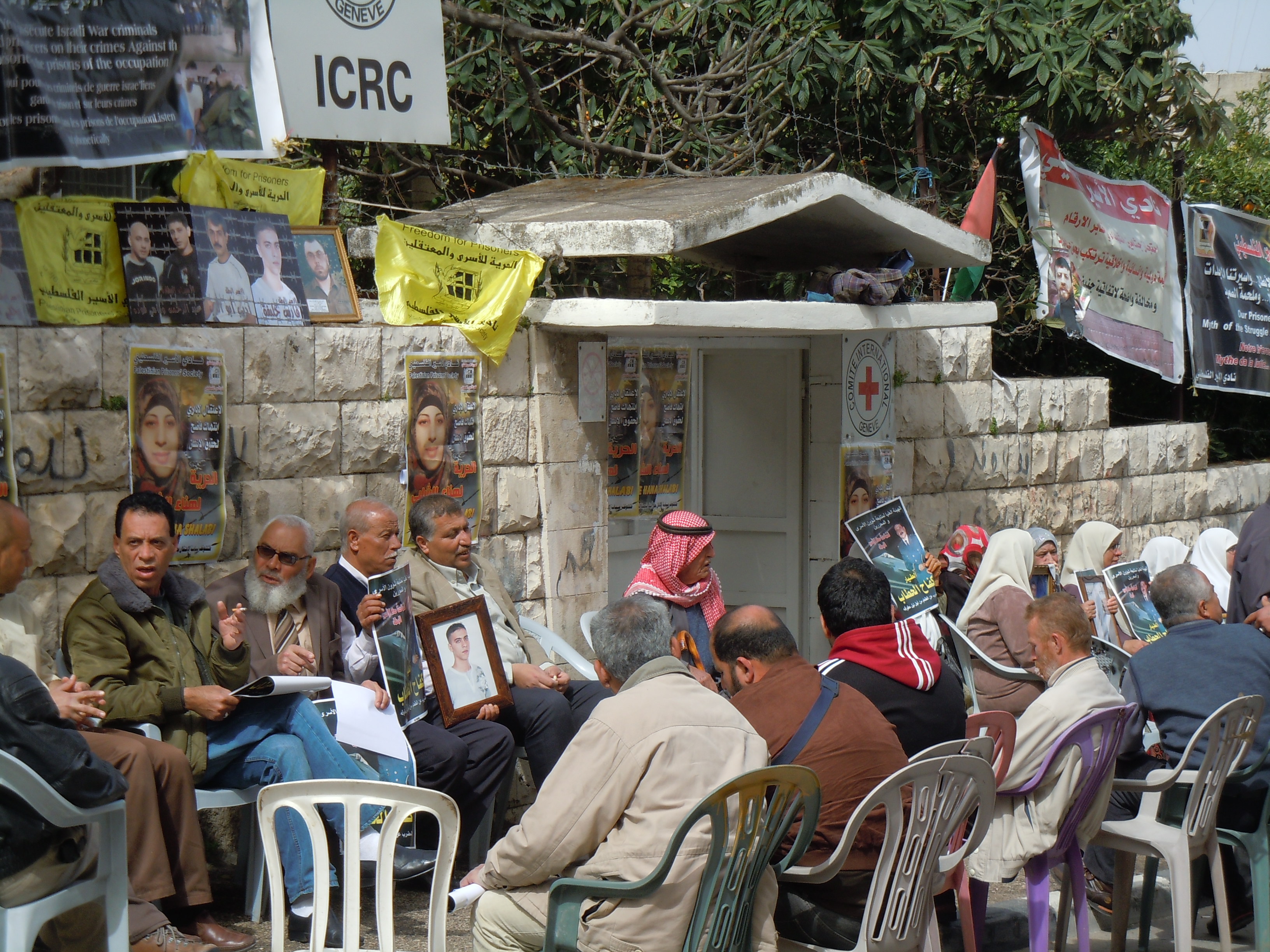
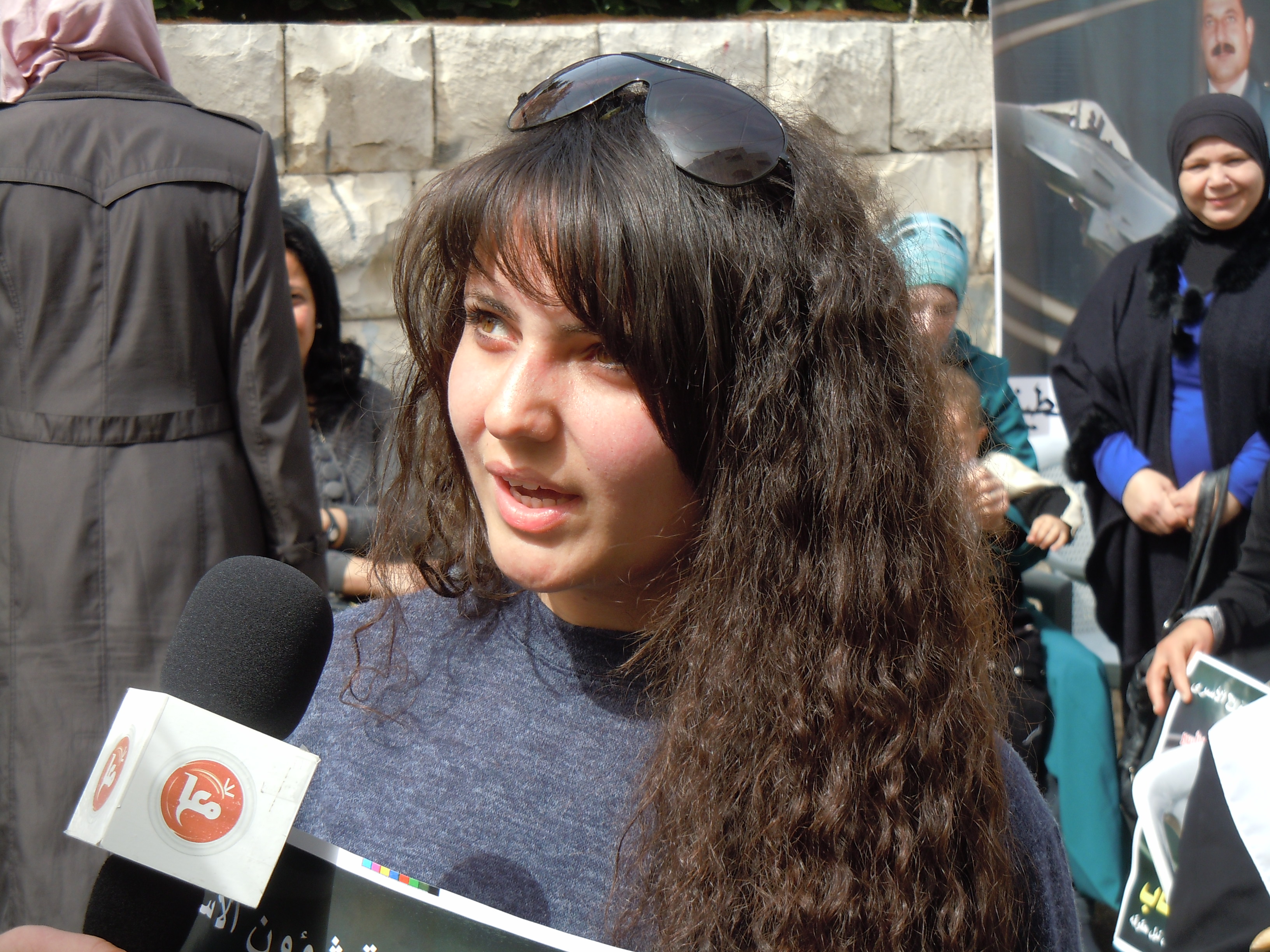
Today, for this first time since that fateful event, I felt guilty. I felt guilty because stood in front of me in the mid-day sun was Hallah Hattab. Hallah is one week into her hunger strike. She is standing in solidarity with her father, Kifah Hattab who is 3 weeks into his hunger strike in an Israeli prison. Kifah is just one of a number who have chosen to go on hunger strike in recent months in protest of Israel’s continued use of administrative detention.

Hallah Hattab is a beautiful 20 something year old that oozes intelligence and holds herself with a confidence which conceals her age.  She has joined others today outside of the International Red Cross in Tulkarm to protest about the conditions that Palestinian prisoners are being held under. Specifically they are looking to highlight Israel’s on-going use of administrative detention. As the Israeli human rights organisation B’tselem states, “according to international law, administrative detention can be used only in the most exceptional cases, as the last means available for preventing danger that cannot be stopped by less harmful means. Israel’s use of administrative detention blatantly violates these restrictions”.

Both men and women gather on the pavement outside of the International Red Cross building sitting on plastic chairs in large circles. Each person holds a photo or a poster of a loved one who is languishing in an Israeli jail. Each of those attending the protest hold their own story of how someone close to them, a son, a brother or a father have been taken away from them. For Hallah it is her father.

I catch Hallah in between interviews with various local, national and international news agencies and ask her how she is feeling. She has the answer to this question down to a fine art, “I am trying to keep my spirits up, I know what I am feeling is nothing compared to what my father is experiencing, but it is still hard”.  Her hazelnut eyes blink at the end of her sentence and then fix themselves on me, attentive and focused on the interview at hand.

After a few seconds silence I ask Hallah how long she will be willing to carry on her hunger strike for and she responds saying that she will continue for “as long as it takes…I want to support my father”. She says these words with real determination. I wonder how far she will be pushed. Khader Adnan recently went on hunger strike for 66 days and very nearly paid the ultimate price. The undertaking that Hallah has taken on is no small one. I am eager to find out what fuels this fire inside of her but we are interrupted at this moment by someone introducing Hallah’s mother.

Her mother stands with us and insists (in perfect English) that she does not speak very good English.  I wonder whether she is just comparing herself to the English that flows from her daughter. Unlike her daughter she looks tired, both physically as well as mentally exhausted. She may not be on her hunger strike but you can see that the situation is taking its toll on her. When I ask her if she is worried about her daughter however her face lights and up she says that she feels ‘nothing but pride’. I half turn back to Hallah to ask about her studies at university and I catch her mother’s proud smile in the corner of my eye.

Frustratingly Hallah is whisked away as some other news agency is wanting to speak to her. I watch on as she gives another interview in another language. I look at her in admiration. I marvel at all she is doing with no father to support her, no food to sustain her and an unknown future to look to. I wonder if I would be able to do what she is doing and I think back to my pathetic failed attempt to fast for one school day.

On the walk back to the house where I am staying I talk to other EAs about Hallah. One colleague rationalises all that she is doing with the simple comment, “it is just her way of coping”.


1 Comment

Filed under Human rights, Middle East, Politics, War

The tale of an Israeli smile

“Do you know what the best thing about tonight is?”. I answered honestly, “No”. The soldier pushes his helmet back up his forehead with the butt his gun and says, “I get to drive these British Land Rovers”. I am not sure how to respond to this and so I sheepishly smile back. My coy response does not deters the soldier, who I later find out is called John, from continuing. “The Palestinians are really suffering you know”. I sensed an old IDF trick coming on, luring lefty NGO types into a false sense of security so I volunteered, “so are the Israelis”. John’s response was telling, “Are you crazy man? You really think the Israelis are suffering in comparison to the Palestinians?”

By this point I will admit that a certain degree of surrealism had been entrenched into the proceedings. I had been called by a local Palestinian at around 1:00 in the morning. He said that the IDF were in his house and they going to arrest his brothers and I should come quickly. As I turned the corner to his house I was met by at least 3 jeeps and an unknown number of soldiers. At first I negotiated a compromise about where my colleague and I could stand to monitor the proceedings. A few minutes later though one of the soldiers beckoned me over and at first started to interrogate me before letting himself slip into casual conversation.

Ignoring the growing sense of irony I pushed on with John, “A lot of Israelis are living in fear, they feel scared all the time, it is not good to live your life in fear”. The IDF soldier, now the voice of rationality in this increasingly bizarre conversation chirped back, “I know that but this fear cannot justify what we are doing here in the West Bank”. I trailed off, “No…of course not”. John was either a master at using reverse psychology or he was an Israeli soldier who was genuinely concerned about the Palestinians.

In the following 5 minutes we talked about the London bombings and how this had fuelled a growing suspicion of Muslim communities in London and what steps could be taken to breakdown this divide. I talked about multi faith projects I have been involved in and he listened with genuine interest. Our conversation meandered easily through politics and religion. After a while I tried to steer the conversation back to the reality in which we found ourselves.

As casually as one can ask an occupying soldier I said, “so, what are you guys up to this evening?”. I was meant to be getting answers to why they were terrorising a community in the middle of night for no apparent reason. Instead I sounded like I was flirting. I clarified, “what are you’re…ummm…objectives?”. The soldier laughed, smiled and said, “We are here for security, I think you know what that means”. I smiled and nodded as if this sort of response comes up all the time and I knew exactly what he meant. Of course I didn’t really know but I guessed this either meant they were there for no reason at all, or there was some super secret army reason for them being there that he couldn’t let on about. I suspected the former.

I glanced around and watched a collection of silhouettes on the roof tops. Men looking on to try and see what the IDF were doing. John caught my glances and reassured me, “they are just curious, there is nothing to be afraid of”. My colleague was stood 20 yards back nervously trying to work out what on earth I could be still talking about after 10 minutes or so of conversation. I knew it was time to draw this surreal conversation to a close. To do this, you would ordinarily ask a closed question like, “Is there anything else?” (a standard way to close what was meant to be an interrogation). On this night though I pushed my thumb into the palm of my hand and said, “I am really sorry, I don’t want to appear to be rude or anything, but if I stay and chat to you here for too long everyone will want to know what I was talking to the soldier about. It might cause some problems tomorrow. I hope you understand”. I was apologising to an occupying soldier for having to break off our nice little midnight chat. Once again, a big smile spreads across John’s face and he beams, “of course, I hear the Israelis have got a bit of bad reputation around these parts”.

As I walked back to my colleague, I felt two completely contradictory emotions. I could feel the cold metal being aimed at my back as I walked away, soldiers poised with suspicion ready to strike at any moment. The cold harsh reality of occupation – soldiers storming houses in the middle of night, interrogating, harassing and intimidating. Then, in complete contrast to this I felt John’s warmth. In my mind’s eye I saw his smile and could hear his soft laughter. Within a few minutes John had shown me a sign a hope and optimism that I know will stay with for days to come.

What will stay with the villagers however is another night time incursion, another family traumatised by interrogation. Mothers and fathers terrified at the prospect of their sons being arrested. Young men having another sleepless night living under the constant threat of arrest. They know too well that being a young male is enough to have you dragged from your house in the middle of the night with no explanation. This will stay with them for longer than just a few days, this will be with the for the rest of their lives.

7 Comments

Filed under Human rights, Middle East, War

The last 24 hours – an extract from my diary.

This is a short extract from my diary (with the naughty bits removed) covering the last 24 hours.

18:25 – I get a text message from one of our local contacts asking if I want to play football in the village with some of the other guys. It sounds like a laugh so I pull on my Arsenal shirt (staying neutral in the Barcelona/Real Madrid turf war) and head out. The two guys I meet are wearing jeans, jackets and leather shoes and I wonder whether my tracksuit trousers and football shirt looks a bit eager. This feeling is confounded when we stop and eat freshly made falafel (it’s hard to say no to Palestinian food). We arrive at the pitch (floodlights and all) and I start to get the feeling that something is not quite right.

18:45 – We spend over an hour warming up (I say we, the two guys who I arrive with are sat on the side – of course they are not playing, they’ve just eaten). This warm up is more exercise than I have done for a very long time. Apparently F.C Jayyus take their warm ups (and football in general) very seriously. I try to cover up my inherent lack of ability and my self-created lack of fitness by making jokes. The guys I came with laugh, everyone else looks on with growing concern at the amount of sweat dripping down this English boy’s face.

The coach barks instructions at players and I occasionally hear my name mentioned (that’s right, this village football team has a coach, and he barks). I try my best not to mess up but get the feeling that I am not the foreign super signing that F.C Jayyus had been looking out for.

21:00 – I survived it, just. One shoulder in the face, and only the occasional noticeable mistake and I think I survived my first (and possibly last) training session with F.C Jayyus. I walk off the pitch knowing full well that my legs will be stiff tomorrow but pretending that this sort of exercise is par for the course for me. It was great to meet some new faces in the village and to have a kick around with them – I wonder if that feeling is mutual? Either way, they are eager for me to come back to the coffee shop with them to watch Champions League football. I excuse myself, miming that I have to get up early tomorrow for checkpoint monitoring (I always thought the Jungle Book was hard but this take charades to a whole new level). I walk away from the group feeling proud that I have turned down the chance to watch football in favour of getting to bed on time – perhaps this whole experience is making me grow up.

23:30 – It’s pathetic and I know it. I have to be up in four and half hours but I could not resist watching Arsenal play (second leg trying to come back from a 4-0 first leg deficit against A.C Milan). Arsenal go 3-0 by half time and I am on cloud nine…and then…nothing. We (because when you support a club you are a part of the collective) crash out of the Champions League and any thought of silverware for the season goes out the window with it. To top it off, my home club, Cheltenham Town drop 3 crucial points in the race for League 2 promotion. I go to bed with my mind swarming with football. How can I love something that consistently causes me so much misery?

But anyway, if you’re looking to support Arsenal or Cheltenham Town I came across these useful coupons for Amazon. Take a look!

1:20 – I am awoken (2 hours after I went to sleep – not that I am bitter) with a phone call to say the IDF are in the village making an arrest (possible arrests – plural). After a quick assessment we decide it is too dangerous to be wandering the streets so we decide to monitor the situation from our rooftop staying in mobile contact with others around the village. It is an eerie feeling to see these silhouettes of men on roof tops in the early hours, all whispering reports to each other. It does however work as an informal information network.

2:30 – An hour later we receive confirmation that a local has been arrested. We can see IDF jeeps buzz around the outskirts of the village but only occasionally see them in the village. These late night visits (often not to make arrests) are happening far too often. I go back to bed, my mind now buzzing not with triviality of football, but of the guy who has just been bundled out of his house in the middle of the night – where will he end up, what will happen to him, what (if anything) will he be charged with?

4:55 – Alarms, I hate alarms. It does its job though and I am up to monitor the agricultural gate to the North of the village which open 5:30 – 6:30 every morning. I arrive and the IDF are parked with their headlights on full beam facing straight at where I monitor the gate from. I stand there, centre stage, performing the worst solo performance they are likely to ever see (essentially a tired Englishman staring blankly at them). After a while a small trickle of farmers flow past and I mutter a few good mornings. The Israelis have made a concerted effort to encourage farmers not to use this gate (as the road on the other side runs straight through a bit of land marked for settlement expansion) but still the locals use it. I wander back to the house feeling cold and tired.

08:45 – A Palestinian with an Israeli ID is coming to pick us up and to drive us to the other side of the separation barrier. We pass through the checkpoint and our bags are x-rayed and a sniffer dog sniffs every nook and cranny of the car. The young girl behind the desk has a staring competition with my passport photo (my photo wins every time) and I am asked why I visited Egypt (A: “I was on holiday”…my mind runs through potential comedy answers and I stop myself from laughing by making a sort of snorting noise). She looks at me and waves me through.

09:30 – We meet a local farmer and he walks us around his land showing the problems that they face (settlement expansion, military activity, water rationing etc). Inside a hut on his land we drink sweet tea and point at maps laid out in front of us. He shows us how the access to his land is being controlled (you need to have a permit to access your own farmland), restricted (they have built a massive separation barrier through the middle of his land – twice) and made unreliable (he had been waiting for months to get a permit). Worst of all, it can be taken away at any minute. We are shown his neighbours land which has been literally blown away – it is now a stone quarry providing material for massive ‘settler only’ road upgrading schemes. Areas all around his land have been claimed by the Israeli government as state property (using British mandate laws I should add – sigh…I love the BBC, tea and cake at 4pm and The Beatles but I sometimes struggle to find anything else to be patriotic about and being in Israel/oPT is not helping this).

We are joined during the day by a Dutch delegation who have decided to spend their free time working as unforced free labour on the land. For some this might seem an odd choice for a holiday but I think I ‘get it’. It is beautiful land they are working on and it is rewarding work. At the very least I ‘get it’ more than those fighting for sun beds in Magaluf.

17:00 – After a long day in the sun in the fields this is exactly what I don’t want. I am sat on a concrete bench in the seam zone (the area in between the separation barrier and the Green Line) waiting for a taxi driver who is over 1 hour late staring at the backend of a checkpoint I am not allowed to enter (it is for workers only). When the taxi does show up (with no explanation for the delay) I need to be driven in a huge loop around and through a car terminal. No one checks any of my nooks and crannies on the way back through.


I am currently serving as an Ecumenical Accompanier in the West Bank – follow the hyperlink for more information.

5 Comments

Filed under Human rights, Middle East, Politics, Social comment

No man is an island

The English poet John Donne once wrote, “No man is an island entire of itself”. This assertion has never faced a more literal challenge however than through the story of Haney Ameer.

Mr Ameer lives on the outskirts of Mas-ha just outside of Qalqiliya in the West Bank. Back in 2003 his house was situated on the path of the proposed separation barrier, 80% of which is built on Palestinian land. When he refused to leave his house and his land the Israeli government decided to build the barrier around him. His house is now surrounded on all four sides by either walls, fences or the separation barrier. He lives in what looks like a high security prison except he now holds the keys for the one small gate that provides access to his property.

On one side of his house is the 8 meter high concrete separation barrier that scars the landscape for as far as the eye can see. All over the wall there is battle between local graffiti artists and the Israeli Defence Force’s (IDF) censoring white paint. On the other side of his house there is an illegal Israeli settlement which is cut off from him by a barbed wire fence. Flanking each end of his property are locked security gates leading to the military road that track the separation barrier. He is hemmed into his small plot of land on all sides.

On the approach to his house our driver and translator rings ahead for him to come and meet us. We pull up alongside the 8 meter high concrete slabs to walk the last few meters. Next to the barrier there is a small rusted metal door from where Mr Ameer emerges. Between 2003 and 2006 he lived in his property not owning these keys to access his own property. For three years he relied on the IDF to let him through the security gate each day to return to his own property. It was not uncommon in those days for friends to throw food parcels over the wall so he could feed his wife and children.

We sit outside his broken and bruised property in the fading evening sun. He explains he cannot fix any of the broken windows, crumbling walls or holes in the roof as he cannot get a permit off the Israelis to ‘build’ on his own land.

I ask him if he ever considered leaving. He responds with a story of isolation and incredible courage which is characterised by a lack of options. The Israelis offered him a lot of money and a chance to rebuild a bigger and better house on more land wherever he wanted in return for his land. He refused. Why he refused is a mixture of a connection to a family home that has been with him for years, and a slightly more harsh reality. The Palestinians who lived nearby warned him that if he sold up to the Israelis he would no longer be considered a ‘Palestinian’, he would be isolated. An ironic threat given his circumstances.

Regardless of his motives, Mr Ameer now finds himself in a physical limbo, not on either side of the separation barrier. He insists that if he could turn back the clock then he would do nothing differently. I ask what he hopes for the future and he bleakly responds, “nothing, I will die like this”. This response sends a shiver down my spine as I realise that this is quite possible. The occupation has come to a point where a family can be living in 60 by 40 meter virtual quarantine and the world does not bat an eyelid.

Mr Ameer has the look of a man who has told his story a million times before. He sits back in his chair as if this is a day to day occurrence for people all around the world as he recalls the details of his isolation. I wonder whether this is just his way of dealing with what is an unimaginable daily infringement on his personal liberty.

The meeting comes to a close and he walks us back to the rusted metal gate. Unlocking the padlock he looks up at the separation barrier and then at the floor. His body forgets what he is doing for a brief moment but his hands are still unlocking the door they have unlocked everyday for the last 6 years.

We leave him on the other side of the barrier. I cannot decide whether I have extreme admiration for this man, or if I just want to shake him by the scruff of the neck and tell him to move with his family to a new house. I suspect if I did the latter, he would sit me down, light a cigarette and tell me to not be so impatient. I am impatient though, I don’t want to think of this man sitting in his house, his virtual prison, until the day dies. There has to be an alternative ending to this tragic story.

The occupation restricts peoples movement, freedoms and lives on a day to day basis. Mr Ammer’s story is unique only because of his physical proximity to the separation barrier.

Haney Ameer will sleep tonight though knowing no one can tell him to leave his family house, not the IDF and certainly not a foreign human rights monitor like myself.

2 Comments

Filed under Human rights, Middle East, Politics, War

The good news story of Aref Sameer Chbieteh

At 25 years of age, he has spent nearly a quarter of his life in prison. Despite his tender age, he has the look of a man who has already seen too much. Sat in a plastic garden chair Aref looks into the near distance as he answers our questions. Surrounding him are his friends and family who have not seen him since his arrest 6 years previous. The room holds a feeling of collective cohesion, together they are strong, but alone I suspect anyone of them could fall apart. Six years ago, the Israeli Defence Force (IDF) took him from his house in the middle of the night and he was charged him with possession of a weapon – a charge that he denies but for which he was found guilty.

I ask Aref about his experiences inside the four different Israeli prisons where he was kept. What he does not say tells a story in itself. His gaunt and clearly underfed body sits slumped in his chair as he struggles through his mind for details that he is not comfortable recalling. He was moved between different prisions after making formal complaints about the conditions in which he was kept. When I tentatively ask him to expand, he simply replies, “they were bad”.

Aref has been a free man for only a few hours when we are ushered to his house. They wanted us to see a ‘good news’ story – a young man returned to his mother. What I heard and saw however was that of a life reduced to distant stares and painful memories.

Aref was detained inside of Israel despite living in the occupied Palestinian territory (oPt), this meant that he was cut off from his family. This is a clear violation of international law.  As Malcolm Smart of Amnesty International said, “International human rights standards and international humanitarian law guarantee every person deprived of liberty the right to humane and dignified conditions of detention…and regular family visits”.  What Aref described to me was a breach of these rights.

His case however is not unique. 6 years is a standard punishment for being caught in possession of a weapon. Equally, Aref was just one of the 5,200 Palestinians from the West Bank – including East Jerusalem – and the  Gaza Strip,  who are currently detained in facilities run by the Israel Prison Service. The vast majority are detained inside Israel. For Aref, years went past where he was not allowed to receive any visitors at all.

I ask him, perhaps through naivety, if he suffered any physical punishment inside prison and for the first time in the meeting a flicker of life passes through his eyes as he snorts before muttering, “of course”.  There is an awkward silence as all we all stare at the floor – I feel embarrassed for asking such a crass question. Aref breaks the silence by explaining that he will never forget what happened to him inside prison. I do not have the nerve or inclination to ask him to expand.

His family around him are buzzing with excitement to see him again after all these years. Before I go, I turn to his mother and ask a question which I hoped would encompass the ‘good news story’ that we had come to see. I ask her what it feels like to have her son back. She looks at me and smiles as a tear forms in the corner of her eye and she says in clear English, “very happy”. My professionalism drops and I meet her smile.

On the way out, Hassan who had arranged the meeting for us moves the conversation onto the 7 other young men who were arrested last night. My heart sinks as I imagine each of their mothers sitting out the years waiting for their sons to be returned. Tomorrow we will try to meet with some of the families of those newly arrested.

3 Comments

Filed under Health, Human rights, Middle East, War

A photo speaks a thousand words – Jayyus

A fellow EA monitors an agricultural gate outside of Jayyus.

Nature does not respect human divisions.

2 groups who feel connected to one piece of land.

Leave a comment

Filed under Human rights, Middle East, Politics, Religion, Social comment, War

Qalqiliya checkpoint and the impossible question – why?

When you awake at 3:00am everything is a blur. The edges of your vision slip away to nothingness, your eyelids drop with every slip of the mind and your senses are numbed. Unless that is, you are stood at Qalqiliya checkpoint in the West Bank. Here your senses are heightened from the cooking meat, the brewing coffee and the mass of humanity. The harsh strip lighting rips through any thought of sleep and ensures you stay with the present, however much you and all around you wish to escape it. What cannot be so easily explained however are the emotions that sit so heavily on the pit of your stomach as you stand in the early hours counting people through the entrance of the checkpoint.

Qalqiliya checkpoint is situated to the north of the city and in the first few hours of opening it will see thousands pass through its gates. On this particular morning I watch 3,000 bodies slip past me, all on their way to try and make a day’s living on the other side of the barrier. Mostly the faces of these men look to me with a registering smile but little else. I am not sure what I expect from my endless cheery “good mornings” but I certainly do not get it. On occasions I get nods, mutters and silent acknowledgments.

I cannot, and do not blame them for this response. For them, it is another freezing morning where they have had to awake well before 3:00am to queue to get past a barrier that an occupying power has built across their land. For them, they have seen little improvements in condition or speed of transit since the international community started monitoring the checkpoint. My EAPPI colleagues and I provide invaluable data to the UN, but for them we are now part of the whole degrading process. I am shocked by the lack of humanity, but they are the victims of it. I am appalled by the humiliation of passing through the checkpoint but they have to endure it. I am saddened to the point of tears building behind my eyes by every one of them not being able to lift their gaze from the floor but it is their reality, not mine.

Cutting into this reality is the continuous voice that is devoid of any sense of irony when it keeps demanding “Yallah yallah” move move. A never ending list of impossible demands reverberates from the PA system above our heads. They keep reminding anyone who is listening that they must move faster. How they expect people to do this is never elaborated upon. A faceless voice demanding the impossible.

This is the reality of my first session monitoring Qalqiliya checkpoint. When you report on human rights violations and how International Humanitarian Law is being violated, the first rule is to show the victim with agency – the ability to influence and change the situation they find themselves in. Here, every aspect of life is controlled. Whether we are talking about access to land, water or food, or the ability to build, work, learn or get medical treatment. Everything is controlled, restricted and made unreliable. In light of this, all I can offer now are the harsh realities of passing through Qalqiliya checkpoint the best as I can recall them.

As I stamp my feet in the bitter cold I try one last “Good Morning” to another body slipping past me. This time though he stops, looks at me, raises a wry smile, and responds “leish?”…. why? Why is it a good morning? For this I have no answer.

Tomorrow I am getting up a few hours later to monitor an agricultural gate that opens before sunrise. At the same time, many of the same men will be starting the same humiliating regime all over again.

8 Comments

Filed under Human rights, Middle East, War

Trans-Caspian Pipeline lives to fight another day

The Council of the European Union has today announced that it has adopted a decision authorising the Commission to negotiate an agreement with Azerbaijan and Turkmenistan on a legal framework for a Trans-Caspian (natural gas) Pipeline System.

I have blogged before about the problems this pipeline may hold. Anyone concerned with human rights and development in Central Asia should follow these developments closely. Will the EU live up to its human rights commitments in its trade deals?

Regardless it looks like the EU is committing itself down the energy road of reliance on large quantities of imported natural gas. A diversification away from Russia is a no brainer but holds with it infinite dangers. Interesting times ahead – watch this space.

Leave a comment

Filed under EU politics, Human rights, Politics, Russia