Tag Archives: West Bank

Jayyous – one year on

Kate Cargin, who served as a human rights monitor with EAPPI just after me, writes about going back to Jayyous a year after we served there. 

Abu Azzam, welcomed us back to Jayyous like members of his own family and his wife Sehan laid on a lavish meal. I had met Juliane, my team-mate from EAPPI last year, in Jerusalem and the two of us were invited by the current team to stay in our old placement house.

Supper with Abu Azzam. Photo: Per-Ake Skagersten

Photo: Per-Ake Skagersten

Now, as then, the most serious problem for people living in Jayyous is the ‘separation barrier’ or ‘separation fence’, which divides the village from 75% of its agricultural land. All other problems stem from that: increasing poverty, emigration, demonstrations and arrests.

The impact of the fence and accompanying restrictions on the village is profound and life-changing. Farmers have to pass through ‘agricultural gates’ to access their land and permits to do so are often not forthcoming. It is a precarious way to live. Not only are people cut off from their farming income, but because of demonstrations against building the fence many have also been denied permits to work in Israel. Breadwinners and young people emigrate; students are pulled out of university. Regular army incursions with exchanges of stone-throwing and tear gas result in arrests, many of them of children. The prevailing emotion is loss and grief. Jayyous used to be a prosperous place to live. Now it is estimated that up to half its inhabitants receive food aid.

When the fence in this area was completed in 2003, the case for Jayyous was taken to the Israeli high court to contest its route. In September 2009, the Israeli High Court handed down a judgement to reroute the barrier to return some land to the village. Yet the farmers were not represented subsequently when the new route was determined which would return only a third of the farmland to the village. The villagers did not accept this, pointing out that all of the land belonged to them. They organised demonstrations which resulted in many arrests and increased army presence in the village. As Abu Azzam put it ‘We are expected to welcome the return of 2,488 dunums (1 dunum = 1,000 m2) and one underground well to the village. However, more than 5,000 dunums and four underground wells remain behind the fence.’ When the new fence is complete, most of the farmers will still have to pass through agricultural gates and some will even have to take a longer route.

Fence showing re-routing in progress

Photo: Fence showing re-routing in progress

Water is a huge issue in Palestine. While I was in Jayyous, villagers were suffering from a chronic lack of water because the fence cut them off from their main water supply. We had a very small well in our garden with a back-up supply from the next door village of Azzun and were warned not to drink it. There had been an agreement to pipe water from some of Jayyous’s own wells back through the fence. This was to be implemented and financed by the International Red Cross. Like many agreements it was taking its time and nothing happened during our time there. After a shaky start when the settlers destroyed the initial pipes, a pipeline is now established from three wells behind the fence to the Jayyous reservoir. However, the villagers have not been given planning permission to lay electricity cables to run the pump. They have been told to use diesel which would increase the cost eightfold. Currently there is a stalemate.

Israel says that the separation barrier is necessary for security. They claim that it has prevented suicide bombings in Israel (the last suicide bomb in Israel was in 2006). However, we remained sceptical. We were told last year ‘everyone knows where the holes are’. All of our team had seen people going through a hole in the fence near one of the checkpoints. Sometimes soldiers went down to guard the hole and sometimes they did nothing. We were very surprised, returning a year later, to see that the same hole was still in operation and had not been blocked. We were even more surprised to be told by a local man that there are eight holes in this section of the fence.

men detained at checkpoint for attempting to go through a hole in the fence

Photo: Men detained at a checkpoint for attempting to go through a hole in the fence

Nevertheless Jewish Israelis are clearly afraid of their Palestinian neighbours and believe that the fence makes them safer. I saw several manifestations of this fear. Last year, when my daughter came to visit me, the border guards tried to stop her entering the West Bank for her own safety. ‘You will be kidnapped and robbed’ they said. On another occasion, an Israeli woman warned me against getting on an ‘Arab’ bus in Jerusalem. ‘Aren’t you afraid?’ she exclaimed in surprise when I asked why that would be a problem. The fear is undoubtedly genuine but it is cynically manipulated by politicians to justify theft of Palestinian land and in the process all Palestinians are demonised. The sad truth is that the separation barrier will not make Israel more secure and does not bring about the end to fear.

My British MP, a reasonable man, was unimpressed when I pointed out the deviation of the separation fence from the Green Line and told him how it represented the livelihood of an entire village. He described it as a small bump on the map. When people talk about a two-state solution they blithely talk of ‘land swaps’ allowing some settlements to remain and Palestinians to be given land elsewhere. This is what ‘land-swaps’ can look like on the ground. Where else can Jayyousi farmers farm if not on the land next to where they live which their families have farmed for generations?

The settlement outpost caravans, which we used to monitor, have been moved from the area designated for return to Jayyous and are now on land next to Abu Azzam’s largest farm. This land was confiscated in 1988 from the Khaled family when Abdul Latif Mohammed al Khaled went to work in Jordan and the land was classified as owned by an absentee. Planning permission has been granted for 40 new houses to be built there and as with all settlements, the houses will be for Jewish Israelis only.  According to official Israeli data, Palestinians have been given only 0.7 percent of confiscated land in the West Bank; around 38 percent has been allocated to illegal Israeli settlements.  Abu Azzam told us that someone from the settlement council comes down to look at his land every day. On one occasion, he told Abu Azzam’s workers: ‘Tell Sharif (Abu Azzam’s given name) this is our land and the shed is our shed.’

Abu Azzam is a naturally cheerful man but he was more worried than I had seen him before. The Israeli army had given him a map showing the re-routed fence. There were also strange yellow lines marked on it going across his land. He said, ‘I do not know what the lines on the map mean. Are they going to take my land? Have they already confiscated my land and I do not know about it?’ This is not without precedent. Sometimes land is declared forfeit but nothing happens on the ground until some years later.

Remembering also that two sizeable plots of Abu Azzam’s land are still behind the rerouted fence, I asked him if he was afraid that village access to land behind the fence would be more difficult now that some of the land had been handed back.

His answer was to tell me a story about a melon farm which had belonged to his extended family. It was situated between the nearby town of Qalqilya, on the Green Line, and the railway, in what is now Israel. The area was designated as a buffer zone when the 1949 armistice line was drawn up, to be neither Palestinian nor Israeli. At first they were assured that they would be allowed to continue farming; then the Israelis simply sealed it off.

I looked at Abu Azzam and wondered how he could bear it. It has been his life’s work to defend his village’s land. He just shrugged and replied quietly, ‘For the moment, they say they will allow us to go there’.

Kate no longer work as an Ecumenical Accompanier and the views contained in this blog entirely her own.

1 Comment

Filed under Human rights, Middle East, War

Scorched earth and shootings, as the Israeli military stand by

This article was originally published on Liberal Conspiracy.

Scorched earth stretched out before me. To my right the fire was still burning across the hillside spreading through olive trees. To my left all that remained was charred black earth.

All around me, men were moving, unable to rest but also unable to access their land to tackle the fire. All they could do was to stand watching as their livelihoods and land burnt.

An hour earlier, 22 year old Najeh al-Safadi had tried to put out the fire on his land and had been shot in the stomach by the private security staff from the overlooking settlement. At the time of writing it is unknown if he will walk again after the bullet damaged his spine.

I was stood with some residents from Urif, a small village in the West Bank close to Nablus. Urif stands on the opposite side of the valley to the illegal settlement of Yitzhar which is described in the New York Times as, “an extremist bastion on the hilltops”.

Violent action from the settlers directed at both the Israeli Defence Force (IDF) and local Palestinians is not uncommon in the area. The International Solidarity Movement reported back in April 2012 that, “that hundreds of villagers [from Urif] have been injured since 2000 [by settlers from Yitzhar], with as many as 40 serious injuries (many of which were gunshot wounds) and one murder”.

Stood on the hillside opposite me, above the one hundred and fifty dunums of burning land but below the settlement of Yitzhar, were a collection of about forty to fifty settlers. A small group of them were still lighting fresh fires, hours after the original fires had been started.

Parked up and stood alongside these settlers were the IDF. The Israeli Army stood by and watched as these crimes unfolded.

A few hours later however, the IDF did intervene. Just as a small number of settlers were on the outskirts of Urif the IDF stepped in. Their contribution? To fire fifty to sixty tear gas canisters at the villagers and international observers who were monitoring the events.

The IDF has said that they, “regard this incident [the shooting] as severe and will thoroughly investigate it”. Between September 2000 to November 2011, B’Tselem sent fifty-five complaints to the Military Advocate General’s Corps regarding cases that raised the suspicion that security forces did not intervene to stop settler violence.

In only five cases was an investigation opened; two of the five were closed without any measures being taken against the soldiers involved. In eighteen cases, no investigation was opened at all. In eleven cases, B’Tselem did not receive any response.

In a flash the ambulances were gone and the only traces that were left of the violence that had just occurred were the smouldering fields and the talk of whether Najeh would make a full recovery.

I left the mayor promising him that I would do what I could to tell the world what I had seen in his village that day.

Leave a comment

Filed under Human rights, Middle East, Politics, War

The missing pieces of Jayyus’ jigsaw

Children are running wild around my feet, unable to decide which is more exciting, the strange foreigner holding a digital camera, or the prospect of finally seeing Ashraf Khaled.

The atmosphere almost reaches fever pitch as rumours spread like wild fire of Ashraf’s imminent return. A car alarm goes off and people break out into a short lived hysteria. The occasional firework flies into the air, the explosion resonates through the narrow village streets and leaves the children delirious with anticipation. For the last week the village of Jayyus in the West Bank has been expecting Ashraf to return. On each anticipated release day, his family would drive to Jenin only to find out at the last minute that they would have to wait for another day or two.

For many of the young boys flittering around my feet they have no memory of Ashraf – many were still in their mothers arms when he was detained eight years previous.  Perhaps this only adds to the excitement – the prospect of the unknown.

The wait is stretched out with small snippets of information being fed to the growing crowd. Someone is sure that he has left the neighbouring village, another comments that he will be here any second. I have no idea what to expect but even I am starting to feel excited.

All of a sudden the suspense spills into carnival jubilance; a procession of cars start to pour into the village. Each car has Palestinian flags and jubilant young men hanging out of the windows, sunroofs and out of places you wouldn’t believe that it was possible to hang. One man leans out of the window holding a box of fireworks firing them into the air. Soon we are encircled with loud explosions as houses all around the village let off fireworks from their flat roofs. Car horns are on permanently, men are shouting trying to be heard over the car horns and feeble stereos try their best to compete. The children, for the first time since I came out onto the street, stand still and watch the spectacle in amazement. The street fills with firework smoke, music, explosions, laughter, and giddy men embracing.

As I stand in the middle of this all, breathing the fresh evening air, I watch a community come together in a public embrace to welcome home a missing piece of their jigsaw. I have long given up asking the reason why anyone is arrested (invariably it is either for ‘security’ or ‘stone throwing’) but on this occasion I venture down this delicate line of questioning. The answer comes back with a cynical sneer. I am told that his brother was killed and he was arrested as a precautionary measure in case his brother’s death ‘radicalised’ him.

In most modern democratic countries this story would be an impossibility or at least it would be considered to be unusual. Sadly, in Israel and the occupied Palestinian territory we know that at least 308 people are currently being held in administrative detention[1]. This is a clear violation of International Human Rights standards. Article 9 of the International Covenant on Civil and Political Rights (ICCPR) clearly states that no person should be subject to , “arbitrary arrest or detention”.

Some men are arrested for genuine security concerns, some are arrested for stone throwing, many however are held without charge or trial.

As the parade of clapped out 1980 Subaru Leones file past for the third or fourth time, I start to look beyond the explosions and the loud music and catch the occasional eye wandering into the near distance. On this night one piece of this village’s jigsaw has been returned but many more remain scattered across Israel languishing in prisons. In the last few weeks at least three of the village’s young men have been detained including the Mayor’s son. Each one leaves a hole in the fabric of this close knit community.

It remains to be seen whether Ashraf will fit back into place here or whether his body and mind has been permanently bent out of shape. Tonight the community will welcome him back with a celebration that will go onto the early hours. Tomorrow the sun will rise and cast its light into the homes of all those who have relatives in one of Israel’s prisons. For as long as the occupation continues and Israel pursues its policy of arbitrary detention the jigsaw of villages like Jayyus will remain incomplete.

2 Comments

Filed under Human rights, Middle East, Politics, War

Administrative detention on the West Bank

This article was written by my colleague Bjoern Gunnar and was originally published in Norwegian and English on his blog.

By invitation from the Qalqiliya branch of Prisoners’ Club, the EAPPI team at Jayyus attended the demonstration against the administrative detention of Khader Adnan who has been detained since 18 December. Adnan is now on his 64th day of hunger strike and has lost a third of his body weight. According to Al Jazeera, the 33 year old baker was arrested in his home in the middle of the night and ‘sentenced’ to four months of administrative detention,  “World leaders have expressed growing concern over the fate of the prisoner, who is being held without charge under a procedure known as “administrative detention”. There are currently more than 300 Palestinians being held in administrative detention by Israel, without charge or trial, for renewable periods of six months, without any way of defending themselves.”

EAPPI teams do not actively participate in demonstrations, but attend to show sympathy and talk with people. Sometimes we find eloquence without the use of words.

In the small town of Qalqiliya, more than two hundred attended the demo. Not bad!
Mothers and sisters with husbands, sons and brothers in administrative detention; faces showing the destructive effects of the use of illegal imprisonment.
There is beauty to be found on the West Bank. Administrative detention is not among these. The life of Khader Adnan is on the line; a very thin line. Should he die in illegal detention, scenarios including disruptive, violent response are more than probable. Israel’s Supreme Court will hear an appeal for Khader’s release today.

Leave a comment

Filed under Human rights, Middle East, Politics, Social comment, War

The lasting legacy of child detention in the West Bank

This article was published on WeSpeakNews – an alternative grass-roots led news service.

It is becoming a regular event but I am far from being able to normalise it. Having sound grenades go off meters from you whilst being caught in a shower of stones is not, and should not, be understood as normal. Increasingly however for the village of Jayyus it is. In the last 7 days there have been 4 Israeli Defence Force (IDF) incursions into Jayyus and its neighbouring village of Azzun.

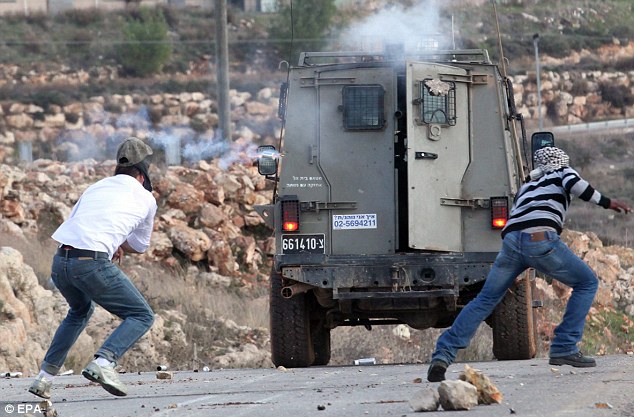
Last night we saw three vehicles tear through the village. What follows is typical of villages across the West Bank. Children who are already on the streets start nervously at first, but soon with collective confidence, throwing stones at the IDF vehicles. We were caught out of position (between the IDF and some stone throwing kids) and so take cover in a shop. The IDF then lets off a couple of sound grenades before tearing out the village, leaving a cloud of dust behind them.

In the aftermath of this relatively small incident I talked to some of the young men on the street. One, who proudly boasts that the IDF ‘questioned him’ comments, “they asked me if I threw stones and I said no”. A stone slips out of his hand. Mostly the boys and young men are excited and exhilarated by the whole episode.

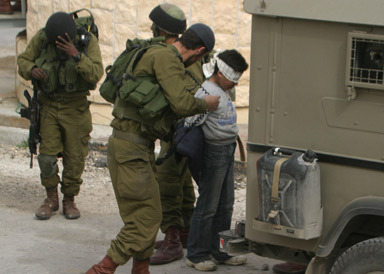
This however is in stark contrast to the Mayor of the village who I visited a few days previously. His son had been arrested during the raid on the village the night before. There is no excitement in his eyes, no exhilaration, just tired resignation. The sight of his children being taken away blindfolded and bound is all too familiar. His house had been broken into and turned upside down in search of weapons that were never found.

One ex-IDF soldier told me recently that in hundreds of house raids he conducted, he only ever found one gun. In his words, “This is about power and intimidation, not arms”.

These arrests have both immediate and long term consequences. Firstly, the children are detained, normally in the early hours, by being blindfolded and bound by armed soldiers. This is a terrifying experience by itself. The NGO Defence for Children International however describe in detail the procedure which arrested children can experience, including, no access to legal help, reports of torture and forced confessions. This treatment leaves a lasting legacy on the attitudes of these children.

The detention of minors, in this manner, clearly violates the UN Convention on the Rights of the Child (article 3) and the UN Convention against Torture. What is most concerning however, is the lack of accountability throughout this system. It is often a battle to ascertain the location of any prisoner, let alone their welfare. There are entire organisations established just to help people track the whereabouts of those detained.

Those who are left in villages like Jayyus are left to hope and pray to their God to protect the children they could not. Not knowing where their children are and when (or if) they will be released, is something no parent should have to go through. As NGOs such as Yesh Din work to protect the basic rights of these children, all that is left to do for those in the village is to start sweeping up the broken glass and to keep praying to their God.

3 Comments

Filed under Human rights, Middle East, Politics, War

The death of Mustafa Tamimi highlights a lack of accountability in the Occupied Palestinian Territories.

The death of Mustafa Tamimi is another example of people suffering from the misuse of tear gas in Israel and The Occupied Palestinian Territories. We have witnessed a series of deaths and injuries in recent years from tear gas canisters being fired directly at crowds. Tristan Anderson of Oakland California is suffering from brain damage, paralysis and seizures after he was hit in the head by a canister at a 2009 demonstration.

The Israeli army has described Mr Tamimi’s death as an ‘exceptional incident’; sadly we know this to not be the case. IDF regulations prohibit firing tear gas directly at people. It would appear though that the military regularly violates its own regulations at Palestinian demonstrations in the West Bank. In April 2009, Bassem Abu-Rahmah, from the village of Bil’in, was killed by a tear gas canister that struck him in the chest.  B’Tselem has been warning officials about security forces’ fire tear-gas canisters directly at persons during demonstrations for some time now.

The IDF commanders need to leave in soldiers mind no doubt that they will face disciplinary action if they are caught firing directly at people with tear gas canisters. At the moment the lack of accountability is only entrenching this problem. Soldiers, and ultimately if orders are given, their commanders must face consequences for their actions.

Even the Daily Mail thinks it is a problem – enough said.

3 Comments

Filed under Uncategorized