This is a feature piece written for OUT magazine.
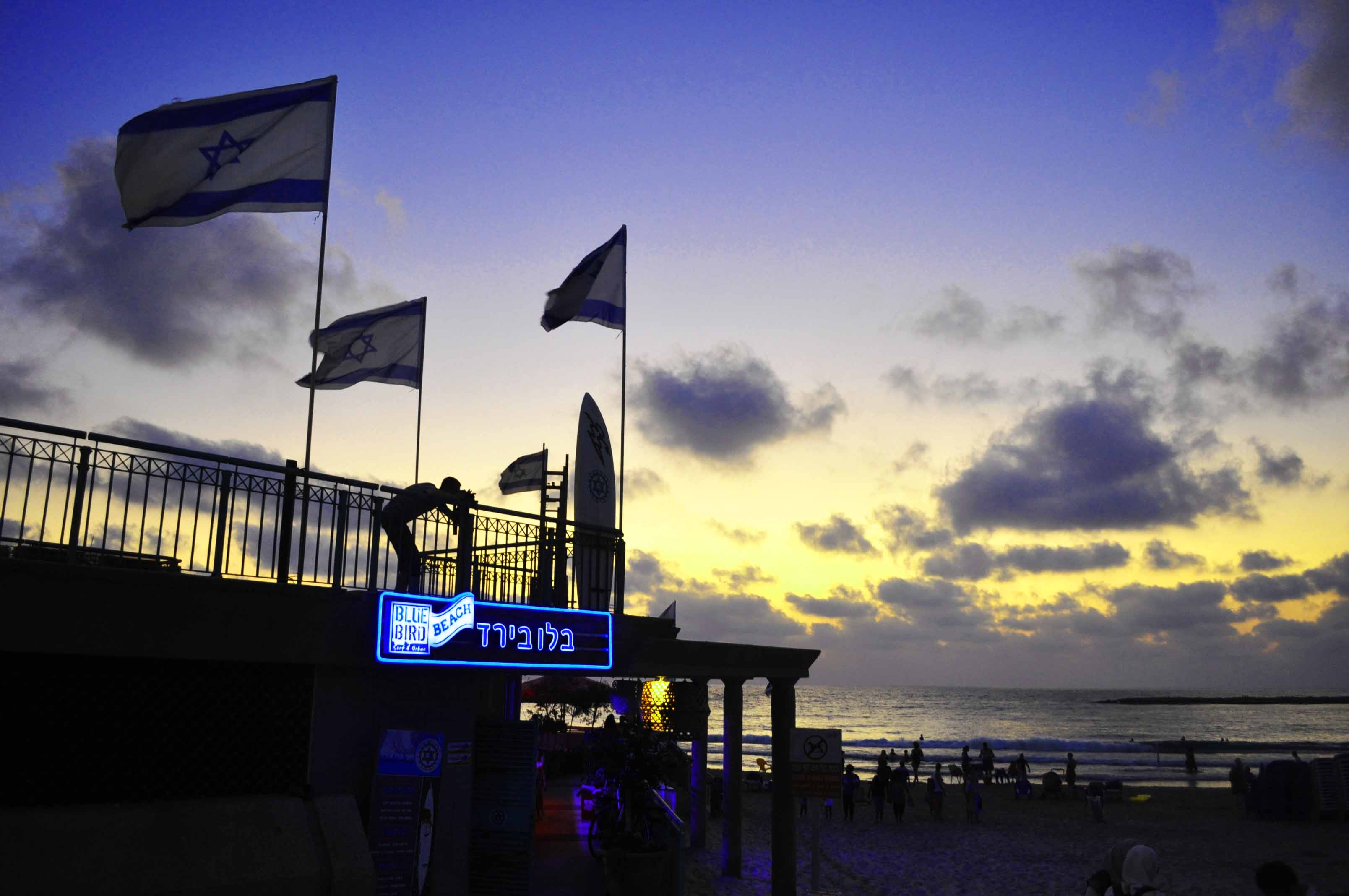
Sat in the evening sun Shaun shifts closer to Paul as the temperature drops in the fading light. I meet the couple sat on a beach in Tel Aviv, Israel. The two men in their mid thirties are on a couple of weeks vacation from their home in south London. I ask them if it is OK to talk to them about the gay scene in Israel and they happily suggest going for beer in the bar a hundred meters away on the beach front.
Sweet smelling smoke fills the air inside the bar as hookah pipes are shared between friends. We are sat with panoramic views of the now silhouetted beach front. Passing the hookah pipe across the table to where the two men are sat side by side I start the interview by asking them why they chose Tel Aviv for their holiday. Paul exhales a plume of smoke, takes a sip from his beer and jokes, “cheap easy jet flights”. Shaun laughs and adds, “I just love the rub down at the [Ben Gurion] airport” (referring to the notoriously inhospitable welcoming foreigners receive at the airport).
With a smile I try a less subtle approach and asked if it had anything to do with the internationally renowned LGBT scene in Tel Aviv. Paul does not hesitate this time and comments, “We want to holiday somewhere that we feel relaxed and welcome. A friend of mine told me about Tel Aviv and so we thought we would check it out”. As an afterthought, as if recalling a distant memory, he adds, “everything is set up for us here”.
Tel Aviv is a well known destination for ‘gay tourism’. Last year Tel Aviv launched a $90 million campaign to present itself as, “an international gay vacation destination.” Leon Avigad, owner of the gay-friendly Brown hotel, explains the city’s popularity, “We are cosmopolitan, we’re very Western, European and American but on the other hand we’re very much into the Middle Eastern warmth and welcoming, and this combination attracts”.
Our visit to Tel Aviv coincide with the holiday of Pesach (Passover), the celebration of the story in Exodus where the ancient Israelites were freed from slavery in Egypt. As such it is very difficult to buy certain things such as beers and certain breads. I ask Shaun if this has been a problem and he responds with more depth than I was perhaps expecting. “I think it is beautiful that this society can hold onto its traditions and religious celebrations and still be so open minded”. I wondered how much Shaun had ventured much beyond the city since being here.
On cue, they ask me what I am doing in Tel Aviv and I tell them all about EAPPI and they seem genuinely interested. I ask them if they have ever been to the occupied Palestinian territories. Paul responds with a degree of defensiveness in his voice that he assumed he wasn’t allowed, “I thought there was a war there”. I explain to them, the best I can, the problems caused by the occupation and what I have experienced since living there. I elaborate my point about why I think it is bad for both Israelis and Palestinians. There is a more than awkward silence and I begin to worry that I might have pushed the conversation both metaphorically and literally too far from Tel Aviv.
As if reading my mind Paul comments, “all of that seems a long way from here”. I take this opportunity to try and relate what is happening in the conflict to their experiences here in Tel Aviv and ask if either of them have ever heard of the phrase, “pinkwash”. They respond in unison, “no”. I try my best to offer a definition of Pinkwash – the idea that Israel has created a deliberate strategy to conceal their continuing violations of Palestinians’ human rights behind an image of modernity, illustrated through the booming gay scene. Both men looked troubled at the idea, clearly concerned that “their community” and “their choices” could somehow be linked to the troubles I had just described about the military occupation.
I try to reassure my two new friends and joke with them that they are not responsible for Israel’s occupation. For Paul however this was not enough. Playing with the beer mat in front of him he almost apologetically comments, “I guess we have only seen a part of life here”. I smile and again try to reassure them both that they are meant to be on holiday relaxing, not peacekeeping. They sheepishly smile back.
For many in the LGBT community it is an ethical dilemma whether or not to boycott Israel as a holiday destination. On one hand it is a beacon of LGBT rights in an otherwise very hostile environment. Some Palestinian activists have tried to persuade me that there is a growing gay rights movement in Palestine. If there is I have yet to stumble across it. Netanyahu told Congress last May that the Middle East was “a region where women are stoned, gays are hanged, and Christians are persecuted.” Sadly, this rhetoric may be alarmist but has also an element of truth in it.
On the other hand however Israel is accused by Amnesty International of “ill-treatment and torture of detainees, excessive use of force, the detention of conscientious objectors, and forced evictions and home demolitions” as well as having a “disregard for international law”. For anyone within the LGBT community who is concerned about equal rights and equality there are some clear moral concerns here.
As an LGBT activist who fundamentally believes in an equality of rights, I cannot settle on Israel having a progressive attitude towards LGBT rights whilst routinely violating other rights through the conflict and occupation. As Haneen Maikay, the director of Al Qaws (a Palestinian gay rights group) recently said in the New York Times, “When you go through a checkpoint it does not matter what the sexuality of the soldier is”. The LGBT community are not separate from the rest of society who suffer from the occupation.
We are now three beers into the conversation and Shaun’s tongue as well as his sense of moral outrage has been loosened, “So what can we do to highlight all this. It’s f***ed up that people can come here and are not told about any of this s***”. Partly through tiredness I decide to avoid the minefield of BDS (boycott disinvestment and sanctions) and instead simply comment that I think it is important to make sure that everyone who comes to Tel Aviv is aware of what is happening just 20 kilometres to the east.
Paul however looks concerned. I have been talking for the last ten minutes and Paul has not spoken. “I don’t know” he says between regular slugs of beer. “there are so many f***ed up countries in the world where you can get hung for just glancing at another guy. It doesn’t feel right to be criticising a country who are opening their arms and welcoming us”. This concern reflects a very real issue within the LGBT community. To criticise Israel is to break an unspoken pact where those working on LGBT issues stand united in their struggle.
The answer to this dilemma presented itself to me in Yad Veshem, the Israeli holocaust museum. Here they have on the wall in large letters the poignant words of Martin Niemöller “First they came for the communists, and I didn’t speak out because I wasn’t a communist. Then they came for the trade unionists, and I didn’t speak out because I wasn’t a trade unionist. Then they came for the Jews, and I didn’t speak out because I wasn’t a Jew. Then they came for me and there was no one left to speak out for me”.
If the 20th century taught us anything it is that silence can allow terrible things to happen. The LGBT community cannot stay silent while Israel uses its progressive attitude towards LGBT tourism to deflect attention from the continual violations of basic human rights standards in the occupied territories. Equally however, I believe we have to welcome Israel’s pioneering approach towards LGBT tourism, and encourage these attitudes to spread to less hospitable parts of Israeli society.
Stood outside the bar, the air is now cold and so our good-byes are short. As the two men turn to leave Paul says to me that “next time we come, I think we should spend a few nights somewhere in the West Bank”. I smile and say that they definitely should. Parts of Israeli society may be a beacon for LGBT rights in the middle east, but it is also an occupier of another land. To understand Israel, I think you have to visit that other land.
Be one of the cool kids and share this article









 The former legal advisor for Judea and Samaria,

 Hynd's Blog
24 hours in Hebron
18:00 I arrived in Hebron repeating the simple instruction over in my head “get out of the bus at Happy Bunny Restaurant”. However many times I said it in my head I just couldn’t quite bring myself to mutter these words out loud. Inevitably the time came when the driver turns and questions, “where”? I respond, “Err…Happy…Bunny…restaurant”. He beams a smile, “of course”. I am whisked to my destination and my nights’ accommodation (a house close to the restaurant, not the restaurant itself).
22:00 Stood in the centre of the closed part of the old city in Hebron I look at some 3,000 year old remains of ‘ancient Hebron’. It looks like rocks to me, but I will concede that they look like slightly more useful rocks than the really old ones by my house in the UK (Stonehenge).
We are stood a few meters from one of the settlements in the middle of Hebron and just down the road from a Israeli family who are due to be evicted in the coming weeks (tensions are high). A soldier approaches us and asks where we are going and before I can answer looks over his shoulder and says, “oh the cave”? (or it could have been “grave”, I wasn’t sure). I, possibly foolishly, replied “yeah the crave” (hedging my bets between a cave and a grave). He then radio’s in to see if it is ok for us to go and look at the cave/grave.
After a few minutes of the soldiers having a ‘boy competition’ (defined universally as making a competition out of something that really shouldn’t be a competition, eg – hitting a balloon to each other becomes “can we hit it to each other 100 times with just our left hand” or in this case “who can shine their lazer on their rifles the furthest”) they decide that it is OK to go look at the cave/grave. We smile and walk to the dead end.
25 meters up the road and we see 6 soldiers waiting outside a military base next to the before mentioned settlement. I tried to casually scan where I was as if I of course know exactly where the cave/grave is. One soldier nods his head towards the far corner. Two options present themselves, the first is the military base and the second is a Palestinian families house. My colleague takes control and walks confidently into the Palestinian house where she knows the family. We stop and say our hellos to the family and ask about this cave/grave…apparently it is where someone from the old testament is buried and it is inside the military base. I leave the house still not sure if it is a cave or a grave but figured I had bigger fish to fry. I didn’t have the nerve or inclination to walk back out onto the street so we slump off down the path at the back of the house.
If nothing else it is nice to see the IDF trust us enough to enter into a military base unaccompanied at ten o’clock at night.
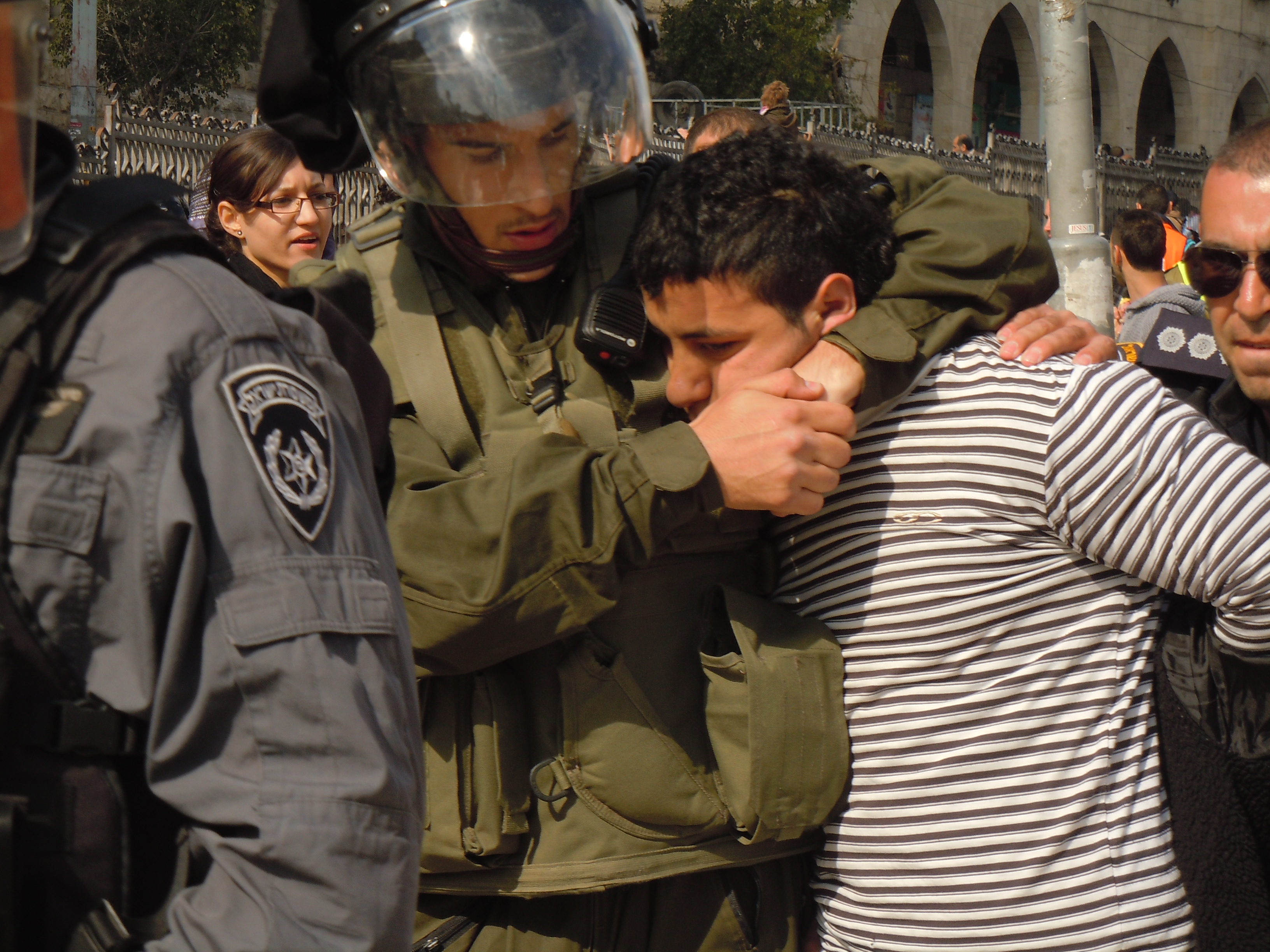
On the way home we see three Palestinians being held up at the checkpoint at the top of Shuhada Street. We stop and monitor the situation. If they are held for over 20 minutes we call the Temporary International Presence in Hebron (TIPH) for support before calling the ICRC. Inevitably the soldiers releases the men after 18 minutes. As we pass the soldiers there is an awkward acknowledgement that these were the same soldiers who had just given us permission to enter their base to see the cave/grave. I try to keep it nice and ask “is it ok to go into the ‘crave’ anytime”?. The soldier looks at me alarmed, “you want to go into the grave”?
23:00 – I fall asleep under a purple Disney duvet.
12:30 – After everything that could be said about Hebron has been said we left the German’s to make their way pass a checkpoint into the old souq. I see at least three of them tut at the soldier on the way past. I make a conscious note that I need to work on my middle class indignation.
13:00 – I see a character walking towards me down Shuhada Street. He looks Israeli, but doesn’t look like one of the settlers living in Hebron (he’s smiling to start with). My inner suspicions are aroused though when he asks where we have just been. I pull out the leaflet I picked up by Abrahams grave (although interestingly he was also meant to have been buried in a ‘cave’ – all very confusing) and thrust it into his hands. Triumphant in the fact that I had not only been to a tourist hot spot but I had proof that I had been into the “Jewish half” of the mosque/synagogue/holy site (don’t ask…Jews and Muslims go in separate doors and can see the same grave/cave but from different sides and are separated by bullet proof glass). He looks at it and mutters he hasn’t been there yet. I am a little disappointed but crack on with conversation.
He turns out to be called Michael and lives just to the South of Tel Aviv. Apart from being a bloody nice guy he also enjoyed liberally sprinkling in words like ‘Plato’ and ‘Power Dynamics’ into conversation. In other words, he was my sort of chap. He described himself as “on the left” of Israeli politics before he rubbished the very concept of ‘left and right politics’ in Israel. He was passionately ‘Jewish’ (and trust me when I say we didn’t use this term lightly, about half of our conversation was on how to define ‘being Jewish’) and to say he was well read was an understatement. About three hours of conversation in the heat of the day later we decide to go and grab some food…he chooses the Gutnick Centre (a Jewish cafe and community centre in the centre of Hebron that is known to the International community as being ‘pro-settlers’).
On the way to lunch Michael wants to walk on the ‘Palestinian side’ of the divided street. I am interested to see what happens so don’t stop him. When we get to the soldier at the top, the soldier tells him he is “lucky to escape with his life”. Michael smiles and we go and drink coffee with some ‘dangerous’ Palestinian shop keepers. We take off our EAPPI jackets in the shop and leave them there before going into the Gutnick centre. This was to avoid provocation but we are also not allowed in wearing the vests. Dangerous pacifist peace workers? We sit down on a table opposite some soldiers and have a nice lunch.
Sometimes the word ‘surreal’ just doesn’t quite cover it.
By this point we have walked to the outskirts of one of the settlements. I ask the soldier if it is ok for us to be there and the soldier and Michael respond in unison “of course”. The ‘white soldiers’ are now pretending to search a playground and I watch on in fascination. This was not something I had expected from Hebron but I was enjoying myself.
In a split second however this whole jubilant atmosphere was shattered by the one and only Anat Cohen – a notoriously aggressive settler. She came out of a house and started screaming at me (ignoring the Israelis I was with) and stamping on my ankles. As she screamed at me I felt flecks of her saliva land on my face. I consciously decide not to wipe it off because I don’t want to be accused of ‘raising my hand’. I looked over her tiny angry shoulders to the soldier looking on. He gives me a comic shrug and looks helpless. I say it is OK, and we will go. The four of us (three internationals and Michael) walk off. She (Anat Cohen) follows me pushing me in my back and shouting. The soldier walks on behind and signals to his colleague in the distance to come. The new soldier asks, “did you do anything”? I smiled and said “of course not”. The soldier tuts a knowing tut and we walk for another 200 meters with Anat Cohen following me stamping on my ankles and screaming at me. While the soldier does nothing. When we stop to enter into a ‘Palestinian only’ part of town we finally say goodbye to Michael and Anat Cohen stares at us both and takes our photos.
I feel really sad that someone could feel that much anger and hatred to a stranger that she has never met or spoken to. I feel worse though for anyone that has to put up with her day in day out.
Michael, the soldier, Anat Cohen, the history, the conflict, the division…all just 24 hours in Hebron.
Be one of the cool kids and share this article
9 Comments
Filed under Middle East, Social comment
Tagged as Anat Cohen, EAPPI, Hebron, Human rights, IDF art, settlements in Hebron, White soldiers in Hebron