This is a feature piece written for OUT magazine.
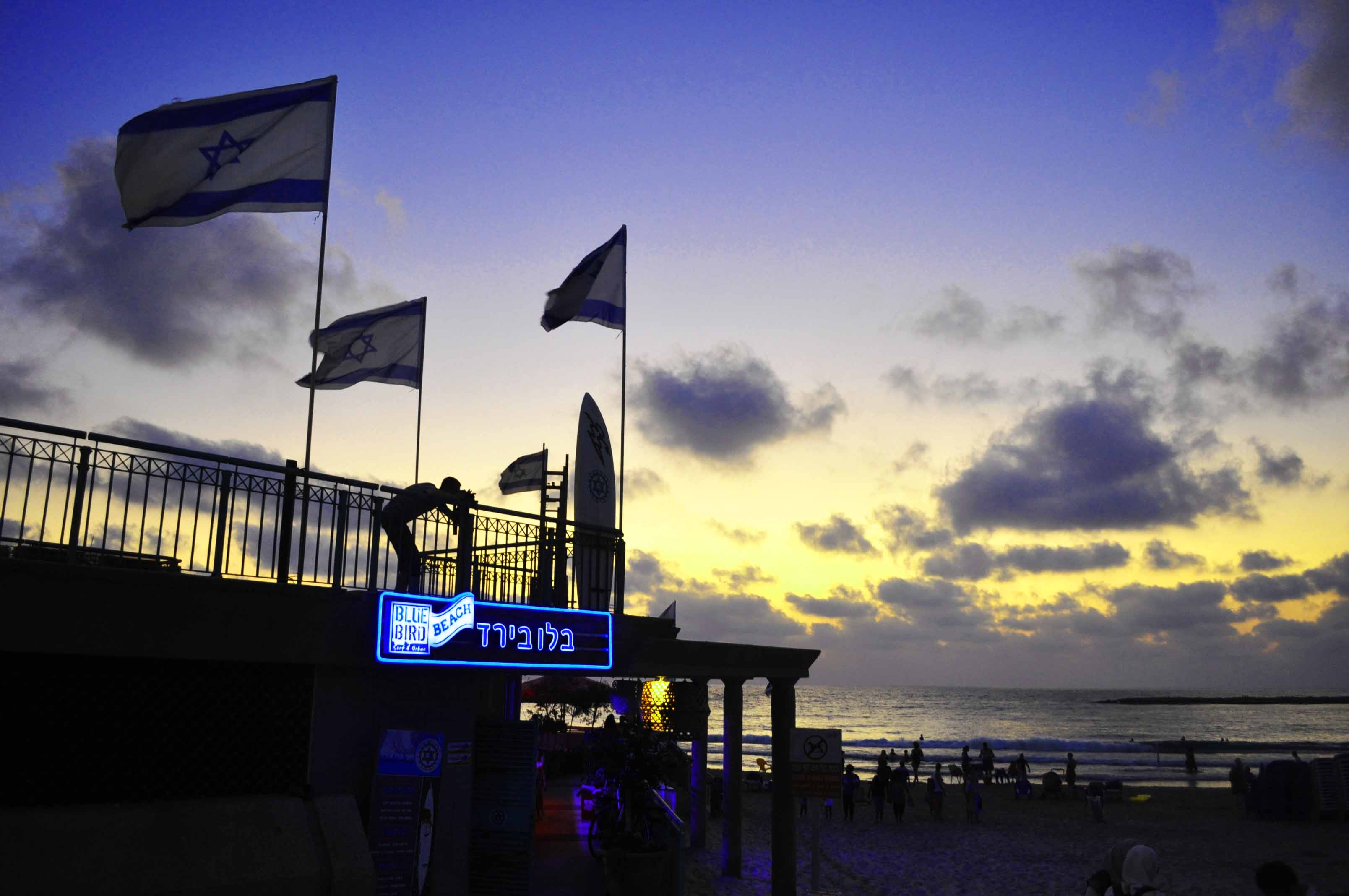
Sat in the evening sun Shaun shifts closer to Paul as the temperature drops in the fading light. I meet the couple sat on a beach in Tel Aviv, Israel. The two men in their mid thirties are on a couple of weeks vacation from their home in south London. I ask them if it is OK to talk to them about the gay scene in Israel and they happily suggest going for beer in the bar a hundred meters away on the beach front.
Sweet smelling smoke fills the air inside the bar as hookah pipes are shared between friends. We are sat with panoramic views of the now silhouetted beach front. Passing the hookah pipe across the table to where the two men are sat side by side I start the interview by asking them why they chose Tel Aviv for their holiday. Paul exhales a plume of smoke, takes a sip from his beer and jokes, “cheap easy jet flights”. Shaun laughs and adds, “I just love the rub down at the [Ben Gurion] airport” (referring to the notoriously inhospitable welcoming foreigners receive at the airport).
With a smile I try a less subtle approach and asked if it had anything to do with the internationally renowned LGBT scene in Tel Aviv. Paul does not hesitate this time and comments, “We want to holiday somewhere that we feel relaxed and welcome. A friend of mine told me about Tel Aviv and so we thought we would check it out”. As an afterthought, as if recalling a distant memory, he adds, “everything is set up for us here”.
Tel Aviv is a well known destination for ‘gay tourism’. Last year Tel Aviv launched a $90 million campaign to present itself as, “an international gay vacation destination.” Leon Avigad, owner of the gay-friendly Brown hotel, explains the city’s popularity, “We are cosmopolitan, we’re very Western, European and American but on the other hand we’re very much into the Middle Eastern warmth and welcoming, and this combination attracts”.
Our visit to Tel Aviv coincide with the holiday of Pesach (Passover), the celebration of the story in Exodus where the ancient Israelites were freed from slavery in Egypt. As such it is very difficult to buy certain things such as beers and certain breads. I ask Shaun if this has been a problem and he responds with more depth than I was perhaps expecting. “I think it is beautiful that this society can hold onto its traditions and religious celebrations and still be so open minded”. I wondered how much Shaun had ventured much beyond the city since being here.
On cue, they ask me what I am doing in Tel Aviv and I tell them all about EAPPI and they seem genuinely interested. I ask them if they have ever been to the occupied Palestinian territories. Paul responds with a degree of defensiveness in his voice that he assumed he wasn’t allowed, “I thought there was a war there”. I explain to them, the best I can, the problems caused by the occupation and what I have experienced since living there. I elaborate my point about why I think it is bad for both Israelis and Palestinians. There is a more than awkward silence and I begin to worry that I might have pushed the conversation both metaphorically and literally too far from Tel Aviv.
As if reading my mind Paul comments, “all of that seems a long way from here”. I take this opportunity to try and relate what is happening in the conflict to their experiences here in Tel Aviv and ask if either of them have ever heard of the phrase, “pinkwash”. They respond in unison, “no”. I try my best to offer a definition of Pinkwash – the idea that Israel has created a deliberate strategy to conceal their continuing violations of Palestinians’ human rights behind an image of modernity, illustrated through the booming gay scene. Both men looked troubled at the idea, clearly concerned that “their community” and “their choices” could somehow be linked to the troubles I had just described about the military occupation.
I try to reassure my two new friends and joke with them that they are not responsible for Israel’s occupation. For Paul however this was not enough. Playing with the beer mat in front of him he almost apologetically comments, “I guess we have only seen a part of life here”. I smile and again try to reassure them both that they are meant to be on holiday relaxing, not peacekeeping. They sheepishly smile back.
For many in the LGBT community it is an ethical dilemma whether or not to boycott Israel as a holiday destination. On one hand it is a beacon of LGBT rights in an otherwise very hostile environment. Some Palestinian activists have tried to persuade me that there is a growing gay rights movement in Palestine. If there is I have yet to stumble across it. Netanyahu told Congress last May that the Middle East was “a region where women are stoned, gays are hanged, and Christians are persecuted.” Sadly, this rhetoric may be alarmist but has also an element of truth in it.
On the other hand however Israel is accused by Amnesty International of “ill-treatment and torture of detainees, excessive use of force, the detention of conscientious objectors, and forced evictions and home demolitions” as well as having a “disregard for international law”. For anyone within the LGBT community who is concerned about equal rights and equality there are some clear moral concerns here.
As an LGBT activist who fundamentally believes in an equality of rights, I cannot settle on Israel having a progressive attitude towards LGBT rights whilst routinely violating other rights through the conflict and occupation. As Haneen Maikay, the director of Al Qaws (a Palestinian gay rights group) recently said in the New York Times, “When you go through a checkpoint it does not matter what the sexuality of the soldier is”. The LGBT community are not separate from the rest of society who suffer from the occupation.
We are now three beers into the conversation and Shaun’s tongue as well as his sense of moral outrage has been loosened, “So what can we do to highlight all this. It’s f***ed up that people can come here and are not told about any of this s***”. Partly through tiredness I decide to avoid the minefield of BDS (boycott disinvestment and sanctions) and instead simply comment that I think it is important to make sure that everyone who comes to Tel Aviv is aware of what is happening just 20 kilometres to the east.
Paul however looks concerned. I have been talking for the last ten minutes and Paul has not spoken. “I don’t know” he says between regular slugs of beer. “there are so many f***ed up countries in the world where you can get hung for just glancing at another guy. It doesn’t feel right to be criticising a country who are opening their arms and welcoming us”. This concern reflects a very real issue within the LGBT community. To criticise Israel is to break an unspoken pact where those working on LGBT issues stand united in their struggle.
The answer to this dilemma presented itself to me in Yad Veshem, the Israeli holocaust museum. Here they have on the wall in large letters the poignant words of Martin Niemöller “First they came for the communists, and I didn’t speak out because I wasn’t a communist. Then they came for the trade unionists, and I didn’t speak out because I wasn’t a trade unionist. Then they came for the Jews, and I didn’t speak out because I wasn’t a Jew. Then they came for me and there was no one left to speak out for me”.
If the 20th century taught us anything it is that silence can allow terrible things to happen. The LGBT community cannot stay silent while Israel uses its progressive attitude towards LGBT tourism to deflect attention from the continual violations of basic human rights standards in the occupied territories. Equally however, I believe we have to welcome Israel’s pioneering approach towards LGBT tourism, and encourage these attitudes to spread to less hospitable parts of Israeli society.
Stood outside the bar, the air is now cold and so our good-byes are short. As the two men turn to leave Paul says to me that “next time we come, I think we should spend a few nights somewhere in the West Bank”. I smile and say that they definitely should. Parts of Israeli society may be a beacon for LGBT rights in the middle east, but it is also an occupier of another land. To understand Israel, I think you have to visit that other land.
Be one of the cool kids and share this article


 Hynd's Blog
The whispered words of Musa Okwonga
I am fully aware how limited this platform, Hynd’s Blog, is. But still, I keep adding to this platform because if you do not dare to whisper out loud the things that are important to you, they will never be heard.
Someone who whispers with more wisdom and wit than I could ever imagine mustering is the poet and journalist, Musa Okwonga. Musa has unwittingly been on-going source of inspiration to me over the last few years.
He has a turn of phrase unmatched and yet, inexplicably, he is yet to become a household name.
Let me give you a few examples of why I think he deserves to be huge:
I spend a lot of my time trying to articulate the blight of racism in football. I struggle though, constantly, to put into words the human stories that football projects without losing the impact and influence the game holds.
In response to Roberto Carlos’ decision to walk off a pitch after a banana was thrown at him; Musa articulated these imagined thoughts of Roberto in the first person:
“I am a man first, and a footballer second. I am a grown man, not an animal, and I am not a creature on display for your entertainment. You have come to a stadium, to watch human beings play football. This is my place of work, and if you will treat it like a zoo, I will show that this pitch is not a cage, and I will leave it.”
And thus he treads that fine line that I so often miss.
A second example: Whenever I dare to whisper out loud about something personal to me such as my family or my partner I instantly clam up with dread. Exposing yourself on the internet’s oh so very social platforms, is something that I think people under-estimate. Just as standing on a stage to perform takes admirable courage, so I also think, writing about personal issues online does.
Musa, in an ever self-effacing way, manages to both perform and write about the most personal of issues with a confidence and coherence I cannot help but to admire. Here I would urge you to watch his performance of his poem, ‘Passport’.
But, it is when he integrates this personal with the overtly political does he really come into his own.
At this point, I would urge you to watch his performance of his poem, ‘Love versus Homophobia’. It is an articulate outpouring of anger at the ambivalence, arrogance and anger that some people hold for his understanding of love.
Now, don’t get me wrong. I don’t think the Vatican will be playing this on loop. Nor do I think the US or UK government’s will be listening to his latest poem, ‘Monotony’. But I leave you with this because, he has dared to whisper these words out loud not knowing who will hear them. All I can do is echo them and ask you to do the same.
This is our monotony:
They bring the most hateful of rainfalls,
And don’t make apologies:
They send storms from the jaws of a drone
To slay those who’d take the USA off its throne –
So each day, we’re preparing for rain;
For these drops not of water
But rage;
Wait –
All you’ll hear is the hum as they’re closing
A teenaged male isn’t safe in the open –
So we’ve taught them to run,
Our daughters and sons –
Taught them something most terrible:
That here in Yemen, it is never wise
To gaze up and daydream into our own skies:
This is –
The only way, we are told;
That’s not so bad as it goes:
No:
Shattered bone,
Shattered hope,
Shattered homes,
We all raise our eyes at the drones –
And so:
In many decades, our youth will explain
Why, when about town, they still walk with necks craned
Be one of the cool kids and share this article
Leave a comment
Filed under sexuality, Social comment, Spoken Word
Tagged as Musa Okwonga, poetry