Category Archives: Sport

Some reflections on learning to kayak on the River Nile

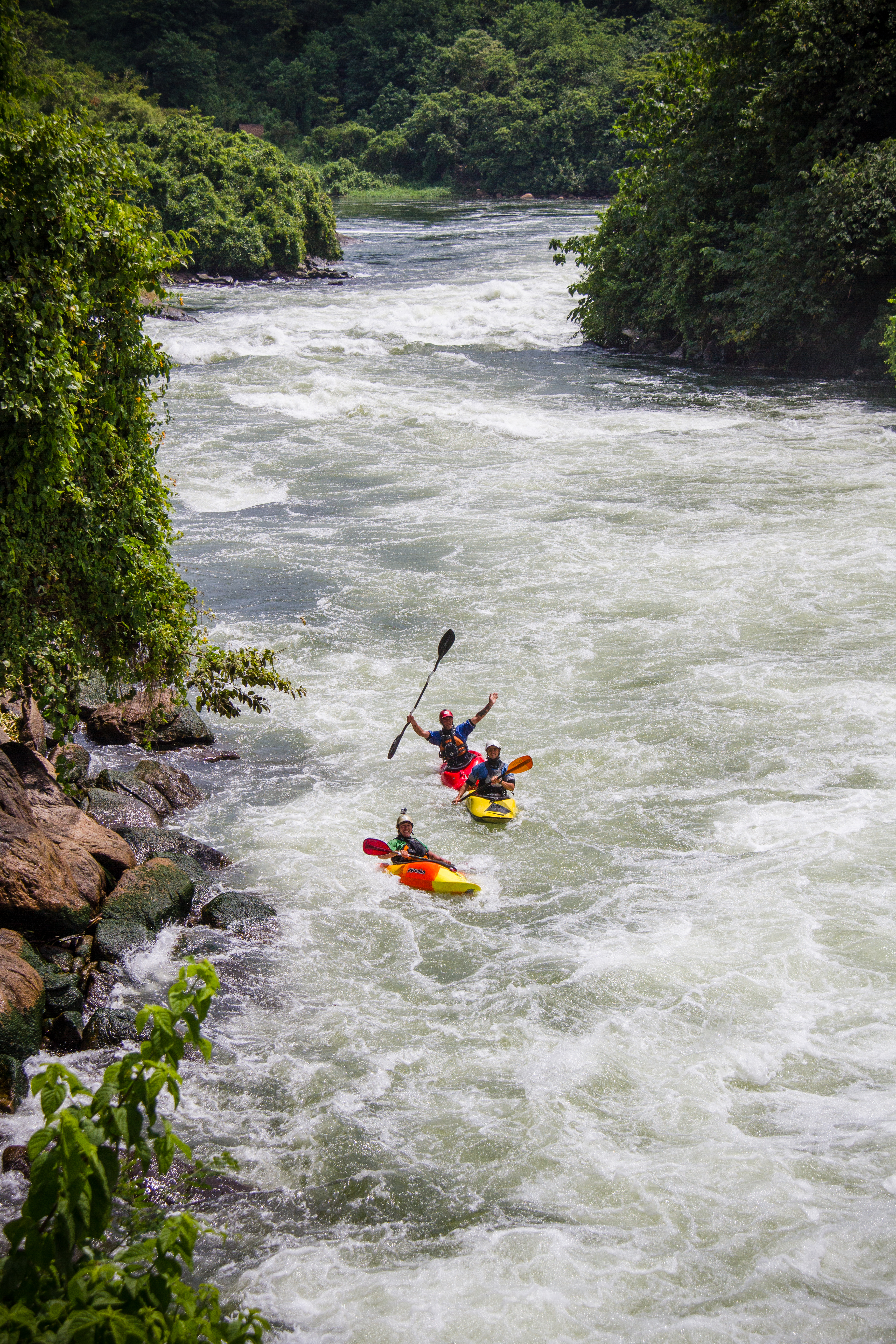
Paddling past 'The Bad Place' on the River Nile

Paddling past ‘The Bad Place’ on the River Nile

I have always loved the outdoors and growing up I occasionally ventured out onto the flat waters of the River Wye, close to my parent’s house in the UK, to do some paddling with my local scout group.

As much as enjoyed these ventures out into the pleasant surroundings of the Wye valley, kayaking remained for me a sport that failed to conjure the passion or excitement of other sports I loved in my teenage years such as mountaineering, football or skiing.

When I moved to Uganda then, it took me almost a whole year until I was persuaded by friends into trying my hand at white-water kayaking on the River Nile.

In retrospect my biggest regret is that I waited this long to try it. Equally though, it was far from love at first sight, or perhaps a more appropriate axiom, all plain sailing from the start.

Getting off the water at the end of the first lesson I knew that a seed had been planted that had the potential to grow into a real passion. I made a conscious choice, despite feeling apprehensive, to give this seed the best chance possible to grow and booked myself onto an additional four lessons with the kayak school ‘Kayak the Nile’.

At that stage, I can remember distinctly feeling that my enthusiasm for kayaking could go either way. As much as I enjoyed the adrenalin of kayaking my first rapid, I also remember a few hours earlier the less pleasurable spluttering for air as I first attempted an upside-down ‘t-rescue’.

Looking back on the last 10 months of padding, I can see though that it was as much the spluttering for air moments, the times I had to work hard, to persevere at practicing skills as it was the exciting splashing down rapids that have helped grow my initial excitement into a real passion.

The hours I spent alone in mate’s swimming pools practising, sometimes successfully and sometimes not, my flat-water role and the sense of achievement at now rolling in (quite) big white-water stands as just one illustration of this.

Unlike some friends that I see now out on the water I don’t feel like kayaking came naturally to me. It took me a bit longer than what I have observed to be ‘normal’ to start feeling relaxed out on the water and especially upside-down.

Even now, 10 months after starting this sport, I still feel panicked when I move into territories that are new to me. Just last weekend I went to surf a wave that was much larger than I was used to and this filled me with an apprehension that, at least in part, dictated how I kayaked on the wave.

It only seems fair at this point to give a virtual hat-tip to the instructors of ‘Kayak the Nile’ who seemed to instinctively know that when I said my goal was to ‘feel in control on the wave’ I was not just referring to the physical challenge of staying up-right but the psychological one of staying relaxed and confident.

Without the careful and consistent guidance of the instructors I am convinced that my seedling of passion planted on that first lesson could easily have been flushed away at any moment.

For as much as I am grateful to the instructors though it is an interesting reflection to note that learning to kayak is also a lot about learning to understand and control yourself. It is not just about taught new skills.

It might sound like an exaggeration to say kayaking teaches you to ‘learn about yourself’ but from a personal experience I can say that one of the most rewarding parts of learning to kayak has been the journey of learning to stay psychologically more in control (for I still don’t feel 100% in control) out on the water.

My passion for kayaking on the Nile though goes beyond all of this.

There is something really profoundly special about being about being on such a huge powerful expanse of water.

Out the Nile I feel something comparable to how I do in large mountain ranges. I feel a sense of my own size and vulnerability in the grand scheme of nature, I feel a sense of wonder at the amazing beauty that surrounds me and a sense of profound appreciation that I am lucky enough to have experienced it.

Even the experience of being near the Nile the night before feels magical. I love waking up after camping on the banks of Nile to see the strong sunlight breaking through the trees with the sort of intensity you only really get on the equator. I love lying in my tent hearing the powerful sound of the water in the rapids carving itself through the rocks in the Nile. I love the, admittedly quite hippy, idea that kayaking is about harnessing the amazing power of nature and working with it.

DSCN5090

Most of all though I think enjoy sharing this passion with people. I love seeing friends do their first lesson, first roll, or first trick on a wave. I love watching those with less experience than me and seeing them progress as much as I love watching those with far more experience than me and feeling that mixture of aspiration and dread about what I might, or might not, be able to achieve in the future.

When I move away from the paddler’s paradise of the River Nile I have no idea if this passion will stay with me but I do know that at this moment I really hope it does.

Leave a comment

Filed under Sport, Travel, Uganda

My guide on how not to prepare and run a half marathon

In pain after my latest 21km of badly prepared for running

In pain after my latest 21km of badly prepared for running

‘A specialist in failure’ is how would so far sum up my running career. Three half marathons spread over 5 years and each one has, in its own way been a gigantic disaster.

Firstly my running history…

At the 2009 Brussel’s half marathon I undertook some serious training and at the nimble age of 23 I thought I might have a good chance of running it in a half decent time. I have since learnt that pints of gin and tonics the night before are not the best preparation for a 21km run.

Despite the hangover I stumbled round the course in 2:10.

Of course, the 2009 Brussel’s half marathon was meant as a warm up 5 weeks before the Stroud half marathon in the UK. Sadly, after literally stumbling over the finish line in Brussels and then starting a new job, my training schedule essentially ceased to exist.  I stopped running.

Again, I have since learnt that doing no exercise 5 weeks before a 21km is not such a good idea. However, hangover free and with a good night’s sleep behind me I managed to cut 10 minutes off my time and sneaked in just under 2 hours (notably 7 minutes slower that my to be father in law who is in his 50s and was running his first half marathon at the time).

On this latter occasion though I was running to raise some money for CLIC Sargent – an organisation that provides care for young people with cancer. So the money raised for a good cause provided a nice silver lining in Stroud.

For the last 5 years though I have dwelled slightly on these two relative failure of runs and always thought that I could, if I avoided being drunk and kept to a training schedule, manage to run a half marathon in a way that I was proud.

And so, 5 weeks ago I decided to sign up for the ‘Run for Fun’ race between Entebbe and Kampala here in Uganda.

I haven’t really run (let alone for fun) since 2009 and so the observant amongst you might have spotted a flaw already – 5 weeks really is not long enough to prepare for a half marathon.

However what I lacked in time, fitness and basic training I made up for in optimism. I not only signed up but also decided to start fundraising for the ‘The African Palliative Care Association’ (see ‘Why I am running for APCA’).

The problem with fundraising for a great cause is that it means you have to go public – you have to share your fundraising page on facebook, twitter and your blog etc. In other words, in my mind at least, there was no backing out.

2 weeks into my inadequate 5 week training I hit a rather painful stumbling block. Once again alcohol was at the root of the problem. Rather drunkenly on a Friday night I fell off the top of a moving Land Rover (spare me the ‘it could have been a lot worse’ comments, I quite realize this).

Luckily I did nothing more than land heavily on my bum – although it could have indeed been a lot worse.

This little alcohol induced stumble though did cause a lot of swelling all round my hip which took about 2 weeks to go down and left all of my muscles feeling rather tight.

For the last week before the date of the half marathon then I did not (could not) run. All I could do was a lot of stretching.

By the time the run came about my leg was feeling ‘OK’ with the exception of my groin that was still feeling tight on my right side.

In retrospect I had my doubts but spurred on my fiancé who was also running and who had also missed weeks of training due to a throat infection I thought I would ‘give it a go’ on the basis I could always stop if it started to really hurt.

16.5km and 1:45 into the race I was a feeling a bit tired but generally OK before sharp pains started shooting all down my left leg. This resulted in me limping the last 5km over a 45 min period brining me over the finish line at around 2:29.

To say that it was hurting at the end is an understatement (see above photographic evidence of me just over the finish line). This was, by far, the most pain I have been in after a half marathon! I guess not too surprisingly.

Despite this third failure our fundraising efforts once again provide the silver lining. 22 people donated a total of £332.69 to the African Palliative Care Association (You can still donate to this exceptionally good cause by clicking here).

So thank you to each and every one of you who donated!

And there it is, my running career, how I am slowly becoming a ‘specialist in failure’ and a few hints and tips on how not to prepare for an run a half marathon!

The only question remaining is…have I got one more in me? Will I manage to run a half marathon, sober, fit and well prepared?

Maybe.


5 Comments

Filed under Sport, Uganda

On Thomas Hitzlsperger, the FA and homophobia in football

hitzlsperger-1-540x304
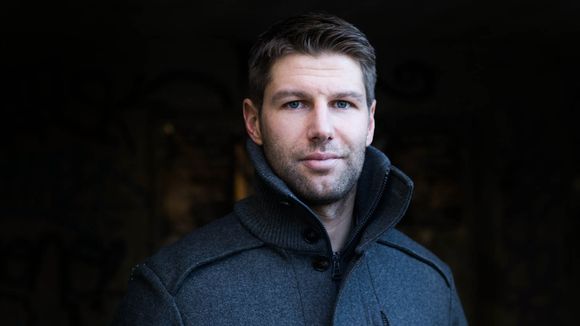
Thomas Hitzlsperger, the former Germany International and Everton footballer has today announced that he is homosexual in an interview with the German newspaper Die Zeit.

I have written before, most recently with diver Tom Daley as the case in point, about the importance of having men and women in the public eye being open and honest about their sexuality. I won’t rehash that article again here.

The point here is an additional one – the impact that Hitzlsperger’s decision may have on his former colleagues -including those in the FA.

In his interview Hitzlsperger stated that part of his reasoning of coming out was “to further the debate about homosexuality among sports professionals”. An admirable aim and a decision that I am sure will impact on players who are considering also coming out.

It is in this light that his decision will have immeasurable ripples – imagine if a current player no longer feels so isolated and decides to come out. Who knows how much of a game changer his decision might turn out to be.

The Premier League is watched and loved by millions all around the world, but it is still bereft of any openly gay footballer. To reiterate this – out of the 25 players in the 20 teams that play in the Premier League, not a single player is openly gay. 0 out of 500 players. This has held true (with varying squad sizes) for the entire history of top-flight football in the UK.

This then begs the question – why? Why has no playing professional ever been able to be open about their sexuality?

Hitzlsperger described the long “difficult process” of coming out. Something which the openly gay sports journalist Musa Okwonga talks more about here.

This process, even when surrounded by support, can be a challenging one. When surrounded by vitriol and hatred, the likes of which can too often be found in the stands, changing rooms and board rooms of British football, this process can transform into a goliath challenge.

It is interesting that Hitzlsperger specifically mentions in the interview that it is “it was not always easy to sit on a table with 20 young men and listen to jokes about gays”. A comment which hopefully all players will take on board.

But this homophobic banter is not just found in the dressing rooms.

One the hardest hitting sections from Graeme Le Saux’s autobiography was not the childish homophobic taunts Robbie Fowler through at him, the crowds obsessive jeering or even the referee’s despicable reaction of booking Le Saux for time wasting, but the FA’s inability to spot the real issue in the situation – institutionalised homophobia.

It is with a touch of irony then that Hitzlsperger’s announcement comes in the aftermath of the FA’s latest embarrassment – their equality adviser, who on national TV called gays ‘detestable’, resigning from his role.

Michael Johnson, the former Birmingham city defender was appointed to his role, one assumes, because of his stellar track record of tackling racism. It is a damning indictment that no one in the FA looked into his views on other pressing equality issues such as homophobia.

John Amaechi, the first former NBA player to come out in public in 2007, hit the nail on the head when he commented:

“the reason that homophobia, antisemitism, racism and other misogyny continue to blight football is that the FA does not understand how to tackle it. You don’t put one person to handle racism and a gay person for homophobia, you pick people who understand that all bigotry is the same monster.”

Today, hopefully, Hitzlsperger will have highlighted to the FA the need to act and to stop letting homophobia be what he referred to as “an ignored issue” in football.

1 Comment

Filed under Football, sexuality, Sport

Learning to kayak the Nile

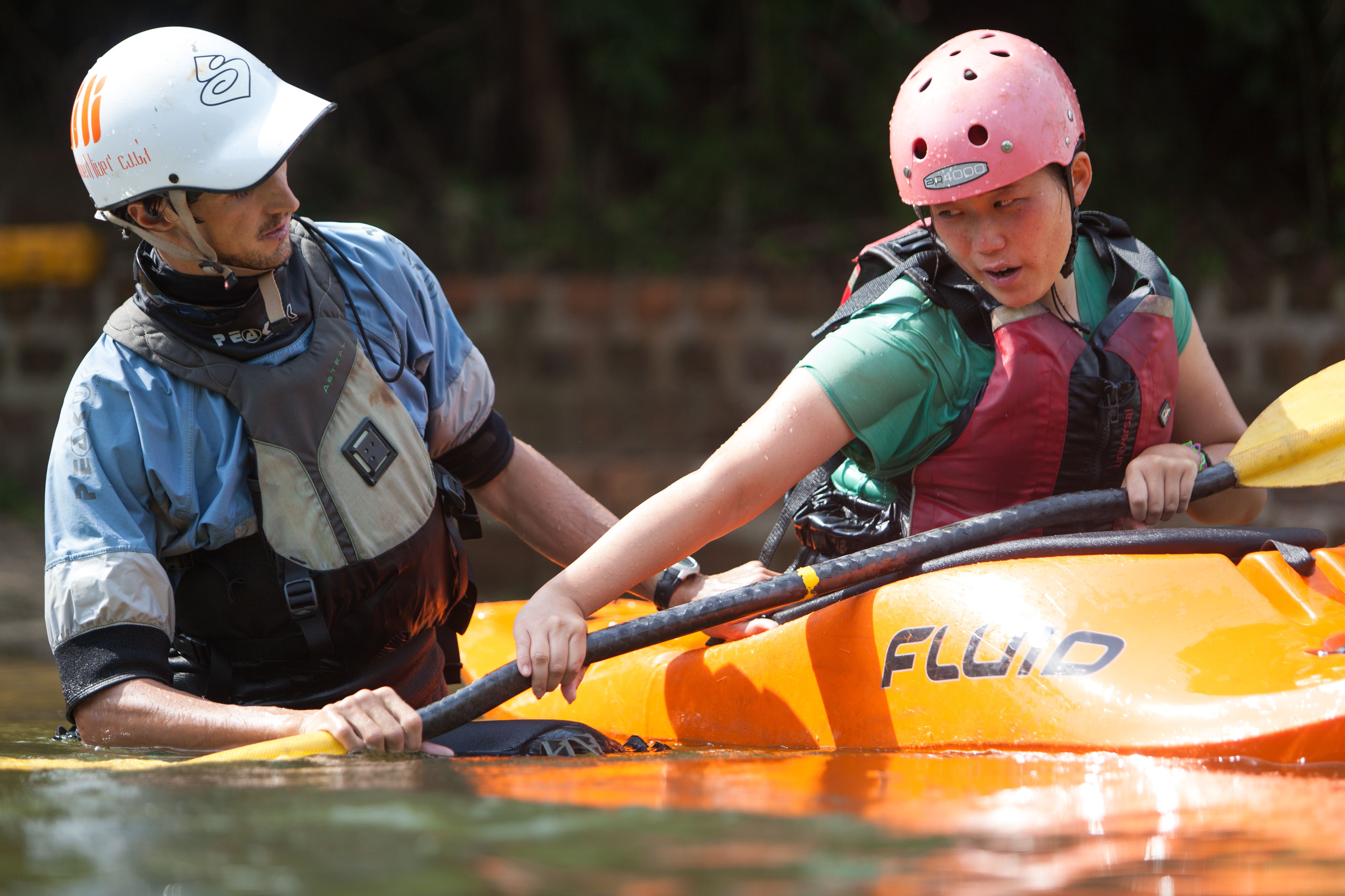
Waves crashes over the front of the kayak. All around, white water sprays up into the air. The relative calm of the flat-water section that follows this 100 meter long rapid seems like a long way off. Every wave that hits the side of the kayak holds the potential to knock this novice kayaker out of the boat and into the white-water. A few minutes later, the perilous waves that were surrounding the kayak are replaced. Now, all around are the ecstatic grins of the other first time white-water kayakers who have just completed the grade three rapid, aptly named, ‘Jaws’. This is just day one of the introduction to white-water kayaking course on the river Nile in Uganda run by Kayak the Nile.

Located a few kilometres to the north of Jinja, arguably the adventure tourism capital of East Africa, the Bujagali Lake offers a more tranquil start to the beginners learning experience. This large section of flat-water provides a picturesque area for first-time paddlers to practice their kayaking skills. The course begins with an introduction to basic kayaking techniques as well as safety and rescue techniques.

The credentials for the instructors passing on their knowledge couldn’t be higher. Out on the water on this morning offering instruction was Emily Wall, two times British Champion.  Perhaps more importantly than her experiences of competing at the highest levels of freestyle kayaking though, is Emily’s patience and obvious enthusiasm for teaching beginners.

Photo by Sim Davis

Out on the water, metaphors are used liberally to explain the movement and science behind kayaking. Whether it is through skiing or surfing Emily finds an analogy that relates to each of the would-be kayakers. Joanna Reid, a British nurse volunteering in Uganda, said after the session that, “Emily was world class and has a gift for teaching. She always made us feel safe. It was Emily and the team that made the day really enjoyable…”

But it’s not just the instructors who make learning to kayak at the source of the Nile special.

To start with, the water is dam released, making the rapids accessible, fun and relatively predictable 365 days a year. Every day you can expect an impressive 1600 cumecs meaning that you know you will have big volume rapids to learn on.

Secondly, the average monthly temperature in Uganda varies by less than two degrees meaning that most days you can expect the temperature to rise to the high twenties, but significantly, little more!

In short, it’s always shorts and t-shirt weather and not wet suits.

Lastly, the range of rapids on the river offers everything from grade 1 to grade 6 with an almost infinite number of lines into the rapids. With the right instructor there really is something for everyone, regardless of confidence and ability levels.

Explaining why she chose the Nile as her home for teaching kayaking, Emily said, “I have kayaked across five continents, yet I’ve chosen to call the Nile home because of the awesome training ground it provides for kayakers of all levels. The white water we have here on the Nile is unique; not only are the rapids warm and deep (with no rocks or crocs), the sun shines and the water flows all year around!”

Photo by Emily Wall

Photo by Emily Wall

In the afternoon then, the beginners head out to explore what this ‘training ground’ downstream of Bujagali Lake has to offer. Of course, fresh faced kayakers are not thrown straight into a grade three rapids. Most of the afternoon is spent practising breaking in and out of fast flowing water (and invariably putting rescue and swimming skills to practice).

But, as the afternoon draws on so the sense of excitement in the groups grows. The group of first-time white water kayakers paddle to a few hundred meters short of the ‘Jaws’ rapids. The river’s immediate horizon has spouts of white water kicking above it and there is the unmistakable sound of water crashing against rocks. Emily, with an ever calming voice gives the internally good advice, “whatever happens, stay calm”. Before adding, “Just keep an active paddle in the water and you’ll be fine”. And that was that.

With a healthy dose of luck and everyone vehemently following Emily’s suggested line through the rapids every learner kayaker comes out of the rapids the other end. Most, if not all, of them are still in their kayaks. But everyone, without exception, has the unmistakable grin on of someone who might have just stumbled across their new passion, white-water kayaking.

Photo by Emily Wall

Photo by Emily Wall

More information:

Visit: www.kayakthenile.com/
Follow: www.twitter.com/kayakthenile
Email: Info@kayakthenile.com

5 Comments

Filed under Outdoors, Politics, Sport, Travel, Uganda

I will always wear a cycling helmet but should government force people to?

The debate about whether or not wearing a cycling helmet should be compulsory is once again raging. This time, the catalyst for the debate is the heart wrenching story of Ryan Smith who is now lying in a coma after being knocked off his bike. His father has made a plea to parents to ensure kids wear a helmet.

But, what seems like common sense (wearing a helmet saves lives in the same way wearing a motorbike helmet does and so should be compulsory as well) is more contentious than it might first seem.

The cycling charity, CTC, makes the point:

“Given that the health benefits of cycling outweigh the risks by around 20:1 (one recent study put it at 77:1), it can be shown that only a very small reduction in cycle use is needed for helmet promotion (let alone helmet laws) to shorten more lives than helmets themselves could possibly save, regardless of how effective helmets might be.”

Essentially, it is saying when Ryan’s father publically talks about the importance of helmets – he’s making people less safe…I assume they would say the same for other people speaking out about helmet use (for example the wife of James Cracknell after his near fatal accident).

A study in the British Medical Journal however shows that:

“helmets reduced the risk by 63-88% for head, brain, and severe brain injury among cyclists of all ages.”

The road safety charity, BRAKE, supports this saying:

“Last year, over 17,000 cyclists were injured on UK roads with over 2,500 killed or seriously injured. The vast majority of these deaths and serious injuries were the result of a head injury. This is precisely why many of our international and European partners have already introduced compulsory helmet wearing,”

These, initially contradictory statements have fuelled a debate that divides cyclists, journalists and politicians alike.

All this evidence though seems to be pointing in the same direction – against the legal enforcement of wearing a helmet, and towards the incentivising of helmet use. It is difficult to believe CTC’s claim that appropriately constructed promotion campaigns would significantly put people off from cycling and as such make people less safe.

There seems to be no shortage of steps that could be taken.

Currently in the UK, a reasonable helmet for a commuter will cost around £30 (for example – this Lazer introductory sports helmet).  I couldn’t find any studies to show cost to helmet use ratios, but anecdotally I can say that I cycled for 3 months in London without a helmet because I lost my old one and at the time couldn’t afford a new one. I would be surprised if there was no correlation there.

Equally there are a host of other measures that could be dreamed up to promote the use of helmets ranging from school curriculum to better helmet storage facilities (when you lock your bike up somewhere you normally have to carry your helmet around with you).

Would having somewhere safe to store your helmet really put people off cycling?

But, to a certain extent, these arguments miss the point. What makes cycling safe or unsafe, primarily is not about what gear you’re wearing but where you are cycling. In cities for example that have physically separated cycle routes, the number of accidents reduce massively.

The flip side of this is of course that badly designed roads massively increase cycle accidents. For example, evidence shows that multi-lane roundabouts act as a death trap for cyclists (anecdotally I cannot help but to think of Elephant and Castle in support of this). This study concluded saying:

“Evidence is beginning to accumulate that purpose-built bicycle-specific facilities reduce crashes and injuries among cyclists, providing the basis for initial transportation engineering guidelines for cyclist safety. Street lighting, paved surfaces, and low-angled grades are additional factors that appear to improve cyclist safety.”

Reading these studies feels like it is just adding weight to common sense. But then again, wearing a helmet also seems like common sense.

Cyclists are safer in large numbers and people only get on a bike when they feel safe. Forcing people to wear helmets will not make them feel safe – investing heavily in separated cycle lanes will.

Is this too simplistic a conclusion?

2 Comments

Filed under Sport

Walking the Bwamba Pass with the Mountain Club of Uganda

A low level of laughter drifts in the air through the wood smoke as we crouch around the flickering campfire. Dotted around the fire are bits of bamboo that protrude from the ground. The sticks are sharpened to a point at one end and have chucks of beef skewered on them hanging over the open fire. The beef both absorbs the smell of the wood smoke and gives off a tantalising aroma.

Bottles of warm beer are passed around the circles while those who have learnt from experience sip of glasses of red wine poured from the box perched within arm’s reach. The sun has long since set on this small campsite in the northern tips of the Rwenzori mountains and the only light now comes from the flickering flames of the fire.

Sat around the fire are members of the Mountain Club of Uganda – a hodgepodge of people brought together by a passion for the mountains. The backdrop to this campfire is the highest mountain range in Africa – The Rwenzoris.

Sat next to me is Tom, a British ex-pat who spends his days working as a photographer for NGOs. He happily tears into the meat fresh from the fire and generously passes it around. I comment on how disappointing my oodles of noodles are in comparison and he laughs a knowing laugh as he takes a sip from his wine.

Opposite me I watch as Daivd, an American law graduate working in the Ugandan courts, chats happily with Manjit, a retired Indian British Doctor who is now volunteering in the International Hospital in Kampala. I catch their expressions in the fire light and their faces give away that they are evidently entering a conversation of substance, the sort of conversation that only occurs after a few beers when you are sat around a campfire.

People begin to pull jumpers on as the fire reduces to embers and the cool mountain air pushes the last of the day’s heat from the campsite. Most people head to their respective tents as the evening draws to a close leaving only the tough or the foolhardy passing around the Waragi. The knowledge of the next day’s walk acts as restraint for some but not all.

As I close up my tent door I listen for a few minutes to the conversation continuing between people who just 24 hours ago were strangers to each other. An ease of conversation created at least in part by the evenings consumption allows for jokes and jesting that would never have occurred elsewhere between such an eclectic group of people.

Despite the differences in age, nationality or anything else, we all there because of an unspoken timeless love affair between man and mountains.

I wake early the next morning before sunrise. The cool dew on the ground soaks into my flip flops as I stumble around half asleep making my preparations for the day’s walk. With a mixture of admiration and annoyance I meet the gentlemen who chose to stay the longest round the campfire and they look surprisingly sharp.

We collectively stumble into a convoy of cars and are driven for a couple of hours to the DRC side of the Rwenzoris from where we will trek over the Bwamba Pass back to the Fort Portal side of the mountain. Everyone sits in a dazed early morning silence as scenery slips pass the car window and we bump our way along increasingly pot holed roads.

We start our accent of nearly 1,400 meters with instant-grueling gradient. The group almost immediately splits into two as people begin to struggle in the now severe morning sun. Once again, with a mixture of admiration and annoyance, I note all of those who remained around the fire the longest striding away at the front. I sigh out loud and convince myself that I am at the back because I am being supportive to the others who were struggling with the heat and gradient.

Image
On the way up I walk the first couple of hours with Stephanie, an American originally from Florida who now lives in the northern Ugandan town of Gulu.  We meander together through agricultural land waving at the cries of the local children as we pass them. With good grace and admirable perseverance Stephanie walks up the unrelenting ascent listening to my equally unrelenting views on the Israel/Palestine conflict.

P1110965
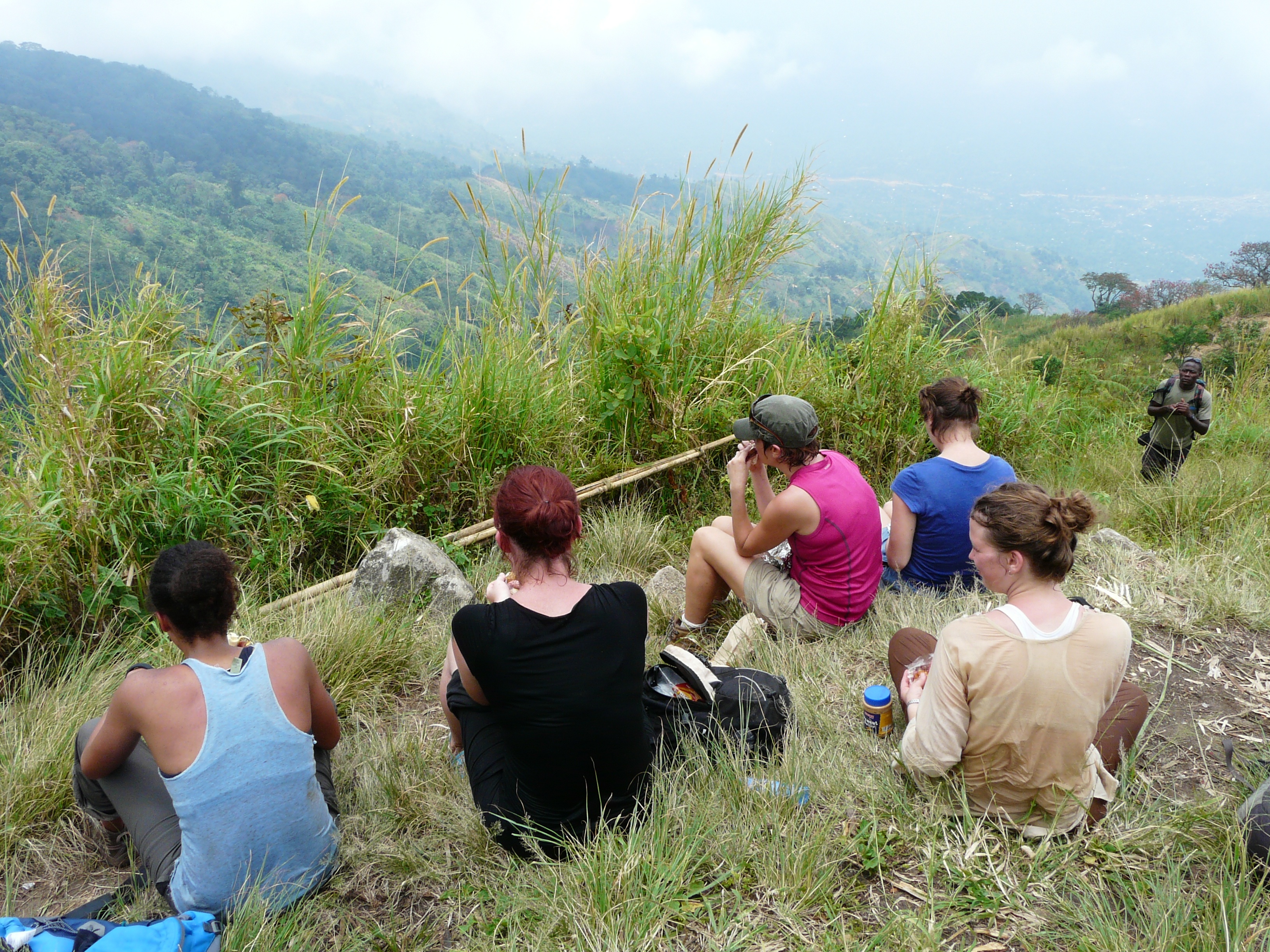
To give everyone a break from the ascent and Stephanie a break from my incessant chattering we regroup and stop for lunch. The views are breathtaking as we look down over the steep slopes onto the plains which stretch out into the Congolese rainforest. From this vantage point you can begin to see why Stanley referred the Ituri Forest as “nothing but miles and miles of endless forest.”

With stomachs filled our small group set off in the heat of mid-day sun with nothing but altitude as relief from the heat. We move out of the agricultural lands and into deep thick rainforest. Walking in these conditions is a continuous contradiction as everything is sodden in the humidity and yet the heat forces a near continuous thirst. Many began to realise that their three litres of water might not be enough to get them over the pass.

Five hours, 1,400 meters ascents and some tired looking walkers later we reach the pass surrounded by thick bamboo forest. A second wind enters the group safe in the knowledge that it is all downhill from then on.

Image
It isn’t long though until the heavens open and hamper our progress.  Heavy balls of rain hit the red earthed paths we are following and reduce them to streams of slippery clay. As I pull on my full waterproofs I watch as Manjit smiles to the sky. With a twinkle in his eye he embraces the rain in his shirt sleeves and skips through the thickening mud.

While Manjit dances his way off the mountainside, others slip and slide their way down a series of precarious paths. Red mud marks the bottoms of those who lose their grip while red faces give away that for some the decent is as hard as the way up.

Walking with now almost unrelenting rain we finish our walk on the Ugandan side of the mountain range some seven hours after we set off.

Manjit stands topless as he wrings out his sodden t-shirt while the rest of us peel off our boots. Looking back I see the cloud curl round the hills and cover the path on which we had just descended. There is no hint at how far into the cloud the path goes or how far we had just come.

This small bit of knowledge remains for those who had just walked the Bwamba Pass.


*2 photos taken from Manjit’s blog – http://manjitsuchdev.wordpress.com/ *

3 Comments

Filed under Outdoors, Sport, Travel, Uganda

The universal language of Messi

This article was originally published on Tattooed Football.

In the dusty streets of Jayyus in the West Bank, the language that children use cuts through adult constructed divisions. The names of Abbas or Netanyahu are alien. What rolls off the lips of the children here are the names of Messi, Fabregas and Puyol.

Jayyus is a small farming community situated near the town of Qalqiliya in the West Bank. It has been devastated by the construction of the separation barrier (which is universally acknowledged to be illegal under international law). 75% of the village’s farmland is now on the wrong side of the barrier. Recently, the village has seen a number of Israeli Defence Force incursions that have resulted in a number of local boys arrested.

These events however are just distractions for the children from the more serious business of street football. The challenge is simple – who can get as close to mastering Messi’s majesty as possible. To this goal, the children spend hours trying to match his touch, skill and athleticism. There is one coffee shop in the village where every Barcelona game is watched religiously and you can see every detail being gulped down with enthusiasm. The attendance, dedication and passion given to this cause is unwavering.

In a situation so bleak, it is heartening to see children throw their enthusiasm into football. I am sure it is a more productive use of time than throwing stones at the IDF. Equally, in a time when football seems so personified by casual racists, materialists and playboys, I find it heartening to see Messi being held up as a role model.

Messi manages, both on and off the pitch to balance his enthusiasm with a calm composure.  Messi also represents the dream that every child holds onto. He was taken from his home in Argentina at the age of 13. It is said he was only 4 foot 7 inches when he signed for Barcelona. From this he has developed into undoubtedly the greatest footballer of a generation. Messi has gone from being a small shy boy playing street football to be earning and inspiring millions.

It is this romance that drives children all over the world. Messi provides each child with a chance to dream. Cut off from life chances, it is this hope that keeps children going. This hope is communicated through the language of Barcelona. Football connects the children on the streets of Jayyus to billions around the world. Whatever the language their government or the occupying government speaks – these children will always be fluent in the language of football. No one can take that away from them.

Steve Hynd is currently an EA with EAPPI and is living in Jayyus, West Bank.

1 Comment

Filed under Football, Human rights, Middle East, Sport, War

The day I was ashamed to be a Cheltenham Town fan

This article was published on the Tattooed Football blog.

We were 2-0 down. The collective voice had slipped out of our supporters. We were silent. Spurs fans responded in the only way they knew, to start mocking our silence. They finished with a collective ‘shhhhhhh’ to illustrate the resonating silence coming from us. What happened next shocked me. It shouldn’t have done, but it did. Someone behind me shouted in a thick West Country accent, ‘you’re not in gas chambers now!’

Read the full article here

2 Comments

Filed under Far-right politics, Football, Gloucestershire, Politics, Social comment, Sport

La Bresse – Probably the best ski resort in the world!

The Vosges mountains! Photo thanks to archi-bald (flickr)

Interested in doing a weekends skiing for less than 120 pounds all inclusive? If so, this is the blog for you.

La Bresse Hohneck, in the Vosges “mountains” in France, I think is probably one of the best ski resorts in the world.  A controversial choice, I will admit that, but give me a second to explain why I think La Bresse can provide you with the perfect ski holiday!

Firstly, lets clarify what I think makes a good ski holiday.  For me, a ski holiday has to be cheap, friendly, involve beer and involve a lot of skiing (both on and off piste).

La Bresse, is not, and will never be a major resort.  With just 32 ski runs (some quite short), it is small by most of Europe’s standard.  You will not find classic runs such as the Black run down from Mont Fort, the Combe Saulire, or Courchevel in the Three Valleys.  What you will find however, is a cheap, friendly resort that will not leave too big a hole in your pocket.

The “main” resort (there are a number of mini resorts accessible by car), has 4 green runs, 11 blue, 11 red and just 1 black.  Let me assure you though, that the one black run (that they cleverly named “Noire”), will excite any ski enthusiast.  It starts with a short plateau that soon drops off the side of the world.  It is a piste that is never bashed, but simply left to wreak havoc with your knees and skiing technique. It is 5 minutes of unadulterated immensity.  Dropping at the sort of speed you should not feel comfortable at; you are left with a sporadic covering of moguls (that vary in shape and size) and snow drifts covering the ice sheets that are left on the exposed sections of the slope.  Getting down it is a challenge, looking good is out of the question. It is a skiing enthusiasts dream, and the sort of slope most sane skiers will avoid at all costs.  At best, it is a technical challenge of a slope, at worst it is a trip to the hospital.

This said, with 9 interesting and varied red runs, there is plenty to keep the more normal intermediate – advanced skier amused.  Equally, there is extensive off-piste to be enjoyed in an area which in the summer is famed for its mountain biking and walking.  Take a 1:25,000 walking map with you, and you can stay entertained for hours. Equally, nearly the whole mountain is accessible by blue and green runs, allowing the beginners and those who lack confidence a chance to explore the whole area.

Hopefully, this will have whetted your appetite.  Now, let me now explain how it is possible to enjoy all this for less than 120 pounds.

Travel:

La Bresse is just 4 and half hour drive away from Brussels (a similar distance from Calais) or an hour or so from Strasbourg (a lot closer than the Alps).  This means it is very possible to go for just two days skiing (meaning no holiday taken from work).  A car however, is a must if you are going to take advantage of my accommodation recommendations later which are 8km from the main slopes. Get a car full of you together and you are looking at 5-10 euro’s of fuel each (double if you are going with just one other).

Ski hire:

For a weekends ski hire, expect to pay around 30 Euro’s from ‘Bol d’air’ – where you get a 10% discount if you stay in my recommended hotel.  Here you can get good quality service, without the queuing that you would experience if you tried to hire the skis from the bottom of the ski slope.  Bol d’air is based about 2 km from the ski slope (you pass it on the way there each morning).

Lift pass:

Thanks to the construction of a new ski station, they have increased the lift pass this year.  It will cost you 45 Euro’s for two days.  This however, puts it on a similar level to ski resorts across Europe.  Lift passes and ski hire are just those “unavoidable” costs that every ski holiday has.

Accommodation;

Here is the real winner, let me introduce you to the L’Angleus in Saulxures Sur Moselotte.  It is a family owned hotel, bar and restaurant. I cannot recommend it to you enough.  It is a really down to earth and charming place with everything you could ever need.

Firstly, a double bedroom will set you back just 37 Euro’s a night (this is almost unheard of for ski accommodation).  That’s 18.50 per person per night (assuming you have someone who is willing to share a bed with you).  It is a warm and friendly hotel.  It is nothing posh, but it serves the purpose of having somewhere warm with beer to come back to in the evenings.  On top of this they serve up an amazing selection of burgers in the restaurant (this is coming from someone who is almost a veggie).  The burgers vary from a 4 Euro “beef burger” through to an 8 Euro “Cheese monster burger”.  Add a portion of chips on the side for 2 Euro’s and you have the biggest meal any hungry skier could ever wish for.  This combined with a liter of very drinkable house red for just 6 Euros (yes that’s right…6 Euors!!!) makes for very enjoyable evenings.

The owners are also really nice people (they have lent me maps, let my girlfriend who was feeling under the weather stay in bed all day on the day we were checking out, and have generally just been really nice to us).  Please, do not get put off by the web-site and go to this hotel!

Food:

See above comment on the burgers and combine it with a few cold pasta salads and you are away.

In the Alps the “cheap option” is shivering outside in the snow, or eating sandwiches under the table whilst trying to not get thrown out by an overly efficient waiters.  Here at La Bresse, they provide you with a very civilized heated “Salle de pique-nique” that sells hot drinks.  Bring your own bread, cheese and chocolate from home (resort shops are always expensive) and you are one well fed skier. For Breakfast, call in at one of the bakeries on the way to the slope for a quick croissant and some bread (bring your own chocolate spread).

Voila! This is how it breaks down:

Travel – 10 Euros
Accommodation – 37 Euros
Ski Hire – 30 Euros
Lift pass – 45 Euros
Food – 15 Euros

Total – 137 euro’s (120 pound sterling!) – Minus 30 Euros if you have your own skies and you drop to below 100 pounds for a weekends skiing. That is how you ski on a budget – and enjoy it.

6 Comments

Filed under Sport