Tag Archives: 2012

A tribute to Marie Colvin

As 2012 slips into the confines of history, I wanted to pay one last tribute to Marie Colvin – one history’s greatest journalists that 2012 so cruelly took from us. I want to ensure that something of her ethos lives on in my writing.

Marie Colvin

Marie Colvin

Marie Colvin is one of the 121 journalists who lost their lives in 2012.  She lost her life in Syria surrounded by the same killings, war crimes and atrocities that she had spent her life reporting as a war correspondent.

She not only did a job that many of us would be unable to do, but she did it without losing a sense of humanity in some of the darkest situations.

Jeremy Bowen described her “big reserves of empathy” – something that is so vital when you spend your time examining the worst humanity has to offer.

In a 2010 speech in Fleet Street Marie described the role of a war correspondent saying:

“Covering a war means going to places torn by chaos, destruction and death, and trying to bear witness. It means trying to find the truth in a sandstorm of propaganda when armies, tribes or terrorists clash…

Despite all the videos you see from the Ministry of Defence or the Pentagon, and all the sanitised language describing smart bombs and pinpoint strikes, the scene on the ground has remained remarkably the same for hundreds of years. Craters. Burned houses. Mutilated bodies. Women weeping for children and husbands. Men for their wives, mothers children.

Our mission is to report these horrors of war with accuracy and without prejudice”

What fascinates and inspires me however is what drove her to then put what she saw down onto paper.

Ingrained in Marie’s writing was a belief, a belief that if the atrocities that she witnessed were recorded and reported then at least there was the potential for action to be taken. Accountability.

If war zones are left without accountability we take nothing into the future except for the loss, anger and desperation which comes to define the bloody aftermath of war.

Marie’s writing acted as a basket to carry the possibility of justice forward. Without accountability, the truth, in all its bloody detail, is left to soak into the cracks of history.

Perhaps part of what drove Marie, and certainly what motivates a lot of my writing and human rights work, is more than just the possibility for action. It is the belief that people care.

In the same speech in 2010 Marie went onto say:

The real difficulty is having enough faith in humanity to believe that enough people be they government, military or the man on the street, will care when your file reaches the printed page, the website or the TV screen”

In 2013, I am going to take these words with me.

I doubt I will find my ways into the war zone of Syria, but I am sure, wherever I end up, there will be human stories to tell. I hope that you, the reader, will also take these words with you.

I do what I do because, like Marie, I trust that you care.
1 Comment

Filed under Human rights, Media, War

Jerusalem is encircled by violence as another Land Day comes and goes under occupation

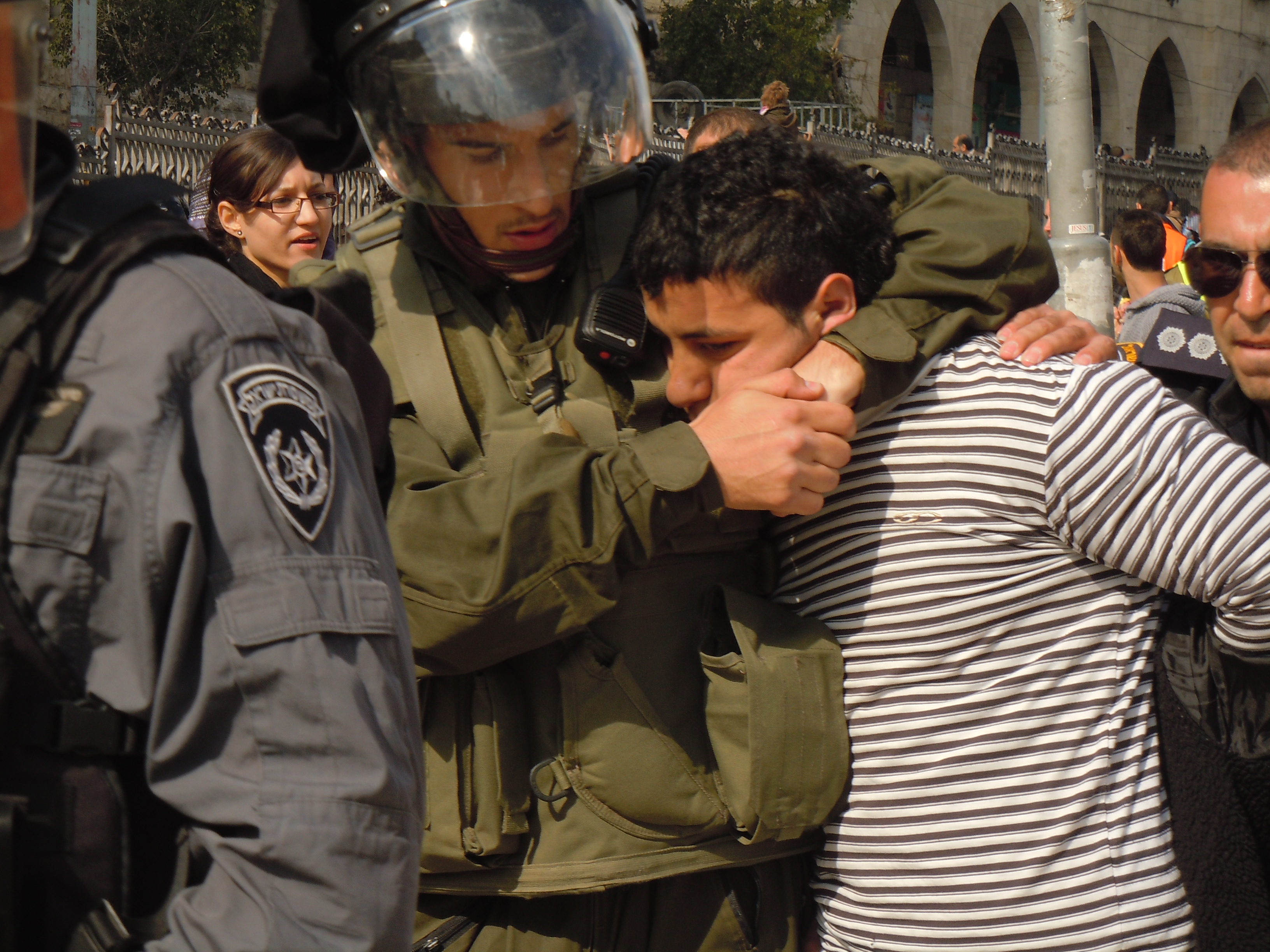
Stood just outside of the historic Old City in Jerusalem I witnessed scenes of panic as the Israeli army, special forces and police force used rubber bullets, riot horses and sound grenades on Palestinian protesters at this year’s ‘Land Day’ protests.

Meanwhile, resident’s in and around Jerusalem saw violence erupt on their streets. Haaretz reported that, at “Qalandiyah checkpoint [protesters] hurled rocks at soldiers, who responded with stun grenades and tear gas” while Ma’an News reported from Bethlehem that “Israeli forces fired tear gas and rubber bullets at protesters”. Al-Jazeera reported that “over 120 people have been injured at Qalandiyah checkpoint”.

Before any of the protests started news reached those on the streets that the civil authority in Israel has been covertly setting outside land for settlement expansion in the West Bank. A particularly hard report to hear on ‘Land Day’ of all days. Haaretz ran the headline ‘Israel Defense Ministry plan earmarks 10 percent of West Bank for settlement expansion’. This did nothing to calm the tensions.

After the mid-day prayers a few hundred protestors gather outside of Damascus gate in the old city. They were met by a comparable number of soldiers, policemen and special forces. News spread that all men under the age of 40 were banned from entering Al Aqsa mosque. Again, a move that did nothing to ease the tensions. Soon after this, no one was allowed to enter or leave Damascus Gate that leads to  the old city. At this stage, the gathering crowd was peaceful (despite reports coming in about injuries and rioting at Qalandiyah checkpoint).

With a rising noise level the tension also grew. Early on in the protest the occasional plastic bottle was thrown from within the crowd. This acted as justification for the Israeli Army and special forces to go in with a series of heavy handed tactics including charging with riot horses and letting off sound grenades. Throughout the protest I saw the occasional act of violence from a protester (such as a stone being thrown) which was then responded to with disproportionate force imposed on the crowd as a whole.

At one stage, I witnessed a Palestinian throw a stone towards a soldier (and miss). The soldier saw who threw the stone, chased after him and fire what I was told was rubber bullets directly at him (they are designed to be fired at the floor to rebound into legs, not directly at a person). On another occasion I saw soldiers beating men who were simply standing, watching and taking photographs. An international who was with me at the protest commented that she saw, “A soldier head butting a protestor in the face using his helmet. Luckily an Israeli policeman was there to pull the soldier away before anything worse happened”. Throughout the protest riot horses were used to charge at protestors who were not showing any visible threat or security concern.

Sadly, I know all too well that this disproportionate use of force at protests occurs all too often throughout the West Bank. A few weeks ago I reported on how the Israeli army breached their own regulations in the way they ‘policed’ a protest at the village of Kafr Qaddum.

I left the protest feeling exhausted. I walked back past ambulance workers treating minor injuries and shop keepers attempting to carry on trading. This Land Day has once again seen injuries, arrests and limitations on the basic right to peacefully protest. Outside of Jerusalem there were reports coming in that a protestor had died in Gaza.

What I saw in Jerusalem was an unnecessary and disproportionate use of violence against an overwhelmingly peaceful protest. This event however is not unique, it remains the impossible reality for those who are attempting to oppose the occupation through non-violent means.

1 Comment

Filed under Human rights, Middle East, Politics, War