

The village of Kafr Qaddum in the West Bank was the scene of some of the worst violence I saw during my half year working as a human rights monitor there.
The village holds weekly demonstrations to demand that their main road be reopened. It was closed by the Israeli military authorities in 2002 to prevent Palestinians from travelling on roads designated for use only by Israeli settlers and adds on nearly 20km to their travel to the main town.
These demonstrations are violent affairs. This is my account of a ‘not so peaceful protest’ which includes footage of a Palestinian being mulled by an Israeli military dog (see below) as well as multiple protesters being shot directly by heavy metal tear gas canisters. This is my account is of a 17 year old boy who was relearning to talk after being shot in the head by a tear gas canister.
As I said – the demonstrations are violent affairs littered with human rights abuses. It is not surprising then that on a number of occasions the Israeli military tried to stop human rights monitors and members of the press from entering the village. On one occasion before a particularly brutal response to the protest I had to travel through the olive groves to avoid the Israeli military checkpoint to gain access to the village.
In midst of this madness trying to marshal events was the figure Murad Shtewi. Murad is (was) a leading activist in the weekly demonstrations held in his village. I met him on a number of occasions normally over strong Arabic coffee and cigarettes to discuss what had occurred in his village during the previous week. Invariably the conversation focused on army raids and arbitrary arrests (painfully common events across the West Bank) but this was juxtaposed to Murad’s middle-eastern understanding of lavish hospitality and his talk of non-violence resistance.
I liked Murad for having optimism in the face of such continued violence (violence that Murad experienced first hand, in the video of the dog attack you can see Murad being pepper sprayed in the face for trying to intervene in the dog attack on his nephew).
Despite witnessing so much violence Murad was also committed to non-violence. This commitment to non-violence is one of the key criteria for Amnesty International who now consider Murad a ‘prisoner of conscience’ after his arrest at around 3am on 29th April of this year (arrests in the middle of the night are common place in the West Bank – even when detaining minors).
Murad is charged with organizing a demonstration without a permit, causing a public disturbance, and throwing rocks during a demonstration. Amnesty International has responded to these charges saying:
“In Amnesty International’s assessment, the charges of rock-throwing and of causing a public disturbance are unfounded. Murad Shtewi has been persecuted for expressing his non-violent opinions and for his role in the peaceful protests in Kufr Qadum against Israel’s illegal settlements. His arrest and detention are a measure to punish him and stop him and other village activists from exercising their rights to freedom of expression and to peaceful assembly.”
As such Amnesty International is calling for Murad Shtewi to be released immediately and unconditionally, as ‘he is a prisoner of conscience, detained solely for the peaceful exercise of his right to freedom of expression’.
This is a call that I am happy to publicly back. On every occasion that I went to Kafr Qaddum I never once saw Murad throw a stone. On a number of occasions I did see him telling others not to throw stones. I also talked to him at length about the importance of non-violent resistance.
This is also the third time Murad has been arrested (each time released without charge) in the last few years, the first was after the dog attack on his nephew.
Simply put, I can’t see how this latest arrest of Murad has any purpose other than to try and deter him from organizing legitimate protests against the Israeli policy of segregation in the West Bank.
It is in light of all this that I ask you to take a few seconds to send this sample letter to Prime Minister Benjamin Netanyahu that significantly not only calls for Murad’s release but also to:
‘take effective measures to prevent the use of unnecessary and excessive force by Israeli forces against peaceful demonstrators’
Please help me help Murad by taking this small action.
For more information:
- Read Amnesty International’s background notes to Murad’s case and the village’s situation.
- Read everything that comes up on my blog if you search ‘Kafr Qaddum’ including a short video of Murad.
 In the past few days thousands of people have seen the image on the right: a





 Hynd's Blog
Crossing the separation barrier daily – one day honey, one day onions
For the two hours preceding this conversation I had been stood watching frustrated agricultural workers waiting to cross the separation barrier to access their own farmland. The separation barrier is built predominantly through the middle of Palestinian farm land and as such was ruled to be illegal by The International Court of Justice at The Hague (in 2004).
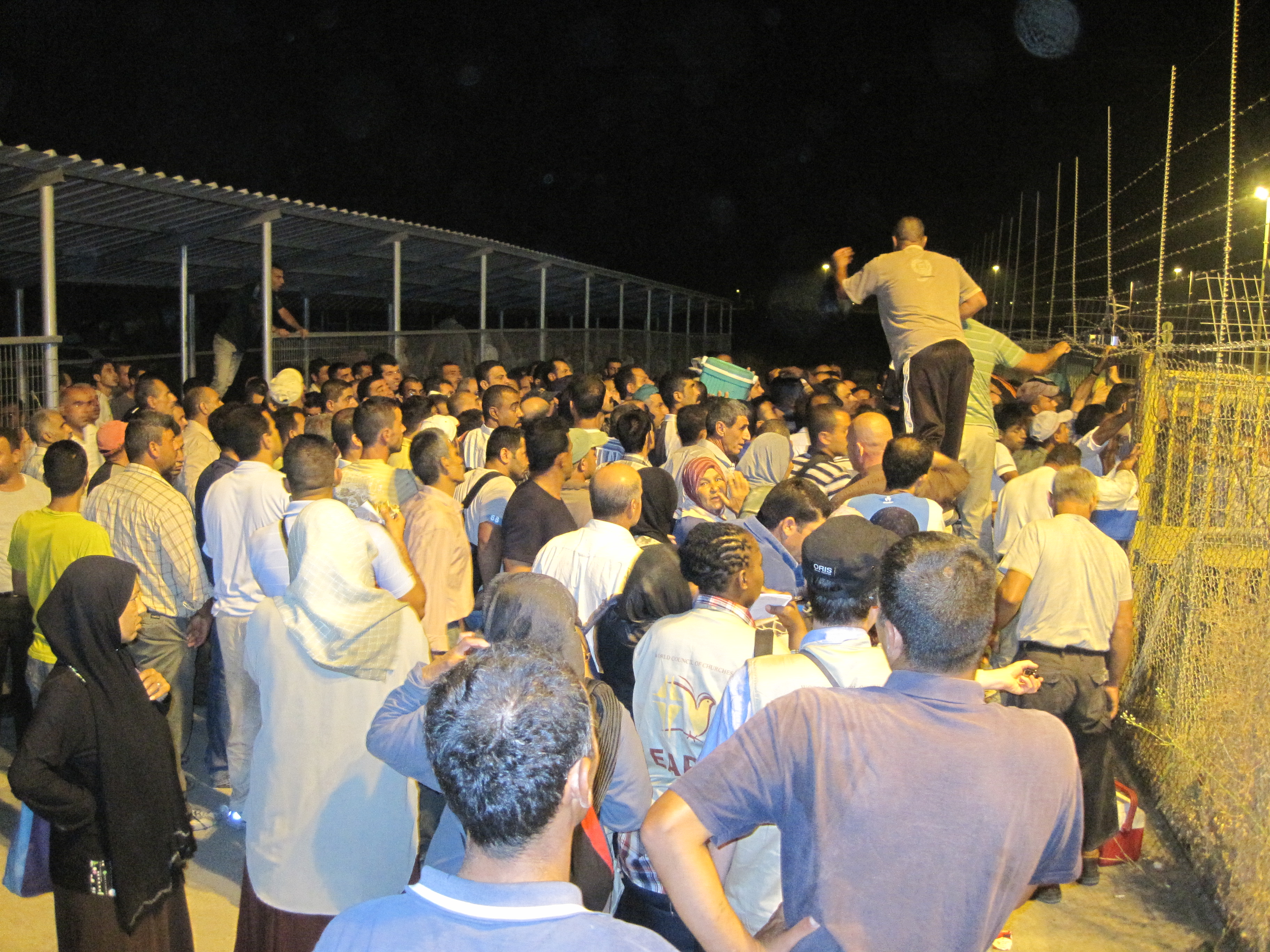
The men are grouped in small circles, one circle lit a small fire out of rubbish and wood they have collected. Others are pacing the width of the road promenading up and down discussing the matters of the world. Others however wait with less patience.
All of the men hand in their permits to one Palestinian who has the unofficial job of keeping the peace and trying to organise what order people will pass in. The men pass in groups of 5 past the first turnstile before entering into a cabin where there papers are checked for what seems like an impossibly long time. One man who was waiting (patiently) nodded to the Palestinian holding the pile of permits and said, ‘He plays cards with those permits. You never know if you will wait 10 minutes or 2 hours”. I asked if there was any favouritism and the man responds, “it is good if we are friends”.
The first few groups of Palestinians emerge from the far side of the checkpoint and go their separate ways to their small plots of land. I look up sporadically to see what the soldiers are doing. There are normally four on duty that I can see (one to check vehicles, 2 to ‘control the crowd’ and one to stand their pointing his gun at people – or this is what I have deduced from previous times). Soldier one (who in previous groups has made an effort to look menacing) is stood in a concrete pillar box resting his chin on his semi-automatic weapon making little effort to keep his eyes open. The second (there to check vehicles) is sitting with feet up on what I have seen in the past used as a second inspection point (which doubles the speed of transit for the workers trying to cross). The final two spend most of their time talking but occasionally tell the men waiting to take a step or two back.
The four soldiers barely look up as a small fist fight breaks out over what I presumed to be a disagreement about who got to pass through the checkpoint next. The soldiers take a couple of steps closer but allow the men waiting to sort themselves out. One of the Palestinians around the fire looks up and sucks air in through his teeth. For the majority of men waiting, they stand patiently looking out at their land to the west. Staring back at them are the soldiers who wait patiently as the minuets left on their shift slip away.
What was notable about this gate monitoring was the lack of anything specific happening. The Palestinians were not tear gassed nor were the soldiers pelted with stones. There was however a low level lack of respect that materialised itself in different forms depending on what side of the locked gate you were stood. There was a understood sub-text that they were not going to make life easy for each other. This is where the power dynamics shine through.
I noticed the Palestinian men would often pretend not to hear the soldiers when they were giving orders or would take a long time to move when they were asked. The response from the soldiers is no less petty but has far more serious repercussions. As I mentioned the power dynamics between the occupied and the occupiers is not equal.
To illustrate, as the workers leave the cabin where there permits are checked the soldiers normally wave on the next group of five men through the turnstile. Today, for no explicable reasons, they waited until the workers were well clear of the gate before allowing others to come forward. This wasted crucial minuets and added to the feeling of frustration.
These small actions (or sometimes lack of actions) meant that at the end of the two hours (the gates opening times) there were over 50 men (and 40 sheep) still waiting to pass when I left the gate at 9:00am. This has serious repercussions on those who do not make it through (loss of income in a desperately poor society). I have monitored this gate many times before and have seen that proactive friendly soldiers can ensure that all men (and animals) pass through without problem and with minimal delay. Today the soldiers did their jobs, but with the minimal possible effort you can imagine.
The tired soldier at the end said that one day is like honey, while another is like onions. He made this comment with a certain fatalistic edge to his voice. What today has taught me is that if some days are like honey while others are like onions as the soldier suggests, then it is because of his choosing. Soldiers (often young conscripts) have an extraordinary amount of power and control over ordinary people’s lives. For the men who have to wake in the early hours of the morning clutching their permits to pass to their own land, days are rarely like honey.
Be one of the cool kids and share this article
1 Comment
Filed under Middle East, Social comment
Tagged as EAPPI, Habla Gate, Human rights, Israel, Palestine, permits, Qalqiliya, separation barrier, Soldiers