Tag Archives: Steve Hynd

Uganda’s Lawless Mountain: Mt Moroto

This article was written for Cotswold Outdoors Community Blog.

Mount Moroto stands at 3,082 meters above sea level in the Karamoja region in the north east of Uganda. Over the last few decades the region has witnessed war and conflict which has left its peaks predominantly unclimbed. Recently there has been a large-scale amnesty on guns and dip in the levels of violence. Steve Hynd from the Mountain Club of Uganda took this opportunity to see what the mountain has to offer.
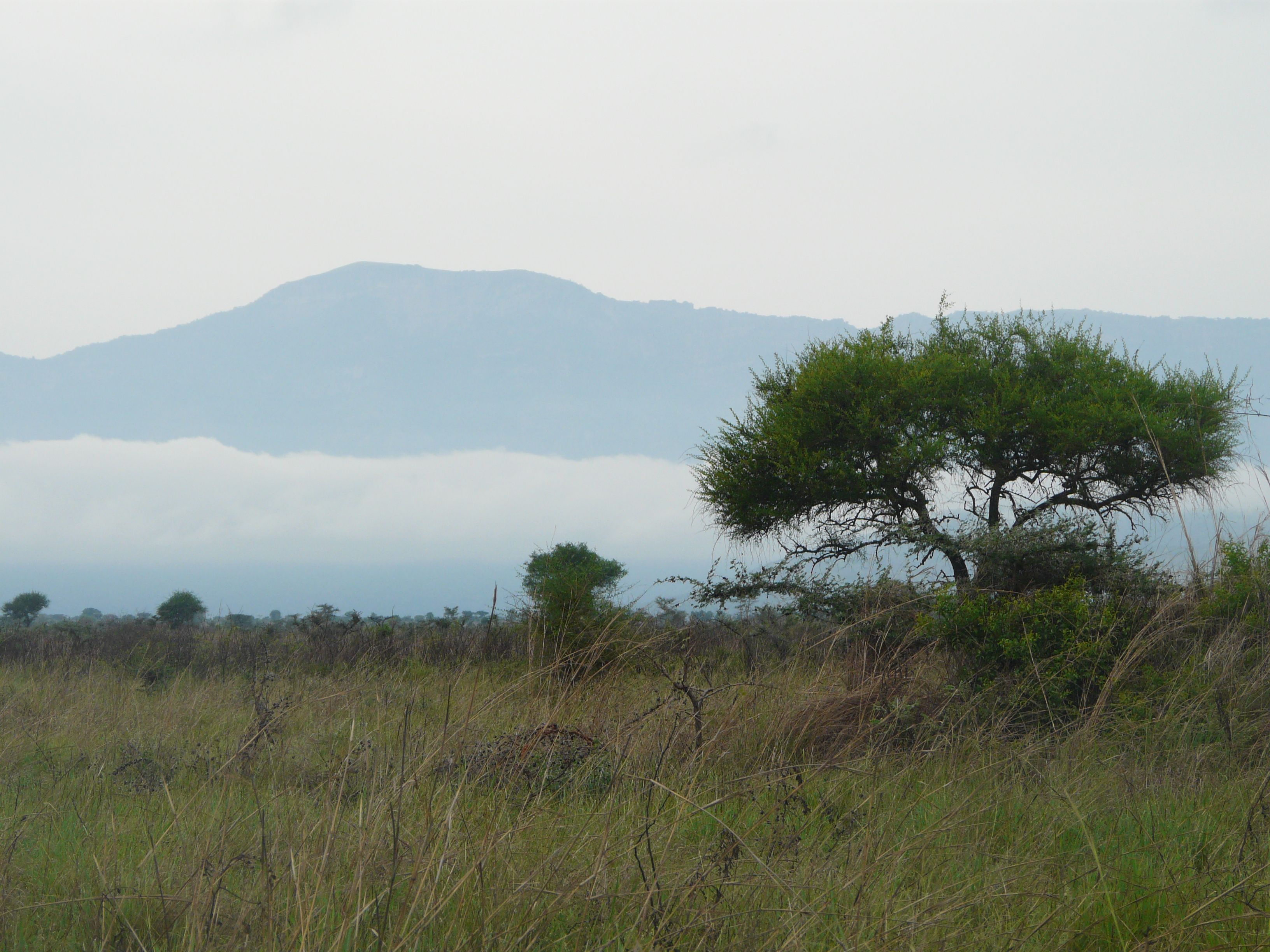
P1120081The Foreign and Commonwealth Office (FCO) advise against all travel to Karamoja. They describe it is as:

largely lawless. There are frequent road ambushes and tribal clashes. Small arms are widespread and there are regular deaths or injury from gunshot wounds”

As it turned out, guns were the least of our problems…

We were travelling in a convoy along a dirt road which locals had told us was impassable during the rainy season. It was Saturday 30th March – the rainy season was due to starts on the April 1st.

On the road, there were a couple of hairy moments; wheels spinning on steeply banked rivers edges, deep mud that resulted in everyone getting out and walking but it was, in a 4X4, passable.

Two and half hours and 45km after leaving Moroto town we arrived at the small mountain village of Tapach.

Tapach sits at the head of a valley tucked in underneath the imposing ridges that lead up to the peaks of Mt Moroto. The village boasts stunning views of the plains of Karamoja that stretch out away from mountain.

Living with some of the best views high on the side of the valley we found Friar Gerald – our only real contact in the village.

With a warm smile he greeted us while glancing at our mud covered cars before asking, “How was the road?” The only honest answer any of us could muster was, “passable”. He grinned a knowing grin and said, “It will be fine along as it doesn’t rain”.

P1120032Friar Gerald was accommodating and kind in helping us find local men to guide us up the mountain and ensured that at least one of them spoke English.

As we waited for the ‘guides’ to come back from the fields where they worked, I asked the Friar a little bit about the valley and the region. We talked about the lasting legacy that the conflict had on the village.

On the drive in we had passed a number of UPDF army camps and I asked if they ever came to the village and the Friar responded saying,

They keep themselves to themselves nowadays. I think that’s better for everyone”.

Clearly the memories of what happened in the region had not gone away. In 2007 Human Rights Watch described a government disarmament drive headed by the army in their report, “Get the Gun”. The report documented wide-spread use torture and a number of murders.

As the Friar said, perhaps it is best they keep themselves to themselves.

The guides soon arrived though and we started snaking our way up the hillside behind the monastery. The climb was tough going and this was extenuated by the 5 litres of water we were carrying as the guides were unsure as whether or not there was any water available on the mountain. The hot sun beat down on us as we huffed and puffed our way up the valley side.

The collecting storm clouds offered us only occasional shade.

Within an hour we were rewarded with panoramic views. In one direction there were the endless plains of Karamoja, on either side deep valleys with small hutted villages and in front of us the peaks of Mt Moroto.
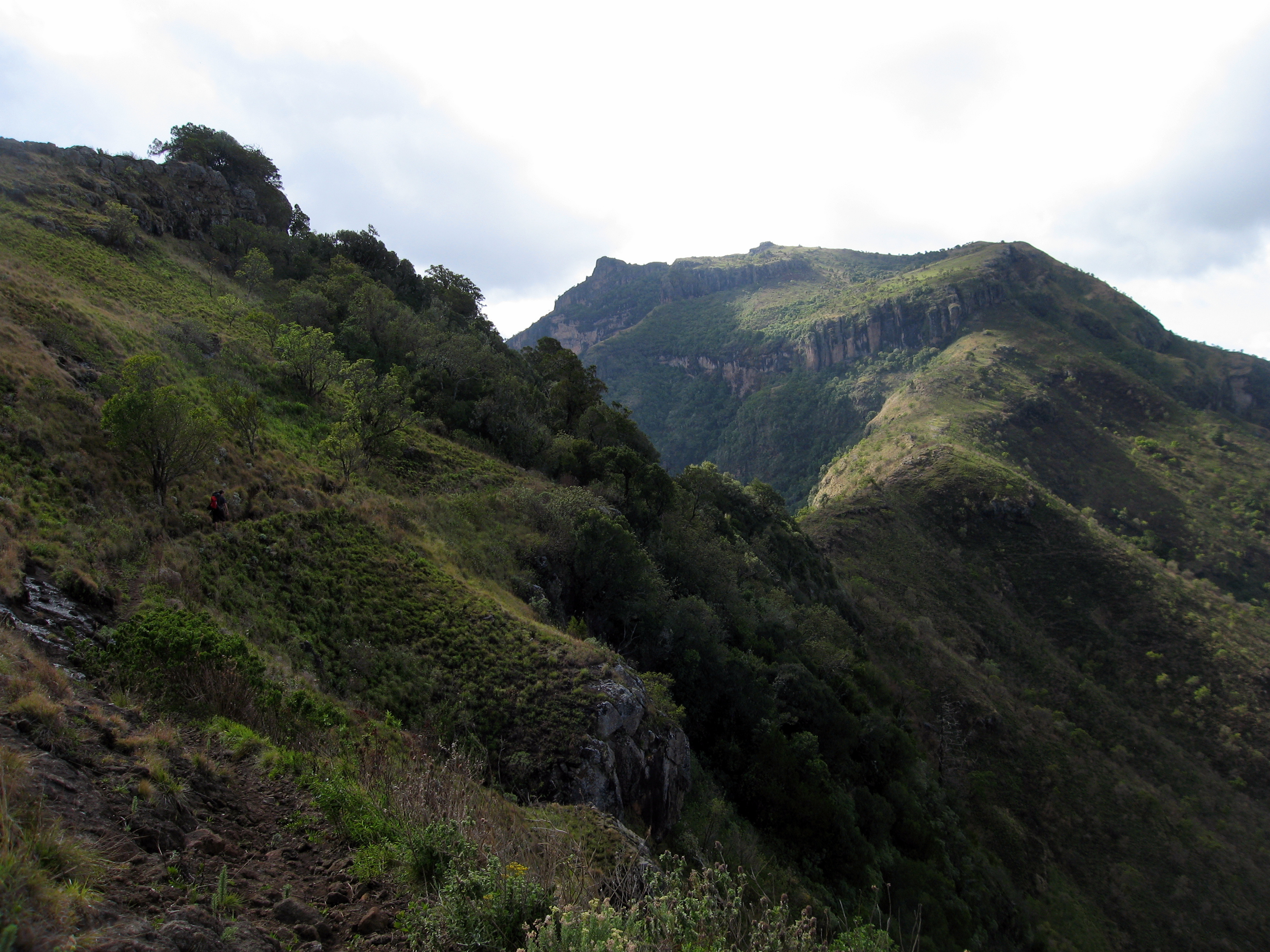
Kyle IMG_3708By mid-afternoon we had climbed around 1,000 meters. High in the mountains the heavens opened in spectacular fashion. The intensity and consistency of the rain slowed our progress as we picked our way across rocky ridges and up steep muddy slopes.

About an hour before dark we stopped high on a ridge to pitch camp.

The guides collected wood and lit a fire, the rest of us erected our tents and prepared food. On the equator the sun sets in a blink of an eye. For a brief moment though the storm clouds were silhouetted in front of departing sun before darkness descended on us.

P1120067That night we lay in our sleeping bags counting the seconds between thunder and lightning while the rain thundered on our tents. I am not sure if I have ever camped in more torrential rain.

Trying to not think about the rain and the state of the road back to Moroto I closed my eyes and let sleep take me.

The next morning we awoke before light and set off in a slow drizzle for the summit leaving our tents pitched on the ridge. The short walk took us through thick forest that clung to the ridge top. We scrambled up steep scrub land making the final assent with anything but elegance. Just under two hours after leaving camp we stood on the summit of Mt Moroto.

Starring into the thick mist I wondered how many other had stood where I was now stood. The answer, of course, is ‘not many’.

We made our way down, packing the camp on the way, slipping and sliding in the now thick mud. We arrived back at to the village at about 4pm with a sense of achievement but also dread about what lay ahead on the now sodden road back to Moroto.

Phoning ahead we found out that friends who were driving a Toyota Rav4 had left the village at 11am and were, at 4pm, still not back to Moroto.

I’ll admit now that I was worried – would we get back to the Moroto before dark? Would we get back at all?

Driving back was in itself an adventure. On a couple of occasions water came over the bonnet of the car, and on countless occasions the ground clearance proved in to be insufficient. But, just over two hours later we arrived back to our rendez vous in Moroto – 10 minutes after those in the Rav4 who left at 11 that morning.

I tried really hard not to be smug.

The other car load that left Tapach after us didn’t arrive back until 11 that night, they told me the next day that they had to cut out the seatbelts to use as a towrope.

The whole weekend was a mini adventure. We were not sure what we would find when we left Kampala for this remote region.  We had heard stories of guns, torture and of course incredible peaks. But what we found were warm welcoming locals who were slightly bemused as to why we wanted to climb Mt Moroto. The soldiers were courteous though and the locals delighted though that we were visiting.

Moroto district doesn’t yet have the infrastructure or the information to really capitalise on its mountaineering-tourism potential. But it does have mountains that are as beautiful as any in the national parks of Uganda.

With a good 4X4 and sense of adventure there is no reason why you cannot enjoy them as well.

If you fancy the trip – feel free to be in touch.

7 Comments

Filed under Outdoors, Travel, Uganda

A visit to Hospice Africa Uganda

This is an article that I wrote for ‘ehospice‘ about my recent visit to a hospice in Kampala.

An incongruous collection of books sit on the shelves next to hand-made jewellery and other bits of bric-a-brac. I stand and flick through the books for a minute enjoying being out of the hot Kampala sun. As I rummage around looking for a bargain the shop assistant, Joy, begins to talk to me about her role at Hospice Africa Uganda.

Joy is one of a dedicated team of volunteers who make it possible for the hospice to carry on offering palliative care services to patients with Cancer and/or HIV/AIDS. Joy, a recently retired surgical nurse, is clearly someone who is driven by the need to help others. When I ask her why she gives up five days a week to help at the hospice she explains:

Read the full article here >>

2 Comments

Filed under Health, Human rights, Uganda

The pursuit of happiness

This is an article that I wrote for the Africa edition of ‘ehospice‘ on the overlap between happiness and palliative care. It marks the first ever International Day of Happiness:

“The pursuit of happiness is enshrined into the US Constitution, the subject of countless books and is now even being measured by governments. Policy makers and development agents are now recognising that ‘progress’ should be about increasing human happiness and wellbeing, not just growing the economy at all costs. In light of this, the UN today marks its first ever ‘International Day of Happiness’.

To read the full article click here >>>

Leave a comment

Filed under Health

Talks on Israel/Palestine

In 2012 I spent five months living in the West Bank as part of the Ecumenical Accompaniment Programme for Palestine and Israel. I then undertook a speaking tour about my experiences.

I wanted to say a huge thank you to everyone who hosted me and to everyone who attended one of my talks.

So a huge thank you to:

I am still available for further one off talks, commentary or debate. My contact details are here.

Leave a comment

Filed under Human rights, Middle East

CHILDREN OF PEACE INTERVIEW

This is a copy of an interview I did for charity Children of Peace.  Children of Peace is a UK based charity that works with both Israeli and Palestinian children to build positive relationships for a future generation, whose communities might live and work in peace, side-by-side.

“Steve is a human rights worker who spent five months in 2012 in the occupied Palestinian territories as part of the Ecumenical Accompaniment Programme in Israel and Palestine. He is currently working in Kampala, Uganda.

Sarah Brown (Sarah): Could you tell us what sparked your interest in Israel/Palestine?

Steve Hynd (Steve): A mixture of design and chance is the straight answer.

My sister studied ancient Hebrew at the University of Jerusalem and was living in West Jerusalem in 2001 and experienced first-hand the impact suicide bombers had on the community in which she was living. I was at secondary school when this was happening and it challenged me to think about the conflict. My sister was moved deeply by what she saw, but will openly admit, she only saw one side of the story. This was my very first introduction to the conflict.

Since then I have been actively involved with human rights issues and organisations for a long time. Invariably Israel/Palestine came up – especially during my time at Amnesty International in the aftermath of Operation Cast Lead.

At first though, I chose to work on other issues and countries and took an active interest in countries such as Turkmenistan (described by Freedom House as ‘the worst of the worst’) thinking that there were others with more knowledge and better placed to work on the Israel/Palestine conflict. I thought to myself ‘what could I contribute?’

Only after getting involved with EAPPI, almost by chance, I have come to think that I do actually have a role to play and something to contribute.

Sarah: What made you decide to work with EAPPI?

Steve: I became interested in a model of human rights work that combined impartial monitoring with the concept of ‘protective presence’. This was being practiced by organisations like Peace brigade International (PBI) and the Ecumenical Accompaniment Programme for Israel and Palestine (EAPPI). PBI worked mainly in South America and EAPPI worked in the West Bank. In the end I chose to apply for EAPPI for a range of reasons including being interested in positive examples of faith based organisations – this led me, in many ways by chance, to Israel and the occupied territories.

I had also come across EAPPI as I had previously worked for the Quakers (who coordinate EAPPI in the UK and Ireland) and had heard very positive feedback from people I respected. Before I applied I contacted Symon Hill (author of the No-Nonsense Guide to Religion) who at the time worked at Friends House in London and he had nothing but praise for the organisation.

Sarah: EAPPI has faced some recent criticism. Would you like to comment on that, or, more generally, on the assertion that Israel, as a comparatively accessible and open society, comes in for a disproportionate amount of scrutiny?

Steve: In the lead up to the Church of England synod vote (to endorse the EAPPI) they did come under a lot of criticism. A small amount of which I felt was valid, but a lot I felt was not valid and indeed was often inaccurate or misleading.

As with all conflicts, EAPPI as a human rights organisation challenges some vested interests and gets attacked because of it.

In terms of Israel more generally…

Israel is paradoxical in its human rights record. In one sense, as the question suggests, it is open and free. It consistently does well in terms of press freedoms and is a beacon of hope, in stark contrast to its neighbours, on issues such LGBT rights.

You cannot however, examine Israel’s human rights policy, without looking at their foreign policy and their on-going occupation of the territories and their continued disregard for International Humanitarian Law.

I have no doubt that some people use these violations as a tool to attack Israel – either because of regional politics or because of anti-Semitic values. Equally however, from my experience, most people working on the conflict are doing so because they care passionately about the victims. I know a number of good people working hard for peace that have been lazily labelled ‘anti-Semites’ – this cheapens a very serious problem.

Equally, sometimes the criticisms of human rights organisations are unfounded. For example, Human Rights Watch is often accused of ‘attacking Israel’ and focusing disproportionately on Israel. In reality, Human Rights Watch works on 17 countries in the Middle East and North Africa. Israel accounts for about 15 percent of published output on the region. The Middle East and North Africa division is one of 16 research programs at Human Rights Watch and receives 5 percent of total budget.

I accept that Israel has more focus on it than most other countries (such as Turkmenistan), but I still maintain that we need more focus on these neglected countries rather than less on Israel. In my opinion it is a disgrace how few people care about, or are willing to work for the people in Turkmenistan.

This why, whenever I speak to people about Israel/Palestine I insist that we can all be doing more and working harder.

Sarah: Could you tell us about some moments which most stick in your mind from your time with EAPPI?

Steve: It is hard to pull out a couple of moments. There was not a day that went by where I didn’t hear about how people’s lives were being affected by the occupation.

Perhaps the best place to start would be the occasion when I felt the most hope. I was in Sderot in Israel on the border with Gaza and we met with representatives from the peace group ‘Other Voice’.

Every house in Sderot has a built in ‘safe room’. I was told residents have just 14 seconds to get to it should they hear the warning siren before rockets from Gaza might hit. This is a physical impossibility for many such as Sderot’s elderly residents. People live in fear. Nearly all of Sderot’s residents have been affected by rocket attacks.

Despite this reality, I found people who were looking to work creatively with Palestinians to find a lasting peace. I passionately believe that change needs to come, at least in part, from within Israel. Groups like Other Voice might provide the seeds from which this change grows.

A second example that sticks in my mind highlights the complicity of the Israeli Defence Force in some of what is happening. I was in the village of Urif and settlers had set fire to a large section of Palestinian farmland. When Palestinians went to put the fire out, the IDF fired teargas at them and the settlement security shot a Palestinian in the spine. When Palestinians went to help the man, the IDF continued to fire tear gas at them. The whole time they watched on as the settlers continued to undertake acts of arson.

This is just one of many examples where the IDF were not fulfilling their responsibilities to protect the occupied population!

Sarah: Is there anything which really surprised you in Israel/Palestine? And anything which you have changed your mind about?

Steve: It surprised me quite how the occupation affects every part of life for so many people. Before I went, I understood that terrible things happened. I didn’t understand that not a day would go by in the West Bank without either a demolition, a midnight raid of a village, some arbitrary arrests, detentions, excessive use of teargas, child detention, etc. The reality of everyday life for an ordinary Palestinian shocked me.

I was lucky, and unusual, in that before I went I didn’t hold many preconceptions about the conflict. In that sense I would say that the experience was a steep learning curve for me.

Sarah: Which commentators (journalists, writers or bloggers) on Israel/Palestine would you recommend to someone wishing to learn more about the region?

Steve: This question has a catch in it. One of my biggest gripes is that too many people approach the conflict from a partisan side-taking perspective. If you follow bloggers, journalists and writers, you have to take 90% of them with the assumption that they are pushing an agenda. In light of that, I feel more comfortable naming a few organisations (with the understanding that I might not agree with everything that they say/do)

  • B’Tselem – The Israeli Human Rights organisation.
  • Breaking the Silence – The Israeli organisation of ‘veteran combatants who have served in the Israeli military since the start of the Second Intifada, and have taken it upon themselves, to expose the Israeli public to the reality of everyday life in the Occupied Territories’.
  • Al Hac – Palestinian Human Rights organisation.
  • EAPPI – They provide regular on-the-ground accounts of what is happening.

I would encourage everyone to explore and read on this issue as widely as possible – trying to empathise with what has been written.

Sarah: Can you tell us something about your hopes/fears for the future?

Steve: The same as most people I think – I hope for lasting peace that enables Israelis and Palestinians to live side by side feeling safe and secure.

My fear? That the detrimental spiral of violence and mistrust will continue and people will continue to suffer.

1 Comment

Filed under Human rights, Middle East, War

The removal of ‘insulting’ from Public Order Act is a victory for free speech

This article was written for Left Foot Forward.

Rowan

MPs have confirmed that the word ‘insulting’ will be removed from Section 5 of the Public Order Act 1986.

This is a major victory for an unlikely alliance of free speech campaigners including The Christian InstituteThe National Secular Society and Rowan Atkinson.

Last month the home secretary Theresa May announced that the government was ‘not minded to challenge a House of Lords amendment removing the word ‘insulting’ from Section 5 of the Public Order Act.

In the past Section 5 had been used against street preachers ‘insulting’ homosexuals and LGBT activists ‘insulting’ religious groups.

As Rowan Atkinson commented, “The clear problem of the outlawing of insult is that too many things can be interpreted as such. Criticism, ridicule, sarcasm, merely stating an alternative point of view to the orthodoxy, can be interpreted as insult”

This change in law is a victory for freedom of speech in the UK.

There remains, however, an important limiting role for the law to play. That role is to provide protection to those who are victims of threatening or abusive behaviour.

In 2011 I blogged saying that, “We all hold the right to live without fear or intimidation. This has to be legally separated, however, from being ‘insulted”.

The distinction has finally been acknowledged by the government and the change in the law later in the year is now just a formality.

It is worth noting, though, that even with this change in law, the discussion about what constitutes threatening behaviour compared to ‘insulting’ behaviour will remain. There is a considerable grey area around what the law should interpret to be ‘threatening’ and what it should view as merely ‘insulting’.

For example, ‘My Tram Experience’ – a video showing a vile torrent of racist abuse on a south London tram – sparked two very different interpretations.

thought her behaviour was threatening and therefore called for her arrest, while bloggerSunny Hundal argued that she was simply being insulting.

With the change in law however, the police are some way towards having a clear distinction to follow. We are no longer asking them to be the judge of what behaviour is deemed ‘insulting’, at least.

Leave a comment

Filed under Celebrity, Human rights, Media, Politics, Social comment

Amazing people inspire Steve to spread the word

This article was was published in the Stroud News and Journal.

Human rights activist Steve Hynd has returned home to the Five Valleys after five months working in one of the most volatile, divided regions on the planet. The vital observations he made in the  West Bank helped inform major peace organisations desperate to bring stability to the landlocked territory, which has been fought over for decades between Israeli and Palestinian troops. Having met some extraordinary people on his travels, Steve is now keen to share his experiences of life in the strained region, where human rights abuses continue to shock the world.

“I LOVE Stroud – everything from its green valleys to its award winning ale. It has a buzz about it that combines a feeling of vibrancy with a relaxed tranquil atmosphere.

It was therefore quite a jump for me to go from a quiet life in the west country to accepting a position with a human rights monitoring scheme in the West Bank.

I have just returned from five months with the scheme, which was co-ordinated by the World Council of Churches.

Throughout my time I witnessed some terrible human rights abuses but I also met some inspiring people carving out lives for themselves in incredibly difficult situations.

For example, I met Mohammed in East Jerusalem who was evicted from his home aged just 14.  His neighbourhood, Sheikh Jarrah, is being targetted by Israeli settlers looking to establish a permenant Jewish presence there.

Today, Mohammad lives back with his family but is forced to live alongside the settlers in his house, which has been literally divided into two, with his family living in the back and the settlers  living in the front.

What struck me most about Mohammad’s story was the honesty with which he told it. He would be the first to admit that he reacted with deep anger towards all Israelis, feeling the rage and injustice of the situation in which he found himself.

This was until Israeli peace activists such as Tzvi Benninga started to come and help him, his family and his neighbourhood. This was the first time he had met an Israeli who was not a soldier or a settler. Every Friday, Palestinians, Israelis and internationals come together to protest in MohammadÕs neighbourhood.

One of my organisation’s roles was to go along to these protests to monitor proceedings. In the past it has been met with violence and tear gas and it would be our role to report that.

Mohammad is just one of a series of inspiring characters that I met whilst I was there. Now that I am back home I feel it is only right to try and tell the stories of a few of the people that I met.

As such I am hoping to do a series of talks around the area about my experiences.

If you would be interested in hosting a talk then please do not hesitate to contact me by emailing stevehynd24@gmail.com.

Whenever I asked anyone I met what they would want me to do to help their situation they nearly always responded in the same way – ‘go home and tell people what you have seen here’, they would say  – so this is what I am hoping to do.

1 Comment

Filed under Human rights, Media, Middle East

Waterfalls and walkers in Ein Gedi

On the other side of the stream I watch on as five elderly ladies help each other climb up a small rocky slope. One at a time each of them grasps onto whatever they can reach with a steely determination. The path they are following weaves its way up through shallow rock pools and passes protruding rocks. Passing me are a unit of off duty soldiers relaxing, chatting and joking. Each pushing their way down the gravel track by which I am stood. They have the look of a group returning from the beach, slightly sun burnt, windswept but happy. Below me I can see other tourists making their way up the side of the small stream. Varying degrees of fitness and determination will decide how far up the valley they go before they place themselves next to a plunge pool for the day.

Ein Gedi is an oasis in the middle of a desert. Waterfalls cut through a barren landscape diving deep into the rock to leave two adjacent blossoming valleys. Each valley has deep plunge pools that attract tourists from across Israel. The whole nature reserve stretches up away from the dead sea leaving you with views across the lowest point on earth and out onto the shores of Jordan. An incomparable location.

What sets Ein Gedi apart however is not the idyllic waterfalls and plunge pools or even the soaring mountain landscape that surrounds it. It is not even the fact that it extends up from the lowest place on earth. What makes Ein Gedi special for me is the people it attracts. Melting together in the scorching dead sea sun are Orthodox Jews, lefty kibbutz dwellers and Israeli Arabs all swimming together. Intermixing amongst all of this are a blend of bemused and astonished internationals, unsure whether to gawp at the beautiful King David Waterfall or the sight of Orthodox Jews splashing in the pools below it. Throughout the nature reserve and beach front, families, friends and foe all come together, transfixed by the natural beauty of their location.

Ein Gedi’s beauty attracts swathes of humans but it also offers a chance to escape the hustle and bustle of the religiosity and intensity which defines so much of Israel’s tourism. If you take one of the paths out of the valley bottom up into the surrounding mountains you can experience a sense of real isolation. Stood at the peak of Mount Yishai overlooking cliffs dropping sharply down to the crafted shoreline of the dead sea it is hard not to feel a sense of wonder at such a landscape. On a still day you might be able to hear the occasional cry of children playing in the valleys below but here on the mountain tops you know you are far from where others will make the effort to walk.

As you make your way back down off the mountain side you walk past people and nature stood side by side, together.

Leave a comment

Filed under Middle East, Travel