Category Archives: Human rights

Bursting the balloon on the new Tory war on drugs

This article was written for Ecohustler. Please do check out the writing on their site.

It’s no laughing matter. When this government referred nitrous oxide, aka laughing gas or NOS, to its so called ‘Advisory Council on the Misuse of Drugs’ (ACMD) one assumed it was because they wanted to be advised. The reality is anything but.

Last week possession of NOS became a criminal offence. As a class C drug, possession can now carry a sentence of up to two years in prison. Those done for supply could face up to 14 years in prison. I will come onto the folly of imprisonment in a bit. But for now, let’s stick with the decision to stick it to the experts. For such a drastic move one would assume the evidence was clear. Far from it.

Ask an expert

The AMCD – you know, the experts – reported on the associated risks of NOS use and were very clear, saying: “Based on this harms assessment, nitrous oxide should not be subjected to control under the Misuse of Drugs Act 1971”. Because they argued, that the “current evidence suggests that the health and social harms are not commensurate with control under the Misuse of Drugs Act 1971”.

And so, after considering this expert advice closely, they of course wasted no time and … did the exact opposite.

To be abundantly clear, this was a political decision devoid of expert backing. First it was the Home Secretary in the form of Patel and then Suella Braverman who supported the criminalisation of laughing gas. But the nail in the coffin of common sense came when the Prime Minister himself backed the move.

In retrospect when Michael Gove quipped in 2016 around Brexit that “people in this country have had enough of experts” it might be fair to assume that by “people” he meant, “The Conservative Party”. Never have we been led by people less equipped to listen to expert advice. Those in power have suckled on their own mind-altering cocktail of extreme arrogance and entitlement combined with a nauseating populism. Like a night out that’s gone off the rails, the consequences are disastrous.

Eton mess

As easy it is to watch this like a melodrama play (and much how Laura Kussenberg’s “State of Chaos” presented it – detached from consequence) it’s essential we focus now on the harms this policy will do and think how best we can mitigate against them.

Firstly, this affects a lot of people. In England and Wales, nitrous oxide is the third most used drug after cannabis and cocaine. And this is heavily weighted towards young people. In the years leading up to COVID (where the numbers dropped for obvious reasons) about 8% of 16-24 year olds used laughing gas.

But, as with so much that relies on the criminal justice system, we know that marginalised and disadvantaged groups will be impacted the most. Trust me when I say we’re not going to see the future Prime Minister’s dormitories in Eton raided anytime soon.

Lock em up

One of the reasons the conspiracy ridden QAnon demand of “lock her up” garnered support was because of an unspoken assumption – that those in power don’t get locked up for serious crimes while others do for minor crimes. As if to cement this idea our political elite sometimes pass laws that threaten prison sentences for relatively innocuous crimes like, say, possession of laughing gas.

The ONS reports that the prison population of England & Wales quadrupled in size between 1900 and 2018, with around half of this increase taking place since 1990. 61% of our prison establishments are now deemed to be overcrowded. 

But dig down deeper and you see trends emerge and who we are locking up – according to the radical hothouse, the House of Commons’ briefing 27% for example identified as an ethnic minority. And research shows a disproportionate number have low levels of literacy (62%] which is four times higher than in the general population. Around 47% of people entering prison have no prior qualifications. I repeat – raids on Eton are not what we are going to see on the back of this legislation.

Our prisons are overcrowded and ill-equipped. While prison sentences generally are known to have a long-term and negative impact on employability, they also can have negative impacts by disrupting family relationships and even putting accommodation at risk.

Snorting in derision

It seems mind blowing that people can’t spot the issue here with politicians on record talking about their own drug use sat in a building that had cocaine residue in 11 out of the 12 toilets tested saying that young and marginalised people should face imprisonment for the possession of a drug that has lower reported harms that many legal drugs such as alcohol.

Regardless, we’re left with a steaming pile of government policy that barely makes sense. For one individual convicted of possession it will cost us an approximate £48,000 a year of taxpayers’ money. A high cost, but nothing compared to the havoc it will wreak onto the lives of those convicted. The war on drugs teaches us that the damage of imprisonment will reverberate through their lives and erode their employability, expose them to serious criminals, potentially risk them losing their home, and put relationships at risk. Oh, and like a duff unregulated drug, it will do nothing to impact the associated harms of drug misuse.

Further reading from people who actually know what the fuck they are talking about:
Transform Drug Policy Foundation’s response
The Advisory Council on the Misuse of Drugs’ updated harms assessment
Crew – A Scottish Charity has a good page on harm reduction measures if you are taking NOS
Drug Policy of The Green Party of England and Wales as an example of what evidence based
policy looks like

Leave a comment

Filed under Health, Human rights, Politics

How you can help the unaccompanied child refugees in Calais

This slideshow requires JavaScript.

On our doorstep, just two dozen miles from the British coast, is a refugee camp that is being demolished leaving people in the most desperate conditions. There are hundreds of children in these camps, many of whom have a legal right to be in the UK. Due to feet dragging, legal technicalities and lack of political will, their temporary shelters are being demolished and they are being left exposed having to fight not just for their rights, but their very survival.

In the next week or two this camp will be fully demolished. Unless our government acts, unless we act, many of these accompanied children will more than likely just go missing and disappear. This happened before, it is likely to happen again. The thought of the exploitation they will likely face should this happen should be enough to inspire us all into action.

Last week I went with the MEP, Molly Scott Cato, who I work with and visited the camp and met with some of the refugees and volunteers. What I saw was the end result of an uncaring and uninterested government. It was simply awful. A policy to do nothing left vulnerable people with nothing. I saw no government representation, no officials offering support, only volunteers where government agencies should have been.

It is worth noting, that the refugee camp in Calais is not, and never was, actually a refugee camp but just a makeshift camp with refugees in. This distinction is important. The former implies order and support and the latter implies disorder and little sufficient support.

Our government’s limited response to this is in the last few days is shameful. At the last minute they generously offer to accept a fraction of the children they are obliged to support. Too little too late. For too long they have been focusing on building a hugely expensive “security wall”.  Perhaps a wall fits better with this governments fortress Britain mentality, but does little to support the children living in the camp. This whole time, rather than resorting too counterproductive Trump-esque style tactics, the British Government could have been registering the children identified to them by NGOs in the camps, to stop them risking their lives trying to get to the UK illegally.

We now face a ticking clock while the camp is demolished. To stop children disappearing, the UK government must step up and process all children with a legal right to be here. This is either through the Dublin III Regulation which entitles them to be reunited with family members living in the UK or under the Alf Dubs amendment which is supposed to bring the most vulnerable unaccompanied children in Europe to safety in the UK.

There are of course children there who don’t have a legal right to be in the UK and for some it may not be in their best interests to come here anyway. For those the UK government needs to be pushing the French authorities to do more in providing reception facilities to these children so they can go through the appropriate asylum process in France.

Whilst in the camp I heard reports of children being turned away by French authorities when they tried to register to claim asylum. Worse still, I also heard numerous reports of excessive use of violence from the French police. Volunteers talked to me about rubber bullets and tear gas being fired directly into groups leaving some minors with serious injuries.

History will judge our own and the French government’s actions and inaction poorly.

This government behaviour has, to some extent, been mitigated against by an army of volunteers that should be highly commended. Until government steps up to its legal and moral reasonability the goodwill of you, I and volunteers is all some have at the moment. If you have not already I urge you to write to your local MP urging government to act urgently. This cannot wait. There is a sample letter here but more powerfully, you can explain why this is important to you in your own words. Secondly, if you can afford to, please send phone credit to the refugees in the camps. This is crucial all the time but even more so during the up-coming demolition. Lastly, if you have time, volunteer either in the UK or the camps yourself.

This is a moral crisis. Primarily a crisis of government but one that touches on each of us. As Dr Seuss said, “Unless someone like you cares a whole awful lot, nothing is going to get better, it’s not.”

I doubt many in government have read Dr Seuss. But you have, so please act.


Leave a comment

Filed under Human rights, Hynd's Blog, Middle East, Photography, Politics, Social comment, War

Tell Cameron and Obama to let Shaker Aamer home to his family

Shaker AI
If you, the wonderful reader of Hynd’s Blog, have a spare 30 seconds I would urge you to support an issue close to my heart. Click here to sign the Amnesty International petition calling for the release or trial of Shaker Aamer, the one remaining British resident in Guantanamo Bay.

The petition simply calls for Obama and Cameron to:

  • Secure the release of Shaker Aamer and return him to the UK without delay, if he is not to be charged and brought to fair trial
  • Give Shaker Aamer immediate and regular access to independent medical assessments and care
  • Immediately investigate all allegations that Shaker Aamer has been subjected to torture and other ill-treatment and ensure that anyone found responsible is brought to justice

I, alongside 12,860 people have already signed this petition. Please join us. Then please do also encourage friends and family to do the same.

Together we can raise a voice loud enough that will force the authorities to listen.

Leave a comment

Filed under Human rights, Politics

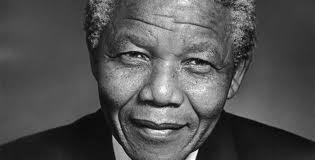
Brian Oosthuysen, on the birth of the Rainbow Nation and the death of Mandela

This is a guest post from Brian Oosthuysen on the death of Nelson Mandela. Brian is a Labour Party Gloucestershire County Councillor in Stroud and he is also a consistent campaigner for freedom, fairness and human rights both locally and internationally. Brian tweets @BrianatRodboro

Mandela 2
Apartheid was an evil, vicious system which saw the death of many thousands and the incarceration of even more. It dominated all aspects of life and was one of the reasons I left SA as a young man.

Nelson Mandela was one of those sent to prison and he suffered in many different and horrible  ways during his 27 years behind bars.

In the 70s and 80s I often addressed meetings as a member of the Anti-Apartheid Movement in England and I always ended my talk with a look into the future, which I saw as unbearably bleak.  “It will”, I would say, “end in bloodshed and the deaths of thousands of black and white people”.

And then Nelson Mandela (Madiba) was released and almost immediately transformed the political and social landscape in South Africa, and the Rainbow Nation was born.

His act of forgiveness to his former warders, his call for reconciliation and his setting up of the Truth and Reconciliation Committee showed the people of South Africa and the world that he was a man of towering stature and amazing integrity.  The constitution which his new government brought in is recognised across the world as one of the most progressive, and his stamp is clearly on it.

South Africa has many problems but the South Africa we now have is a country more at peace with itself than it has been since before 1945 when the Nationalist government came to power and Madiba is the reason for this.

Madiba once said, “No one is born hating another because of the colour of his skin or his background or his religion. People must learn to hate and if they can learn to hate, they can be taught to love, for love comes more naturally to the human heart than its opposite.”

He lived out that maxim and his death leaves the world a darker, colder place.

Hamba Kahle, Madiba.


1 Comment

Filed under Gloucestershire, Human rights, Politics

Jayyous – one year on

Kate Cargin, who served as a human rights monitor with EAPPI just after me, writes about going back to Jayyous a year after we served there. 

Abu Azzam, welcomed us back to Jayyous like members of his own family and his wife Sehan laid on a lavish meal. I had met Juliane, my team-mate from EAPPI last year, in Jerusalem and the two of us were invited by the current team to stay in our old placement house.

Supper with Abu Azzam. Photo: Per-Ake Skagersten

Photo: Per-Ake Skagersten

Now, as then, the most serious problem for people living in Jayyous is the ‘separation barrier’ or ‘separation fence’, which divides the village from 75% of its agricultural land. All other problems stem from that: increasing poverty, emigration, demonstrations and arrests.

The impact of the fence and accompanying restrictions on the village is profound and life-changing. Farmers have to pass through ‘agricultural gates’ to access their land and permits to do so are often not forthcoming. It is a precarious way to live. Not only are people cut off from their farming income, but because of demonstrations against building the fence many have also been denied permits to work in Israel. Breadwinners and young people emigrate; students are pulled out of university. Regular army incursions with exchanges of stone-throwing and tear gas result in arrests, many of them of children. The prevailing emotion is loss and grief. Jayyous used to be a prosperous place to live. Now it is estimated that up to half its inhabitants receive food aid.

When the fence in this area was completed in 2003, the case for Jayyous was taken to the Israeli high court to contest its route. In September 2009, the Israeli High Court handed down a judgement to reroute the barrier to return some land to the village. Yet the farmers were not represented subsequently when the new route was determined which would return only a third of the farmland to the village. The villagers did not accept this, pointing out that all of the land belonged to them. They organised demonstrations which resulted in many arrests and increased army presence in the village. As Abu Azzam put it ‘We are expected to welcome the return of 2,488 dunums (1 dunum = 1,000 m2) and one underground well to the village. However, more than 5,000 dunums and four underground wells remain behind the fence.’ When the new fence is complete, most of the farmers will still have to pass through agricultural gates and some will even have to take a longer route.

Fence showing re-routing in progress

Photo: Fence showing re-routing in progress

Water is a huge issue in Palestine. While I was in Jayyous, villagers were suffering from a chronic lack of water because the fence cut them off from their main water supply. We had a very small well in our garden with a back-up supply from the next door village of Azzun and were warned not to drink it. There had been an agreement to pipe water from some of Jayyous’s own wells back through the fence. This was to be implemented and financed by the International Red Cross. Like many agreements it was taking its time and nothing happened during our time there. After a shaky start when the settlers destroyed the initial pipes, a pipeline is now established from three wells behind the fence to the Jayyous reservoir. However, the villagers have not been given planning permission to lay electricity cables to run the pump. They have been told to use diesel which would increase the cost eightfold. Currently there is a stalemate.

Israel says that the separation barrier is necessary for security. They claim that it has prevented suicide bombings in Israel (the last suicide bomb in Israel was in 2006). However, we remained sceptical. We were told last year ‘everyone knows where the holes are’. All of our team had seen people going through a hole in the fence near one of the checkpoints. Sometimes soldiers went down to guard the hole and sometimes they did nothing. We were very surprised, returning a year later, to see that the same hole was still in operation and had not been blocked. We were even more surprised to be told by a local man that there are eight holes in this section of the fence.

men detained at checkpoint for attempting to go through a hole in the fence

Photo: Men detained at a checkpoint for attempting to go through a hole in the fence

Nevertheless Jewish Israelis are clearly afraid of their Palestinian neighbours and believe that the fence makes them safer. I saw several manifestations of this fear. Last year, when my daughter came to visit me, the border guards tried to stop her entering the West Bank for her own safety. ‘You will be kidnapped and robbed’ they said. On another occasion, an Israeli woman warned me against getting on an ‘Arab’ bus in Jerusalem. ‘Aren’t you afraid?’ she exclaimed in surprise when I asked why that would be a problem. The fear is undoubtedly genuine but it is cynically manipulated by politicians to justify theft of Palestinian land and in the process all Palestinians are demonised. The sad truth is that the separation barrier will not make Israel more secure and does not bring about the end to fear.

My British MP, a reasonable man, was unimpressed when I pointed out the deviation of the separation fence from the Green Line and told him how it represented the livelihood of an entire village. He described it as a small bump on the map. When people talk about a two-state solution they blithely talk of ‘land swaps’ allowing some settlements to remain and Palestinians to be given land elsewhere. This is what ‘land-swaps’ can look like on the ground. Where else can Jayyousi farmers farm if not on the land next to where they live which their families have farmed for generations?

The settlement outpost caravans, which we used to monitor, have been moved from the area designated for return to Jayyous and are now on land next to Abu Azzam’s largest farm. This land was confiscated in 1988 from the Khaled family when Abdul Latif Mohammed al Khaled went to work in Jordan and the land was classified as owned by an absentee. Planning permission has been granted for 40 new houses to be built there and as with all settlements, the houses will be for Jewish Israelis only.  According to official Israeli data, Palestinians have been given only 0.7 percent of confiscated land in the West Bank; around 38 percent has been allocated to illegal Israeli settlements.  Abu Azzam told us that someone from the settlement council comes down to look at his land every day. On one occasion, he told Abu Azzam’s workers: ‘Tell Sharif (Abu Azzam’s given name) this is our land and the shed is our shed.’

Abu Azzam is a naturally cheerful man but he was more worried than I had seen him before. The Israeli army had given him a map showing the re-routed fence. There were also strange yellow lines marked on it going across his land. He said, ‘I do not know what the lines on the map mean. Are they going to take my land? Have they already confiscated my land and I do not know about it?’ This is not without precedent. Sometimes land is declared forfeit but nothing happens on the ground until some years later.

Remembering also that two sizeable plots of Abu Azzam’s land are still behind the rerouted fence, I asked him if he was afraid that village access to land behind the fence would be more difficult now that some of the land had been handed back.

His answer was to tell me a story about a melon farm which had belonged to his extended family. It was situated between the nearby town of Qalqilya, on the Green Line, and the railway, in what is now Israel. The area was designated as a buffer zone when the 1949 armistice line was drawn up, to be neither Palestinian nor Israeli. At first they were assured that they would be allowed to continue farming; then the Israelis simply sealed it off.

I looked at Abu Azzam and wondered how he could bear it. It has been his life’s work to defend his village’s land. He just shrugged and replied quietly, ‘For the moment, they say they will allow us to go there’.

Kate no longer work as an Ecumenical Accompanier and the views contained in this blog entirely her own.

1 Comment

Filed under Human rights, Middle East, War

On Israeli settlers: “They come down from the hills and get us with dogs and guns”

I have just stumbled across this article that the wonderful Kate Hardie-Buckley wrote after visiting me and my former colleague Emmet Sheerin in Yanoun in the Occupied Palestinian Territories.

I don’t think I shared the article on Hynd’s Blog at the time.

The title, “They come down from the hills and get us with dogs and guns“, might read to some as being as slightly over the top. The fact that I can promise it isn’t says a lot about life in Yanoun.

Anyway, have a read of the article and let me know what you think.

PS – you can also watch Emmet’s video about life in Yanoun.


Leave a comment

Filed under Human rights, Media, Middle East, War

A visit to Hospice Africa Uganda

This is an article that I wrote for ‘ehospice‘ about my recent visit to a hospice in Kampala.

An incongruous collection of books sit on the shelves next to hand-made jewellery and other bits of bric-a-brac. I stand and flick through the books for a minute enjoying being out of the hot Kampala sun. As I rummage around looking for a bargain the shop assistant, Joy, begins to talk to me about her role at Hospice Africa Uganda.

Joy is one of a dedicated team of volunteers who make it possible for the hospice to carry on offering palliative care services to patients with Cancer and/or HIV/AIDS. Joy, a recently retired surgical nurse, is clearly someone who is driven by the need to help others. When I ask her why she gives up five days a week to help at the hospice she explains:

Read the full article here >>

2 Comments

Filed under Health, Human rights, Uganda

Intervening in New Delhi for International Women’s Day

This is a guest post by Angelique Mulholland. Angelique is a tireless human rights campaigner, articulate social commentator and a very good friend of mine. Please read, comment and share.

As part of my trip around Asia to find out more about women’s human rights at ground level, I have spent a week in New Delhi in the lead up to the big event in every activists’ calendar- International Women’s Day.

Within 72 hours of arriving in New Delhi, I was sexually harassed twice, both times on the Metro. With the “New Delhi gang rape” fresh in my mind, I can honestly tell you, I have felt a number of extreme emotions over this past week. Fear and anger are just two of them.

Both times, I said nothing to these men who presumed they had a right to touch me without my permission. In your head, when you imagine this happening to you, you always think you’ll fight back and give them hell. But in the reality of harassment – it doesn’t always work that way.

sexual harrassment on metro
I am fortunate though. I am fortunate because all week I have been working for a human rights charity called Breakthrough. They understand better than anyone why it can be hard for the victim to speak up. That’s why they encourage intervention from others; both men and women. Their most successful campaign here in India is called “Bell Bajao” which in Hindi means “Ring the Bell”.

India’s biggest women’s human rights problem is not in public spaces, it’s actually in the home. The objective of the campaign is clear and effective; if you hear a woman being subjected to violence next door, then “Bell Bajao.” Get up, go next door and #RingTheBell. Intervene. Stand up for that woman. Here is one of the powerful videos, created by Breakthrough which shows how the people of India can do just that.

As I have learnt, intervening is an extremely important part of ending violence and harassment against women. Why? Because very often it is too difficult for the victims of violations just to speak out for themselves.

Why is it so hard to speak out? Why did I say nothing to these men?

I said nothing because I was shocked – beyond belief – both times. You may think I would have been prepared after all the reading I had done on the daily harassment that many women face in New Delhi – but no – I assure you, nothing prepares you for a man grabbing your breast when you innocently get off at your stop, or a man pushing himself up against you after he glimpses your shoulder when your top slips down by accident. Nothing prepares you for either of these things and shock is definitely the first emotion.

I said nothing because I was scared of the repercussions. I estimate that there is a ratio of 100 men to 1 women on the streets of Delhi. If I had shouted at either of these guys on the train, would the other men have stood up for me? Would they have laughed? Would they have understood? Would I have put myself in more danger? Would they have given a shit? I don’t know. I really don’t know…

I hope that Breakthough’s new campaign “One million men, One million promises” will galvanize men into standing up and intervening. The campaign aims to get men in India and around the world to make a promise to stand up for women’s human rights. Make a promise to intervene if they see a woman being harassed. Make a promise to tell other men who are behaving inappropriately to start behaving appropriately and with respect. Putting it simply, it’s about getting the good guys, and there are so many of them, to stand up and tell the bad guys where to go…

“One Million Men, One Million Promises” was launched on International Women’s Day at the British High Commission in New Delhi. I was there and tweeting with the digital team. Please do follow both @LeakyM and the Twitter account for the event which is @bell_bajao for updates. The hash tag is #RingTheBell.

For the women of India who are harassed and subjected to violence on a daily basis – I ask you to join the campaign and make your promise to help end this.

http://breakthrough.tv/ringthebell/

1 Comment

Filed under Human rights, Social comment

Talks on Israel/Palestine

In 2012 I spent five months living in the West Bank as part of the Ecumenical Accompaniment Programme for Palestine and Israel. I then undertook a speaking tour about my experiences.

I wanted to say a huge thank you to everyone who hosted me and to everyone who attended one of my talks.

So a huge thank you to:

I am still available for further one off talks, commentary or debate. My contact details are here.

Leave a comment

Filed under Human rights, Middle East

CHILDREN OF PEACE INTERVIEW

This is a copy of an interview I did for charity Children of Peace.  Children of Peace is a UK based charity that works with both Israeli and Palestinian children to build positive relationships for a future generation, whose communities might live and work in peace, side-by-side.

“Steve is a human rights worker who spent five months in 2012 in the occupied Palestinian territories as part of the Ecumenical Accompaniment Programme in Israel and Palestine. He is currently working in Kampala, Uganda.

Sarah Brown (Sarah): Could you tell us what sparked your interest in Israel/Palestine?

Steve Hynd (Steve): A mixture of design and chance is the straight answer.

My sister studied ancient Hebrew at the University of Jerusalem and was living in West Jerusalem in 2001 and experienced first-hand the impact suicide bombers had on the community in which she was living. I was at secondary school when this was happening and it challenged me to think about the conflict. My sister was moved deeply by what she saw, but will openly admit, she only saw one side of the story. This was my very first introduction to the conflict.

Since then I have been actively involved with human rights issues and organisations for a long time. Invariably Israel/Palestine came up – especially during my time at Amnesty International in the aftermath of Operation Cast Lead.

At first though, I chose to work on other issues and countries and took an active interest in countries such as Turkmenistan (described by Freedom House as ‘the worst of the worst’) thinking that there were others with more knowledge and better placed to work on the Israel/Palestine conflict. I thought to myself ‘what could I contribute?’

Only after getting involved with EAPPI, almost by chance, I have come to think that I do actually have a role to play and something to contribute.

Sarah: What made you decide to work with EAPPI?

Steve: I became interested in a model of human rights work that combined impartial monitoring with the concept of ‘protective presence’. This was being practiced by organisations like Peace brigade International (PBI) and the Ecumenical Accompaniment Programme for Israel and Palestine (EAPPI). PBI worked mainly in South America and EAPPI worked in the West Bank. In the end I chose to apply for EAPPI for a range of reasons including being interested in positive examples of faith based organisations – this led me, in many ways by chance, to Israel and the occupied territories.

I had also come across EAPPI as I had previously worked for the Quakers (who coordinate EAPPI in the UK and Ireland) and had heard very positive feedback from people I respected. Before I applied I contacted Symon Hill (author of the No-Nonsense Guide to Religion) who at the time worked at Friends House in London and he had nothing but praise for the organisation.

Sarah: EAPPI has faced some recent criticism. Would you like to comment on that, or, more generally, on the assertion that Israel, as a comparatively accessible and open society, comes in for a disproportionate amount of scrutiny?

Steve: In the lead up to the Church of England synod vote (to endorse the EAPPI) they did come under a lot of criticism. A small amount of which I felt was valid, but a lot I felt was not valid and indeed was often inaccurate or misleading.

As with all conflicts, EAPPI as a human rights organisation challenges some vested interests and gets attacked because of it.

In terms of Israel more generally…

Israel is paradoxical in its human rights record. In one sense, as the question suggests, it is open and free. It consistently does well in terms of press freedoms and is a beacon of hope, in stark contrast to its neighbours, on issues such LGBT rights.

You cannot however, examine Israel’s human rights policy, without looking at their foreign policy and their on-going occupation of the territories and their continued disregard for International Humanitarian Law.

I have no doubt that some people use these violations as a tool to attack Israel – either because of regional politics or because of anti-Semitic values. Equally however, from my experience, most people working on the conflict are doing so because they care passionately about the victims. I know a number of good people working hard for peace that have been lazily labelled ‘anti-Semites’ – this cheapens a very serious problem.

Equally, sometimes the criticisms of human rights organisations are unfounded. For example, Human Rights Watch is often accused of ‘attacking Israel’ and focusing disproportionately on Israel. In reality, Human Rights Watch works on 17 countries in the Middle East and North Africa. Israel accounts for about 15 percent of published output on the region. The Middle East and North Africa division is one of 16 research programs at Human Rights Watch and receives 5 percent of total budget.

I accept that Israel has more focus on it than most other countries (such as Turkmenistan), but I still maintain that we need more focus on these neglected countries rather than less on Israel. In my opinion it is a disgrace how few people care about, or are willing to work for the people in Turkmenistan.

This why, whenever I speak to people about Israel/Palestine I insist that we can all be doing more and working harder.

Sarah: Could you tell us about some moments which most stick in your mind from your time with EAPPI?

Steve: It is hard to pull out a couple of moments. There was not a day that went by where I didn’t hear about how people’s lives were being affected by the occupation.

Perhaps the best place to start would be the occasion when I felt the most hope. I was in Sderot in Israel on the border with Gaza and we met with representatives from the peace group ‘Other Voice’.

Every house in Sderot has a built in ‘safe room’. I was told residents have just 14 seconds to get to it should they hear the warning siren before rockets from Gaza might hit. This is a physical impossibility for many such as Sderot’s elderly residents. People live in fear. Nearly all of Sderot’s residents have been affected by rocket attacks.

Despite this reality, I found people who were looking to work creatively with Palestinians to find a lasting peace. I passionately believe that change needs to come, at least in part, from within Israel. Groups like Other Voice might provide the seeds from which this change grows.

A second example that sticks in my mind highlights the complicity of the Israeli Defence Force in some of what is happening. I was in the village of Urif and settlers had set fire to a large section of Palestinian farmland. When Palestinians went to put the fire out, the IDF fired teargas at them and the settlement security shot a Palestinian in the spine. When Palestinians went to help the man, the IDF continued to fire tear gas at them. The whole time they watched on as the settlers continued to undertake acts of arson.

This is just one of many examples where the IDF were not fulfilling their responsibilities to protect the occupied population!

Sarah: Is there anything which really surprised you in Israel/Palestine? And anything which you have changed your mind about?

Steve: It surprised me quite how the occupation affects every part of life for so many people. Before I went, I understood that terrible things happened. I didn’t understand that not a day would go by in the West Bank without either a demolition, a midnight raid of a village, some arbitrary arrests, detentions, excessive use of teargas, child detention, etc. The reality of everyday life for an ordinary Palestinian shocked me.

I was lucky, and unusual, in that before I went I didn’t hold many preconceptions about the conflict. In that sense I would say that the experience was a steep learning curve for me.

Sarah: Which commentators (journalists, writers or bloggers) on Israel/Palestine would you recommend to someone wishing to learn more about the region?

Steve: This question has a catch in it. One of my biggest gripes is that too many people approach the conflict from a partisan side-taking perspective. If you follow bloggers, journalists and writers, you have to take 90% of them with the assumption that they are pushing an agenda. In light of that, I feel more comfortable naming a few organisations (with the understanding that I might not agree with everything that they say/do)

  • B’Tselem – The Israeli Human Rights organisation.
  • Breaking the Silence – The Israeli organisation of ‘veteran combatants who have served in the Israeli military since the start of the Second Intifada, and have taken it upon themselves, to expose the Israeli public to the reality of everyday life in the Occupied Territories’.
  • Al Hac – Palestinian Human Rights organisation.
  • EAPPI – They provide regular on-the-ground accounts of what is happening.

I would encourage everyone to explore and read on this issue as widely as possible – trying to empathise with what has been written.

Sarah: Can you tell us something about your hopes/fears for the future?

Steve: The same as most people I think – I hope for lasting peace that enables Israelis and Palestinians to live side by side feeling safe and secure.

My fear? That the detrimental spiral of violence and mistrust will continue and people will continue to suffer.

1 Comment

Filed under Human rights, Middle East, War

The removal of ‘insulting’ from Public Order Act is a victory for free speech

This article was written for Left Foot Forward.

Rowan

MPs have confirmed that the word ‘insulting’ will be removed from Section 5 of the Public Order Act 1986.

This is a major victory for an unlikely alliance of free speech campaigners including The Christian InstituteThe National Secular Society and Rowan Atkinson.

Last month the home secretary Theresa May announced that the government was ‘not minded to challenge a House of Lords amendment removing the word ‘insulting’ from Section 5 of the Public Order Act.

In the past Section 5 had been used against street preachers ‘insulting’ homosexuals and LGBT activists ‘insulting’ religious groups.

As Rowan Atkinson commented, “The clear problem of the outlawing of insult is that too many things can be interpreted as such. Criticism, ridicule, sarcasm, merely stating an alternative point of view to the orthodoxy, can be interpreted as insult”

This change in law is a victory for freedom of speech in the UK.

There remains, however, an important limiting role for the law to play. That role is to provide protection to those who are victims of threatening or abusive behaviour.

In 2011 I blogged saying that, “We all hold the right to live without fear or intimidation. This has to be legally separated, however, from being ‘insulted”.

The distinction has finally been acknowledged by the government and the change in the law later in the year is now just a formality.

It is worth noting, though, that even with this change in law, the discussion about what constitutes threatening behaviour compared to ‘insulting’ behaviour will remain. There is a considerable grey area around what the law should interpret to be ‘threatening’ and what it should view as merely ‘insulting’.

For example, ‘My Tram Experience’ – a video showing a vile torrent of racist abuse on a south London tram – sparked two very different interpretations.

thought her behaviour was threatening and therefore called for her arrest, while bloggerSunny Hundal argued that she was simply being insulting.

With the change in law however, the police are some way towards having a clear distinction to follow. We are no longer asking them to be the judge of what behaviour is deemed ‘insulting’, at least.

Leave a comment

Filed under Celebrity, Human rights, Media, Politics, Social comment

“This is what occupation looks like” says ex-Israeli soldiers

Breaking The Silence is a group of ex-Israeli soldiers who have taken it upon themselves to “expose the Israeli public to the reality of everyday life in the Occupied Territories”.

Today they put out this important message:

In the past few days thousands of people have seen the image on the right: a Palestinian child in the cross hairs of an Israeli soldier’s gun after the soldier took the photo and uploaded it to his personal Instagram account. It was shared hundreds of times, with many people expressing their discomfort with this absurd show of force where a person can aim a gun at a child just to post a ‘cool’ picture and get many shares.
The image on the left was taken by another Israeli soldier in Hebron in 2003. He later gave us the rights to the photo along with a testimony that were presented in the first Breaking the Silence photo exhibition. The solider in question took the photo using his own personal film camera to keep as a ‘souvenir’.

Both pictures are testaments to the abuse of power rooted in the military control of another people.

Ten years have passed. Technology and media have changed. The distribution of images has changed. But the exaggerated sense of power and the blatant disregard for human life and dignity have remained: this is what occupation looks like.

2 Comments

Filed under Human rights, Middle East, War

A tribute to Marie Colvin

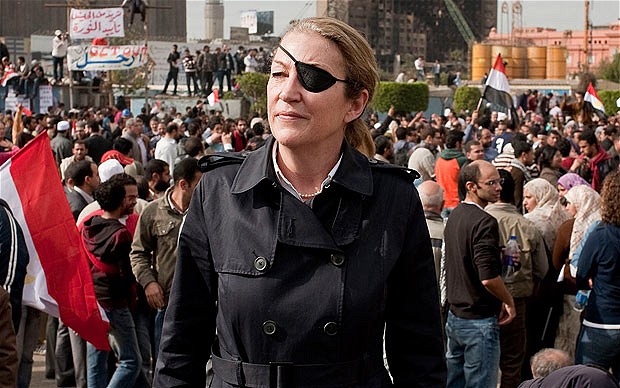
As 2012 slips into the confines of history, I wanted to pay one last tribute to Marie Colvin – one history’s greatest journalists that 2012 so cruelly took from us. I want to ensure that something of her ethos lives on in my writing.

Marie Colvin

Marie Colvin

Marie Colvin is one of the 121 journalists who lost their lives in 2012.  She lost her life in Syria surrounded by the same killings, war crimes and atrocities that she had spent her life reporting as a war correspondent.

She not only did a job that many of us would be unable to do, but she did it without losing a sense of humanity in some of the darkest situations.

Jeremy Bowen described her “big reserves of empathy” – something that is so vital when you spend your time examining the worst humanity has to offer.

In a 2010 speech in Fleet Street Marie described the role of a war correspondent saying:

“Covering a war means going to places torn by chaos, destruction and death, and trying to bear witness. It means trying to find the truth in a sandstorm of propaganda when armies, tribes or terrorists clash…

Despite all the videos you see from the Ministry of Defence or the Pentagon, and all the sanitised language describing smart bombs and pinpoint strikes, the scene on the ground has remained remarkably the same for hundreds of years. Craters. Burned houses. Mutilated bodies. Women weeping for children and husbands. Men for their wives, mothers children.

Our mission is to report these horrors of war with accuracy and without prejudice”

What fascinates and inspires me however is what drove her to then put what she saw down onto paper.

Ingrained in Marie’s writing was a belief, a belief that if the atrocities that she witnessed were recorded and reported then at least there was the potential for action to be taken. Accountability.

If war zones are left without accountability we take nothing into the future except for the loss, anger and desperation which comes to define the bloody aftermath of war.

Marie’s writing acted as a basket to carry the possibility of justice forward. Without accountability, the truth, in all its bloody detail, is left to soak into the cracks of history.

Perhaps part of what drove Marie, and certainly what motivates a lot of my writing and human rights work, is more than just the possibility for action. It is the belief that people care.

In the same speech in 2010 Marie went onto say:

The real difficulty is having enough faith in humanity to believe that enough people be they government, military or the man on the street, will care when your file reaches the printed page, the website or the TV screen”

In 2013, I am going to take these words with me.

I doubt I will find my ways into the war zone of Syria, but I am sure, wherever I end up, there will be human stories to tell. I hope that you, the reader, will also take these words with you.

I do what I do because, like Marie, I trust that you care.

1 Comment

Filed under Human rights, Media, War

Watch: Yanoun – by Emmet Sheerin

This is a video by a friend and former colleague Emmet Sheerin. We lived together for a  few months in the village of Yanoun in the West Bank as part of the EAPPI programme. This is his short video which was made while we were there.

http://vimeo.com/54138761

5 Comments

Filed under Human rights, Media, Middle East

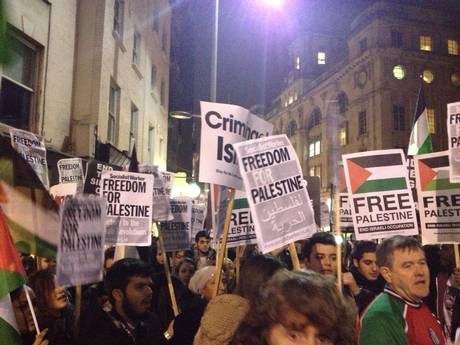
As Gaza burns Londoners take to the streets

Hundreds of miles away, families are huddled up inside their houses fearing the next explosion. Across the south of Israel and throughout Gaza, civilians are suffering the anxiety of a war that they cannot escape.  The second day of fighting in Gaza has left a mounting death toll and an unknown number of people with life changing injuries.

This bloodshed seems a long way away from the Israeli embassy in north London. It is though, ultimately why around 1000 people gathered here on a cold November night.

As I approach the planned protest I am met first by a sea of blue and white – mainly in the form of the Israeli flags but also Union Jacks. A few hundred people had gathered to offer support for Israel. I quickly have two leaflets thrust into my hand; one entitled “Defending Israel from Terror” and the other urging me to donate to “Rocket Aid”.

I dither on the pavement as I read the leaflets. Some of the language on the leaflets attracts my attention. The first leaflet states “Operation Pillar of Defence is aimed at removing the threat to Israeli citizens. No innocent civilians will be targeted” and I think about how this aspiration seems to so routinely not be lived up to. Amnesty International has stated that two Israeli airstrikes in the last week alone have failed to distinguish between civilian and military targets and as such constitute a violation of International Humanitarian Law.

My attention though shifts to a woman who is draped in an Israeli flag handing a small child a leaflet whilst saying, “it’s important everyone knows the truth”. I decide that now was not the time to discuss the philosophy of ‘truth’. Instead I start a conversation.

It would be fair to say that we don’t always see eye to eye on every issue. At times though we find common ground, “Israel’s external security threat is not to be underestimated” she says. At times though we had to agree to disagree, “I don’t know what more Israel could be doing to get peace”. I offer her a list. At times I am left speechless by some of her analogies – the bombing of Gaza, she said is like having children “you talk to them and you talk to them but sometimes you just lose your rag”. I bit my lip.

Despite at times finding her views unpalatable, she was friendly and engaging and our conversation attracted other around us. A young Londoner called Harry was hanging around the edge of the protest and soon we were having a good conversation. Harry is a 17 year old student who wants to study International Relations and oozes confidence and intelligence.

I asked Harry why he was there and he responded passionately about schooling and how he thought that every kid should have access to it without being scared of rocket attacks. Indeed, Harry who has family in Israel had none of the anger or angst that can sometimes be found in these situations and I believed him when he said “I’m also here for the Palestinians, I’m here because I want them to be free from Hamas, a terrorist government”.

As I worked my way through the crowd trying to make my way to the much larger “pro-Palestine” demonstration I briefly met a man whose son had gone and joined the IDF, a spokesman for the ZF and a young girl of about 6 who “just wanted there to be peace”- a diverse crowd.

All the time though I kept being distracted by snippets of less guarded conversations in the crowd. “Fuck human rights” “Those Arabs, they would kill each of us if we turned our backs” “Why do Arabs always smell like they’ve shit themselves”. I couldn’t help but to be appalled and I wondered what someone like Harry would have made of some of these comments.

As I made my way through the lines of police between the protests, one stopped me and asked, “Are you one of them?” I gave an oddly constrained answer as if under interrogation and said “I was looking to get into the Palestine demonstration”. To seek clarification the officer asked “Are you Jewish”? I answered honestly, “no”. This seemed to be enough to let me walk freely between the demonstrations.

Once through I was met with the swaying force of 1,000 people all shouting and chanting. There were Socialist Worker Party banners everywhere.  Almost immediately someone approached me and said “solidarity brother” and held out his fist. I replicated and we did, what I thought to be, a slightly awkward fist tap (like a high five but with your fist clenched). He looked at me smiled and said, “Yeah fuck the Jews man” and walked off.

With no sense of irony he turned and immediately started talking to a group of Jews who are anti-Zionist and can often be seen on ‘pro-Palestinian’ demonstrations. Language is used and abused but I still found the flippancy in which he muttered the phrase “fuck the Jews” to be deeply disturbing.

A wee scuffle broke out at one point between a young activist called Joe and a portly policeman. I approached Joe afterwards and asked what the problem was. Angrily at first he said, “They won’t let me confront them…the fascist scum. The EDL are down there and these pigs won’t let me through”. He looks through the policeman who is still hovering over us and says, “The Zionists are standing side by side with the fucking EDL”.

I asked around and indeed even went back to check, and couldn’t see any sign that the EDL had been at either demonstration.

All around me the crowd is loud. They chant in slogans that have been used for as long as the occupation and the mass of people seem to move with a collective pulse. The atmosphere is intense and the police numbers grow around the edges of the swelling crowd.

A young man with a scarf around his face sees me making notes and winds his way up to me. He tells me above the ambient noise that he is Indian and this is the reason why he has come here today. “I am here for myself because my country was occupied for hundreds of years. I’m here standing up for myself but also for the Palestinians – the oppressed”.

I ask him if he thinks it will work, if this demonstration will make any difference and he responds simply, “we have to try”. Even though he has a scarf over his face I can see his cheeks lifting and some wrinkles appear in the corner of his eyes. He exudes a sense of optimism.

Just as I finish speaking to him a small fight breaks out and two protestors are taken away by the police whilst chanting defiantly “Free free Palestine, from the river to the sea, free free Palestine”. The whole evening feels electric as if at any moment it could spill over.

After a gradual decline though, the cold takes most people back to their warm houses. Only a handful of anarchists and activist are left. One proclaims proudly “I’m only leaving in handcuffs” to which a policeman responds “did you bring any with you”?

As I arrived back to the warm of my south London flat, I turn on my computer and I am virtually reminded of the reason why we had all trekked across London on this cold November night. The Palestinian news agency, Ma’an News has on its front page a story that is grimly entitled “Teen brothers among 3 killed in Israeli airstrike”.

It states, “An Israeli airstrike killed three Palestinians in the northern Gaza Strip on Thursday evening…bringing the death toll to 19 on the second day of fighting.”

No amount of goodwill on either side will bring back the dead and only the Israeli government and Hamas have the power to stop further bloodshed. Let’s hope the leadership was listening to some of the moderate voices out on the streets of north London  on this chilly November evening.

8 Comments

Filed under Human rights, Middle East, Politics, War

In defence of Amnesty International. A response to Nick Cohen.

An edited version of this article was published on the Liberal Conspiracy blog.

Nick Cohen held nothing back in this Sunday’s Observer as he declared that Amnesty International (AI) had ‘lost its way. His attack varied from the organisational to the ideological but always ended with teeth dug firmly into the jugular of the most established human rights organisation in the world.

If you were to work your way through the red mist that hangs over his article you might, at times, find crumbs of real issues and debates – all of which are already taking place within the Amnesty International membership but to which his article adds little. Indeed, the misleading and at times factually wrong nature of Cohen’s claims makes it impossible for a neutral reader to disentangle his hyperbole from genuine debate.

His opening paragraph lays down the foundations for his meandering ideological attack as he accuses Amnesty of both suffering from a ‘post-colonial guilt’ and seeing ‘freedom as a bourgeoisie illusion’.

To simplify this argument in such a flippant way is to undermine the complexity of human rights theory.  These accusations strike at the heart of the debate between and universal absolutist understandings of human rights versus a more relativistic approach. The assertion that AI has fallen victim ‘from both sides’ misses its purposeful allegiance with the argument for universal, indivisible rights.

There is a very real discussion here that is raging within the AI membership. How you reconcile Economic, Social and Cultural Rights (ECSR) – which could be argued to be relative to their surroundings – with AI’s traditional absolutist approach. AI would argue that there is no distinction, many members would and do. These sorts of subtleties though find little time in Cohen’s article.

Cohen moves effortlessly in the first two paragraphs from the ideological to the organisational attacking AI saying:

it is a wreck. Staff have gone on strike in both its British and international offices to protest against the management’s decision to sack workers campaigning to defend prisoners on death row, women’s rights, gay rights and refugees”.

Indeed, AI staff have gone on strike and I have blogged about why they have here. I see no reason though for AI to apologise for moving its resources in an effort to globally rebalance its work.

Again though, the debate around growing globally and how this affects national sections is one that is fiercely debated within AI but Cohen seems happy to skip over it. There are many who disagree with me and feel that money raised in the UK should be spent in the UK, others think it is only right and proper to spread influence into geographic areas where traditionally AI has not had a significant presence.

Instead of taking on these interesting and nuanced points, Cohen goes for jugular. He quotes UNITES’s call for Kate Allen to stand down and then inexplicably connects that to Irene Khan’s recent ‘£500,000 pay off’ as Secretary General of AI.

I will not defend the outrageous actions of Irene Khan, nor the mismanagement that resulted in her leaving in the way she did. What I will do is clarify Cohen’s remarks. To start, he puts his comments into the plural “Amnesty’s directors receive £500,000 payoffs”. As far as I am aware only one Secretary General (Irene Khan) has received £500,000.

In addition, this £500,000 was not totally a ‘pay-off’. It included the current years pay and pension contributions. The actual ‘pay-off’ part of the sum was much smaller – although still outrageous.

Equally, it represents less than 1% of the annual budget, so to continue Cohen’s jumble sale analogy – it represents 1 pence of every pound raised being misspent (and that is a one too many).

What Cohen fails to say, is that at the time – the UK director Kate Allen was one of the fiercest critics of this whole debacle and spoke clearly and eloquently on the behalf of the UK membership.  Connecting the Irene Khan debacle with a call for Kate Allen to step down is unfair and misleading.

Cohen though is clearly not worrying about whose toes he is stepping on. He slips effortlessly back into his meandering ideological argument connecting AI financial situation with an accusation that “it is afflicted with a mental deformation: the racism of low expectations; the belief that human rights are “western” rights”. Again, this simply could not be further from the truth. If anything AI is too rigid in its belief that human rights are universal and applicable to all. Cohen offers no support to this statement.

Cohen moves on to take issue with AI’s expansion of its mandate, to include working on issues such as death penalty cases. Cohen argues that these causes AI has adopted (through a slow democratic process) are a ‘hodgepodge’ of campaigns that have resulted in AI work just being a ‘rich man’s self-indulgence’.  This ‘hodgepodge’ he describes partly reflects AI internal democracy (any member can bring a motion to their national AGM who will in turn take some policy ideas to the International Council Meeting to be voted on). It also however reflects AI growing capacity to work on ‘the full spectrum’ of human rights. Some in AI consider this a natural evolution for a human rights organisation.

Personally I see nothing contentious in AI adopting the death penalty as a campaign and developing it as a specialism. Indeed the last 40 years has shown us that AI has played a central role in the fight against the death penalty which has seen it almost eradicated in most of the world. This is a record in which I am proud to have played a small part of.

In what is the first logical step in Cohen’s article he connects AI growing mandate with the much more recent move ‘grow in the global south’ – an admirable goal. He then connects this with AI’s work on economic social and cultural rights, such as the right to education.

Cohen seems to see (or wishes to present no argument for) why AI might be working on issues such as the right to education. Instead he comments “Human rights “for the vast majority of the world’s population don’t mean very much”…Freedom of expression means nothing to a man who can’t read”. You can hear him sneering as he adds, “Poverty, not authoritarianism, was the evil that Amnesty must face”.

As a standalone sentence, ‘Freedom of expression means nothing to a man who can’t read’ makes a lot of sense. As I stated earlier though, there is a very real debate within AI membership about the scope of AI mandate and whether or not it should stretch to ESCR. Again though, Cohen shows no willing to dwell on such important questions.

Instead Cohen skips to another internal disagreement that resulted in the departure of Gita Saghal, the then head of AI gender unit. Cohen states she left because “she criticised its [AI’s} alliances with misogynist Islamists”. By ‘misogynist Islamists’ he means Mozzam Begg, a former Guantanamo Bay prisoner, who now runs the organisation ‘Caged Prisoners’.

I share some, but not all of, Gita’s concerns. Unlike her however, I feel confident within AI for room to debate these issues. The very idea that it was as simple as Gita being ‘forced out’ by AI though is simply misleading. Equally, the assertion that Cohen leaves unchallenged that ‘AI is in cohort with misogynist Islamists’ is also misleading. A curtsey glance at AI work on women’s rights across the Arab world will give evidence of that.

As Cohen’s article drags on so it gets more and more alarmist. He quotes an anonymous source ‘within AI’ that claims “sustained and strategic campaigning that we do with partner organisations, the UK government, the UK public, etc, will end“. This is simply not true. Sustained and strategic campaigning in the UK will remain at the heart of AIUK’s work. Simple.

Cohen finishes with a rallying cry for members to not ‘take it’. And, to an extent, I agree. If you are a member, research these issues beyond Cohen’s misleading snapshots and then come along to the AGMs and debate and vote.

That is how a membership organisation works!  This is how we will ensure AI is able to do what it does best – fight for human rights and shed a light onto some of the darkest situations around the world.

14 Comments

Filed under Human rights

Rockets and war crimes cannot break the Israeli peace movement

At the time of writing, 80 rockets have been launched from Gaza since last night – all aimed at the south of Israel.

The Israeli Defence Force (IDF) spokesman on twitter pointed out earlier that these rockets are not always intercepted.

The latest series of attacks have caused at least 5 injuries. Towns across the south of Israel are, once again, living in fear that a rocket could hit at any moment.

These attacks, due to their indiscriminate nature are a violation of International Humanitarian Law as they fail to distinguish between civilian and combatant. Amnesty International has accused Hamas, who regularly claim responsibility for these rocket attacks, of War Crimes.

These most recent attacks reminded me of my visit to Sderot earlier this year. Sderot is an Israeli town less than a kilometer from the Gaza border with a population of just 24,000 people. Life in Sderot is dictated by the near constant danger of rocket attacks.

Every house in Sderot has a built in ‘safe room’. I was told residents have just 14 seconds to get to it should they hear the warning siren. A physical impossibility for many such as Sderot’s elderly residents.

Town planners have ensured that there are always bomb shelters close by out in the streets. Every bus stop is built to double up as a bomb shelter. As a result, residents of Sderot are never far from shelter nor the reminder that they live in a constant danger.

Nearly all of Sderot’s residents have been affected by rocket attacks. 13 people have been killed in the small town in the last decade alone. The most recent was 35 year old Shir-El Friedman who was killed on the 9th May 2008.

Despite this terrifying reality, I met some within this small community that are actively looking to reach out to those living in Gaza.

I met a representative from ‘Other Voice‘ – a group of Israelis, mainly based in Sderot, who are working to end the circle of violence both in Gaza and Sderot. Their website states:

The Palestinians are also suffering. They, like us, strive for a quiet and peaceful life and for a better future. We believe that only by working together can we reach a long lasting solution. Therefore, our group is in ongoing contact with Palestinians in the Gaza Strip who believe, as we do, in non-violence and mutual respect that will bring about the much anticipated change”.

To meet Israelis living with this constant threat of attack but who were looking to create dialogue rather than conflict was truly inspiring. Too often, across both Israel and the occupied Palestinian territories, I witnessed the exact opposite happening.

The most difficult question I am left with, is that I don’t know how I would respond if I lived under such constant fear! This however only exaggerates my admiration for those like the members of Other Voice.

6 Comments

Filed under Human rights, Middle East, War

Testimony from an IDF soldier living near Qalqiliya

I have written a lot on this blog trying to explain to you what life was like living in Jayyus, a small Palestinian village close to Qalqiliya in the West Bank. Equally, I tried to give the people I met a platform to tell their stories.

Well today I stumbled across this testimoney from an Israeli Lieutenant in the IDF who served close to Qalqiliya over ten years ago. Things have changed a lot since then but I thought you might appreciate this view of Qalqiliya from the eyes of an Israeli serving in the army.

The period this describes is October 2000. You can read the full testimony here.

“I was around Qalqiliya then, which was considered a very friendly town to Israelis. Many Israelis used to go there, shopping for everything, using local garages for repairs, buying stuff, drugs, everyone was hanging out there all the time, and suddenly all at once lots of Palestinians were attacking the checkpoint. A little checkpoint, and all those Palestinians coming along and throwing stones, and armed. You couldn’t even tell where this suddenly fell from.

This happened while you were already an officer?

Right after I was commissioned…Our objective was to lay ambushes on various roads in the area, which are the border line between a Palestinian village and a Jewish settlement. They would simply come down after nightfall and throw stones at a car. The driver – frightened – would move the car and get hit. Our objective was to actually catch them [The Palestinians] before the act.

What do you do to catch them?

Lay an ambush. Our instructions were: anyone seen after 9 PM or so descending towards the road, you shoot. Legs down. Every ambush of this sort goes out with a small marksman rifle.

The instructions were to shoot at anyone arriving on the road without any warning? How did it go?

Think of a road with these steep hills on both sides which do not actually enable strategic control of the road. There are terraces of olive groves, that is the reason for this structure. It was rather logical geographically. This was at the time when the east-west highway was not yet constructed. There was just the old road. The new road simply bypasses all the Arab villages, creates an isolated route. There was none of this back then.

The situation was not weird, it was ridiculous. People shot at anything they saw moving. As a commander on the ground who is not supposed to shoot, you give the order to your soldiers and expect them to understand that if they see someone through their special sights who looks like he’s going to do something, they should shoot him in the legs or lower. In the knees. That was a very clear instruction. And they knew perfectly well how to aim and where to aim, regarding ranges. There are different ranges, after all. If you shoot at a leg you might hit the chest. There are situations where you know exactly what you’re going to hit if you aim here or there as regards the weapon’s deviation. And suddenly after two months of warfare, I don’t even know how long that was, two months of uncertainty, because there actually was uncertainty, what we called ‘waning and waxing tides’, two days calm and then chaos, and wild deployments, everyone in the area would leap at anything, stressed out like crazy.

So lots and lots of people got hurt and died, for no reason. Nothing you could even say they did. They did nothing. And then the army realized it was losing control. I’m talking to you here about a company in training of young soldiers, eight months into their army service. The older companies were even in a rougher spot. They had marksmen rifles so they would simply snipe away with more serious ammunition, not 5.56 but 7.62 caliber. Suddenly the army realized it had a problem. At least, the way I understand it now, they stopped it. They said: no more shooting. You need confirmation to open fire. Suspect arrest procedure. So then this procedure came in for suspect arrest. It didn’t exist until then. No such thing. Suspect arrest procedure went like this: You detect someone, you shoot….

It was a confused time. There were stones hurled, Molotov-cocktails, but no serious terrorist attacks. No targeted alerts. Nothing of the sort. As for intelligence information, it read like this: there is an attempt to enter roads. No one spoke of infiltration into Jewish settlements, soldier kidnappings, nothing targeted.

This instruction was handed down from the top, to shoot anyone approaching the roads after 9 PM?

Yes. It was a clear order, at least in our designated area. Anyone descending from that hill and looking suspicious, with no obvious reason to be there. Look, let’s say at 11 or 10 PM people have no reason to be there. Could be, perhaps they did do something. On the other hand, people at 11 PM don’t have too much reason to travel that road, see? So perhaps people really did try to throw stones, but hitting, I mean I’m talking to you here about kids hitting. Okay, they throw stones inside the village. Or there’s a demonstration in the village. The army tricks them by trying to enter and creating a riot. We knew that every entry of an army jeep into an angry village provokes a riot. That’s what brought them on, really. Not every commander was interested in keeping things quiet.

Some wanted to heat things up. Commanders? Company commanders?

Yes. The battalion commander was moderate, the company commanders were all gung-ho. Really. They were eager to enter and create planned disturbances.

A company commander would come along and say: tonight at 8 PM we’re going in for a provocation? Or during a patrol, he’d suddenly say: ‘Let’s hop in’?

No. It was more like, let’s hop in, make the rounds of the village now”.


This testimony was taken by the organisation “Breaking the Silence

1 Comment

Filed under Human rights, Middle East, War

Special Report: Palestinian Villages in the Firing Zone

This is a special report by my friend and colleague Leah Levane.

“Farming is in our soul and in our blood, if they take this away, we will be destroyed” Sara, resident of Jinba

The 30,000 stony, barren dunams of Massafer Yatta in the South Hebron Hills are beautiful in a stark and awesome way.  It is also, apparently ideal training terrain for the Israeli army, particularly in the event of another war with Lebanon.

Consequently the 1500 people, 14,000 sheep and 2,000 goats that currently live in 8 villages towards the southernmost part of the West Bank, will be evacuated and their villages destroyed so that the training can take place. The Israeli Minister of Defence gave these orders in the Israeli High Court on July 23rd 2012, as the government’s response to the villagers’ appeal to the designation of their homes and land not as Massafer Yatta, not as a collection of hamlets with their own names but instead as FIRING ZONE 918’.

Although the Court has still to make its final decision on this case, the army has already been closing roads and on August 7th, set up a checkpoint between the villages of Jinba and Khirbet Biral’Idd. Helicopters flew over the South Hebron Hills to support the army’s actions, and soldiers then entered the village, frightening residents and damaging property. Even before the announcement was made, a car was impounded for 10 days that belong to Comet ME, an organisation linking these and other villages in the south Hebron Hills to electricity by putting in solar panels and wind turbines.

Life is hard in these villages even without the Occupation to contend with; water is difficult and expensive to obtain and transport across the rough terrain where there are only dirt roads. The school in Jinba operates from tents, which are cold in winter and access to teaching materials is very limited. The school in At Tuwani (just outside the northern perimeter of Massafer Yatta, was under a demolition order for many years and was also contending with settler violence from the nearby Havat Ma’on settlement outpost (illegal even under Israeli law, although all Settlements in the West Bank are illegal under international law),

The area was first declared a firing Zone in 1999. 700 residents were evacuated.. The evacuation was halted by a interim injunction issued by the Israeli High Court of Justice (HCJ) in the year 2000 and in response to petitions filed by the residents and this limbo has continued since then following further petitions,, but no final decision has yet been made and this has meant that for over a decade, the residents of these twelve uniquely traditional villages have lived under the constant threat of demolition, evacuation, and dispossession.

Israel’s claims are that the people who live and continue their ancient culture of husbandry cultivation are nonpermanent residents and the villagers maintain that they are permanent residents but the Security Forces say they are not and that they are seasonally nomadic. School records in the area show that families are there year round.  (The Israeli Army is permitted under international law and if for security reasons, to remove people from a firing zone or limit their mobility within the area, except in the case of permanent residents.

These hamlets existed long before 1967 and some residents have ownership documents from the Ottoman period. And the historical existence of the hamlets has been recognised by the Israeli Ministry of Defense [see Ya’akov Havakuk, Life in the Caves of South Hebron (1985, Israel Ministry of Defense).

Now, after twelve years of waiting for a final decision, the Minister of Defence has announced that he wants to order the people from 8 of the 12 villages to leave.  These villages are: A-Sfay,  Al Kharuba, A-Tabban, Al Fakheit, Al Majaz, Al Halaweh, Al Mirkez, Jinba. Of the remaining 4 villages, at least two, Tuba and Um Fagara, have demolition orders on most of the structures in their villages. If the decision is implemented, what will happen to the people there?

In August and November 1999 the majority of people in these twelve hamlets were served with immediate evacuation orders due to their “illegal dwelling in a fire zone”. On November 16, 1999 security forces arrived and evacuated over 700 residents by force. The IDF destroyed homes and cisterns and confiscated property.  The villagers, dispossessed of their lands and their livelihoods, were left homeless. (ACRI – May 2012)

We met Sara, who is a teacher who lives with her husband and in-laws in Jinba.  Her husband died during the second intifada and later she married again. She has 5 children and the whole family have been subject to military incursions over the years. The DCO do not grant them any building permits, no matter how often they apply. Because of her first husband’s connection to the intifada, the family members are not allowed to work in Israel.  The option the Israeli government give them is to move to the nearby large town of Yatta where unemployment is very high and 75% work in the Israeli economy. Furthermore, as a large extended family they rely solely on agricultural activities for livelihood. Sara said “farming is in our soul and in our blood, if they take this away, we will be destroyed. “

Is the area needed by the Army?

The army had not held live-fire training in the firing zone for many years and by 2005, the two main military bases located in and around the firing zone, Adasha Infantry and Um Daraj, had been closed down. (Of course, this was before the loss of the Second Lebanon War in 2006).  These bases have not been reopened. (See 2005 B’Tselem Report (“Means of Expulsion: Violence, Harassment and Lawlessness against Palestinians”)

The Army has objected to the fact that there are people living in the area and visiting the area, other than those who in 2000 were granted the right to return to the area pending a final decision. Of course, the legal proceedings have been going on for 12 years and so it is to be expected that the villages have developed, the population grown and needs have changed. (See also section below)

British Aid and humanitarian needs in the area

The UK government funded 15 cisterns and a series of 19 toilets, including cesspools as part of the DFID humanitarian project. These structures serve 18 families (approximately 320 persons), the majority of whom reside in A-Sfay.  All these structures have had demolition orders on them for some years and the Security Forces contend that the establishment of the cisterns and cesspools was a violation of the Court’ agreeing that residents could come back into the area in March 2000 pending a permanent decision because this calls upon  Palestinian residents to preserve the status quo that existed at the time the (1999) evacuation orders were served. (my emphasis).

It is important, however, to note that international humanitarian law requires an Occupying Power has a responsibilityfor the humanitarian needs of the population and it is does not make sense to the residents that when the Court issued an order allowing the villagers to return to their lands in 2000, that it meant to deny them their most basic needs. Without these cisterns and cesspools structures, a humanitarian crisis would surely have already arisen.

Finally….

Massafer Yatta is in Area C, an area comprising 62% of the West Bank, including all the Israeli Settlements and Settlement outposts.  It is almost impossible for Palestinians in Area C to get permits to build houses, schools, cisterns, clinics, tents. Everything is considered a structure, solar panels and wind turbines and even the water tankers that have to be driven in by tractor to all the Palestinian villages in this area. There are now more Israeli citizens living in Area C of the West Bank than Palestinians (350,000 Israelis compared with c. 150,000 Palestinians and these figures exclude the 200,000 Jewish Israelis living in the annexed part of Jerusalem, which was part of the West Bank until 1967.)

My thanks to ACRI (Association for Civil Rights in Israel, who together with Rabbis for Human Rights and Breaking the Silence provided much of the history and technical information

Leah Levane is serving for three months with the Ecumenical Accompaniment Programme in Palestine and Israel (EAPPI). EAPPI brings internationals to the West Bank to experience life under occupation. Ecumenical Accompaniers (EAs) provide protective presence to vulnerable communities, monitor and report human rights abuses and support Palestinians and Israelis working together for peace. When they return home, EAs campaign for a just and peaceful resolution to the Israeli/Palestinian conflict through an end to the occupation, respect for international law and implementation of UN resolutions.

Leave a comment

Filed under Human rights, Middle East

Amazing people inspire Steve to spread the word

This article was was published in the Stroud News and Journal.

Human rights activist Steve Hynd has returned home to the Five Valleys after five months working in one of the most volatile, divided regions on the planet. The vital observations he made in the  West Bank helped inform major peace organisations desperate to bring stability to the landlocked territory, which has been fought over for decades between Israeli and Palestinian troops. Having met some extraordinary people on his travels, Steve is now keen to share his experiences of life in the strained region, where human rights abuses continue to shock the world.

“I LOVE Stroud – everything from its green valleys to its award winning ale. It has a buzz about it that combines a feeling of vibrancy with a relaxed tranquil atmosphere.

It was therefore quite a jump for me to go from a quiet life in the west country to accepting a position with a human rights monitoring scheme in the West Bank.

I have just returned from five months with the scheme, which was co-ordinated by the World Council of Churches.

Throughout my time I witnessed some terrible human rights abuses but I also met some inspiring people carving out lives for themselves in incredibly difficult situations.

For example, I met Mohammed in East Jerusalem who was evicted from his home aged just 14.  His neighbourhood, Sheikh Jarrah, is being targetted by Israeli settlers looking to establish a permenant Jewish presence there.

Today, Mohammad lives back with his family but is forced to live alongside the settlers in his house, which has been literally divided into two, with his family living in the back and the settlers  living in the front.

What struck me most about Mohammad’s story was the honesty with which he told it. He would be the first to admit that he reacted with deep anger towards all Israelis, feeling the rage and injustice of the situation in which he found himself.

This was until Israeli peace activists such as Tzvi Benninga started to come and help him, his family and his neighbourhood. This was the first time he had met an Israeli who was not a soldier or a settler. Every Friday, Palestinians, Israelis and internationals come together to protest in MohammadÕs neighbourhood.

One of my organisation’s roles was to go along to these protests to monitor proceedings. In the past it has been met with violence and tear gas and it would be our role to report that.

Mohammad is just one of a series of inspiring characters that I met whilst I was there. Now that I am back home I feel it is only right to try and tell the stories of a few of the people that I met.

As such I am hoping to do a series of talks around the area about my experiences.

If you would be interested in hosting a talk then please do not hesitate to contact me by emailing stevehynd24@gmail.com.

Whenever I asked anyone I met what they would want me to do to help their situation they nearly always responded in the same way – ‘go home and tell people what you have seen here’, they would say  – so this is what I am hoping to do.

1 Comment

Filed under Human rights, Media, Middle East