Category Archives: Human rights

Israeli surrealism: ‘This is not an occupation’

This article was written by Chris Cox, a friend, a journalist and currently based in Hebron with EAPPI. Chris will be blogging throughout his stay in the West Bank.

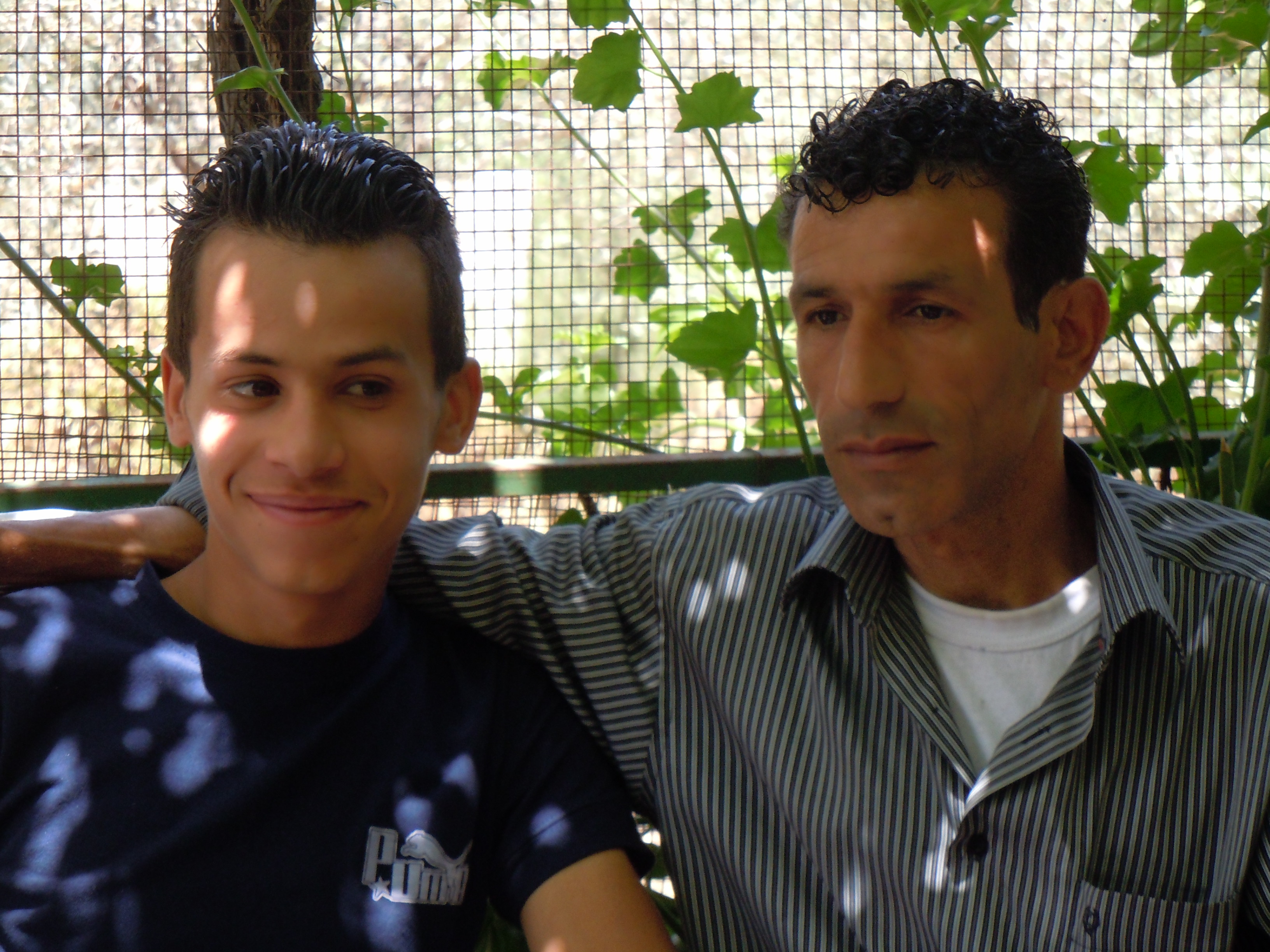
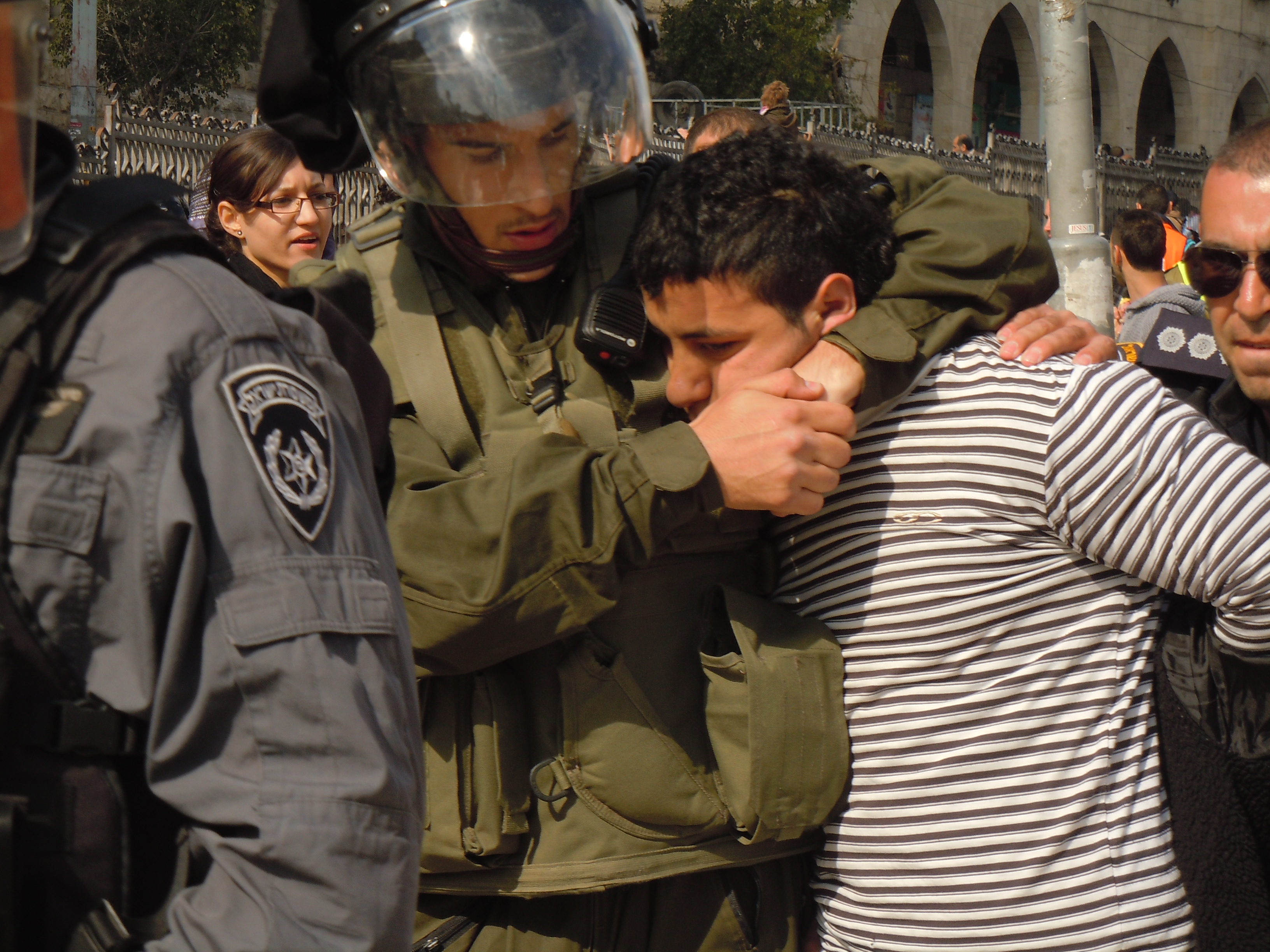
Hazem Abu Rajab outside his house in Hebron, July 2012. [Photo: Eero Mäntymaa]

The art of surrealism involves mastering the element of surprise, the jarring juxtaposition, and the perfect non sequitur. This week, a judiciary panel appointed by the Israeli government proved themselves to be gifted surrealists: boldly breaking with decades of legal consensus to the contrary, the panel concluded that Israel is in fact not occupying the West Bank.One of its arguments, in a nutshell, is that occupations only last for short periods. Because Israel has been ‘a presence’ (or, in the language of unanimously-approved UN resolutions, ‘an occupier’) in the West Bank for over four decades, the situation no longer qualifies as occupation.

Try telling that to Hazem Abu Rajab, who shares his Hebron home with the Israeli border police. Since March this year, the Rajab family – nine in total, including Hazem’s parents – have had armed police occupying two-thirds of their house. Two of them sit outside the front door around the clock, while another mans the roof – on which flies an Israeli flag.

That would be enough to make anyone’s life miserable. When I visited Hazem last week – along with my EAPPI colleagues – he told me that the border police routinely pretend they do not know his family members, making them wait up to 20 minutes while they ‘confirm’ their identities before allowing them into the house.

But this is not an occupation, of course. It’s essential to remember that.

The Rajab family are in this situation because Israeli-Jewish settlers broke into their home in March this year, claiming to have purchased it from a Palestinian man – a claim the Rajab family flatly reject. Hazem told the Guardian how his family were woken at 1am by Israeli soldiers, armed and wearing black, who broke down three doors. “Within five minutes, 100 to 150 settlers were inside,” he said.

The settlers have since been evicted, but their claim has led the Israeli authorities to classify the property – which has been in the Rajab family for generations – as ‘disputed’.

“It’s going to take forever,” says Hamed Qawasmeh, a UN human rights officer. “It’s always like this. Once a home is ‘disputed’, no one can move into it.”

Hazem has spent the last seven years converting the basement of the house into an apartment, so that he can get married and live there with his wife. He works as a labourer, on low wages, and had painstakingly laid the foundations for the next phase of his life.

Now, Hazem and his family are trapped in limbo while the case makes its glacial way through the Israeli courts. His basement apartment was welded shut by the settlers when they moved in, and remains so.

Meanwhile, Hazem says, the border police humiliate his family in dozens of ways on an almost daily basis. He tells me the guards urinate in front of his female family members, swear loudly and play music, and make the Rajab family keep their windows closed on hot summer days.

“Each one of them is a government on his own,” says Hazem.

But this is not an occupation. Remember that. This is not an occupation.

Leave a comment

Filed under Human rights, Middle East

Violent attacks in Yanoun, West Bank

For the last two months (May 2012 – June 2012) I have been staying in the village of Yanoun in the West Bank. It is with great sadness that I share this latest report coming from EAPPI.

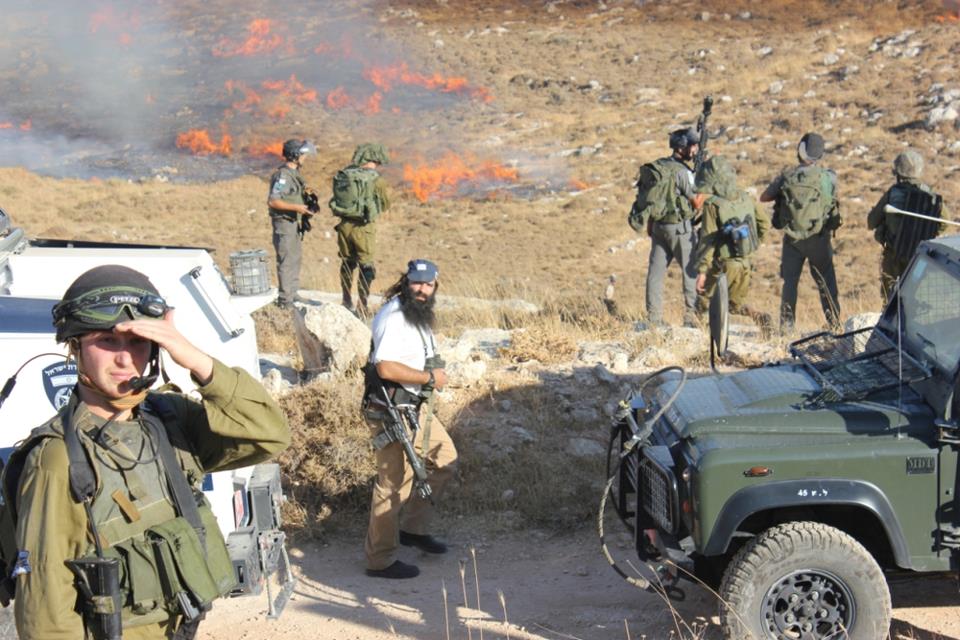
On Saturday, 7 July 2012 at approximately 3:00PM (GMT+2) Israeli settlers from the illegal settlement of Itamar approached three Palestinian farmers in Yanoun who were harvesting their wheat and grazing their sheep. The settlers were armed with knives and killed three of the farmers’ sheep. A clash then ensued, in which the settlers and farmers began throwing stones at one-another.

When EAs arrived to the scene, three fires were ablaze in the fields, but it was unknown whether the flames were intentionally lit by the settlers or were started by teargas canisters that the Israeli military fired at the farmers. Nonetheless, two wheat fields and one olive grove were burnt, and when other Palestinian farmers arrived at the scene to turn out the flames, Israeli soldiers and police prevented them from reaching the fields by firing more teargas at them. In total six Palestinians were injured, and five were hospitalized:

·       Jawdat Bani Jaber (Hospitalized): was beaten and stabbed multiple times by settlers, then shot in the face and foot by Israeli soldiers. He was then handcuffed by Israeli soldiers and attacked again by the settlers while the soldiers pursued other Palestinian farmers. After being attacked, the military did not allow a present ambulance take him to a hospital or care for him for approximately 3-hours.

·       Ibrahim Bani Jaber (Hospitalized): was beaten by a soldier on his head with the butt-stock of an M16 rifle, causing damage to his eye, and was later beaten by settlers while handcuffed.]

·       Hakimun Bani Jaber (Hospitalized): was shot in the arm at close range by a soldier.

·       Adwan Bani Jaber (Hospitalized): was beaten by settlers with clubs.

·       Ashraf Bani Jaber: was beaten by a soldier with a club.

·       Jawdat Ibrahim (Hospitalized): was handcuffed, beaten by Israeli soldiers and then released for the settlers to attack as they watched. He was then tied up by the settlers and left on his land; he was found the next morning (Sunday, 8 July 2012).

Rashid, Mayor of Yanoun and long-time EAPPI local contact, expressed fear that settlers initiated the clash to enforce new invisible boundaries, which would defacto confiscate much of the area’s wheat fields to the Itamar Settlement.

ADDITTIONAL INFORMATION:

Yanoun is a small village in Area C of the West Bank, just southeast of Nablus. It has about 65 inhabitants who are dependent upon farming and animal husbandry as their main source of livelihood. The village is surrounded by the illegal Israeli settlement of Itamar and since 1996 the residents of Yanoun have consistently experienced settler harassment and violence, as well as property damage and confiscation.

In October of 2002 the settlers of Itimar forcibly evacuated Yanoun of its inhabitants. International humanitarian agencies and Israeli human rights organizations then came to Yanoun to provide a protective presence with the aim of facilitating the return of the community. These left Yanoun within weeks of the community’s return; however, the Ecumenical Accompaniment Programme in Palestine and Israel (EAPPI) has remained in Yanoun since October 2002. Based in Yanoun Ecumenical Accompaniers (EAs) provide a protective presence, monitor, and report on human rights violations in the community, as well as the entire Nablus Governorate and Jordan Valley.

INTERNATIONAL HUMANITARIAN LAW:

The International Court of Justice has stated that the 1949 Fourth Geneva Convention for the Protection of Civilian persons in Times of War applies to the occupied Palestinian territory. All Israeli settlements are illegal according to Article 49 the Fourth Geneva Convention, which states, “The Occupying Power shall not deport or transfer parts of its own civilian population into the territory it occupies.”

Article 4 of the Fourth Geneva Convention states, “Persons protected by the Convention are those who, at a given moment and in any manner whatsoever, find themselves, in case of a conflict or occupation, in the hands of a Party to the conflict or Occupying Power of which they are not nationals.” Thus, according to International Humanitarian Law, Israel has the duty as an occupying power to protect Palestinians from settler attacks.

We encourage you to:

·       Forward this article to your networks.

·       Inform your representative in parliament about what has happened in Yanoun.

·       Update news/media agencies (radio, TV & print) in your countries about this incident.

·       Contact (Preferably fax) the following officials and call on them to condemn this attack and hold Israeli settlers accountable for the human rights violations that they commit against Palestinian civilians:

o   Your Ambassador and/or Consul General in Israel

http://www.mfa.gov.il/MFA/Sherut/ForeignInIsrael/Continents

o   The Israeli Ambassador in your country

http://www.mfa.gov.il/MFA/About+the+Ministry/Diplomatic+missions/Web+Sites+of+Israeli+Missions+Abroad.htm

You may use the sample letter below or draft your own:

Dear Ambassador / Consul General / Minister / Judge Advocate General / Lieutenant-General,

I call upon you to condemn Israeli settler violence against Palestinian civilians and to call for all those who violate human rights in the oPt to be held legally accountable for their actions.

On Saturday, 7 July 2012 at approximately 3:00PM (GMT+2)Israeli settlers from the illegal settlement of Itamar approached three Palestinian farmers in Yanoun who were harvesting their wheat and grazing their sheep. The settlers were armed with knives and killed three of the farmers’sheep.

A clash then ensued, in which the settlers and farmers began throwing stones at one-another. Israeli soldiers and police arrived to the scene only to support the settlers’ attack on a defenseless community.

In total six Palestinians were injured, and five were hospitalized:

·      Jawdat Bani Jaber (Hospitalized): was beaten and stabbed multiple times by settlers,then shot in the face and foot by Israeli soldiers. He was then handcuffed by Israeli soldiers and attacked again by the settlers while the soldiers pursued other Palestinian farmers. After being attacked, the military did not allow a present ambulance take him to a hospital or care for him for approximately 3-hours.

·      Ibrahim Bani Jaber (Hospitalized): was beaten by a soldier on his head with the butt-stock of an M16 rifle, causing damage to his eye, and was later beaten by settlers while handcuffed.

·      Hakimun Bani Jaber (Hospitalized): was shot in the arm at close range by a soldier.

·      Adwan Bani Jaber (Hospitalized): was beaten by settlers with clubs.

·      Ashraf Bani Jaber: was beaten by a soldier with a club.

·      Jawdat Ibrahim (Hospitalized): was handcuffed, beaten by Israeli soldiers and then released for the settlers to attack as they watched. He was then tied up by the settlers and left on his land; he was found the next morning (Sunday, 8 July 2012).

Though the settlers were the attackers in this clash, the Israeli Military and Police provided them with protection to carry out the attack. The soldiers and officers attacked Palestinians who defended themselves from the settlers, did not attempt to put out the fires that blazed throughPalestinians’ fields – nor let anyone else do so, and delayed medical attention for the victims of the attack.

Like the many Israeli settler attacks that take place on an on-going basis across the occupied Palestinian territory, no Israeli settlers were arrested during this attack.Sincerely,

YOUR NAME

Leave a comment

Filed under Human rights, Middle East

Another Friday, another protest in Kafr Qaddum

This is a guest article by my friend and colleague David Heap who is currently based in Tulkarm. It was originally published on the EAPPI website.

For the Abu Ihab family, Friday wasn’t too bad. Admittedly there were Israeli soldiers on their roof firing tear gas, they couldn’t leave the house, the sons had been chased down the stairs by armed soldiers and the stink of tear gas and burning car tyres drifted through the room. But Isra’a, the youngest daughter, said they weren’t really afraid today.

Kafr Qaddum is a pleasant Palestinian hillside village of some four thousand people. It has a mayor, a mosque, an elementary school. It had a road joining it to the next village one and a half kilometres away – but not anymore.

Between the two villages are two Israeli settlements, legal under Israeli law, but illegal according to UN Resolutions, which expressly forbid the civilian settlement of lands occupied as a result of conflict. The road was closed for security reasons by the Israeli authorities in 2003. The only security problems the townspeople were aware of were some damage to their crops and olive trees in the early days of the settlement, but all had been peaceful for a good while. Israeli authorities had reportedly promised to re-open the road at the same time as the main road beyond it to Nablus re-opened. This happened two years ago, but their road remained closed.

Since the first of July 2011 the people of Kafr Qaddum have held a demonstration every Friday against the closure, which means a 20 kilometre detour to get to families and friends and a six-fold increase in bus fares for students. It can get very angry, as it had on the 15th of June this year, because the Israeli army had raided the village in the middle of the night before and detained 20 young men. They can be held in administrative detention inside Israel, many kilometres away from their families for hours, days, weeks, months or years, often without trial. If they admit to the claims against them (often stone-throwing) they can be released upon payment of a fine that is around 10,000 shekels (€2000.) A Palestinian going to work in Israel as a labourer or farmhand earns 120-180 shekels per day.

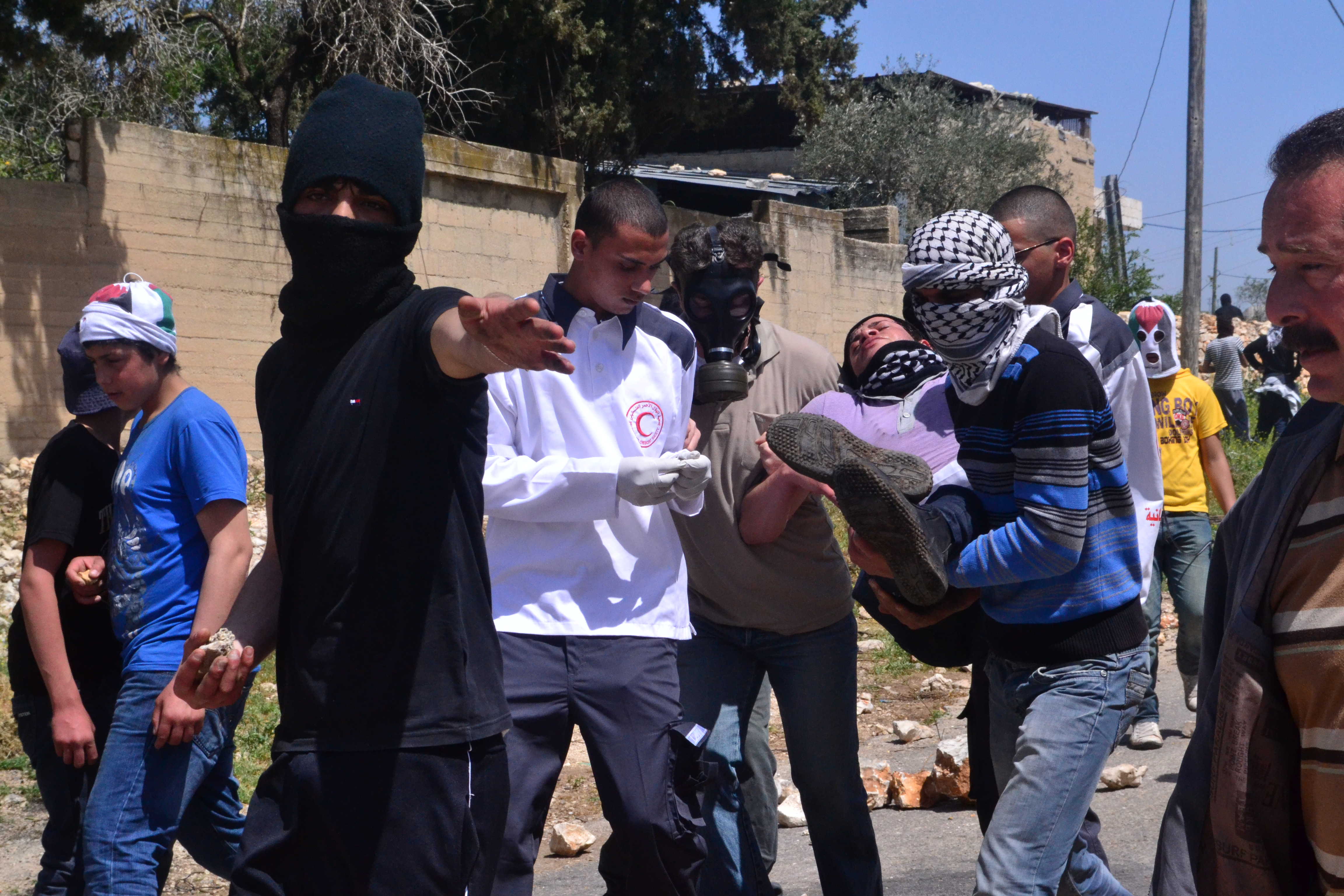
That Friday, it was a game of kids advancing and throwing stones, soldiers dashing forward threateningly with the guns, kids running back, soldiers withdrawing, kids advancing again went on till the main adult procession came up the hill. Tyres had been set alight and were now billowing smoke. The same pattern of ebb and flow was repeated, only now tear gas was being lobbed regularly. Mostly into a field to the side of the demo, but some skittering along the road into the crowd. Men were regularly brought back choking and temporarily blinded and a Red Crescent ambulance zoomed up and down giving aid to the worst affected. One man was hurt more seriously as it seemed his shirt had caught fire and he was burned.

Things quietened down after an hour or so and the procession came back chanting slogans. A quiet enough day we were told. Unlike the previous week there had been no chemically-created “Skunk” water shot from water cannons and no sound bombs, which disorientate and nauseate as well as deafen.

Back in the Abu Ihab house, which is at the outer limit of the village and always caught up in the midst of things, things were now quite calm. The soldiers had left the roof and for once had not cut the television cable. The mother was preparing a huge and delicious meal of chicken, rice, vegetables, pickles, pitta bread, tea and coffee.

Leave a comment

Filed under Human rights, Middle East

Children’s Rights under Occupation

This is a guest post by Jane Harries, a friend and a colleague living in Yanoun where I spent the last few months. An unedited version of this article can be found here.

How do children fare under occupation?  From the children in Yanoun and the surrounding villages we can see there are restrictions here which children in the UK don’t face – lack of facilities such as play areas and swimming pools which we take for granted. Children’s drawings portray guns and tanks, showing the underlying fear and trauma which comes from witnessing armed settlers and army incursions.  One of the testimonies to the success of EAPPI’s protective presence in the village is the fact that the children feel safe to play in front of the International House.

What about the treatment of minors by the occupying power?  We had a glimpse of what this can mean when we visited Bassam Nadar and his son Muhammed in the village of Madama, west of Yanoun, and listened to their story.  Recently, as the villagers’ wheat was getting ready for harvest, settlers came down from the mountain and set fire to the fields.  The villagers went to try to extinguish the flames, including Bassam’s two sons, Mohammed (17 years) and Ahmed (15 years).  They had succeeded in doing so when an army jeep turned up and arrested the two boys, accusing them of starting the fire.  They were taken to Huwara military camp, then to the settlement of Ariel’s police station, then back to Huwara and eventually to Majidu prison in Israel.

Bassam heard of the boys’ arrest through a journalist from Nablus, who had been with them, had photographs to prove their innocence, and intervened on their behalf.  After numerous phone calls, Bassam found out where his sons were and eventually – on the third day – they were released – but on the condition that he went to Ariel police station and paid 2,500 Shekels for each son.  He was advised by a lawyer not to pay, so Bassam went to Ariel police station and told the Israeli police he was unable to do so.  His phone number was taken but – up until the present time, nothing further has happened.

In quiet measured tones Bassam’s eldest son, Mohammed, told us his story in his own words.  He and his brother had been blindfolded and handcuffed whilst being transported between the different sites for interrogation, and nobody informed them – or their family – where they were.  The soldiers had put their feet on his head and joked as he lay on the floor of the jeep.  In Ariel police station his picture and finger prints were taken.  Only on the third day was he able to speak to his father.  When the two brothers were eventually released, this was at the border miles away from their village.  It was with the help of a taxi driver that they were eventually able to make their way home.

This story illustrates a disregard by the Israeli army and police for human rights, even in the case of minors.  Palestinian minors are dealt with under military rather than civilian law. This two-track system of justice which supports discrimination and undermines any rule of law illustrates to the Palestinians that they are second-class citizens and that there is no system of redress.

We can only imagine how children are affected by the fear and violence they experience, either directly or indirectly.  Bassam told us that his younger son is still suffering psychological problems from his experience of being arrested by the Israeli army.  As an occupying power Israel has an obligation to treat civilians humanely and never to discriminate against them. (Article 27, Fourth Geneva Convention). Israel is also a signatory of the United Nations Convention on the Rights of the Child (UNCRC).  For Palestinian children on the ground these obligations may seem far from the reality.

2 Comments

Filed under Human rights, Middle East

Fighting on two fronts: A farmer’s fight with the Palestinian Authority and the Israeli Occupation

“We are always looking at the Israeli guns pointing at us and we don’t notice the Palestinian knives in our back”. Bazem, the mayor of Tawayel has been waiting now for “over two years” for funding promised to him from the Nablus governorate. Today he faces unimaginable hardship but he insists the problem that annoys him the most is “being completely ignored” by the PA (Palestinian Authority). From talking to a number of local officials now I know that this sentiment is shared by many but often people also use the PA as a scapegoat to vent their frustrations.

I had gone back to visit Bazem as his community had received another two demolition orders since I last visited a few weeks ago. Tents that offer accommodation were due to be ripped down as they were built in the Israeli controlled Area C of the West Bank. This subject however takes up just a fraction of our meeting as he keeps turning the conversation back to the “real problem” – the PA. “We are on the front line against the soldiers, we are the ones defending Palestinian land by staying here, so why do those people sat on chairs under air conditioners cause us so much problem”.

I ask him if he is just referring to the money he has been promised and he looks at me scornfully, “not only do they not give, but they take. The price of barley for our sheep has gone up fifty percent because of PA tax. And where does the money go”? He leaves the hypothetical question to linger in the air and it remains hovering over us for the rest of the meeting.

I have heard from other sources that this common story around PA tax is a popular myth. Another local contact when asked about this subject commented, “the increase in the price is not caused by the PA and there is no increase in tax, it is caused by the increase in global prices of these items”. I did not know enough either way to challenge him.

I had been told previously that the road going into their community was so bad because they live in Area C and as such the Israelis would not give them permission to put tarmac down and so I asked if there had been any progress. Again, the Mayor was not interested in Israel but turned the question back to the PA, “They [The PA] agreed months ago to lay loose stones down on our road to make sure it is passable, still I hear nothing from them”. Although Bazem remains good humoured throughout our meeting I can feel his frustration building.

I ask Bazem what he will do if in a month he still has not received any of the money or help he has been promised, “first I will meet them, if I still get nothing I cannot promise what I will do. I have many ways to choose, hunger strikes, talking to the media or international friends. We cannot continue to suffer like this”. He pauses before sighing the word, “khallas” (finished).

Being the mayor of such a troubled community is clearly taking its toll on Bazem both personally but also emotionally. I ask him about his personal expenditure, how he affords to travel to Nablus and the phone calls to try and sort out these problems. He answers matter-of-factly “I spend maybe 1,200 NIS every month [about £240]” before immediately twisting the answer towards the problems his neighbours face. “A few days ago with the UN I visited some families that I had not spoken to for a while, I could not believe what I saw. One family needed 25,000 NIS [£5,000] just for their sheep food. What do the PA offer…nothing”. I didn’t ask why he thought the PA should pay for a families sheep food.

I took the decision to enter a subject area I had in the past chosen to avoid, Palestinian politics. I was keen to know whether this resentment towards the PA was synonymous with a resentment towards Fatah so I asked if he thought life would be different if Hamas was in power. Bazem pauses and leans towards me despite speaking through a translator and says, “When you build a house, the foundations have to be right or the whole house will be bad. Hamas lays bad foundations. Fatah just don’t know how to keep their house tidy”. I sought clarity and asked if he was happy then Fatah are still in control and he answered shaking his head, “All the party are no good. They are fighting each other, not looking to help the people. They think about their salaries not the people”.

A number of different village and town officials have expressed similar sentiments to me in the past but all have asked not to be named. All have hinted at corruption at a systemic level. I ask Bazem if it is OK to tell this story and he says, “I don’t want to get into trouble but I speak the truth. People must hear the truth so yes, tell your people how we Palestinians treat each other”. I knew as he said these words this story would be met with quiet support from many Palestinians but also vocal criticism. A united Palestinian voice is often stated as their most “important weapon”. Bazem later commented, “if we fraction then we lose our fight”.

I ask Bazem if the land that he is fighting for is important to him because it is his or because he sees it as his national duty to defend Palestine’s land. “This land is not mine, it is Palestine’s. I am lucky to be Palestinian and so I can look after the land. This is why I must support my Palestinian neighbours”.

I ask about its many ‘Jewish neighbours’ (in the illegal settlements) and he pauses for a considerable amount of time. It was clear he was not going to rush into this answer. Finally he responds, “Settlers are a cancer”. Again he paused and I looked at him, he clearly was not happy with his first answer. “If I have good neighbours then maybe, but at the moment it is like having your enemy as a neighbour. I cannot live beside someone who wants to swallow me whole”.

I asked him if he had ever had a good Israeli neighbour and he smiled and responded as if this was a stupid questions, “of course. In Gittit [a close by settlement] I have many friends and we visit each other and help each other”. Again he pauses and I wonder how those in the PA would respond to a man who so openly criticised them whilst talking about having settler friends. Bazem brings me back from my own thoughts though with the clarification, “They understand my problems but they cannot do anything to help because of the religious settlers. They control everything”.

I leave Bazem convinced that his community faces a plethora of problems, but non-the-wiser about the source of these problems. Is it the Israeli state, the settlers, the extreme settlers, the PA or who? I suspect it is a cocktail of the above. Regardless of whether or not the accusations against the PA hold up to scrutiny the stories are widely accepted in many villages I have visited. Is it a PR problem or fundamental lack of support from the PA? The straight answer is I do not know.

1 Comment

Filed under Human rights, Middle East, Politics

The Women in Black and freedom of speech in Israel

Crinkles collected in the corner of her eyes as she smiled and said “I have been coming here for the last twenty four years. I sometimes wonder why, but I come. We have to show our belief as Israelis, as humans, in peace”. I was standing with a handful of women who were dressed in black, collected in the middle of a busy road junction in West Jerusalem. They come at same time, to the same place, every Friday. They stand with large cut out plastic hands with the message “Stop the Occupation” written on them in three languages. Collectively they are referred to as the “Women in Black”.

As the protesters began to assemble I was standing with three women, all in their seventies, all smiling and all opposed to the occupation. It was hard not to be won over by them.

The Women in Black movement started in 1988, a month or so after the first intifada broke out. The first protests began in Jerusalem but the idea spread internationally taking on local relevance. In Germany for example, Women in Black protests became active in countering the neo-Nazi movements. Everywhere they appeared they were organised by women and condemn violence in whatever its form.

Defying any stereotype around age or gender or nationality, the Women in Black are a powerful striking image on the road side making those passing by stop and take notice. Even through the smiles you could sense a steely determination which brings these women out onto the streets every Friday. This determination resonates to those around.

Before the demonstration I had been told about a ‘counter demonstration’ that occurs on the opposite side of the street to the Women in Black protest. At first this ‘counter demonstration’ played out like I would have expected. A small group of predominantly men gathered waving Israeli flags. One held a placard with the slogan, “Get an occupation and support Israel” (You have to give credit where it is due, it is a witty slogan). These two demonstrations happened alongside each other with little interaction.

Cars passed by honking their horns in support, and both protests took the noise and commotion to be in support of their cause. It was unclear to me who was honking to who but I got the feeling that most people were supporting the ‘counter demonstration’.

A taxi driver with a small Israeli flag flying from his window puts two fingers up at the women and drives off.

One passer by stopped and asked one of the Women in Black why they thought there was a counter protest. The answer showed, at the very least, an ability to understand what drives those who attend the ‘counter demonstration’. Glancing out from her black sun hat she answered, “For them, we are calling for half of Israel to be given away. Not only that, but we are asking for it to be given to a group of people who they think want Israel, and by extension their families, driven into the sea”. When the Women in Black call for an end of an occupation of a foreign land, many Israelis see it as ‘giving away’ part of greater Israel.

This back-story is important to understand as it provides a partial explanation (different to a justification) to why then the protest took a nasty and unpleasant turn.

A small group from the ‘counter demonstration’ crossed over the street and started accusing the Women in Black of being everything from ‘Nazis’ to ‘supporters of Ahmadinejad’ (Iranian leader). No slur appeared to be too extreme. To the credit of the Women in Black protesters, and perhaps because of previous experience, they showed almost no reaction to the provocation. Silently they continued to hold their signs calling for an end to the occupation.

This was until one ‘counter protestor’ approached me and accused me of being a “German, Nazi, Christian” (wrong on all three fronts). At this point one of the Women in Black came over encouraging me to ‘not talk to this man’. You can hear me at a number of points say “it’s ok” to her, trying to calm the situation as the ‘counter protester’ continued his hate speech. I only managed to record a small part of what he said and missed some of his worse comments. Still, both the recordings are truly shocking in places (see video below).

The Women in Black are on the street every Friday, keeping the Israeli opposition to the occupation in the public’s mind. Many involved in the protest want the counter demonstration banned, feeling that it is ‘threatening’. I agree it is certainly unpleasant.

For me however, Israel as a modern democratic state has to support the plurality of views and enable this ‘counter demonstration’ to take place for as long as remains peaceful and non-threatening. I did not witness any behaviour which was ‘threatening’. Of course the same has to be true for Palestinians who routinely have their right to protest violated.

As Voltaire didn’t actually ever say, “I disapprove of what you say, but I will defend to the death your right to say it”.

7 Comments

Filed under Human rights, Middle East, Politics, Religion

Walking in the (Occupied) Golan Heights

“This really is paradise” said Ziv, a twenty four year old Israeli ranger working in the Yehudiya National Park. He flicks back his dreadlocks and smiles at us looking for confirmation. My colleague, good friend and fellow hiker, Helene responds, “It really is”. We were stood overlooking the impressive Zavitan waterfall which cuts into the incredible landscape that’s rich in fauna and wildlife. In the immediate vicinity of the waterfalls it is hard to disagree with either of their assessments.

Helene and I walked for hours through deep gorges, stopping only occasionally to swim in the natural pools. Sporadically however we would hear in the background the unmistakable sound of explosions. A reminder that the Yehudiya National Park is surrounded by Israeli military areas. At one point as we were sat by a pool side a flock of birds flew from the tree in which they were perched at the sound of an especially loud explosion.

With every explosion, I was reminded that we were enjoying ourselves in an Occupied Territory. This mixture of unworldly beauty combined with occupation followed by an illegal annexation is what I spent three days thinking about as I walked in the Occupied Golan Heights.

The Golan Heights were occupied by Israel during the 1967 war and as such they were internationally considered to be “Occupied Territories”. In 1981 Israel formally annexed the territory and argued this changed the territory’s legal status. Despite this annexation and subsequent claim, the law of belligerent occupation continues to apply until the international community acknowledges a political-legal settlement between the parties. This did not happen in 1981 and has not occurred since.

The UN Security Council Resolution 497 of December 17, 1981 summarises the international community’s response to the annexation stating, “(The UN) Strongly condemns Israeli annexationist policies and practices in the occupied Syrian Golan Heights, the establishment of settlements, the confiscation of lands, the diversion of water resources, the intensification of repressive measures against the Syrian citizens therein and the forcible imposition of the Israeli citizenship on Syrian nationals, and declares all these measures as null and void as they constitute violations of the Geneva Convention relative to the Protection of Civilian Persons in Time of War”

As such, as an Occupying Power, Israel is obligated to adhere to the principles of international humanitarian law, notably the Fourth Geneva Convention Relative to the Protection of Civilian Persons in Time of War, and must also adhere to the principles of the international human rights law. This position has been repeatedly upheld by the UN and international human rights organisations.

Despite this clear status the occupied Golan Heights is often ignored by the media covering the “Israel/Palestine conflict”. Journalist and author Mya Guarnieri commented on this saying, “Perhaps it’s easier for journalists to talk about ‘Israel and the Occupied Palestinian Territories’ or the ‘Israeli-Palestinian conflict.’ But to do so is an oversimplification that ignores the broader regional context that includes the Golan Heights”. Living in the West Bank, reporting on what I see, this is a criticism that I am acutely aware of. To understand the current struggle for the realisation of human rights in the oPT you must also have an understanding of the Golan Heights.

After the occupation of 1967 130,000 Syrians were forcibly displaced from the territory leaving only 6,000 behind. A report by The Arab Centre for Human Rights in the Occupied Syrian Golan, highlights human rights abuses from expropriation of land and water resources through to settlement expansion. A report well worth reading.

What troubled me during my time in the Golan however was that all of this that I had read about human rights before visiting the Golan seemed a million miles from what I actually saw. Visiting the Golan Heights felt, as a tourist, to be no different from visiting any other part of Israel.

Hitch hiking to start a walk one day an Israeli picked us up, drove us no more than 5 minutes and insisted we take her number in case we were in the area and wanted to spend Shabbat with her family. I was met with a well maintained tourist industry and extreme kindness and hospitality – this was comparable to my experience in the rest of Israel.

My time in the Golan left me confused, it didn’t feel as oppressive as the oPT but I knew, in many ways, that it was comparable. My resolve from the trip is to return, to speak to more Israelis living in the Golan and to search out the small number of Syrians still living there, still resisting the occupation. What I witnessed, mainly from an Israeli perspective, was a complete normalisation of life, including the military presence. I left wondering what I would have experienced if I had spent time with the remaining Syrian communities in the area.

3 Comments

Filed under Human rights, Middle East

Scorched earth and shootings, as the Israeli military stand by

This article was originally published on Liberal Conspiracy.

Scorched earth stretched out before me. To my right the fire was still burning across the hillside spreading through olive trees. To my left all that remained was charred black earth.

All around me, men were moving, unable to rest but also unable to access their land to tackle the fire. All they could do was to stand watching as their livelihoods and land burnt.

An hour earlier, 22 year old Najeh al-Safadi had tried to put out the fire on his land and had been shot in the stomach by the private security staff from the overlooking settlement. At the time of writing it is unknown if he will walk again after the bullet damaged his spine.

I was stood with some residents from Urif, a small village in the West Bank close to Nablus. Urif stands on the opposite side of the valley to the illegal settlement of Yitzhar which is described in the New York Times as, “an extremist bastion on the hilltops”.

Violent action from the settlers directed at both the Israeli Defence Force (IDF) and local Palestinians is not uncommon in the area. The International Solidarity Movement reported back in April 2012 that, “that hundreds of villagers [from Urif] have been injured since 2000 [by settlers from Yitzhar], with as many as 40 serious injuries (many of which were gunshot wounds) and one murder”.

Stood on the hillside opposite me, above the one hundred and fifty dunums of burning land but below the settlement of Yitzhar, were a collection of about forty to fifty settlers. A small group of them were still lighting fresh fires, hours after the original fires had been started.

Parked up and stood alongside these settlers were the IDF. The Israeli Army stood by and watched as these crimes unfolded.

A few hours later however, the IDF did intervene. Just as a small number of settlers were on the outskirts of Urif the IDF stepped in. Their contribution? To fire fifty to sixty tear gas canisters at the villagers and international observers who were monitoring the events.

The IDF has said that they, “regard this incident [the shooting] as severe and will thoroughly investigate it”. Between September 2000 to November 2011, B’Tselem sent fifty-five complaints to the Military Advocate General’s Corps regarding cases that raised the suspicion that security forces did not intervene to stop settler violence.

In only five cases was an investigation opened; two of the five were closed without any measures being taken against the soldiers involved. In eighteen cases, no investigation was opened at all. In eleven cases, B’Tselem did not receive any response.

In a flash the ambulances were gone and the only traces that were left of the violence that had just occurred were the smouldering fields and the talk of whether Najeh would make a full recovery.

I left the mayor promising him that I would do what I could to tell the world what I had seen in his village that day.

Leave a comment

Filed under Human rights, Middle East, Politics, War

The silence in Kafr Qaddum

The silence was the most telling part of the whole meeting. The silence was intermittently punctured by the muttering of an occasional word. These words though, when they came, held the weight of a thousand. In this silence I could feel the presence of Waseam Barahem next to me throughout the meeting. Even when others were speaking I was conscious of his silence next to me.

Just over three weeks ago, seventeen year old Waseam was struck in the head by a tear gas canister, nearly died and momentarily lost his ability to speak. Today he is only able to say a few words. His father, Abu Walid remembers the day painfully, “I saw it all, I saw the soldier aim directly at my child”. Accounts vary, but most report the soldiers being fifty to one hundred meters away. All accounts that I have heard agree that the soldiers were firing directly into the crowd. This is something I have seen too many times before and is something that the IDF’s own regulations prohibit.

Waseam was struck directly on his head and suffered large amounts of internal bleeding. He was taken first to Nablus but then to a hospital in Jordan for a life saving operation.

His father described to me the moments after the shooting, “At first I didn’t think it was serious, just some blood on his head. Then the man who works with the ambulance told me it was bad. I wanted to go through the olive trees [to avoid the Israeli flying checkpoint] because I was worried they would try to arrest Waseam [on the way to the hospital]. The man who works with the ambulance though told me we had to go straight through the checkpoint because we didn’t have time to go through the trees. The soldiers also knew it was serious because when we come they open the checkpoint for us. They telephoned ahead to the hospital because they knew every minute counted”.

By any account Waseam is lucky to be alive.

Less than six months ago Mustafa Tamimi died after being struck by a tear gas canister. It is a very real danger that both internationals and Palestinians face when they attend protests.

Regardless of the dangers, the villagers of Kafr Qaddum continue to protest every Friday. I asked Waseam if he was worried about this coming Friday’s demonstration and the possibility of soldiers coming into the village. His answer was short but clear, “next Friday, I will go to the demonstration”. I looked at Waseam trying to read him, to distinguish the macho pride of a seventeen year old boy from what he was really feeling. Did he really not feel any fear after having such a close brush with death?

I turned to his father and asked if he was happy with his son being on the streets during the demonstration. His answer was framed in the context of the impossibility of criticising anyone who is ‘opposing the occupation’. He half shrugged and said “I always knew he would protest”.

I tried once more to frame a question in a way that would allow them to perhaps partly express their feelings. I asked Waseam if he was worried about his friends who go to the front of the demonstration. His silence stretched out for what felt like minutes before he finally replied, “I do worry about my friends”. His gaze fell to the floor and once again we were absorbed into his silence.

The sound of scraping chairs marked the end of our meeting. I left wishing Waseam a full recovery and I asked him to promise to “stay safe”. It felt ridiculous saying these words considering the context. Living in Kafr Qaddum, even if you avoid the weekly demonstration, is anything but “staying safe”.

4 Comments

Filed under Health, Human rights, Middle East

Protest at Kafr Qaddum 11.05.12

The organiser of the weekly protest at Kafr Qaddum took a few seconds to explain to me his version of events from today’s protest.

These are some images I took from today’s protest:

Two boys using slingshots to throw stones at the soldiers.

The Israeli Army entering the village.

A member of the press (who made it past the flying checkpoints put down by the Israeli Army to stop press entering the village) is carried out of the protest by a first aider.

A small boy collects the empty tear gas canisters

If you would like to read what the protest at Kafr Qaddum is like – click here

Leave a comment

Filed under Human rights, Middle East

Yanoun – the first village in Palestine to be forcibly displaced since 1967

I am sat in the hamlet of Yanoun, 15 kilometres to the south-east of Nablus reading the words of Rashed Murrar – the mayor of Yanoun – describing how the village almost ceased to exist, “They came with dogs and guns, every Saturday night. They beat men in front of their children. One Saturday they said they didn’t want to see anyone here next Saturday and that we should move to Aqraba. The whole village left that week”.

On a good day it is hard to imagine that Yanoun was nearly wiped off the map or even that it is facing any problems. I am currently on the hillside overlooking a stunning landscape with interweaving rolling green hills. It is the most beautiful place I have visited in Palestine. It feels so incredibly peaceful and remote. Just as I am writing this article however a military jeep comes up the valley and drives up to every house in the hamlet. Looking across the valley there are further clues that everything is not quite right here. On the horizon there sits a handful of buildings that make up one of many illegal settler outposts in the area.

The Israeli peace group Ta’ayush describe the events leading up to the 2002 dispersion as, “years of unrelenting harassment, destruction of infrastructure, armed patrols and threats of shooting” (from the EAPPI publication ‘Living with Settlers’). An entire Palestinian village, the first since 1967, was up-rooted and displaced.

As a result, at the invitation of the mayor, there has been an international presence in the hamlet since 2003. Sadly however, attacks and harassment are still part of life here.

In addition to the attacks, Yanoun has lost hundreds of acres of land. This is either because the settlers have claimed it for their own or because it is deemed a ‘closed military zone’ by the Israeli military. The term ‘closed military zone’ is used with derision throughout Yanoun. Most people here understands the IDF to be on “the side of the  settlers” as one resident commented to me. One former EA in Yanoun commented that they saw “soldiers sitting down and having a picnic with settlers on Palestinian land”.

The settlements remain illegal under international humanitarian law; Article 49, of the 1949 Geneva Convention IV states: “The Occupying Power shall not deport or transfer parts of its own civilian population into the territory it occupies”. For this reason, the settlements are condemned by every major nation in the world (except Israel). The Israeli NGO Peace Now describes these illegal settlements as, “the biggest obstacle to a two state solution”.

The three main settlements that surround Yanoun are Itamar, Yizhar and Bracha. Yizhar was the home of the infamous Rabbi Yitzhak Shapira, the author of “The Kings Torah”. The Kings Torah offers a theological basis for the killing of non-Jews.  According to the Rabbi, non-Jews are “uncompassionate by nature” and attacks on them “curb their evil inclination,” while babies and children of Israel’s enemies may be killed since “it is clear that they will grow to harm us”. The Israeli tabloid Ma’ariv described it as the stuff of “Jewish terror”.

Although not all as extreme as Rabbi Yitzhak Shapira, many of the residents are extremely hostile to both Palestinians and internationals. They see the fields and valleys as “their land” – some believing it is literally their God given right to be there.

Attacks from people living in these settlements are common place in Yanoun and  the surrounding villages.  As a result of the settlement, there are a series of de facto invisible boundaries surrounding Yanoun that cannot safely be crossed by either Palestinians or internationals. All the hilltops and fields out of the valley bottom are no go areas for fear of violence or provoking ‘revenge attacks’ on Palestinian villages.

It is equally inspiring and terrifying to be here, to see how a community live their lives perched perilously close to having their homes and livelihoods eradicated. Already though I felt a resilience here – a living embodiment of the phrase “to exist is to resist”.

3 Comments

Filed under Human rights, Middle East

Spending the pink pound in Israel

This is a feature piece written for OUT magazine.

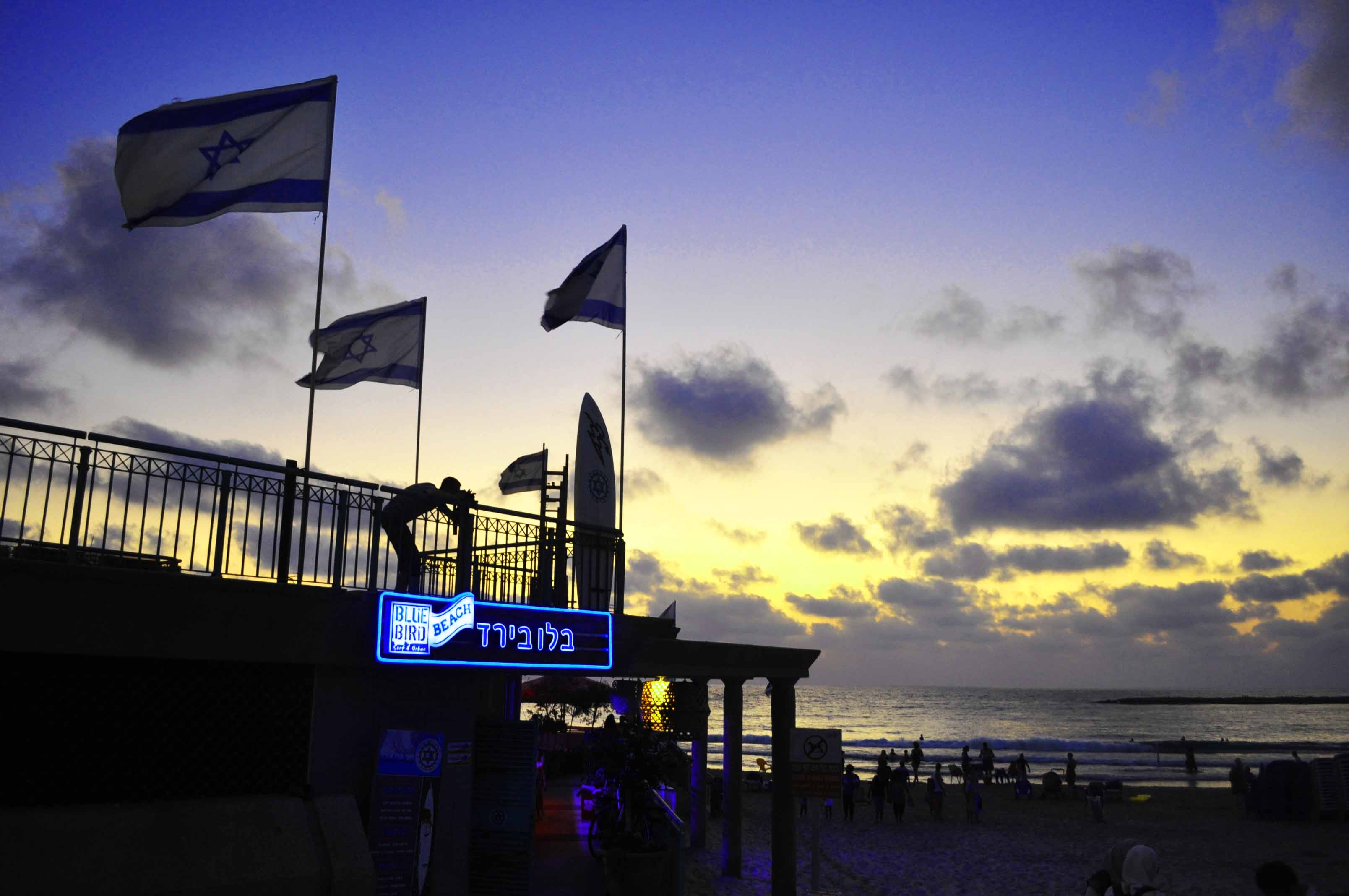
Sat in the evening sun Shaun shifts closer to Paul as the temperature drops in the fading light. I meet the couple sat on a beach in Tel Aviv, Israel. The two men in their mid thirties are on a couple of weeks vacation from their home in south London. I ask them if it is OK to talk to them about the gay scene in Israel and they happily suggest going for beer in the bar a hundred meters away on the beach front.

Sweet smelling smoke fills the air inside the bar as hookah pipes are shared between friends. We are sat with panoramic views of the now silhouetted beach front.  Passing the hookah pipe across the table to where the two men are sat side by side I start the interview by asking them why they chose Tel Aviv for their holiday. Paul exhales a plume of smoke, takes a sip from his beer and jokes, “cheap easy jet flights”. Shaun laughs and adds, “I just love the rub down at the [Ben Gurion] airport” (referring to the notoriously inhospitable welcoming foreigners receive at the airport).

With a smile I try a less subtle approach and asked if it had anything to do with the internationally renowned LGBT scene in Tel Aviv. Paul does not hesitate this time and comments, “We want to holiday somewhere that we feel relaxed and welcome. A friend of mine told me about Tel Aviv and so we thought we would check it out”. As an afterthought, as if recalling a distant memory, he adds, “everything is set up for us here”.

Tel Aviv is a well known destination for ‘gay tourism’. Last year Tel Aviv launched a $90 million campaign to present itself as, “an international gay vacation destination.” Leon Avigad, owner of the gay-friendly Brown hotel, explains the city’s popularity, “We are cosmopolitan, we’re very Western, European and American but on the other hand we’re very much into the Middle Eastern warmth and welcoming, and this combination attracts”.

Our visit to Tel Aviv coincide with the holiday of Pesach (Passover), the celebration of the story in Exodus where the ancient Israelites were freed from slavery in Egypt. As such it is very difficult to buy certain things such as beers and certain breads. I ask Shaun if this has been a problem and he responds with more depth than I was perhaps expecting. “I think it is beautiful that this society can hold onto its traditions and religious celebrations and still be so open minded”. I wondered how much Shaun had ventured much beyond the city since being here.

On cue, they ask me what I am doing in Tel Aviv and I tell them all about EAPPI and they seem genuinely interested. I ask them if they have ever been to the occupied Palestinian territories. Paul responds with a degree of defensiveness in his voice that he assumed he wasn’t allowed, “I thought there was a war there”. I explain to them, the best I can, the problems caused by the occupation and what I have experienced since living there. I elaborate my point about why I think it is bad for both Israelis and Palestinians. There is a more than awkward silence and I begin to worry that I might have pushed the conversation both metaphorically and literally too far from Tel Aviv.

As if reading my mind Paul comments, “all of that seems a long way from here”. I take this opportunity to try and relate what is happening in the conflict to their experiences here in Tel Aviv and ask if either of them have ever heard of the phrase, “pinkwash”. They respond in unison, “no”. I try my best to offer a definition of Pinkwash – the idea that Israel has created a deliberate strategy to conceal their continuing violations of Palestinians’ human rights behind an image of modernity, illustrated through the booming  gay scene. Both men looked troubled at the idea, clearly concerned that “their community” and “their choices” could somehow be linked to the troubles I had just described about the military occupation.

I try to reassure my two new friends and joke with them that they are not responsible for Israel’s occupation. For Paul however this was not enough. Playing with the beer mat in front of him he almost apologetically comments, “I guess we have only seen a part of life here”. I smile and again try to reassure them both that they are meant to be on holiday relaxing, not peacekeeping. They sheepishly smile back.

For many in the LGBT community it is an ethical dilemma whether or not to boycott Israel as a holiday destination. On one hand it is a beacon of LGBT rights in an otherwise very hostile environment. Some Palestinian activists have tried to persuade me that there is a growing gay rights movement in Palestine. If there is I have yet to stumble across it. Netanyahu told Congress last May that the Middle East was “a region where women are stoned, gays are hanged, and Christians are persecuted.” Sadly, this rhetoric may be alarmist but has also an element of truth in it.

On the other hand however Israel is accused by Amnesty International of “ill-treatment and torture of detainees, excessive use of force, the detention of conscientious objectors, and forced evictions and home demolitions” as well as having a “disregard for international law”. For anyone within the LGBT community who is concerned about equal rights and equality there are some clear moral concerns here.

As an LGBT activist who fundamentally believes in an equality of rights, I cannot settle on Israel having a progressive attitude towards LGBT rights whilst routinely violating other rights through the conflict and occupation.  As Haneen Maikay, the director of Al Qaws (a Palestinian gay rights group) recently said in the New York Times, “When you go through a checkpoint it does not matter what the sexuality of the soldier is”. The LGBT community are not separate from the rest of society who suffer from the occupation.

We are now three beers into the conversation and Shaun’s tongue as well as his sense of moral outrage has been loosened, “So what can we do to highlight all this. It’s f***ed up that people can come here and are not told about any of this s***”. Partly through tiredness I decide to avoid the minefield of BDS (boycott disinvestment and sanctions) and instead simply comment that I think it is important to make sure that everyone who comes to Tel Aviv is aware of what is happening just 20 kilometres to the east.

Paul however looks concerned. I have been talking for the last ten minutes and Paul has not spoken. “I don’t know” he says between regular slugs of beer. “there are so many f***ed up countries in the world where you can get hung for just glancing at another guy. It doesn’t feel right to be criticising a country who are opening their arms and welcoming us”. This concern reflects a very real issue within the LGBT community. To criticise Israel is to break an unspoken pact where those working on LGBT issues stand united in their struggle.

The answer to this dilemma presented itself to me in Yad Veshem, the Israeli holocaust museum. Here they have on the wall in large letters the poignant words of Martin Niemöller “First they came for the communists, and I didn’t speak out because I wasn’t a communist. Then they came for the trade unionists, and I didn’t speak out because I wasn’t a trade unionist.  Then they came for the Jews, and I didn’t speak out because I wasn’t a Jew. Then they came for me and there was no one left to speak out for me”.

If the 20th century taught us anything it is that silence can allow terrible things to happen. The LGBT community cannot stay silent while Israel uses its progressive attitude towards LGBT tourism to deflect attention from the continual violations of basic human rights standards in the occupied territories. Equally however, I believe we have to welcome Israel’s pioneering approach towards LGBT tourism, and encourage these attitudes to spread to less hospitable parts of Israeli society.

Stood outside the bar, the air is now cold and so our good-byes are short. As the two men turn to leave Paul says to me that “next time we come, I think we should spend a few nights somewhere in the West Bank”. I smile and say that they definitely should. Parts of Israeli society may be a beacon for LGBT rights in the middle east, but it is also an occupier of another land. To understand Israel, I think you have to visit that other land.

12 Comments

Filed under Human rights, Middle East, Politics, Religion, sexuality, War

From the West Country to the West Bank – an interview with Steve Hynd, in Jayyus, Occupied Palestinian Territory

I was interviewed by Eugene Grant (of Dead Letter Drop fame). Have a read!

“Have I seen awful things? Completely.” Only a few weeks ago, Steve Hynd was observing a protest near Jayyus – a small village in the West Bank, Israel – when the army fired tear gas canisters directly at the crowd as they were running away. One of the three inch-long steel canisters struck a protestor – standing a few feet away from him – in the neck.

For Hynd, the words ‘police tactics’ are a complete misnomer. “Why would you have soldiers stewarding a protest?.” He says such tactics constitute not so much a policing strategy as “an aggressive attack on protest”. Since then, he’s stopped using the term Israeli Defence Force (IDF) – the military wing of the country’s security forces. The phrase, he says, suggests the force is there for defensive purposes, “but I’ve seen it overwhelmingly used for acts of aggression… when you say ‘army’ people understand that armies can be aggressive.”

You can read the full interview here.

Leave a comment

Filed under Beer, Human rights, Middle East

Another crackdown on the protest in Kafr Qaddum

My head started swimming and I couldn’t open my eyes. I could feel broken stones crunch beneath my feet and I knew I was moving away from the protest. For a terrifying 30 seconds I lost track of what was happening. An autopilot sense of self preservation kicked in that my conscious self had little control over. Just as my senses started to return I felt a colleagues hand rest on my lower back and lead me to the side of the street. Here I crouched in the small amount of shade offered by the shop-front from the midday sun. My stomach had tied itself into a knot and my head felt like it had split in two. Only then did I realise that I must have walked away from my colleague who was now stood in front of me with her camera in hand. I glanced up an offered what I hoped was a reassuring smile.

A few minutes earlier I had been stood at the back of a demonstration in Kafr Qaddum, a small village in the West Bank. I was there to monitor the proceedings and reporting on any human rights violations I witnessed. In the minuets preceding I had filmed a number of ‘warning shots’ being fired over the crowd and whiffed the faintest smell of tear gas. I believed I was far enough back though to avoid the worse of what was to inevitably come. I was stood on the side of the street next to a large wall that could also offer me protection, should it have been needed, from any direct fire. My colleague was nearby and I felt in control of situation.

Seconds later the Israeli army fired a volley of tear gas canisters (some directly into the crowd) that filled the streets with a penetrating thick gas. At first I stayed in position as it appeared the soldiers were aiming just for the front of the protest. As the crowd turned to run however, the tear gas landed closer and closer to me. At this point one canister landed a few yards away and filled my lungs with the gas. What happened next is a blur. I remember a man kicking the canister away down the hill but little else.

On the approach to the village earlier that day there were some clear signs that the protest was not going to pass peacefully. The Israeli Army had set up a series of checkpoints cutting off the only main entrance to village. I approached as part of a mini convoy of human rights monitors. I was travelling with others from EAPPI and the Israeli human rights organisation B’Tselem. As we approached the checkpoint it became abundantly clear that international human rights monitors were not being allowed into the village. Later I would find out that the same restrictions were being applied to media outlets.

I already had reasonable suspicion to believe that this week’s protest at Kafr Qaddum was going to witness an escalation of violence on previous weeks. The day before the village had seen 19 of its residents arrested in an IDF raid. “It was a clear illustration of strength aimed to intimidate us and to stop us making protest” one villager suggested. There were reports that a large amounts jewellery had also been stolen during the raid. This combined with the checkpoints only heightened our unease about the protest.

After meeting a series of other journalists, news agencies and human rights monitors who had also been turned away we decided to collectively head across the fields and enter the village “through the back door”. As the representative from B’Tselem put it, “if we do not reach the village today I am sure some very bad things will happen and they will go unreported”.

Sadly, his prediction of violence proved to be true. Both the Israeli Army and boys and young men from the village once again illustrated their willingness to take part in acts of violence against one another. Before being ‘tear gassed’ myself I saw stones the size of my fist being flung through sling shots at the soldiers who then responded with the brutality that I am coming all to use to seeing.

It is important, however distressing these scenes of violence are, that the world hears about them. Today I saw a large number of boys throwing stones before the Israeli Army fired tear gas directly at the crowd as a whole.  The obvious difference in these actions is that one was undertaken by a professional army and the other by young boys in an occupied village.

2 Comments

Filed under Human rights, Middle East, Politics, War

Jerusalem is encircled by violence as another Land Day comes and goes under occupation

Stood just outside of the historic Old City in Jerusalem I witnessed scenes of panic as the Israeli army, special forces and police force used rubber bullets, riot horses and sound grenades on Palestinian protesters at this year’s ‘Land Day’ protests.

Meanwhile, resident’s in and around Jerusalem saw violence erupt on their streets. Haaretz reported that, at “Qalandiyah checkpoint [protesters] hurled rocks at soldiers, who responded with stun grenades and tear gas” while Ma’an News reported from Bethlehem that “Israeli forces fired tear gas and rubber bullets at protesters”. Al-Jazeera reported that “over 120 people have been injured at Qalandiyah checkpoint”.

Before any of the protests started news reached those on the streets that the civil authority in Israel has been covertly setting outside land for settlement expansion in the West Bank. A particularly hard report to hear on ‘Land Day’ of all days. Haaretz ran the headline ‘Israel Defense Ministry plan earmarks 10 percent of West Bank for settlement expansion’. This did nothing to calm the tensions.

After the mid-day prayers a few hundred protestors gather outside of Damascus gate in the old city. They were met by a comparable number of soldiers, policemen and special forces. News spread that all men under the age of 40 were banned from entering Al Aqsa mosque. Again, a move that did nothing to ease the tensions. Soon after this, no one was allowed to enter or leave Damascus Gate that leads to  the old city. At this stage, the gathering crowd was peaceful (despite reports coming in about injuries and rioting at Qalandiyah checkpoint).

With a rising noise level the tension also grew. Early on in the protest the occasional plastic bottle was thrown from within the crowd. This acted as justification for the Israeli Army and special forces to go in with a series of heavy handed tactics including charging with riot horses and letting off sound grenades. Throughout the protest I saw the occasional act of violence from a protester (such as a stone being thrown) which was then responded to with disproportionate force imposed on the crowd as a whole.

At one stage, I witnessed a Palestinian throw a stone towards a soldier (and miss). The soldier saw who threw the stone, chased after him and fire what I was told was rubber bullets directly at him (they are designed to be fired at the floor to rebound into legs, not directly at a person). On another occasion I saw soldiers beating men who were simply standing, watching and taking photographs. An international who was with me at the protest commented that she saw, “A soldier head butting a protestor in the face using his helmet. Luckily an Israeli policeman was there to pull the soldier away before anything worse happened”. Throughout the protest riot horses were used to charge at protestors who were not showing any visible threat or security concern.

Sadly, I know all too well that this disproportionate use of force at protests occurs all too often throughout the West Bank. A few weeks ago I reported on how the Israeli army breached their own regulations in the way they ‘policed’ a protest at the village of Kafr Qaddum.

I left the protest feeling exhausted. I walked back past ambulance workers treating minor injuries and shop keepers attempting to carry on trading. This Land Day has once again seen injuries, arrests and limitations on the basic right to peacefully protest. Outside of Jerusalem there were reports coming in that a protestor had died in Gaza.

What I saw in Jerusalem was an unnecessary and disproportionate use of violence against an overwhelmingly peaceful protest. This event however is not unique, it remains the impossible reality for those who are attempting to oppose the occupation through non-violent means.

1 Comment

Filed under Human rights, Middle East, Politics, War

Abuse in Qalandia Checkpoint

“You clearly don’t understand f****** Hebrew so let’s try in f****** English – you do not have a permit to enter so why don’t you f*** off back to whatever village you have come from”. My ears pricked up at this sudden harsh use of my mother tongue. I had for the last 15 minutes been sat in the middle of Qalandia checkpoint letting the mix of Arabic and Hebrew wash over me as I waited patiently for the man in front of me to pass through. The Palestinian man who stood with me turned a full 360 degrees looking at the ceiling before breathing heavily and saying to the young soldier on the  other side of the glass, “I understand f****** English, I do have a f****** permit to pass and I would appreciate it if you showed some respect and didn’t use such f****** foul language”. The swelling queue behind me laughed. The young female soldier stared him straight in the eye.

Qalandia checkpoint is on the outskirts of Jerusalem and is one of the largest in the occupied Palestinian territories (oPt). It is not near any border between Israel and the oPt but rather divides the Palestinian cities of Ramallah and Jerusalem. The man in front of me I would later find out was an orthodox Palestinian Christian wanting to go and pray at his church in Jerusalem.

The Palestinian man was at this point demanding to see the young soldier’s supervisor. Both parties were shouting and screaming. They both seemed to hold opposite opinions about this one piece of paper – his permit. Despite the close vicinity of the two, the man was shouting at the top of his voice, “I have a permit to cross 24 hours – why do you not let me through?!”. The soldier on the other side of the glass was matching his volume screaming, “You do not have the right permit so you cannot pass – it is that simple”. At this stage I had no way of telling who was right. Was the man confused about the terms of his permit or was the soldier mistaken? Without marching up and asking to look at the permit I had no way of really knowing. The following series of events however gave me a strong idea.

I had been stood waiting for just under half an hour listening to these two go round and round in their never ending argument. Back and forth with little variation they would shout, “I have a permit”…“no you f****** don’t”. Finally the soldier looked at her colleague and they both started laughing. The man did not. The young soldier (I guess aged between 18 and 20) turned to the man laughing and said, “Fine you can go through…you’re pathetic”. I was taken aback. The man scowled at her, picked up his belongings and turned on his heel to pass through the final turnstile. I watched him enter into the mid-day sun and temporarily out of sight.

I approached the young soldier with my passport in hand and with all the correct visas in place. I was a little worried though that she was going to cause me problems as well. I half smiled at her on my approach to the glass screen. She looked up and asked what my name was and so I nervously responded, “erm…Steve”. She smiled at me and said, “I hope you have a nice stay in Jerusalem, it’s a beautiful city. Sorry about the delay”. She then waved me through without looking at my visa or passport.

Outside, the Palestinian Christian apologised to me saying that he was sorry I had to witness him shouting but “they only listen to me if I shout”. I said it was no problem. I then asked him what the issue was with his permit. He laughed a bitter laugh and said, “nothing, look [he hands me the permit]…Everything is fine, they just do this to make life hard for you”. I folded the permit and handed it back to him. As we were walking towards the bus that would take us to the heart of Jerusalem he turned to me and said, “Can you imagine – every time I want to pray I have to go through this. I sometimes wonder  if this is God testing me”. Sat on the bus I wondered how many people in my parents’ church would still attend if they had to pass through Qalandia checkpoint every Sunday on their way to church.

Thinking back to the soldier in the checkpoint I wondered what had driven her to respond in such a way to this particular man. Was it her own way of escaping the insurmountable monotony of working at a checkpoint? I do not know. All I can say for certain is that today I had another up-close look at the one of the many restrictions on life here and saw an ugly glimpse of the daily struggle that Palestinians face under occupation.

6 Comments

Filed under Human rights, Middle East, War

Still here, still occupied

This article was written for the Occupied Times newspaper.

On BBC 5 live, Michael Richmond (also of OT fame) was debating the Occupy movement when one of his opponents shrilly suggested, “no one suffers in this country, we have a welfare state”. I felt like I had just ran into a brick wall. This sort of view could only come from someone who has never spent time with the homeless, the destitute or the desperate. The comment oozed a certain complacency that is replicated across middle England. I passionately believe that the challenge for us is to help people understand issues that are alien to their existence. Issues that they have not, and possibly never will, personally experienced. This is no easy task.

I am currently sat in my house pondering the very same conundrum regarding a very different type of occupation. I am currently living in Jayyus, a small farming village in the West Bank which has been living under occupation now for over 45 years. Every aspect of life here is controlled, restricted and made unreliable. Whether we are talking about access to water, employment or education; it can all be taken away at a snap of the fingers.

I passionately believe that part of the problem that enables this occupation to continue rests in European and Israeli citizens inability to imagine what life is really like for Palestinians living here. This is part of the reason why I am here – to try and tell the stories of those living under occupation to those who can affect change, you!

Equally, I believe we face a similar challenge within the Occupy movement. Most people cannot feel what it is like to be on the negative end of our unfair, unequal and deeply discriminatory economic and social system. When we try to reach out to suburbia and tell them the system is falling apart around their ears, they look through their double glazed windows and wonder what on earth we are talking about. We have no choice, it is time to get personal!

It is in light of this that I wanted to share with you a recent experience I have had. Through this experience I hope that I can explain to you the devastating affect that the occupation here in the West Bank is having on ordinary people’s lives throughout the occupied territories. I hope to get you to open up your European double glazed windows and to see the occupation for what it is.

I met with Haney Ameer just a few days ago. Mr Ameer lives on the outskirts of Mas-ha just outside of Qalqiliya in the West Bank. Back in 2003 his house was situated on the path of the proposed separation barrier, 80% of which is built on Palestinian land. When he refused to leave his house, the Israeli government decided to build the barrier around him. His house is now surrounded on all four sides by either walls, fences or the separation barrier. He lives in what looks like a high security prison except he now holds the keys for the one small gate that provides access to his property.

On one side of his house is the 8 meter high concrete separation barrier that scars the landscape for as far as the eye can see. On the other side of his house there is an illegal Israeli settlement which is cut off from him by a barbed wire fence. Flanking each end of his property are locked security gates leading to the military road that track the separation barrier. He is hemmed into his small plot of land on all sides.

Between 2003 and 2006 he lived in his property not owning these keys to access his own property. For three years he relied on the IDF to let him through the security gate each day to return to his own property. It was not uncommon in those days for friends to throw food parcels over the wall so he could feed his wife and children.

I sat outside his broken and bruised property in the fading evening sun just a few days ago. He explained to me he cannot fix any of the broken windows, crumbling walls or holes in the roof as he cannot get a permit off the Israelis to ‘build’ on his own land.

The Israelis offered him a lot of money and a chance to rebuild a bigger and better house on more land wherever he wanted in return for his land. He refused. Why he refused is a mixture of a connection to a family home that has been with him for years, and a slightly more harsh reality. The Palestinians who lived nearby warned him that if he sold up to the Israelis he would no longer be considered a ‘Palestinian’, he would be isolated. An ironic threat given his circumstances.

The meeting comes to a close and he walks us back to the rusted metal gate in the wall. Unlocking the padlock he looks up at the separation barrier and then at the floor. His body forgets what he is doing for a brief moment but his hands are still unlocking the door they have unlocked everyday for the last 6 years.

Mr Ameer lives in the most unimaginable conditions. And this is the point. They are unimaginable. The occupy movement now faces a challenge, to make the unimaginable a reality. We have to make all those who sit behind their double glazing understand that there are people across the UK who are suffering unimaginably because of the gross inequalities in our society. Just as most of you dear readers will struggle to give two hoots about Haney, so most of suburbia will struggle to give two hoots about you! This is our challenge. We have to make people care.  This challenge is not related to the degree to which people are suffering, but our ability to enable people empathise with those that are experiencing the suffering.

Leave a comment

Filed under Human rights, Middle East, Politics, Social comment

A not so peaceful protest

This article was posted on the Liberal Conspiracy blog.

I was stood in the middle of an escalating protest against the Israeli occupation in the village of Kafr Qaddum. The air was thick with tear gas, panic was spreading as people were running in all directions to escape. In this commotion another round of tear gas was fired directly at the crowd. I saw someone meters from me collapse. A man caught him as he was falling and lifted him onto his shoulders. As he tried to escape other men came to help carry him. After a few meters they laid him down on the ground and it became clear he had been shot in the neck by a tear gas canister. This was the second person of the day to suffer this fate.

The former legal advisor for Judea and Samaria, Col. Sharon Afek of the Israeli Defence Force stated in April 2009 that, “direct firing [of tear-gas canisters] at persons is prohibited” and that, “very soon, an explicit and broad directive will be issued that will prohibit the firing of a tear-gas canister directly at a person.” When in July 2011 the Israeli human rights group B’tselem enquired to why they were still recording multiple incidents of tear gas canister being directly at crowds, Major Uri Sagi, of the office of the legal advisor for Judea and Samaria within the IDF stated that, “we have again clarified to the forces…the rules relating to firing of tear-gas canisters at persons, including the prohibition on directly firing a tear-gas canister at a person.”
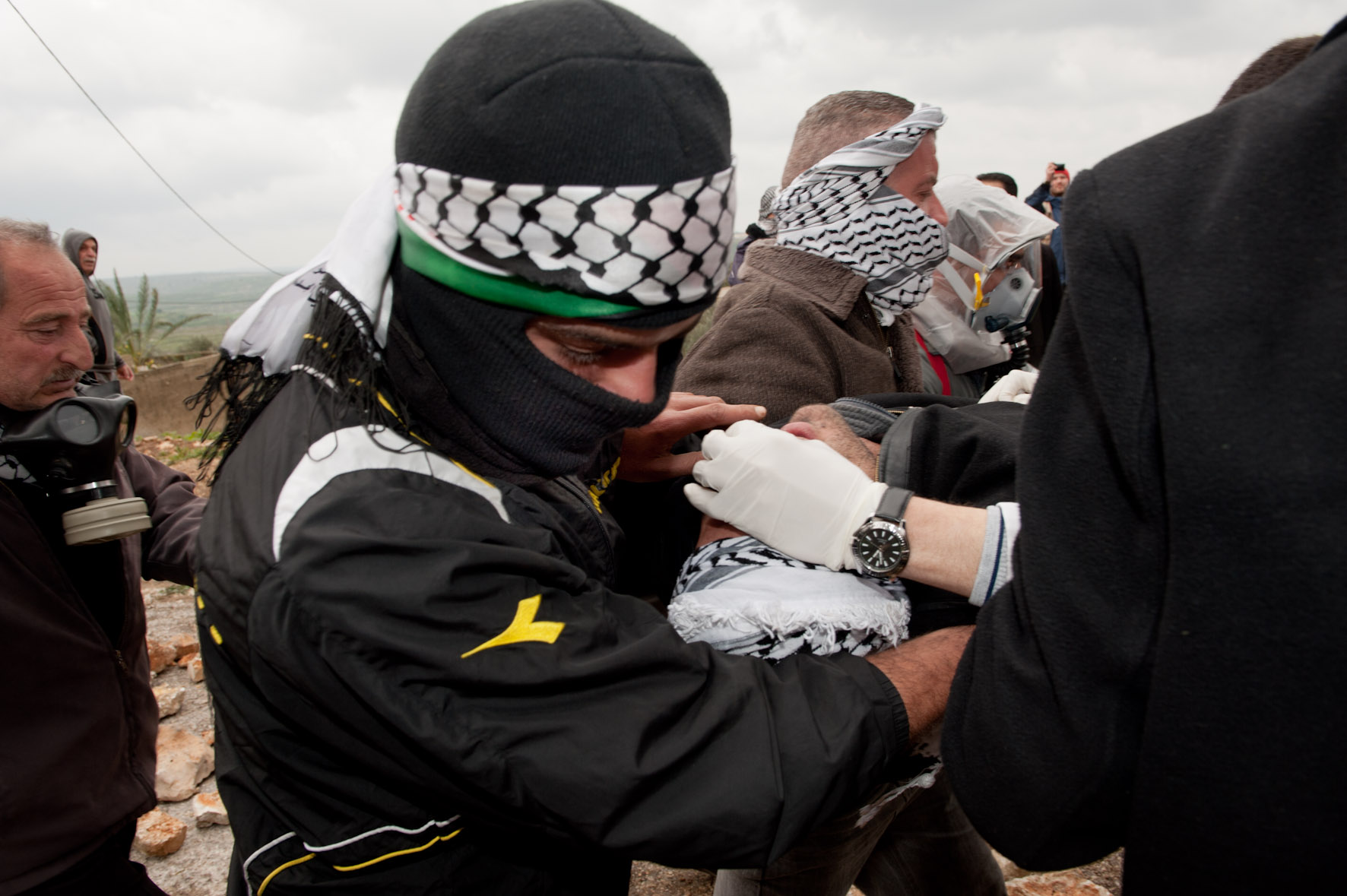
In December 2011 the death of Mustafa Tamimi was caught on camera. He was killed by a tear gas canister fired by an IDF soldier from the back of a jeep just a few meters away. This incident caused international outcry. It was raised by Don Foster MP in a letter to the Foreign and Commonwealth Office and gained wide spread media coverage.

Despite this extensive history I today witnessed another two Palestinian men being hit by IDF fired gas canisters. Despite IDF regulations stating that tear gas must be fired at a 60 degree angle I witnessed them repeatedly firing directly at the crowd. Not only does this violate the IDFs own regulations regarding the use of tear gas, it also violates International Humanitarian Law by failing to distinguish between civilian and combatant.

This however was only one part of the story of what happened at the protest at Kafr Qaddum today. The IDF tactics varied between spraying chemically produced water with a awful smell (aka ‘skunk water’, firing tear gas (at the crowd) and even using dogs to capture protestors towards the front. I was told that this boy had his arm broken by the dog before being arrested. This was the first time I had seen dogs being used at protests – a potentially worrying development.

The protest is organised under the principle of non-violence. Regularly however stones are thrown at the IDF by boys from the village despite men trying to stop them. It was reported that last week that a soldier was hit in the face by one of these stones. This reality that the IDF faces however provides no justification for their continued breach of both IHL and their own regulations. We are collecting too many examples now of the IDF misusing tear gas. It is time for the IDF to start enforcing its own standards and to live up to its obligations under International Humanitarian Law

6 Comments

Filed under Human rights, Middle East, War

No father, no food and an unknown future

When I was at school I did a sponsored fast – nothing was to go between my lips for the entire school day. I was raising money for something, a cancer charity maybe. During the morning break-time I remember pushing a doughnut into my porky little face. I scoffed it down and never told a soul about it. Licking my sausage fingers I can remember not feeling even the slightest crack of guilt.

Today, for this first time since that fateful event, I felt guilty. I felt guilty because stood in front of me in the mid-day sun was Hallah Hattab. Hallah is one week into her hunger strike. She is standing in solidarity with her father, Kifah Hattab who is 3 weeks into his hunger strike in an Israeli prison. Kifah is just one of a number who have chosen to go on hunger strike in recent months in protest of Israel’s continued use of administrative detention.

Hallah Hattab is a beautiful 20 something year old that oozes intelligence and holds herself with a confidence which conceals her age.  She has joined others today outside of the International Red Cross in Tulkarm to protest about the conditions that Palestinian prisoners are being held under. Specifically they are looking to highlight Israel’s on-going use of administrative detention. As the Israeli human rights organisation B’tselem states, “according to international law, administrative detention can be used only in the most exceptional cases, as the last means available for preventing danger that cannot be stopped by less harmful means. Israel’s use of administrative detention blatantly violates these restrictions”.

Both men and women gather on the pavement outside of the International Red Cross building sitting on plastic chairs in large circles. Each person holds a photo or a poster of a loved one who is languishing in an Israeli jail. Each of those attending the protest hold their own story of how someone close to them, a son, a brother or a father have been taken away from them. For Hallah it is her father.

I catch Hallah in between interviews with various local, national and international news agencies and ask her how she is feeling. She has the answer to this question down to a fine art, “I am trying to keep my spirits up, I know what I am feeling is nothing compared to what my father is experiencing, but it is still hard”.  Her hazelnut eyes blink at the end of her sentence and then fix themselves on me, attentive and focused on the interview at hand.

After a few seconds silence I ask Hallah how long she will be willing to carry on her hunger strike for and she responds saying that she will continue for “as long as it takes…I want to support my father”. She says these words with real determination. I wonder how far she will be pushed. Khader Adnan recently went on hunger strike for 66 days and very nearly paid the ultimate price. The undertaking that Hallah has taken on is no small one. I am eager to find out what fuels this fire inside of her but we are interrupted at this moment by someone introducing Hallah’s mother.

Her mother stands with us and insists (in perfect English) that she does not speak very good English.  I wonder whether she is just comparing herself to the English that flows from her daughter. Unlike her daughter she looks tired, both physically as well as mentally exhausted. She may not be on her hunger strike but you can see that the situation is taking its toll on her. When I ask her if she is worried about her daughter however her face lights and up she says that she feels ‘nothing but pride’. I half turn back to Hallah to ask about her studies at university and I catch her mother’s proud smile in the corner of my eye.

Frustratingly Hallah is whisked away as some other news agency is wanting to speak to her. I watch on as she gives another interview in another language. I look at her in admiration. I marvel at all she is doing with no father to support her, no food to sustain her and an unknown future to look to. I wonder if I would be able to do what she is doing and I think back to my pathetic failed attempt to fast for one school day.

On the walk back to the house where I am staying I talk to other EAs about Hallah. One colleague rationalises all that she is doing with the simple comment, “it is just her way of coping”.


1 Comment

Filed under Human rights, Middle East, Politics, War

The tale of an Israeli smile

“Do you know what the best thing about tonight is?”. I answered honestly, “No”. The soldier pushes his helmet back up his forehead with the butt his gun and says, “I get to drive these British Land Rovers”. I am not sure how to respond to this and so I sheepishly smile back. My coy response does not deters the soldier, who I later find out is called John, from continuing. “The Palestinians are really suffering you know”. I sensed an old IDF trick coming on, luring lefty NGO types into a false sense of security so I volunteered, “so are the Israelis”. John’s response was telling, “Are you crazy man? You really think the Israelis are suffering in comparison to the Palestinians?”

By this point I will admit that a certain degree of surrealism had been entrenched into the proceedings. I had been called by a local Palestinian at around 1:00 in the morning. He said that the IDF were in his house and they going to arrest his brothers and I should come quickly. As I turned the corner to his house I was met by at least 3 jeeps and an unknown number of soldiers. At first I negotiated a compromise about where my colleague and I could stand to monitor the proceedings. A few minutes later though one of the soldiers beckoned me over and at first started to interrogate me before letting himself slip into casual conversation.

Ignoring the growing sense of irony I pushed on with John, “A lot of Israelis are living in fear, they feel scared all the time, it is not good to live your life in fear”. The IDF soldier, now the voice of rationality in this increasingly bizarre conversation chirped back, “I know that but this fear cannot justify what we are doing here in the West Bank”. I trailed off, “No…of course not”. John was either a master at using reverse psychology or he was an Israeli soldier who was genuinely concerned about the Palestinians.

In the following 5 minutes we talked about the London bombings and how this had fuelled a growing suspicion of Muslim communities in London and what steps could be taken to breakdown this divide. I talked about multi faith projects I have been involved in and he listened with genuine interest. Our conversation meandered easily through politics and religion. After a while I tried to steer the conversation back to the reality in which we found ourselves.

As casually as one can ask an occupying soldier I said, “so, what are you guys up to this evening?”. I was meant to be getting answers to why they were terrorising a community in the middle of night for no apparent reason. Instead I sounded like I was flirting. I clarified, “what are you’re…ummm…objectives?”. The soldier laughed, smiled and said, “We are here for security, I think you know what that means”. I smiled and nodded as if this sort of response comes up all the time and I knew exactly what he meant. Of course I didn’t really know but I guessed this either meant they were there for no reason at all, or there was some super secret army reason for them being there that he couldn’t let on about. I suspected the former.

I glanced around and watched a collection of silhouettes on the roof tops. Men looking on to try and see what the IDF were doing. John caught my glances and reassured me, “they are just curious, there is nothing to be afraid of”. My colleague was stood 20 yards back nervously trying to work out what on earth I could be still talking about after 10 minutes or so of conversation. I knew it was time to draw this surreal conversation to a close. To do this, you would ordinarily ask a closed question like, “Is there anything else?” (a standard way to close what was meant to be an interrogation). On this night though I pushed my thumb into the palm of my hand and said, “I am really sorry, I don’t want to appear to be rude or anything, but if I stay and chat to you here for too long everyone will want to know what I was talking to the soldier about. It might cause some problems tomorrow. I hope you understand”. I was apologising to an occupying soldier for having to break off our nice little midnight chat. Once again, a big smile spreads across John’s face and he beams, “of course, I hear the Israelis have got a bit of bad reputation around these parts”.

As I walked back to my colleague, I felt two completely contradictory emotions. I could feel the cold metal being aimed at my back as I walked away, soldiers poised with suspicion ready to strike at any moment. The cold harsh reality of occupation – soldiers storming houses in the middle of night, interrogating, harassing and intimidating. Then, in complete contrast to this I felt John’s warmth. In my mind’s eye I saw his smile and could hear his soft laughter. Within a few minutes John had shown me a sign a hope and optimism that I know will stay with for days to come.

What will stay with the villagers however is another night time incursion, another family traumatised by interrogation. Mothers and fathers terrified at the prospect of their sons being arrested. Young men having another sleepless night living under the constant threat of arrest. They know too well that being a young male is enough to have you dragged from your house in the middle of the night with no explanation. This will stay with them for longer than just a few days, this will be with the for the rest of their lives.

7 Comments

Filed under Human rights, Middle East, War