Abuse in Qalandia Checkpoint

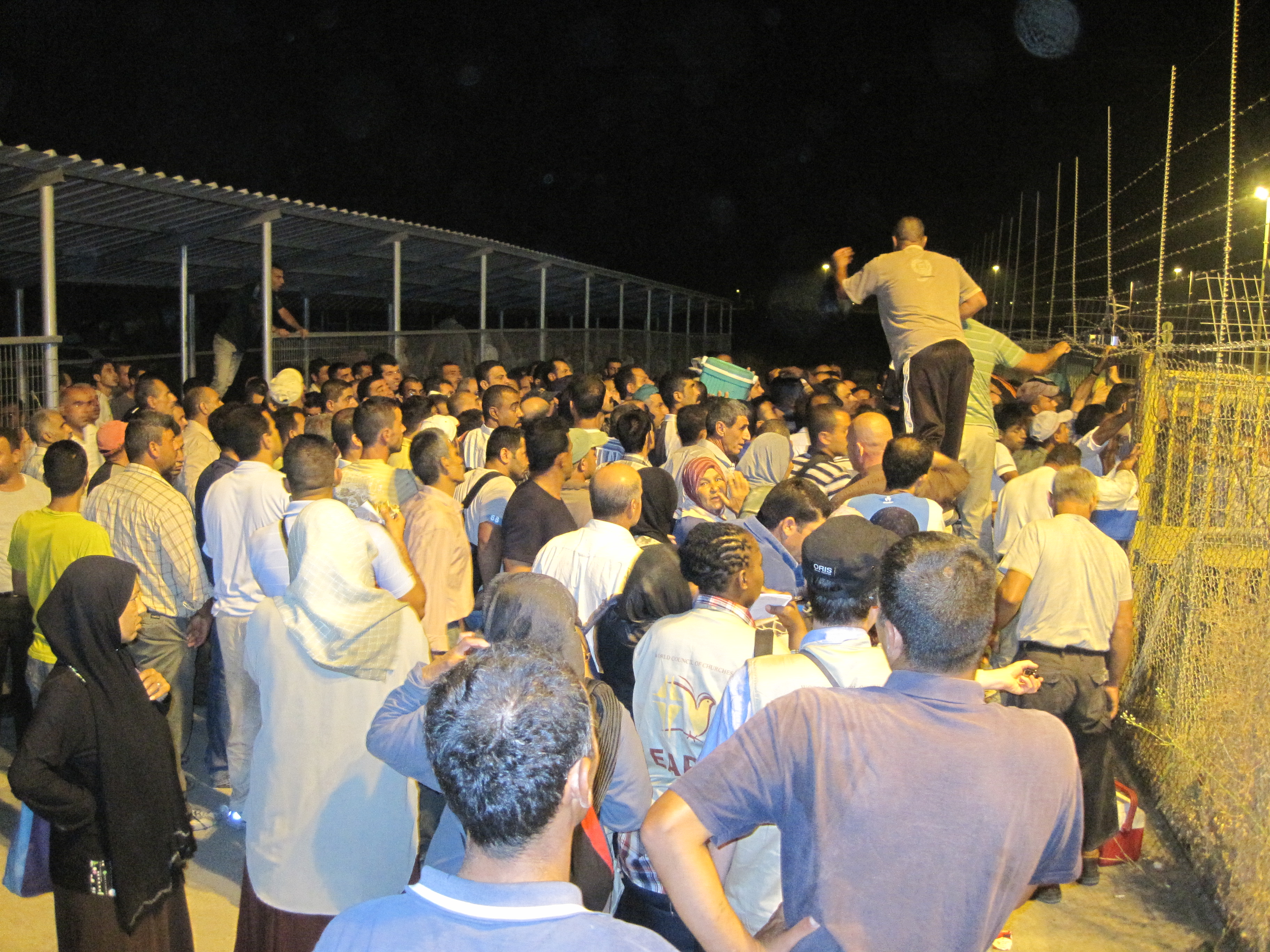
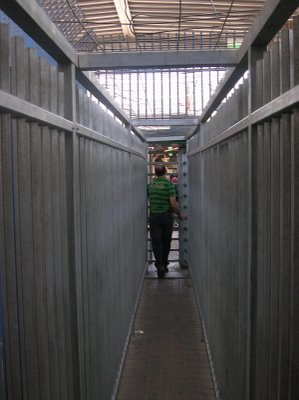
“You clearly don’t understand f****** Hebrew so let’s try in f****** English – you do not have a permit to enter so why don’t you f*** off back to whatever village you have come from”. My ears pricked up at this sudden harsh use of my mother tongue. I had for the last 15 minutes been sat in the middle of Qalandia checkpoint letting the mix of Arabic and Hebrew wash over me as I waited patiently for the man in front of me to pass through. The Palestinian man who stood with me turned a full 360 degrees looking at the ceiling before breathing heavily and saying to the young soldier on the  other side of the glass, “I understand f****** English, I do have a f****** permit to pass and I would appreciate it if you showed some respect and didn’t use such f****** foul language”. The swelling queue behind me laughed. The young female soldier stared him straight in the eye.

Qalandia checkpoint is on the outskirts of Jerusalem and is one of the largest in the occupied Palestinian territories (oPt). It is not near any border between Israel and the oPt but rather divides the Palestinian cities of Ramallah and Jerusalem. The man in front of me I would later find out was an orthodox Palestinian Christian wanting to go and pray at his church in Jerusalem.

The Palestinian man was at this point demanding to see the young soldier’s supervisor. Both parties were shouting and screaming. They both seemed to hold opposite opinions about this one piece of paper – his permit. Despite the close vicinity of the two, the man was shouting at the top of his voice, “I have a permit to cross 24 hours – why do you not let me through?!”. The soldier on the other side of the glass was matching his volume screaming, “You do not have the right permit so you cannot pass – it is that simple”. At this stage I had no way of telling who was right. Was the man confused about the terms of his permit or was the soldier mistaken? Without marching up and asking to look at the permit I had no way of really knowing. The following series of events however gave me a strong idea.

I had been stood waiting for just under half an hour listening to these two go round and round in their never ending argument. Back and forth with little variation they would shout, “I have a permit”…“no you f****** don’t”. Finally the soldier looked at her colleague and they both started laughing. The man did not. The young soldier (I guess aged between 18 and 20) turned to the man laughing and said, “Fine you can go through…you’re pathetic”. I was taken aback. The man scowled at her, picked up his belongings and turned on his heel to pass through the final turnstile. I watched him enter into the mid-day sun and temporarily out of sight.

I approached the young soldier with my passport in hand and with all the correct visas in place. I was a little worried though that she was going to cause me problems as well. I half smiled at her on my approach to the glass screen. She looked up and asked what my name was and so I nervously responded, “erm…Steve”. She smiled at me and said, “I hope you have a nice stay in Jerusalem, it’s a beautiful city. Sorry about the delay”. She then waved me through without looking at my visa or passport.

Outside, the Palestinian Christian apologised to me saying that he was sorry I had to witness him shouting but “they only listen to me if I shout”. I said it was no problem. I then asked him what the issue was with his permit. He laughed a bitter laugh and said, “nothing, look [he hands me the permit]…Everything is fine, they just do this to make life hard for you”. I folded the permit and handed it back to him. As we were walking towards the bus that would take us to the heart of Jerusalem he turned to me and said, “Can you imagine – every time I want to pray I have to go through this. I sometimes wonder  if this is God testing me”. Sat on the bus I wondered how many people in my parents’ church would still attend if they had to pass through Qalandia checkpoint every Sunday on their way to church.

Thinking back to the soldier in the checkpoint I wondered what had driven her to respond in such a way to this particular man. Was it her own way of escaping the insurmountable monotony of working at a checkpoint? I do not know. All I can say for certain is that today I had another up-close look at the one of the many restrictions on life here and saw an ugly glimpse of the daily struggle that Palestinians face under occupation.
6 Comments

Filed under Human rights, Middle East, War

Still here, still occupied

This article was written for the Occupied Times newspaper.

On BBC 5 live, Michael Richmond (also of OT fame) was debating the Occupy movement when one of his opponents shrilly suggested, “no one suffers in this country, we have a welfare state”. I felt like I had just ran into a brick wall. This sort of view could only come from someone who has never spent time with the homeless, the destitute or the desperate. The comment oozed a certain complacency that is replicated across middle England. I passionately believe that the challenge for us is to help people understand issues that are alien to their existence. Issues that they have not, and possibly never will, personally experienced. This is no easy task.

I am currently sat in my house pondering the very same conundrum regarding a very different type of occupation. I am currently living in Jayyus, a small farming village in the West Bank which has been living under occupation now for over 45 years. Every aspect of life here is controlled, restricted and made unreliable. Whether we are talking about access to water, employment or education; it can all be taken away at a snap of the fingers.

I passionately believe that part of the problem that enables this occupation to continue rests in European and Israeli citizens inability to imagine what life is really like for Palestinians living here. This is part of the reason why I am here – to try and tell the stories of those living under occupation to those who can affect change, you!

Equally, I believe we face a similar challenge within the Occupy movement. Most people cannot feel what it is like to be on the negative end of our unfair, unequal and deeply discriminatory economic and social system. When we try to reach out to suburbia and tell them the system is falling apart around their ears, they look through their double glazed windows and wonder what on earth we are talking about. We have no choice, it is time to get personal!

It is in light of this that I wanted to share with you a recent experience I have had. Through this experience I hope that I can explain to you the devastating affect that the occupation here in the West Bank is having on ordinary people’s lives throughout the occupied territories. I hope to get you to open up your European double glazed windows and to see the occupation for what it is.

I met with Haney Ameer just a few days ago. Mr Ameer lives on the outskirts of Mas-ha just outside of Qalqiliya in the West Bank. Back in 2003 his house was situated on the path of the proposed separation barrier, 80% of which is built on Palestinian land. When he refused to leave his house, the Israeli government decided to build the barrier around him. His house is now surrounded on all four sides by either walls, fences or the separation barrier. He lives in what looks like a high security prison except he now holds the keys for the one small gate that provides access to his property.

On one side of his house is the 8 meter high concrete separation barrier that scars the landscape for as far as the eye can see. On the other side of his house there is an illegal Israeli settlement which is cut off from him by a barbed wire fence. Flanking each end of his property are locked security gates leading to the military road that track the separation barrier. He is hemmed into his small plot of land on all sides.

Between 2003 and 2006 he lived in his property not owning these keys to access his own property. For three years he relied on the IDF to let him through the security gate each day to return to his own property. It was not uncommon in those days for friends to throw food parcels over the wall so he could feed his wife and children.

I sat outside his broken and bruised property in the fading evening sun just a few days ago. He explained to me he cannot fix any of the broken windows, crumbling walls or holes in the roof as he cannot get a permit off the Israelis to ‘build’ on his own land.

The Israelis offered him a lot of money and a chance to rebuild a bigger and better house on more land wherever he wanted in return for his land. He refused. Why he refused is a mixture of a connection to a family home that has been with him for years, and a slightly more harsh reality. The Palestinians who lived nearby warned him that if he sold up to the Israelis he would no longer be considered a ‘Palestinian’, he would be isolated. An ironic threat given his circumstances.

The meeting comes to a close and he walks us back to the rusted metal gate in the wall. Unlocking the padlock he looks up at the separation barrier and then at the floor. His body forgets what he is doing for a brief moment but his hands are still unlocking the door they have unlocked everyday for the last 6 years.

Mr Ameer lives in the most unimaginable conditions. And this is the point. They are unimaginable. The occupy movement now faces a challenge, to make the unimaginable a reality. We have to make all those who sit behind their double glazing understand that there are people across the UK who are suffering unimaginably because of the gross inequalities in our society. Just as most of you dear readers will struggle to give two hoots about Haney, so most of suburbia will struggle to give two hoots about you! This is our challenge. We have to make people care.  This challenge is not related to the degree to which people are suffering, but our ability to enable people empathise with those that are experiencing the suffering.

Leave a comment

Filed under Human rights, Middle East, Politics, Social comment

A revolution is brewing in Palestine

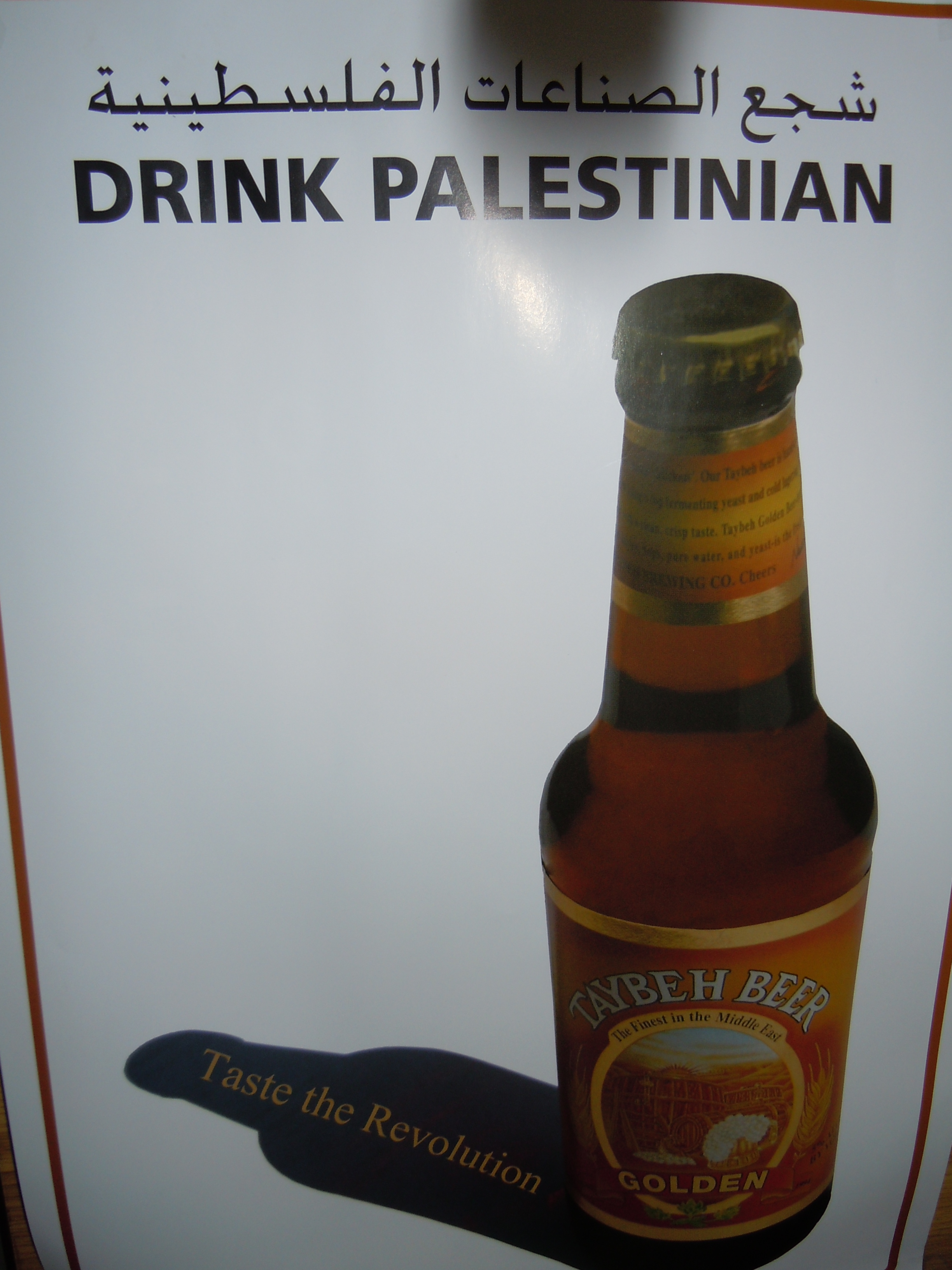
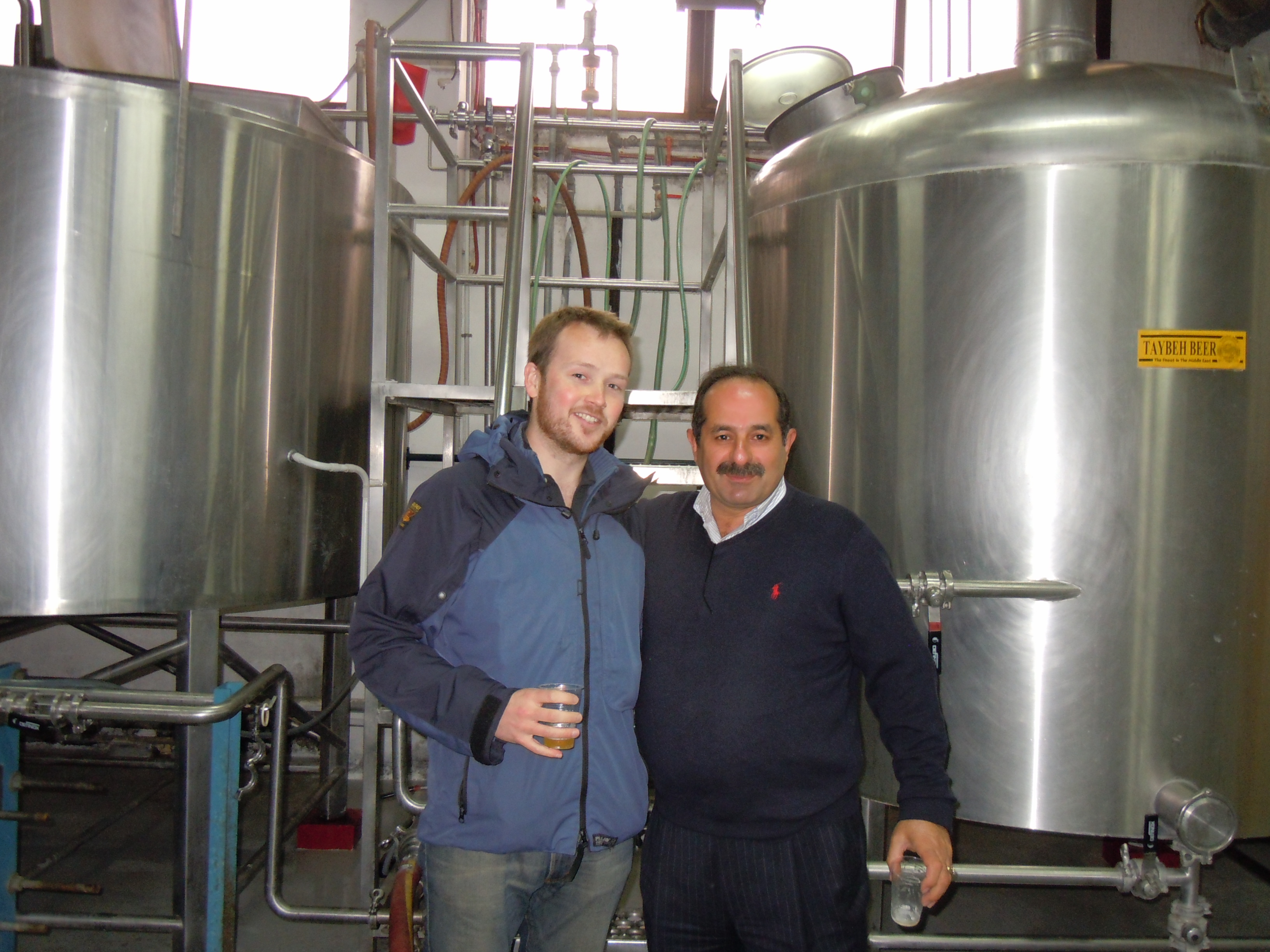
Nestled in amongst beautiful rolling hills you find a small micro-brewery with a revolutionary spirit. The Brewery was established with the intention of supporting the local economy and to use only the finest natural ingredients. This, for those of you who know me, could easily describe Stroud Brewery, my former employer.

Today however, I am describing the only micro-brewery in Palestine – Taybeh Brewery. It is based in the village of Taybeh (aptly meaning ‘delicious’) just outside of Ramallah, the de facto administrative capital of the West Bank.

This may seem an unusual place to stumble across a brewery. When you think of a micro-brewery, Palestine is not the first place to spring to mind. To suggest that brewing might not ‘belong’ in the middle-east is an idea that head brewer Nadim Khoury has evidently heard one too many times; It is near to impossible to leave the brewery without picking up the fact that beer was first brewed in the Middle-East up to 5,000 years ago.

Nadim is a man who is hard to dislike – when he strides into his brewery you can feel his passion, warmth and enthusiasm rush towards you. His big bushy moustache has no chance of hiding his beaming smile as he asks you if you would like a beer – you just know that he wouldn’t mind one himself. Nadim is clearly very proud of his brewery and so he should be. The story he has to tell is truly remarkable.

In 1994 just after the signing of the Oslo Accords, Nadim and his brother David invested some 1.2 million US Dollars into the brewery (all the equipment had to be specially imported). Nadim started this brewery with no more than some home-brew experience. Nadim set up the brewery in his home village of Taybeh determined to support the ‘new’ emerging Palestinian economy. He described people’s attitudes at the time by saying, “people thought I was crazy”. I smiled and he cackled a crazy man’s laugh and started to walk away muttering, “really crazy”.

There are a few very good reasons why anyone other than Nadim might think twice before setting up a brewery in Palestine. Indeed, it has to be noted that Nadim is currently the only person to have taken on the task (with considerable success I might add). He has had to overcome large cultural and religious issues as well as the small issue of living and working under military occupation. I was eager to find out the source of his success.

“It was crucial to get Arafat on board with our vision” Nadim says gleaming at a picture of him shaking hands with Arafat. “With Arafat on board I knew that I could make this work”. The subtext that is never spoken here is clear – with the endorsement of Arafat, overly zealous locals who might have otherwise taken an objection to a brewery opening remained quiet. Today, the majority of people who drink Taybeh beer are Muslims – not Christians, secularists or Jews. I suspect that’s one lingering stereotype that Nadim is happy to have broken.

Taybeh however is a Christian village. I asked Nadim what relations are like with his immediate neighbouring ‘Muslim villages’ and he responded positively highlighting the importance of the brewery to all of the surrounding local economy. “In the 2 days that people from all over the world come here for our ‘Oktoberfest’ local traders sell more of their produce than in all of the rest of year”. Quite a claim – I can see why the locals might have a soft spot for the brewery.

The brewery attracts a wide spread of support from the significant Palestinian Christian population right through to the droves of internationals that make their secular pilgrimage to this site. Israeli activists have also been known to show their support of the brewery.

Life has not always been easy for Nadim or the brewery though. On a number of occasions the brewery has been on the brink of closure due to a terrible mix of dropping demand (during the second intifada for example) and continued restrictions on movement of people and produce (he has to drive the beer for hours to a checkpoint in the south of the West Bank to ‘export’ his beer to Israel). At this point he shows me a cask that he has cut in half – he uses it to illustrate to IDF soldiers what the inside of a cask looks like. Now, whenever his beer passes a checkpoint it has to be weighed (more that 3 kilograms either way and it does not get pass). I don’t think any other brewery in the world faces these sorts of challenges.

As if this story is not remarkable enough, another twist to the tale walks through the door – Nadim’s daughter and now the first ever female Palestinian brewer. She is articulate and shares her father’s passion for brewing. I talk with her about the beer industry in the UK and how it is so dominated by men and ask what challenges she faces here in the West Bank. She answers sincerely saying “some of the older customers prefer to deal with my father but most have got used to it by now”. Another stereotype being chipped away at?

As we leave (with a handful of bottles) I over hear the rest of family (all who have various roles within the business) chatting. One of them is being interviewed by a reporter about a film she produced highlighting the issue of domestic violence in Palestine. Nothing surprises me now. This brewery is breaking down boundaries built up by prejudice. At the same time it is building and laying the foundations for the future. At the heart of whatever the future holds for this region there has to be a stable economy. Taybeh Brewery is busy laying the foundations for this future.

As I wait for a taxi to take me back to the reality of the rest of the occupied territories, I consider how, for me at least, I cannot think of more appropriate way support local people than to raise a glass of Taybeh beer. When people ask what you can do help resist the occupation and help people survive, I reckon this has to be one of the easier asks. Click here and have a beer – cheers!

2 Comments

Filed under Beer, Economics, Middle East, War

A not so peaceful protest

This article was posted on the Liberal Conspiracy blog.

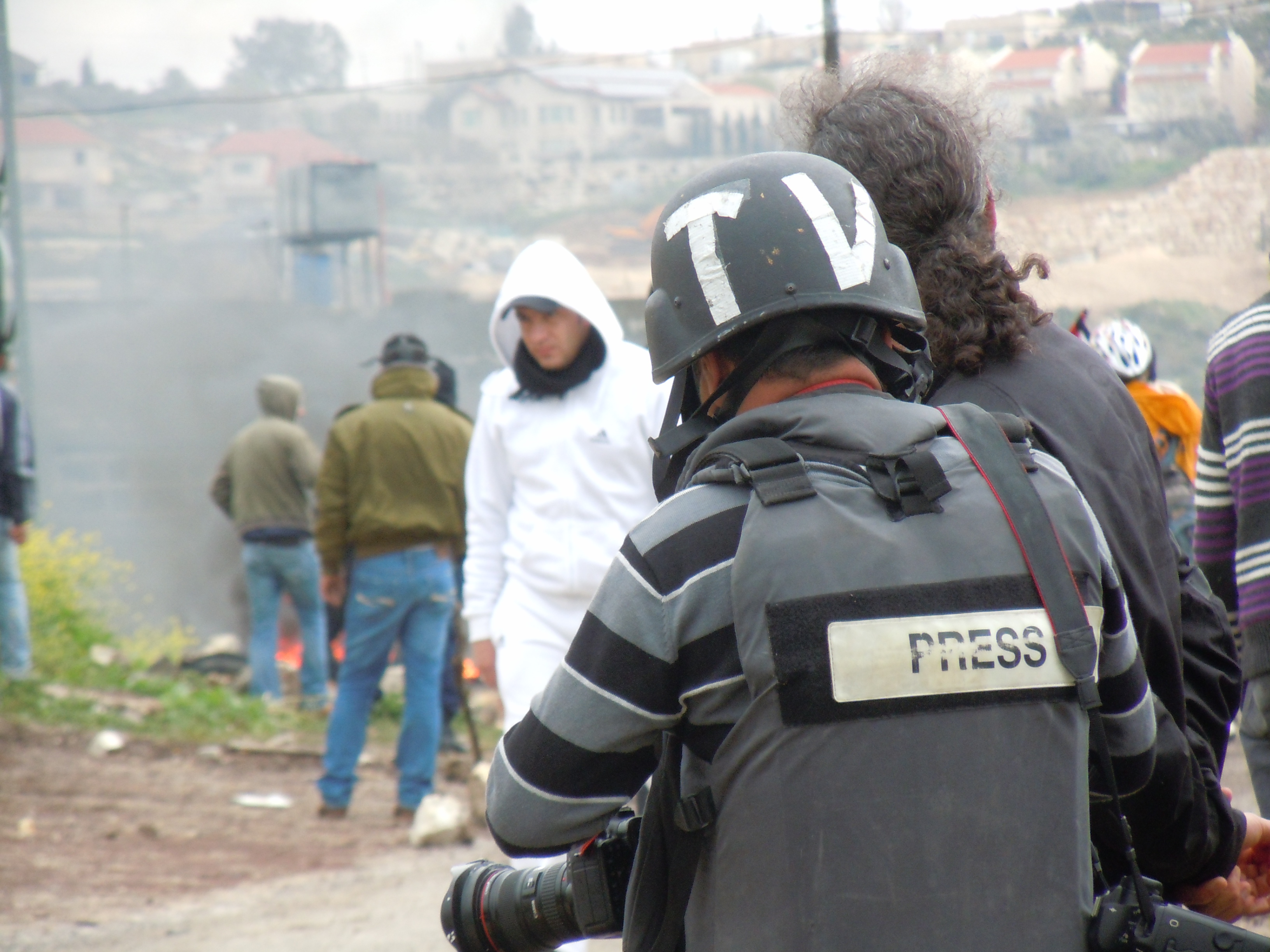
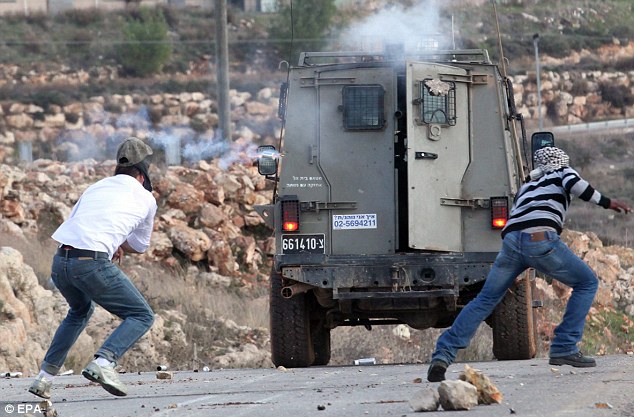
I was stood in the middle of an escalating protest against the Israeli occupation in the village of Kafr Qaddum. The air was thick with tear gas, panic was spreading as people were running in all directions to escape. In this commotion another round of tear gas was fired directly at the crowd. I saw someone meters from me collapse. A man caught him as he was falling and lifted him onto his shoulders. As he tried to escape other men came to help carry him. After a few meters they laid him down on the ground and it became clear he had been shot in the neck by a tear gas canister. This was the second person of the day to suffer this fate.

The former legal advisor for Judea and Samaria, Col. Sharon Afek of the Israeli Defence Force stated in April 2009 that, “direct firing [of tear-gas canisters] at persons is prohibited” and that, “very soon, an explicit and broad directive will be issued that will prohibit the firing of a tear-gas canister directly at a person.” When in July 2011 the Israeli human rights group B’tselem enquired to why they were still recording multiple incidents of tear gas canister being directly at crowds, Major Uri Sagi, of the office of the legal advisor for Judea and Samaria within the IDF stated that, “we have again clarified to the forces…the rules relating to firing of tear-gas canisters at persons, including the prohibition on directly firing a tear-gas canister at a person.”
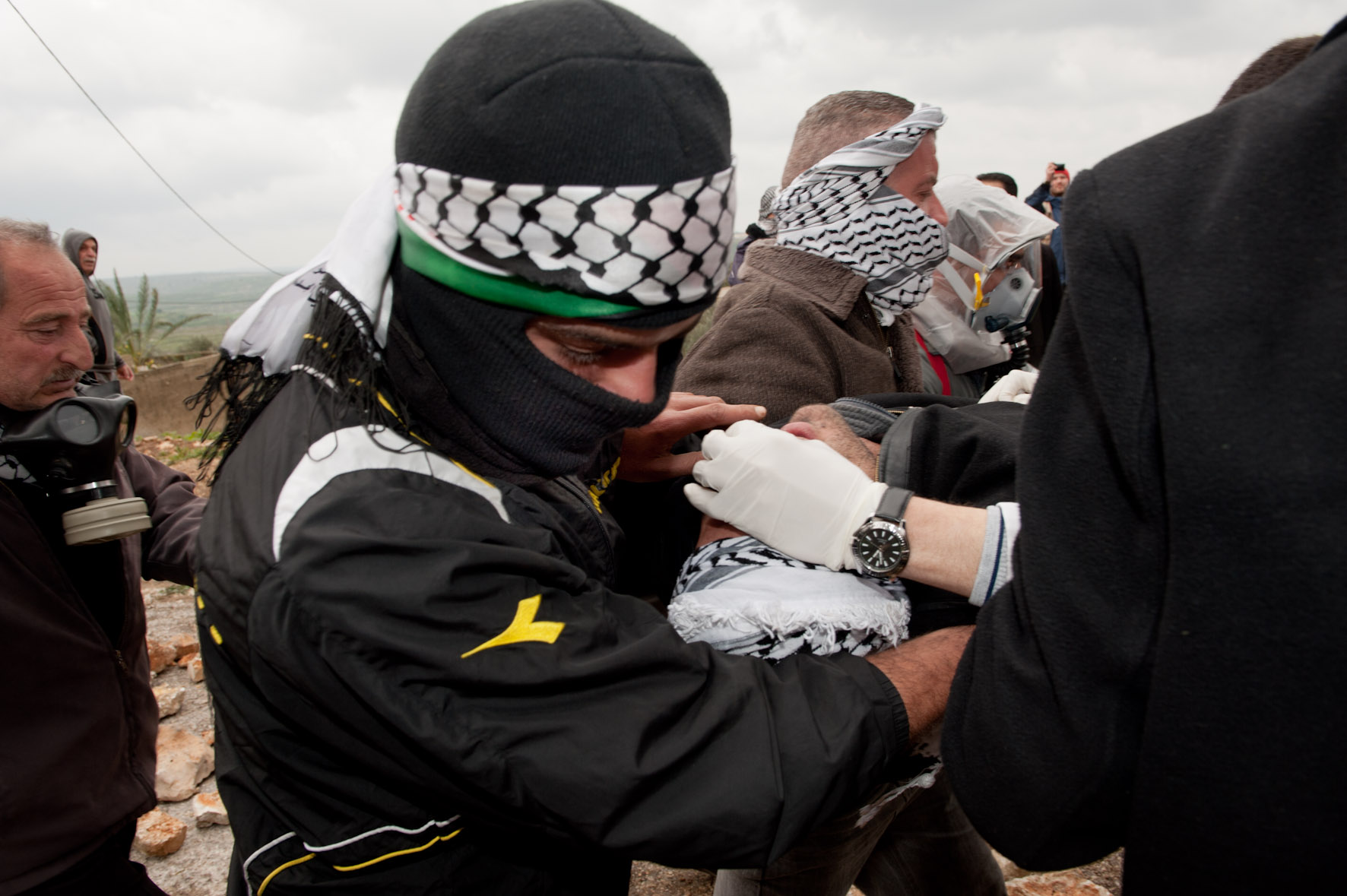
In December 2011 the death of Mustafa Tamimi was caught on camera. He was killed by a tear gas canister fired by an IDF soldier from the back of a jeep just a few meters away. This incident caused international outcry. It was raised by Don Foster MP in a letter to the Foreign and Commonwealth Office and gained wide spread media coverage.

Despite this extensive history I today witnessed another two Palestinian men being hit by IDF fired gas canisters. Despite IDF regulations stating that tear gas must be fired at a 60 degree angle I witnessed them repeatedly firing directly at the crowd. Not only does this violate the IDFs own regulations regarding the use of tear gas, it also violates International Humanitarian Law by failing to distinguish between civilian and combatant.

This however was only one part of the story of what happened at the protest at Kafr Qaddum today. The IDF tactics varied between spraying chemically produced water with a awful smell (aka ‘skunk water’, firing tear gas (at the crowd) and even using dogs to capture protestors towards the front. I was told that this boy had his arm broken by the dog before being arrested. This was the first time I had seen dogs being used at protests – a potentially worrying development.

The protest is organised under the principle of non-violence. Regularly however stones are thrown at the IDF by boys from the village despite men trying to stop them. It was reported that last week that a soldier was hit in the face by one of these stones. This reality that the IDF faces however provides no justification for their continued breach of both IHL and their own regulations. We are collecting too many examples now of the IDF misusing tear gas. It is time for the IDF to start enforcing its own standards and to live up to its obligations under International Humanitarian Law

6 Comments

Filed under Human rights, Middle East, War

No father, no food and an unknown future

When I was at school I did a sponsored fast – nothing was to go between my lips for the entire school day. I was raising money for something, a cancer charity maybe. During the morning break-time I remember pushing a doughnut into my porky little face. I scoffed it down and never told a soul about it. Licking my sausage fingers I can remember not feeling even the slightest crack of guilt.

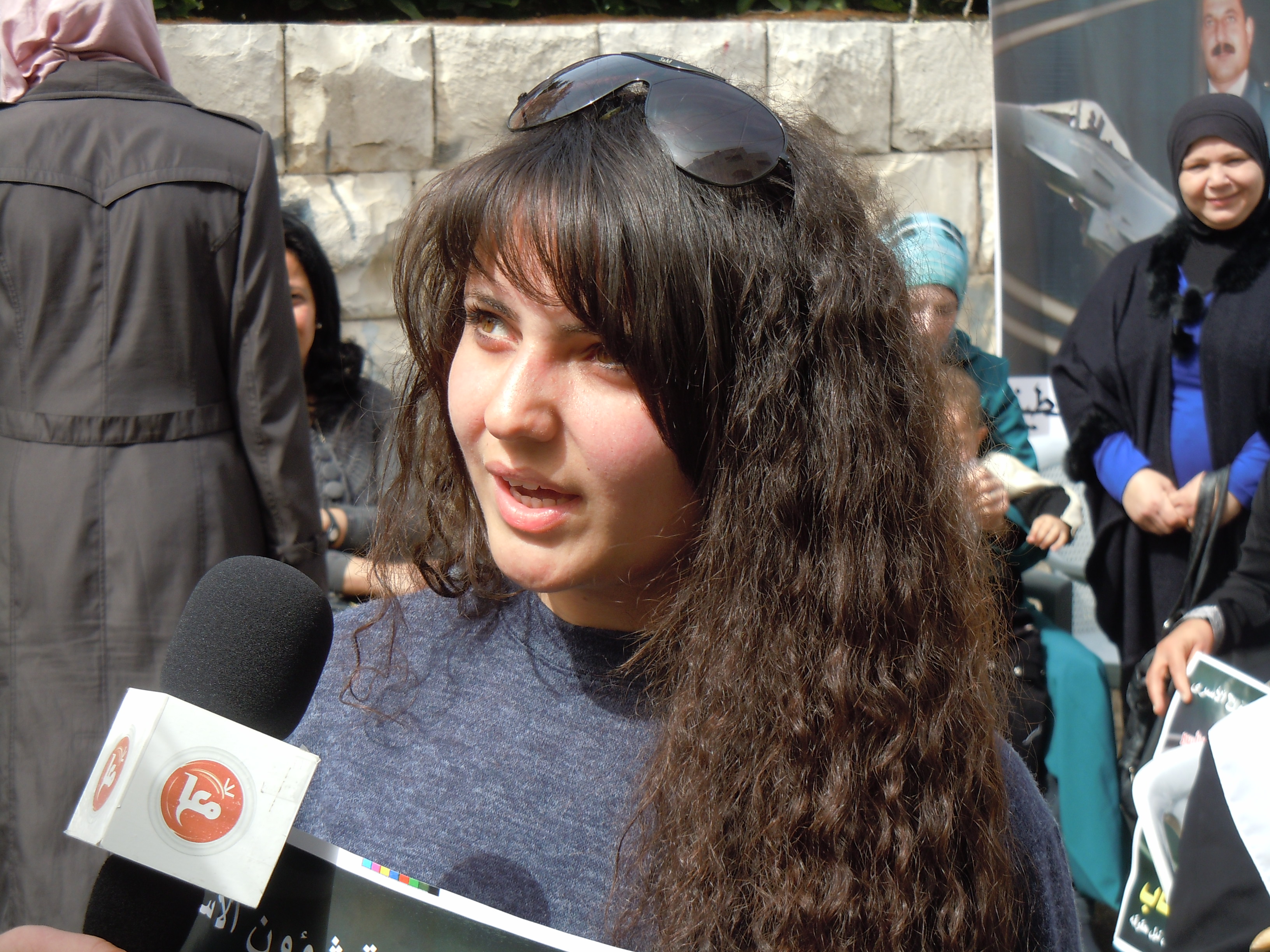
Today, for this first time since that fateful event, I felt guilty. I felt guilty because stood in front of me in the mid-day sun was Hallah Hattab. Hallah is one week into her hunger strike. She is standing in solidarity with her father, Kifah Hattab who is 3 weeks into his hunger strike in an Israeli prison. Kifah is just one of a number who have chosen to go on hunger strike in recent months in protest of Israel’s continued use of administrative detention.

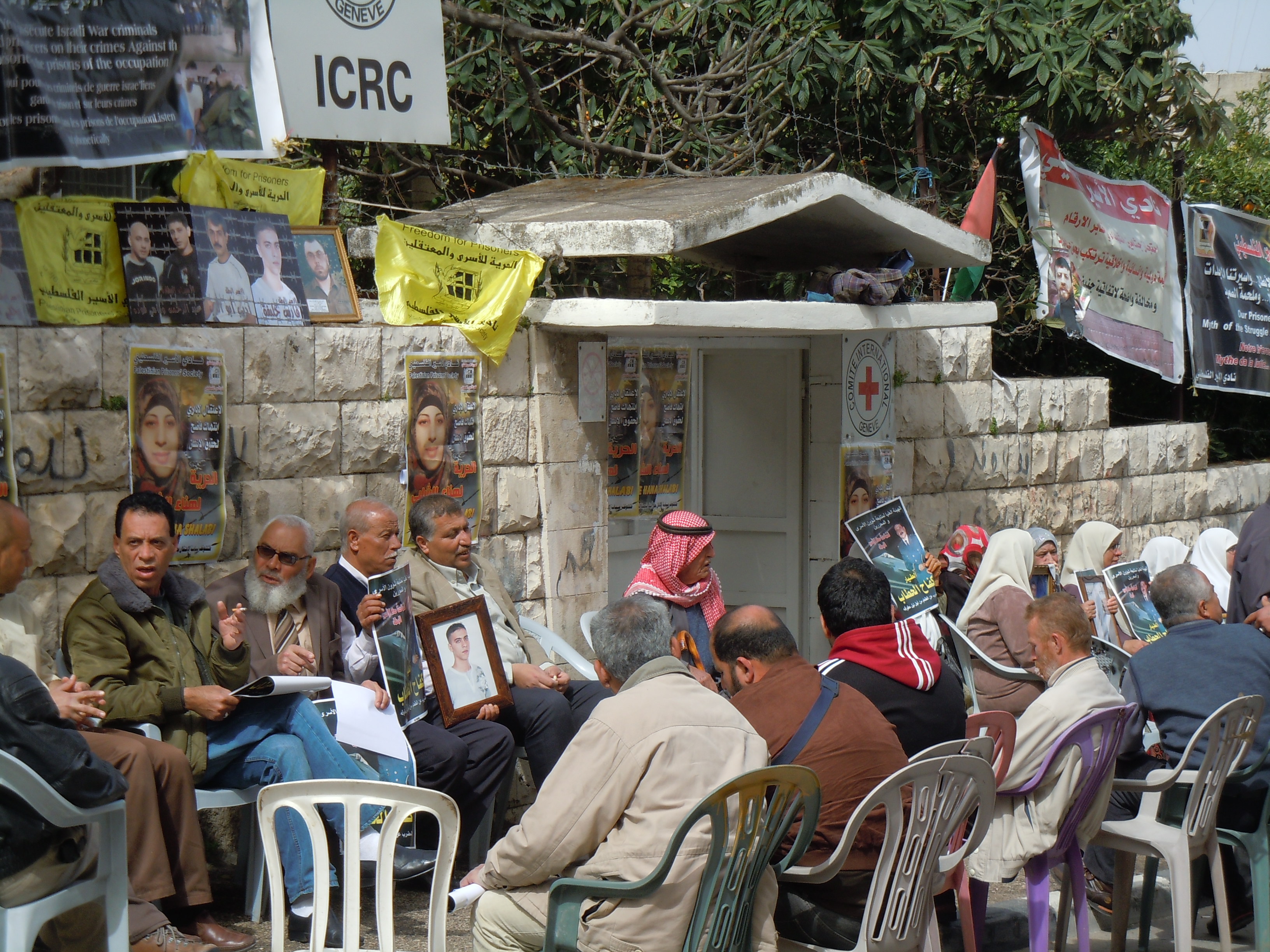
Hallah Hattab is a beautiful 20 something year old that oozes intelligence and holds herself with a confidence which conceals her age.  She has joined others today outside of the International Red Cross in Tulkarm to protest about the conditions that Palestinian prisoners are being held under. Specifically they are looking to highlight Israel’s on-going use of administrative detention. As the Israeli human rights organisation B’tselem states, “according to international law, administrative detention can be used only in the most exceptional cases, as the last means available for preventing danger that cannot be stopped by less harmful means. Israel’s use of administrative detention blatantly violates these restrictions”.

Both men and women gather on the pavement outside of the International Red Cross building sitting on plastic chairs in large circles. Each person holds a photo or a poster of a loved one who is languishing in an Israeli jail. Each of those attending the protest hold their own story of how someone close to them, a son, a brother or a father have been taken away from them. For Hallah it is her father.

I catch Hallah in between interviews with various local, national and international news agencies and ask her how she is feeling. She has the answer to this question down to a fine art, “I am trying to keep my spirits up, I know what I am feeling is nothing compared to what my father is experiencing, but it is still hard”.  Her hazelnut eyes blink at the end of her sentence and then fix themselves on me, attentive and focused on the interview at hand.

After a few seconds silence I ask Hallah how long she will be willing to carry on her hunger strike for and she responds saying that she will continue for “as long as it takes…I want to support my father”. She says these words with real determination. I wonder how far she will be pushed. Khader Adnan recently went on hunger strike for 66 days and very nearly paid the ultimate price. The undertaking that Hallah has taken on is no small one. I am eager to find out what fuels this fire inside of her but we are interrupted at this moment by someone introducing Hallah’s mother.

Her mother stands with us and insists (in perfect English) that she does not speak very good English.  I wonder whether she is just comparing herself to the English that flows from her daughter. Unlike her daughter she looks tired, both physically as well as mentally exhausted. She may not be on her hunger strike but you can see that the situation is taking its toll on her. When I ask her if she is worried about her daughter however her face lights and up she says that she feels ‘nothing but pride’. I half turn back to Hallah to ask about her studies at university and I catch her mother’s proud smile in the corner of my eye.

Frustratingly Hallah is whisked away as some other news agency is wanting to speak to her. I watch on as she gives another interview in another language. I look at her in admiration. I marvel at all she is doing with no father to support her, no food to sustain her and an unknown future to look to. I wonder if I would be able to do what she is doing and I think back to my pathetic failed attempt to fast for one school day.

On the walk back to the house where I am staying I talk to other EAs about Hallah. One colleague rationalises all that she is doing with the simple comment, “it is just her way of coping”.


1 Comment

Filed under Human rights, Middle East, Politics, War

The tale of an Israeli smile

“Do you know what the best thing about tonight is?”. I answered honestly, “No”. The soldier pushes his helmet back up his forehead with the butt his gun and says, “I get to drive these British Land Rovers”. I am not sure how to respond to this and so I sheepishly smile back. My coy response does not deters the soldier, who I later find out is called John, from continuing. “The Palestinians are really suffering you know”. I sensed an old IDF trick coming on, luring lefty NGO types into a false sense of security so I volunteered, “so are the Israelis”. John’s response was telling, “Are you crazy man? You really think the Israelis are suffering in comparison to the Palestinians?”

By this point I will admit that a certain degree of surrealism had been entrenched into the proceedings. I had been called by a local Palestinian at around 1:00 in the morning. He said that the IDF were in his house and they going to arrest his brothers and I should come quickly. As I turned the corner to his house I was met by at least 3 jeeps and an unknown number of soldiers. At first I negotiated a compromise about where my colleague and I could stand to monitor the proceedings. A few minutes later though one of the soldiers beckoned me over and at first started to interrogate me before letting himself slip into casual conversation.

Ignoring the growing sense of irony I pushed on with John, “A lot of Israelis are living in fear, they feel scared all the time, it is not good to live your life in fear”. The IDF soldier, now the voice of rationality in this increasingly bizarre conversation chirped back, “I know that but this fear cannot justify what we are doing here in the West Bank”. I trailed off, “No…of course not”. John was either a master at using reverse psychology or he was an Israeli soldier who was genuinely concerned about the Palestinians.

In the following 5 minutes we talked about the London bombings and how this had fuelled a growing suspicion of Muslim communities in London and what steps could be taken to breakdown this divide. I talked about multi faith projects I have been involved in and he listened with genuine interest. Our conversation meandered easily through politics and religion. After a while I tried to steer the conversation back to the reality in which we found ourselves.

As casually as one can ask an occupying soldier I said, “so, what are you guys up to this evening?”. I was meant to be getting answers to why they were terrorising a community in the middle of night for no apparent reason. Instead I sounded like I was flirting. I clarified, “what are you’re…ummm…objectives?”. The soldier laughed, smiled and said, “We are here for security, I think you know what that means”. I smiled and nodded as if this sort of response comes up all the time and I knew exactly what he meant. Of course I didn’t really know but I guessed this either meant they were there for no reason at all, or there was some super secret army reason for them being there that he couldn’t let on about. I suspected the former.

I glanced around and watched a collection of silhouettes on the roof tops. Men looking on to try and see what the IDF were doing. John caught my glances and reassured me, “they are just curious, there is nothing to be afraid of”. My colleague was stood 20 yards back nervously trying to work out what on earth I could be still talking about after 10 minutes or so of conversation. I knew it was time to draw this surreal conversation to a close. To do this, you would ordinarily ask a closed question like, “Is there anything else?” (a standard way to close what was meant to be an interrogation). On this night though I pushed my thumb into the palm of my hand and said, “I am really sorry, I don’t want to appear to be rude or anything, but if I stay and chat to you here for too long everyone will want to know what I was talking to the soldier about. It might cause some problems tomorrow. I hope you understand”. I was apologising to an occupying soldier for having to break off our nice little midnight chat. Once again, a big smile spreads across John’s face and he beams, “of course, I hear the Israelis have got a bit of bad reputation around these parts”.

As I walked back to my colleague, I felt two completely contradictory emotions. I could feel the cold metal being aimed at my back as I walked away, soldiers poised with suspicion ready to strike at any moment. The cold harsh reality of occupation – soldiers storming houses in the middle of night, interrogating, harassing and intimidating. Then, in complete contrast to this I felt John’s warmth. In my mind’s eye I saw his smile and could hear his soft laughter. Within a few minutes John had shown me a sign a hope and optimism that I know will stay with for days to come.

What will stay with the villagers however is another night time incursion, another family traumatised by interrogation. Mothers and fathers terrified at the prospect of their sons being arrested. Young men having another sleepless night living under the constant threat of arrest. They know too well that being a young male is enough to have you dragged from your house in the middle of the night with no explanation. This will stay with them for longer than just a few days, this will be with the for the rest of their lives.

7 Comments

Filed under Human rights, Middle East, War

The last 24 hours – an extract from my diary.

This is a short extract from my diary (with the naughty bits removed) covering the last 24 hours.

18:25 – I get a text message from one of our local contacts asking if I want to play football in the village with some of the other guys. It sounds like a laugh so I pull on my Arsenal shirt (staying neutral in the Barcelona/Real Madrid turf war) and head out. The two guys I meet are wearing jeans, jackets and leather shoes and I wonder whether my tracksuit trousers and football shirt looks a bit eager. This feeling is confounded when we stop and eat freshly made falafel (it’s hard to say no to Palestinian food). We arrive at the pitch (floodlights and all) and I start to get the feeling that something is not quite right.

18:45 – We spend over an hour warming up (I say we, the two guys who I arrive with are sat on the side – of course they are not playing, they’ve just eaten). This warm up is more exercise than I have done for a very long time. Apparently F.C Jayyus take their warm ups (and football in general) very seriously. I try to cover up my inherent lack of ability and my self-created lack of fitness by making jokes. The guys I came with laugh, everyone else looks on with growing concern at the amount of sweat dripping down this English boy’s face.

The coach barks instructions at players and I occasionally hear my name mentioned (that’s right, this village football team has a coach, and he barks). I try my best not to mess up but get the feeling that I am not the foreign super signing that F.C Jayyus had been looking out for.

21:00 – I survived it, just. One shoulder in the face, and only the occasional noticeable mistake and I think I survived my first (and possibly last) training session with F.C Jayyus. I walk off the pitch knowing full well that my legs will be stiff tomorrow but pretending that this sort of exercise is par for the course for me. It was great to meet some new faces in the village and to have a kick around with them – I wonder if that feeling is mutual? Either way, they are eager for me to come back to the coffee shop with them to watch Champions League football. I excuse myself, miming that I have to get up early tomorrow for checkpoint monitoring (I always thought the Jungle Book was hard but this take charades to a whole new level). I walk away from the group feeling proud that I have turned down the chance to watch football in favour of getting to bed on time – perhaps this whole experience is making me grow up.

23:30 – It’s pathetic and I know it. I have to be up in four and half hours but I could not resist watching Arsenal play (second leg trying to come back from a 4-0 first leg deficit against A.C Milan). Arsenal go 3-0 by half time and I am on cloud nine…and then…nothing. We (because when you support a club you are a part of the collective) crash out of the Champions League and any thought of silverware for the season goes out the window with it. To top it off, my home club, Cheltenham Town drop 3 crucial points in the race for League 2 promotion. I go to bed with my mind swarming with football. How can I love something that consistently causes me so much misery?

But anyway, if you’re looking to support Arsenal or Cheltenham Town I came across these useful coupons for Amazon. Take a look!

1:20 – I am awoken (2 hours after I went to sleep – not that I am bitter) with a phone call to say the IDF are in the village making an arrest (possible arrests – plural). After a quick assessment we decide it is too dangerous to be wandering the streets so we decide to monitor the situation from our rooftop staying in mobile contact with others around the village. It is an eerie feeling to see these silhouettes of men on roof tops in the early hours, all whispering reports to each other. It does however work as an informal information network.

2:30 – An hour later we receive confirmation that a local has been arrested. We can see IDF jeeps buzz around the outskirts of the village but only occasionally see them in the village. These late night visits (often not to make arrests) are happening far too often. I go back to bed, my mind now buzzing not with triviality of football, but of the guy who has just been bundled out of his house in the middle of the night – where will he end up, what will happen to him, what (if anything) will he be charged with?

4:55 – Alarms, I hate alarms. It does its job though and I am up to monitor the agricultural gate to the North of the village which open 5:30 – 6:30 every morning. I arrive and the IDF are parked with their headlights on full beam facing straight at where I monitor the gate from. I stand there, centre stage, performing the worst solo performance they are likely to ever see (essentially a tired Englishman staring blankly at them). After a while a small trickle of farmers flow past and I mutter a few good mornings. The Israelis have made a concerted effort to encourage farmers not to use this gate (as the road on the other side runs straight through a bit of land marked for settlement expansion) but still the locals use it. I wander back to the house feeling cold and tired.

08:45 – A Palestinian with an Israeli ID is coming to pick us up and to drive us to the other side of the separation barrier. We pass through the checkpoint and our bags are x-rayed and a sniffer dog sniffs every nook and cranny of the car. The young girl behind the desk has a staring competition with my passport photo (my photo wins every time) and I am asked why I visited Egypt (A: “I was on holiday”…my mind runs through potential comedy answers and I stop myself from laughing by making a sort of snorting noise). She looks at me and waves me through.

09:30 – We meet a local farmer and he walks us around his land showing the problems that they face (settlement expansion, military activity, water rationing etc). Inside a hut on his land we drink sweet tea and point at maps laid out in front of us. He shows us how the access to his land is being controlled (you need to have a permit to access your own farmland), restricted (they have built a massive separation barrier through the middle of his land – twice) and made unreliable (he had been waiting for months to get a permit). Worst of all, it can be taken away at any minute. We are shown his neighbours land which has been literally blown away – it is now a stone quarry providing material for massive ‘settler only’ road upgrading schemes. Areas all around his land have been claimed by the Israeli government as state property (using British mandate laws I should add – sigh…I love the BBC, tea and cake at 4pm and The Beatles but I sometimes struggle to find anything else to be patriotic about and being in Israel/oPT is not helping this).

We are joined during the day by a Dutch delegation who have decided to spend their free time working as unforced free labour on the land. For some this might seem an odd choice for a holiday but I think I ‘get it’. It is beautiful land they are working on and it is rewarding work. At the very least I ‘get it’ more than those fighting for sun beds in Magaluf.

17:00 – After a long day in the sun in the fields this is exactly what I don’t want. I am sat on a concrete bench in the seam zone (the area in between the separation barrier and the Green Line) waiting for a taxi driver who is over 1 hour late staring at the backend of a checkpoint I am not allowed to enter (it is for workers only). When the taxi does show up (with no explanation for the delay) I need to be driven in a huge loop around and through a car terminal. No one checks any of my nooks and crannies on the way back through.


I am currently serving as an Ecumenical Accompanier in the West Bank – follow the hyperlink for more information.

5 Comments

Filed under Human rights, Middle East, Politics, Social comment

The missing pieces of Jayyus’ jigsaw

Children are running wild around my feet, unable to decide which is more exciting, the strange foreigner holding a digital camera, or the prospect of finally seeing Ashraf Khaled.

The atmosphere almost reaches fever pitch as rumours spread like wild fire of Ashraf’s imminent return. A car alarm goes off and people break out into a short lived hysteria. The occasional firework flies into the air, the explosion resonates through the narrow village streets and leaves the children delirious with anticipation. For the last week the village of Jayyus in the West Bank has been expecting Ashraf to return. On each anticipated release day, his family would drive to Jenin only to find out at the last minute that they would have to wait for another day or two.

For many of the young boys flittering around my feet they have no memory of Ashraf – many were still in their mothers arms when he was detained eight years previous.  Perhaps this only adds to the excitement – the prospect of the unknown.

The wait is stretched out with small snippets of information being fed to the growing crowd. Someone is sure that he has left the neighbouring village, another comments that he will be here any second. I have no idea what to expect but even I am starting to feel excited.

All of a sudden the suspense spills into carnival jubilance; a procession of cars start to pour into the village. Each car has Palestinian flags and jubilant young men hanging out of the windows, sunroofs and out of places you wouldn’t believe that it was possible to hang. One man leans out of the window holding a box of fireworks firing them into the air. Soon we are encircled with loud explosions as houses all around the village let off fireworks from their flat roofs. Car horns are on permanently, men are shouting trying to be heard over the car horns and feeble stereos try their best to compete. The children, for the first time since I came out onto the street, stand still and watch the spectacle in amazement. The street fills with firework smoke, music, explosions, laughter, and giddy men embracing.

As I stand in the middle of this all, breathing the fresh evening air, I watch a community come together in a public embrace to welcome home a missing piece of their jigsaw. I have long given up asking the reason why anyone is arrested (invariably it is either for ‘security’ or ‘stone throwing’) but on this occasion I venture down this delicate line of questioning. The answer comes back with a cynical sneer. I am told that his brother was killed and he was arrested as a precautionary measure in case his brother’s death ‘radicalised’ him.

In most modern democratic countries this story would be an impossibility or at least it would be considered to be unusual. Sadly, in Israel and the occupied Palestinian territory we know that at least 308 people are currently being held in administrative detention[1]. This is a clear violation of International Human Rights standards. Article 9 of the International Covenant on Civil and Political Rights (ICCPR) clearly states that no person should be subject to , “arbitrary arrest or detention”.

Some men are arrested for genuine security concerns, some are arrested for stone throwing, many however are held without charge or trial.

As the parade of clapped out 1980 Subaru Leones file past for the third or fourth time, I start to look beyond the explosions and the loud music and catch the occasional eye wandering into the near distance. On this night one piece of this village’s jigsaw has been returned but many more remain scattered across Israel languishing in prisons. In the last few weeks at least three of the village’s young men have been detained including the Mayor’s son. Each one leaves a hole in the fabric of this close knit community.

It remains to be seen whether Ashraf will fit back into place here or whether his body and mind has been permanently bent out of shape. Tonight the community will welcome him back with a celebration that will go onto the early hours. Tomorrow the sun will rise and cast its light into the homes of all those who have relatives in one of Israel’s prisons. For as long as the occupation continues and Israel pursues its policy of arbitrary detention the jigsaw of villages like Jayyus will remain incomplete.

2 Comments

Filed under Human rights, Middle East, Politics, War

How to kill flowers

My colleague and friend Mamela accompanied me to visit Haney Ameer (No man is an Island) a few days ago. Here are her words reflecting on the rose garden that remains beautiful on Haney Ameer’s small patch of land outside of his house:

How to Kill Flowers

You can build towers
Cause them great distress
Cut water access
Reduce their showers

Threatened by a knife
Remain delicate
Calm yet intricate
They bare endless strife
Not by death, through life

You can raise a wall
That may never fall
Despite the deadly shade
Beauty does not fade
One bit, not at all

While flowers exist
Nourished by light mist
With strength to endure
Not harmful but pure
They persist to resist

2 Comments

Filed under Middle East

No man is an island

The English poet John Donne once wrote, “No man is an island entire of itself”. This assertion has never faced a more literal challenge however than through the story of Haney Ameer.

Mr Ameer lives on the outskirts of Mas-ha just outside of Qalqiliya in the West Bank. Back in 2003 his house was situated on the path of the proposed separation barrier, 80% of which is built on Palestinian land. When he refused to leave his house and his land the Israeli government decided to build the barrier around him. His house is now surrounded on all four sides by either walls, fences or the separation barrier. He lives in what looks like a high security prison except he now holds the keys for the one small gate that provides access to his property.

On one side of his house is the 8 meter high concrete separation barrier that scars the landscape for as far as the eye can see. All over the wall there is battle between local graffiti artists and the Israeli Defence Force’s (IDF) censoring white paint. On the other side of his house there is an illegal Israeli settlement which is cut off from him by a barbed wire fence. Flanking each end of his property are locked security gates leading to the military road that track the separation barrier. He is hemmed into his small plot of land on all sides.

On the approach to his house our driver and translator rings ahead for him to come and meet us. We pull up alongside the 8 meter high concrete slabs to walk the last few meters. Next to the barrier there is a small rusted metal door from where Mr Ameer emerges. Between 2003 and 2006 he lived in his property not owning these keys to access his own property. For three years he relied on the IDF to let him through the security gate each day to return to his own property. It was not uncommon in those days for friends to throw food parcels over the wall so he could feed his wife and children.

We sit outside his broken and bruised property in the fading evening sun. He explains he cannot fix any of the broken windows, crumbling walls or holes in the roof as he cannot get a permit off the Israelis to ‘build’ on his own land.

I ask him if he ever considered leaving. He responds with a story of isolation and incredible courage which is characterised by a lack of options. The Israelis offered him a lot of money and a chance to rebuild a bigger and better house on more land wherever he wanted in return for his land. He refused. Why he refused is a mixture of a connection to a family home that has been with him for years, and a slightly more harsh reality. The Palestinians who lived nearby warned him that if he sold up to the Israelis he would no longer be considered a ‘Palestinian’, he would be isolated. An ironic threat given his circumstances.

Regardless of his motives, Mr Ameer now finds himself in a physical limbo, not on either side of the separation barrier. He insists that if he could turn back the clock then he would do nothing differently. I ask what he hopes for the future and he bleakly responds, “nothing, I will die like this”. This response sends a shiver down my spine as I realise that this is quite possible. The occupation has come to a point where a family can be living in 60 by 40 meter virtual quarantine and the world does not bat an eyelid.

Mr Ameer has the look of a man who has told his story a million times before. He sits back in his chair as if this is a day to day occurrence for people all around the world as he recalls the details of his isolation. I wonder whether this is just his way of dealing with what is an unimaginable daily infringement on his personal liberty.

The meeting comes to a close and he walks us back to the rusted metal gate. Unlocking the padlock he looks up at the separation barrier and then at the floor. His body forgets what he is doing for a brief moment but his hands are still unlocking the door they have unlocked everyday for the last 6 years.

We leave him on the other side of the barrier. I cannot decide whether I have extreme admiration for this man, or if I just want to shake him by the scruff of the neck and tell him to move with his family to a new house. I suspect if I did the latter, he would sit me down, light a cigarette and tell me to not be so impatient. I am impatient though, I don’t want to think of this man sitting in his house, his virtual prison, until the day dies. There has to be an alternative ending to this tragic story.

The occupation restricts peoples movement, freedoms and lives on a day to day basis. Mr Ammer’s story is unique only because of his physical proximity to the separation barrier.

Haney Ameer will sleep tonight though knowing no one can tell him to leave his family house, not the IDF and certainly not a foreign human rights monitor like myself.

2 Comments

Filed under Human rights, Middle East, Politics, War

The good news story of Aref Sameer Chbieteh

At 25 years of age, he has spent nearly a quarter of his life in prison. Despite his tender age, he has the look of a man who has already seen too much. Sat in a plastic garden chair Aref looks into the near distance as he answers our questions. Surrounding him are his friends and family who have not seen him since his arrest 6 years previous. The room holds a feeling of collective cohesion, together they are strong, but alone I suspect anyone of them could fall apart. Six years ago, the Israeli Defence Force (IDF) took him from his house in the middle of the night and he was charged him with possession of a weapon – a charge that he denies but for which he was found guilty.

I ask Aref about his experiences inside the four different Israeli prisons where he was kept. What he does not say tells a story in itself. His gaunt and clearly underfed body sits slumped in his chair as he struggles through his mind for details that he is not comfortable recalling. He was moved between different prisions after making formal complaints about the conditions in which he was kept. When I tentatively ask him to expand, he simply replies, “they were bad”.

Aref has been a free man for only a few hours when we are ushered to his house. They wanted us to see a ‘good news’ story – a young man returned to his mother. What I heard and saw however was that of a life reduced to distant stares and painful memories.

Aref was detained inside of Israel despite living in the occupied Palestinian territory (oPt), this meant that he was cut off from his family. This is a clear violation of international law.  As Malcolm Smart of Amnesty International said, “International human rights standards and international humanitarian law guarantee every person deprived of liberty the right to humane and dignified conditions of detention…and regular family visits”.  What Aref described to me was a breach of these rights.

His case however is not unique. 6 years is a standard punishment for being caught in possession of a weapon. Equally, Aref was just one of the 5,200 Palestinians from the West Bank – including East Jerusalem – and the  Gaza Strip,  who are currently detained in facilities run by the Israel Prison Service. The vast majority are detained inside Israel. For Aref, years went past where he was not allowed to receive any visitors at all.

I ask him, perhaps through naivety, if he suffered any physical punishment inside prison and for the first time in the meeting a flicker of life passes through his eyes as he snorts before muttering, “of course”.  There is an awkward silence as all we all stare at the floor – I feel embarrassed for asking such a crass question. Aref breaks the silence by explaining that he will never forget what happened to him inside prison. I do not have the nerve or inclination to ask him to expand.

His family around him are buzzing with excitement to see him again after all these years. Before I go, I turn to his mother and ask a question which I hoped would encompass the ‘good news story’ that we had come to see. I ask her what it feels like to have her son back. She looks at me and smiles as a tear forms in the corner of her eye and she says in clear English, “very happy”. My professionalism drops and I meet her smile.

On the way out, Hassan who had arranged the meeting for us moves the conversation onto the 7 other young men who were arrested last night. My heart sinks as I imagine each of their mothers sitting out the years waiting for their sons to be returned. Tomorrow we will try to meet with some of the families of those newly arrested.

3 Comments

Filed under Health, Human rights, Middle East, War

Administrative detention on the West Bank

This article was written by my colleague Bjoern Gunnar and was originally published in Norwegian and English on his blog.

By invitation from the Qalqiliya branch of Prisoners’ Club, the EAPPI team at Jayyus attended the demonstration against the administrative detention of Khader Adnan who has been detained since 18 December. Adnan is now on his 64th day of hunger strike and has lost a third of his body weight. According to Al Jazeera, the 33 year old baker was arrested in his home in the middle of the night and ‘sentenced’ to four months of administrative detention,  “World leaders have expressed growing concern over the fate of the prisoner, who is being held without charge under a procedure known as “administrative detention”. There are currently more than 300 Palestinians being held in administrative detention by Israel, without charge or trial, for renewable periods of six months, without any way of defending themselves.”

EAPPI teams do not actively participate in demonstrations, but attend to show sympathy and talk with people. Sometimes we find eloquence without the use of words.

In the small town of Qalqiliya, more than two hundred attended the demo. Not bad!
Mothers and sisters with husbands, sons and brothers in administrative detention; faces showing the destructive effects of the use of illegal imprisonment.
There is beauty to be found on the West Bank. Administrative detention is not among these. The life of Khader Adnan is on the line; a very thin line. Should he die in illegal detention, scenarios including disruptive, violent response are more than probable. Israel’s Supreme Court will hear an appeal for Khader’s release today.
Leave a comment

Filed under Human rights, Middle East, Politics, Social comment, War

The universal language of Messi

This article was originally published on Tattooed Football.

In the dusty streets of Jayyus in the West Bank, the language that children use cuts through adult constructed divisions. The names of Abbas or Netanyahu are alien. What rolls off the lips of the children here are the names of Messi, Fabregas and Puyol.

Jayyus is a small farming community situated near the town of Qalqiliya in the West Bank. It has been devastated by the construction of the separation barrier (which is universally acknowledged to be illegal under international law). 75% of the village’s farmland is now on the wrong side of the barrier. Recently, the village has seen a number of Israeli Defence Force incursions that have resulted in a number of local boys arrested.

These events however are just distractions for the children from the more serious business of street football. The challenge is simple – who can get as close to mastering Messi’s majesty as possible. To this goal, the children spend hours trying to match his touch, skill and athleticism. There is one coffee shop in the village where every Barcelona game is watched religiously and you can see every detail being gulped down with enthusiasm. The attendance, dedication and passion given to this cause is unwavering.

In a situation so bleak, it is heartening to see children throw their enthusiasm into football. I am sure it is a more productive use of time than throwing stones at the IDF. Equally, in a time when football seems so personified by casual racists, materialists and playboys, I find it heartening to see Messi being held up as a role model.

Messi manages, both on and off the pitch to balance his enthusiasm with a calm composure.  Messi also represents the dream that every child holds onto. He was taken from his home in Argentina at the age of 13. It is said he was only 4 foot 7 inches when he signed for Barcelona. From this he has developed into undoubtedly the greatest footballer of a generation. Messi has gone from being a small shy boy playing street football to be earning and inspiring millions.

It is this romance that drives children all over the world. Messi provides each child with a chance to dream. Cut off from life chances, it is this hope that keeps children going. This hope is communicated through the language of Barcelona. Football connects the children on the streets of Jayyus to billions around the world. Whatever the language their government or the occupying government speaks – these children will always be fluent in the language of football. No one can take that away from them.

Steve Hynd is currently an EA with EAPPI and is living in Jayyus, West Bank.

1 Comment

Filed under Football, Human rights, Middle East, Sport, War

The lasting legacy of child detention in the West Bank

This article was published on WeSpeakNews – an alternative grass-roots led news service.

It is becoming a regular event but I am far from being able to normalise it. Having sound grenades go off meters from you whilst being caught in a shower of stones is not, and should not, be understood as normal. Increasingly however for the village of Jayyus it is. In the last 7 days there have been 4 Israeli Defence Force (IDF) incursions into Jayyus and its neighbouring village of Azzun.

Last night we saw three vehicles tear through the village. What follows is typical of villages across the West Bank. Children who are already on the streets start nervously at first, but soon with collective confidence, throwing stones at the IDF vehicles. We were caught out of position (between the IDF and some stone throwing kids) and so take cover in a shop. The IDF then lets off a couple of sound grenades before tearing out the village, leaving a cloud of dust behind them.

In the aftermath of this relatively small incident I talked to some of the young men on the street. One, who proudly boasts that the IDF ‘questioned him’ comments, “they asked me if I threw stones and I said no”. A stone slips out of his hand. Mostly the boys and young men are excited and exhilarated by the whole episode.

This however is in stark contrast to the Mayor of the village who I visited a few days previously. His son had been arrested during the raid on the village the night before. There is no excitement in his eyes, no exhilaration, just tired resignation. The sight of his children being taken away blindfolded and bound is all too familiar. His house had been broken into and turned upside down in search of weapons that were never found.

One ex-IDF soldier told me recently that in hundreds of house raids he conducted, he only ever found one gun. In his words, “This is about power and intimidation, not arms”.

These arrests have both immediate and long term consequences. Firstly, the children are detained, normally in the early hours, by being blindfolded and bound by armed soldiers. This is a terrifying experience by itself. The NGO Defence for Children International however describe in detail the procedure which arrested children can experience, including, no access to legal help, reports of torture and forced confessions. This treatment leaves a lasting legacy on the attitudes of these children.

The detention of minors, in this manner, clearly violates the UN Convention on the Rights of the Child (article 3) and the UN Convention against Torture. What is most concerning however, is the lack of accountability throughout this system. It is often a battle to ascertain the location of any prisoner, let alone their welfare. There are entire organisations established just to help people track the whereabouts of those detained.

Those who are left in villages like Jayyus are left to hope and pray to their God to protect the children they could not. Not knowing where their children are and when (or if) they will be released, is something no parent should have to go through. As NGOs such as Yesh Din work to protect the basic rights of these children, all that is left to do for those in the village is to start sweeping up the broken glass and to keep praying to their God.

3 Comments

Filed under Human rights, Middle East, Politics, War

A photo speaks a thousand words – Jayyus

A fellow EA monitors an agricultural gate outside of Jayyus.

Nature does not respect human divisions.

2 groups who feel connected to one piece of land.

Leave a comment

Filed under Human rights, Middle East, Politics, Religion, Social comment, War

Qalqiliya checkpoint and the impossible question – why?

When you awake at 3:00am everything is a blur. The edges of your vision slip away to nothingness, your eyelids drop with every slip of the mind and your senses are numbed. Unless that is, you are stood at Qalqiliya checkpoint in the West Bank. Here your senses are heightened from the cooking meat, the brewing coffee and the mass of humanity. The harsh strip lighting rips through any thought of sleep and ensures you stay with the present, however much you and all around you wish to escape it. What cannot be so easily explained however are the emotions that sit so heavily on the pit of your stomach as you stand in the early hours counting people through the entrance of the checkpoint.

Qalqiliya checkpoint is situated to the north of the city and in the first few hours of opening it will see thousands pass through its gates. On this particular morning I watch 3,000 bodies slip past me, all on their way to try and make a day’s living on the other side of the barrier. Mostly the faces of these men look to me with a registering smile but little else. I am not sure what I expect from my endless cheery “good mornings” but I certainly do not get it. On occasions I get nods, mutters and silent acknowledgments.

I cannot, and do not blame them for this response. For them, it is another freezing morning where they have had to awake well before 3:00am to queue to get past a barrier that an occupying power has built across their land. For them, they have seen little improvements in condition or speed of transit since the international community started monitoring the checkpoint. My EAPPI colleagues and I provide invaluable data to the UN, but for them we are now part of the whole degrading process. I am shocked by the lack of humanity, but they are the victims of it. I am appalled by the humiliation of passing through the checkpoint but they have to endure it. I am saddened to the point of tears building behind my eyes by every one of them not being able to lift their gaze from the floor but it is their reality, not mine.

Cutting into this reality is the continuous voice that is devoid of any sense of irony when it keeps demanding “Yallah yallah” move move. A never ending list of impossible demands reverberates from the PA system above our heads. They keep reminding anyone who is listening that they must move faster. How they expect people to do this is never elaborated upon. A faceless voice demanding the impossible.

This is the reality of my first session monitoring Qalqiliya checkpoint. When you report on human rights violations and how International Humanitarian Law is being violated, the first rule is to show the victim with agency – the ability to influence and change the situation they find themselves in. Here, every aspect of life is controlled. Whether we are talking about access to land, water or food, or the ability to build, work, learn or get medical treatment. Everything is controlled, restricted and made unreliable. In light of this, all I can offer now are the harsh realities of passing through Qalqiliya checkpoint the best as I can recall them.

As I stamp my feet in the bitter cold I try one last “Good Morning” to another body slipping past me. This time though he stops, looks at me, raises a wry smile, and responds “leish?”…. why? Why is it a good morning? For this I have no answer.

Tomorrow I am getting up a few hours later to monitor an agricultural gate that opens before sunrise. At the same time, many of the same men will be starting the same humiliating regime all over again.

8 Comments

Filed under Human rights, Middle East, War

Why the left needs to keep the faith

An edited version of this blog was first published on Liberal Conspiracy blog.

‘Politics and religion should not mix’. This is the mantra that is lazily wheeled out by self congratulating lefties as they marvel in their own enlightened wisdom. I come across well meaning social progressives who openly shun the role of faith based organisations as either an evangelical force that should be scorned, or, at best, a tool by which individuals can act out their selfish desire to please the big man upstairs. This lingering stereotype of faith based organisations not only alienates billions around the world who see their faith as their primary moral compass but also pragmatically restricts social movement’s ability to bring about the change they are so desperate to see.

Many, at this stage might assume that I am one of those rather smug Christian types who go around asking people to accept Jesus’ warm love into their hearts – I am not. I am, like many in 21st Century Britain, painfully middle class and going through and an existential crisis as I try to work out ‘what it all means’. I am as unsure about the existence of any deity as you can possibly be. So don’t worry, I am not trying to convert you, and neither do I see this article as my one way ticket to heaven. I am fairly sure that God doesn’t read blogs anyway.

I am however, excited about the truly radical potential of Christianity to bring about social change. All around the world, we can see different denominations working progressively on a range of issues. This could be The Salvation Army offering support to the homeless, The Quakers campaigning for peace or the Catholic Church fighting global poverty.

At this point, the sceptics out there will point to Christianity being used to discriminate against entire communities (LGBT for example) or the Catholic Church and their opposition to contraception. If you, dear reader, were felling particularly pernickety, you might start pointing to George Bush claiming that God told him to invade Afghanistan or wars that have been fought in the name of God. Religion, in many peoples mind is a bringer of war, the perpetrator of hatred and an opium for the ill informed masses.

My response would be to point to the fallibility of all human organisations, including organized religion.  There is nothing inherent within any faith to suggest that it will always work for a positive social agenda, neither is there to suggest it will always cause harm. If we on the left are too smug to engage, we will leave ‘doing God’ to those who want to justify oil wars, invasions or subordinating an entire gender. It is time for us then to throw off the shackles of conformity and acknowledge a very simple truth – Christianity can be really radical!

It has taken me a while to get to a position in my life where I can work comfortably and confidently with people of faith knowing full well that they believe in something that I don’t. When working for Amnesty International, I started to spot the myriad of backgrounds and experiences that had drawn people to become human rights activists. It is clear to me now that somebody’s faith is just one of those reasons. Why are many on the left happy to work with those of faith but not faith based organisations? In the past I have had a pleasure of working for The Quakers, who are just one example of a faith based organisation who are putting their faith into practice to work towards social causes.

I am excited to be (once again) putting this theory into practice. In February I will be heading out to Israel and the Occupied Palestinian Territories with the Ecumenical Accompaniment Programme in Palestine and Israel which is coordinated through the World Council of Churches. This is an organisation bringing different denominations, faiths and backgrounds together to work progressively for a non-violent solution to the conflict. It is an exciting example of a faith based organisation working inclusively with Israelis, Palestinians and the International Community to work towards the end of the occupation and for all in the region to enjoy basic human rights standards.

We on the left need to incorporate faith based groups into all of our work. They unlock the door to millions in the UK and billions around the world. We need to show we are truly inclusive by illustrating that faith can be used positively. If we fail to do this, we run the risk of George Bush and the like becoming the public face of Christianity. There are inspiring people out there from Archbishop Desmond Tutu through to the Archbishop Dr John Sentamu who are working on causes I would be proud to support. All we on the secular left need to do, is show that we can get over these outdated stereotypes of faith based organisations and embrace their progressive potential.

5 Comments

Filed under Human rights, Middle East, Politics, Religion, Social comment

The day I was ashamed to be a Cheltenham Town fan

This article was published on the Tattooed Football blog.

We were 2-0 down. The collective voice had slipped out of our supporters. We were silent. Spurs fans responded in the only way they knew, to start mocking our silence. They finished with a collective ‘shhhhhhh’ to illustrate the resonating silence coming from us. What happened next shocked me. It shouldn’t have done, but it did. Someone behind me shouted in a thick West Country accent, ‘you’re not in gas chambers now!’

Read the full article here

2 Comments

Filed under Far-right politics, Football, Gloucestershire, Politics, Social comment, Sport

My New Year’s resolution is to embrace projects, fads and whims

In less than 12 hours time, thousands of people up and down the country will make a resolution. At the same time thousands of people up and down this country will sneer at those who have just made a resolution. Those who make ‘resolutions’ will suffer the inevitable late January blue as all of those positive resolutions come crushing down around them in a rubble of realism. Here is to how to avoid those blues whilst also skipping effortlessly around the Victor Meldrew downfalls of those who sneer at any one who tries to make a positive change in their lives.

To tackle the inevitable failure of your New Year’s Resolutions you have three options. One, don’t make any resolutions – a guaranteed way not to fail. Two, set your sights incredibly low. Don’t wish to play the piano, learn French or trek to Everest. This option allows you to resolve to walk less, or get in touch with fewer friends or to not worry about how much you smoke, all very achievable. This option, if followed through with sufficient lack of self worth, will also guarantee that you won’t fail. Finally, you could simply replace the word “resolution” (a definite decision) with the word “fad”. This is my preferred option. This last option acknowledges that what we decide won’t last more than a few weeks, a month at best, and we are happy with that. I will run a mile every day – until I get bored. I will drink a smoothy for breakfast – until it seems too much effort.  I will, at best, read the first few chapters of Dickens complete works

The “Fad” is a magical device that allows us to throw ourselves into something as if we had just made a real “resolution” whilst at the same time avoiding the inevitable disappointment when we go back to black coffee for breakfast. It allows an innocence, an enthusiasm and most of all an opportunity that neither options 1 or 2 allow. To set your sights low, or to avoid any aspiration leaves you with a pessimistic outlook that Victor Meldrew might find disheartening.

People will mock you for having “fads” but let me tell you this – we who embrace the power of the fad will be learning how to snowboard, starting to read the works of Dickens or supping a banana and mango smoothy for breakfast. It will also be us who have moved effortlessly onto our next fad by mid-February while those who make a list of resolutions sit depressed watching deal or no deal with a tub of Sainsbury’s basic ice cream on their bellies.

See this New Year’s as an opportunity to try something new and embrace it with all the enthusiasm you can muster. Don’t however be so naive as to think that now, after all these years of not getting round to it, you are going to go cold turkey on the fags, learn the piano or lose 2 stone – you’re not.

You never know, what starts out as a fad might turn into a resolution. This blog, over 2 years ago started off as my latest fad (I had got bored of swimming) – and somehow I have stuck at it. It is better to stick at a fad than to fail at to stick at a resolution.  It is time that we liberate the word ‘fad’ and embrace it with all the power and enthusiasm that it entails.

Leave a comment

Filed under Social comment

The death of Mustafa Tamimi highlights a lack of accountability in the Occupied Palestinian Territories.

The death of Mustafa Tamimi is another example of people suffering from the misuse of tear gas in Israel and The Occupied Palestinian Territories. We have witnessed a series of deaths and injuries in recent years from tear gas canisters being fired directly at crowds. Tristan Anderson of Oakland California is suffering from brain damage, paralysis and seizures after he was hit in the head by a canister at a 2009 demonstration.

The Israeli army has described Mr Tamimi’s death as an ‘exceptional incident’; sadly we know this to not be the case. IDF regulations prohibit firing tear gas directly at people. It would appear though that the military regularly violates its own regulations at Palestinian demonstrations in the West Bank. In April 2009, Bassem Abu-Rahmah, from the village of Bil’in, was killed by a tear gas canister that struck him in the chest.  B’Tselem has been warning officials about security forces’ fire tear-gas canisters directly at persons during demonstrations for some time now.

The IDF commanders need to leave in soldiers mind no doubt that they will face disciplinary action if they are caught firing directly at people with tear gas canisters. At the moment the lack of accountability is only entrenching this problem. Soldiers, and ultimately if orders are given, their commanders must face consequences for their actions.

Even the Daily Mail thinks it is a problem – enough said.

3 Comments

Filed under Uncategorized