
This is a copy of an interview I did for charity Children of Peace. Children of Peace is a UK based charity that works with both Israeli and Palestinian children to build positive relationships for a future generation, whose communities might live and work in peace, side-by-side.
“Steve is a human rights worker who spent five months in 2012 in the occupied Palestinian territories as part of the Ecumenical Accompaniment Programme in Israel and Palestine. He is currently working in Kampala, Uganda.
Sarah Brown (Sarah): Could you tell us what sparked your interest in Israel/Palestine?
Steve Hynd (Steve): A mixture of design and chance is the straight answer.
My sister studied ancient Hebrew at the University of Jerusalem and was living in West Jerusalem in 2001 and experienced first-hand the impact suicide bombers had on the community in which she was living. I was at secondary school when this was happening and it challenged me to think about the conflict. My sister was moved deeply by what she saw, but will openly admit, she only saw one side of the story. This was my very first introduction to the conflict.
Since then I have been actively involved with human rights issues and organisations for a long time. Invariably Israel/Palestine came up – especially during my time at Amnesty International in the aftermath of Operation Cast Lead.
At first though, I chose to work on other issues and countries and took an active interest in countries such as Turkmenistan (described by Freedom House as ‘the worst of the worst’) thinking that there were others with more knowledge and better placed to work on the Israel/Palestine conflict. I thought to myself ‘what could I contribute?’
Only after getting involved with EAPPI, almost by chance, I have come to think that I do actually have a role to play and something to contribute.
Sarah: What made you decide to work with EAPPI?
Steve: I became interested in a model of human rights work that combined impartial monitoring with the concept of ‘protective presence’. This was being practiced by organisations like Peace brigade International (PBI) and the Ecumenical Accompaniment Programme for Israel and Palestine (EAPPI). PBI worked mainly in South America and EAPPI worked in the West Bank. In the end I chose to apply for EAPPI for a range of reasons including being interested in positive examples of faith based organisations – this led me, in many ways by chance, to Israel and the occupied territories.
I had also come across EAPPI as I had previously worked for the Quakers (who coordinate EAPPI in the UK and Ireland) and had heard very positive feedback from people I respected. Before I applied I contacted Symon Hill (author of the No-Nonsense Guide to Religion) who at the time worked at Friends House in London and he had nothing but praise for the organisation.
Sarah: EAPPI has faced some recent criticism. Would you like to comment on that, or, more generally, on the assertion that Israel, as a comparatively accessible and open society, comes in for a disproportionate amount of scrutiny?
Steve: In the lead up to the Church of England synod vote (to endorse the EAPPI) they did come under a lot of criticism. A small amount of which I felt was valid, but a lot I felt was not valid and indeed was often inaccurate or misleading.
As with all conflicts, EAPPI as a human rights organisation challenges some vested interests and gets attacked because of it.
In terms of Israel more generally…
Israel is paradoxical in its human rights record. In one sense, as the question suggests, it is open and free. It consistently does well in terms of press freedoms and is a beacon of hope, in stark contrast to its neighbours, on issues such LGBT rights.
You cannot however, examine Israel’s human rights policy, without looking at their foreign policy and their on-going occupation of the territories and their continued disregard for International Humanitarian Law.
I have no doubt that some people use these violations as a tool to attack Israel – either because of regional politics or because of anti-Semitic values. Equally however, from my experience, most people working on the conflict are doing so because they care passionately about the victims. I know a number of good people working hard for peace that have been lazily labelled ‘anti-Semites’ – this cheapens a very serious problem.
Equally, sometimes the criticisms of human rights organisations are unfounded. For example, Human Rights Watch is often accused of ‘attacking Israel’ and focusing disproportionately on Israel. In reality, Human Rights Watch works on 17 countries in the Middle East and North Africa. Israel accounts for about 15 percent of published output on the region. The Middle East and North Africa division is one of 16 research programs at Human Rights Watch and receives 5 percent of total budget.
I accept that Israel has more focus on it than most other countries (such as Turkmenistan), but I still maintain that we need more focus on these neglected countries rather than less on Israel. In my opinion it is a disgrace how few people care about, or are willing to work for the people in Turkmenistan.
This why, whenever I speak to people about Israel/Palestine I insist that we can all be doing more and working harder.
Sarah: Could you tell us about some moments which most stick in your mind from your time with EAPPI?
Steve: It is hard to pull out a couple of moments. There was not a day that went by where I didn’t hear about how people’s lives were being affected by the occupation.
Perhaps the best place to start would be the occasion when I felt the most hope. I was in Sderot in Israel on the border with Gaza and we met with representatives from the peace group ‘Other Voice’.
Every house in Sderot has a built in ‘safe room’. I was told residents have just 14 seconds to get to it should they hear the warning siren before rockets from Gaza might hit. This is a physical impossibility for many such as Sderot’s elderly residents. People live in fear. Nearly all of Sderot’s residents have been affected by rocket attacks.
Despite this reality, I found people who were looking to work creatively with Palestinians to find a lasting peace. I passionately believe that change needs to come, at least in part, from within Israel. Groups like Other Voice might provide the seeds from which this change grows.
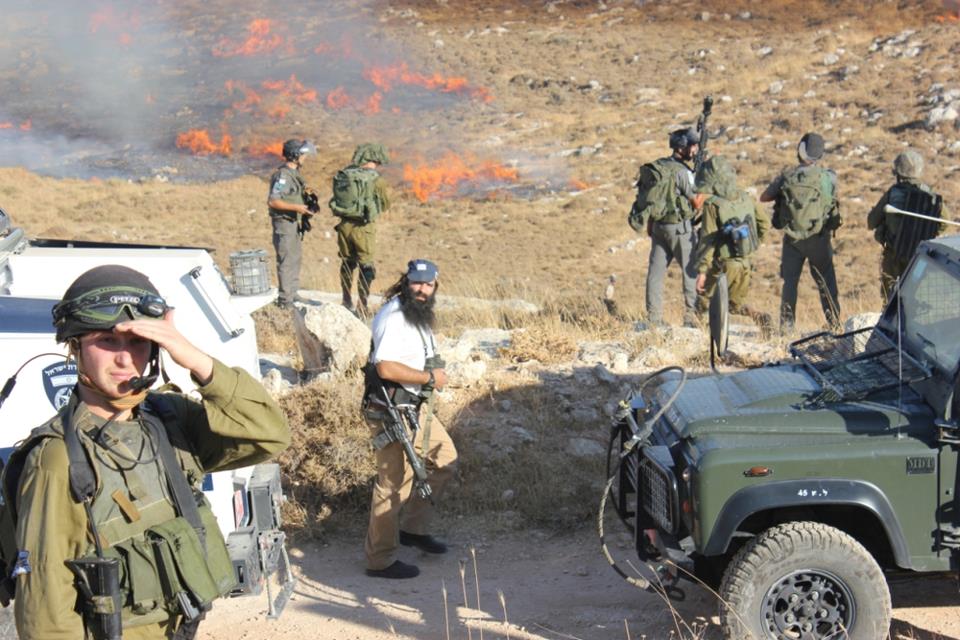
A second example that sticks in my mind highlights the complicity of the Israeli Defence Force in some of what is happening. I was in the village of Urif and settlers had set fire to a large section of Palestinian farmland. When Palestinians went to put the fire out, the IDF fired teargas at them and the settlement security shot a Palestinian in the spine. When Palestinians went to help the man, the IDF continued to fire tear gas at them. The whole time they watched on as the settlers continued to undertake acts of arson.
This is just one of many examples where the IDF were not fulfilling their responsibilities to protect the occupied population!
Sarah: Is there anything which really surprised you in Israel/Palestine? And anything which you have changed your mind about?
Steve: It surprised me quite how the occupation affects every part of life for so many people. Before I went, I understood that terrible things happened. I didn’t understand that not a day would go by in the West Bank without either a demolition, a midnight raid of a village, some arbitrary arrests, detentions, excessive use of teargas, child detention, etc. The reality of everyday life for an ordinary Palestinian shocked me.
I was lucky, and unusual, in that before I went I didn’t hold many preconceptions about the conflict. In that sense I would say that the experience was a steep learning curve for me.
Sarah: Which commentators (journalists, writers or bloggers) on Israel/Palestine would you recommend to someone wishing to learn more about the region?
Steve: This question has a catch in it. One of my biggest gripes is that too many people approach the conflict from a partisan side-taking perspective. If you follow bloggers, journalists and writers, you have to take 90% of them with the assumption that they are pushing an agenda. In light of that, I feel more comfortable naming a few organisations (with the understanding that I might not agree with everything that they say/do)
- B’Tselem – The Israeli Human Rights organisation.
- Breaking the Silence – The Israeli organisation of ‘veteran combatants who have served in the Israeli military since the start of the Second Intifada, and have taken it upon themselves, to expose the Israeli public to the reality of everyday life in the Occupied Territories’.
- Al Hac – Palestinian Human Rights organisation.
- EAPPI – They provide regular on-the-ground accounts of what is happening.
I would encourage everyone to explore and read on this issue as widely as possible – trying to empathise with what has been written.
Sarah: Can you tell us something about your hopes/fears for the future?
Steve: The same as most people I think – I hope for lasting peace that enables Israelis and Palestinians to live side by side feeling safe and secure.
My fear? That the detrimental spiral of violence and mistrust will continue and people will continue to suffer.

 In the past few days thousands of people have seen the image on the right: a






 Hynd's Blog
An unemployed mother, 11 children and a council ‘eco-mansion’ – the true cost to society
My home village, Churchdown, has become the centre of a media storm. Blowing in from middle England this storm is causing lasting damage. Not just to Britain’s poorest families but to each and every one of us.
Just round the corner from the Hare and Hounds in Churchdown, one of my old haunts, lives Heather Frost. Heather is unemployed and is currently living in temporary council accommodation with her 11 children.
Cue the tabloid hysteria…
The Sun reports “A JOBLESS mum on benefits is having a £400,000 council house built for her — and her brood of ELEVEN children”
The Daily Mail goes with, “mother of 11 to get six-bedroom eco-house after moaning her TWO council homes are cramped”
While The Express analysed the events saying, “The result has instead been to create powerful incentives for irresponsible people to bring into the world very large numbers of children they cannot possibly support”
I am not here to argue the morality of having 11 children, but to comment on the media storm surrounding this story.
I hope to show how it’s inaccuracies and how it causes lasting damage not just to some of the poorest in our society but to each and every one of us.
So where to start in this quagmire of misinformation?
Virtually all media reporting of the story goes to great length to try and generalise Heather’s quite extraordinary story into an attack on our benefits system in general. The Daily Mail reports that there are over 190 families with more than 10 children and this is costing us, the taxpayer, over £11 million a year.
Of course, what the Mail describes is a fraction of the overall benefits system. These 190 households sit alongside 1.35 million other households where at least one parent claims an out of work benefit.
Ally Fogg in the Guardian points out that the £11 million that these families receive, constitutes less than one hundredth of 1% of the total benefits bill of £100bn (excluding pensions).
The cost to us…the taxpayer? Small change.
The Express tries to score come political points with it’s analysis that we now have a ‘powerful incentive’ for people to have more children.
This ‘powerful incentive’ the Express describes is referring to child benefit. This currently stands at just £20.30 a week for your first child and then an additional £13.40 a week for any further children you have.
To put this into context. Krishna News in Churchdown paid me more money per week for doing a paper round than Heather Frost gets for each of her additional children.
Additionally, two of her children are between 16 and 20 so she would only receive child benefit if they are still in full time education. Her oldest child is now 21 so is not eligible for child benefit.
Who needs facts when you write for the Express though? Little inconvenient facts like the average reproduction rate of 1.9 children for families on benefit. The almost identical reproduction rate to those not on benefits.
If there is a ‘powerful incentive’ to have children on benefits (which there isn’t) then those on benefits have yet to spot it.
Ah, but she is having a brand new £400,000 house built for her and her ‘brood’ The Sun reports. Well, keep reading and in paragraph 7 of that same story it explains how Tewksbury Council could afford this. It states, “Tewkesbury Borough Council sold a plot of land…to Severn Vale Housing association…A condition of the sale was that one of the 15 affordable properties they built on the site would be a six-bedroom home”.
The penny drops. When The Sun quotes Robert Oxley from the TaxPayers Alliance saying, “It’s scandalous that so much time and money is being spent on one custom-built house” he doesn’t actually say whether or not it is ‘tax payer’s money’ that is being spent.
These stories fuel a hatred for some of the poorest families in Britain. Regardless of how many times tabloids but the word ‘struggling’ mockingly in inverted commas, it won’t effect the fact that 1 in 5 Brits live in poverty and are struggling.
These stories though act as smokescreens. They force us to focus on how the poor are costing us rather than how poverty is costing all of us.
As we worry about the £11 million being spent on people with large families we learn to ignore the £25 billion that child poverty is costing the UK every year.
The people who suffer? Not just the 4.5 million at risk of homelessness who are currently on the housing waiting list or the 3.6 million children that are living in poverty in the UK.
In times of austerity, this media storm is costing all of us.
UPDATE: New Research out today suggest that in many UK cities over 40% of kids live in poverty.
Be one of the cool kids and share this article
11 Comments
Filed under Gloucestershire, Homelessness, Politics, Social comment
Tagged as Churchdown, council house cost, Heather Frost, mumwith 11 children