Tag Archives: EAPPI

On Israeli settlers: “They come down from the hills and get us with dogs and guns”

I have just stumbled across this article that the wonderful Kate Hardie-Buckley wrote after visiting me and my former colleague Emmet Sheerin in Yanoun in the Occupied Palestinian Territories.

I don’t think I shared the article on Hynd’s Blog at the time.

The title, “They come down from the hills and get us with dogs and guns“, might read to some as being as slightly over the top. The fact that I can promise it isn’t says a lot about life in Yanoun.

Anyway, have a read of the article and let me know what you think.

PS – you can also watch Emmet’s video about life in Yanoun.


Leave a comment

Filed under Human rights, Media, Middle East, War

Watch: Yanoun – by Emmet Sheerin

This is a video by a friend and former colleague Emmet Sheerin. We lived together for a  few months in the village of Yanoun in the West Bank as part of the EAPPI programme. This is his short video which was made while we were there.

http://vimeo.com/54138761

5 Comments

Filed under Human rights, Media, Middle East

Israeli surrealism: ‘This is not an occupation’

This article was written by Chris Cox, a friend, a journalist and currently based in Hebron with EAPPI. Chris will be blogging throughout his stay in the West Bank.

Hazem Abu Rajab outside his house in Hebron, July 2012. [Photo: Eero Mäntymaa]

The art of surrealism involves mastering the element of surprise, the jarring juxtaposition, and the perfect non sequitur. This week, a judiciary panel appointed by the Israeli government proved themselves to be gifted surrealists: boldly breaking with decades of legal consensus to the contrary, the panel concluded that Israel is in fact not occupying the West Bank.One of its arguments, in a nutshell, is that occupations only last for short periods. Because Israel has been ‘a presence’ (or, in the language of unanimously-approved UN resolutions, ‘an occupier’) in the West Bank for over four decades, the situation no longer qualifies as occupation.

Try telling that to Hazem Abu Rajab, who shares his Hebron home with the Israeli border police. Since March this year, the Rajab family – nine in total, including Hazem’s parents – have had armed police occupying two-thirds of their house. Two of them sit outside the front door around the clock, while another mans the roof – on which flies an Israeli flag.

That would be enough to make anyone’s life miserable. When I visited Hazem last week – along with my EAPPI colleagues – he told me that the border police routinely pretend they do not know his family members, making them wait up to 20 minutes while they ‘confirm’ their identities before allowing them into the house.

But this is not an occupation, of course. It’s essential to remember that.

The Rajab family are in this situation because Israeli-Jewish settlers broke into their home in March this year, claiming to have purchased it from a Palestinian man – a claim the Rajab family flatly reject. Hazem told the Guardian how his family were woken at 1am by Israeli soldiers, armed and wearing black, who broke down three doors. “Within five minutes, 100 to 150 settlers were inside,” he said.

The settlers have since been evicted, but their claim has led the Israeli authorities to classify the property – which has been in the Rajab family for generations – as ‘disputed’.

“It’s going to take forever,” says Hamed Qawasmeh, a UN human rights officer. “It’s always like this. Once a home is ‘disputed’, no one can move into it.”

Hazem has spent the last seven years converting the basement of the house into an apartment, so that he can get married and live there with his wife. He works as a labourer, on low wages, and had painstakingly laid the foundations for the next phase of his life.

Now, Hazem and his family are trapped in limbo while the case makes its glacial way through the Israeli courts. His basement apartment was welded shut by the settlers when they moved in, and remains so.

Meanwhile, Hazem says, the border police humiliate his family in dozens of ways on an almost daily basis. He tells me the guards urinate in front of his female family members, swear loudly and play music, and make the Rajab family keep their windows closed on hot summer days.

“Each one of them is a government on his own,” says Hazem.

But this is not an occupation. Remember that. This is not an occupation.

Leave a comment

Filed under Human rights, Middle East

Another Friday, another protest in Kafr Qaddum

This is a guest article by my friend and colleague David Heap who is currently based in Tulkarm. It was originally published on the EAPPI website.

For the Abu Ihab family, Friday wasn’t too bad. Admittedly there were Israeli soldiers on their roof firing tear gas, they couldn’t leave the house, the sons had been chased down the stairs by armed soldiers and the stink of tear gas and burning car tyres drifted through the room. But Isra’a, the youngest daughter, said they weren’t really afraid today.

Kafr Qaddum is a pleasant Palestinian hillside village of some four thousand people. It has a mayor, a mosque, an elementary school. It had a road joining it to the next village one and a half kilometres away – but not anymore.

Between the two villages are two Israeli settlements, legal under Israeli law, but illegal according to UN Resolutions, which expressly forbid the civilian settlement of lands occupied as a result of conflict. The road was closed for security reasons by the Israeli authorities in 2003. The only security problems the townspeople were aware of were some damage to their crops and olive trees in the early days of the settlement, but all had been peaceful for a good while. Israeli authorities had reportedly promised to re-open the road at the same time as the main road beyond it to Nablus re-opened. This happened two years ago, but their road remained closed.

Since the first of July 2011 the people of Kafr Qaddum have held a demonstration every Friday against the closure, which means a 20 kilometre detour to get to families and friends and a six-fold increase in bus fares for students. It can get very angry, as it had on the 15th of June this year, because the Israeli army had raided the village in the middle of the night before and detained 20 young men. They can be held in administrative detention inside Israel, many kilometres away from their families for hours, days, weeks, months or years, often without trial. If they admit to the claims against them (often stone-throwing) they can be released upon payment of a fine that is around 10,000 shekels (€2000.) A Palestinian going to work in Israel as a labourer or farmhand earns 120-180 shekels per day.

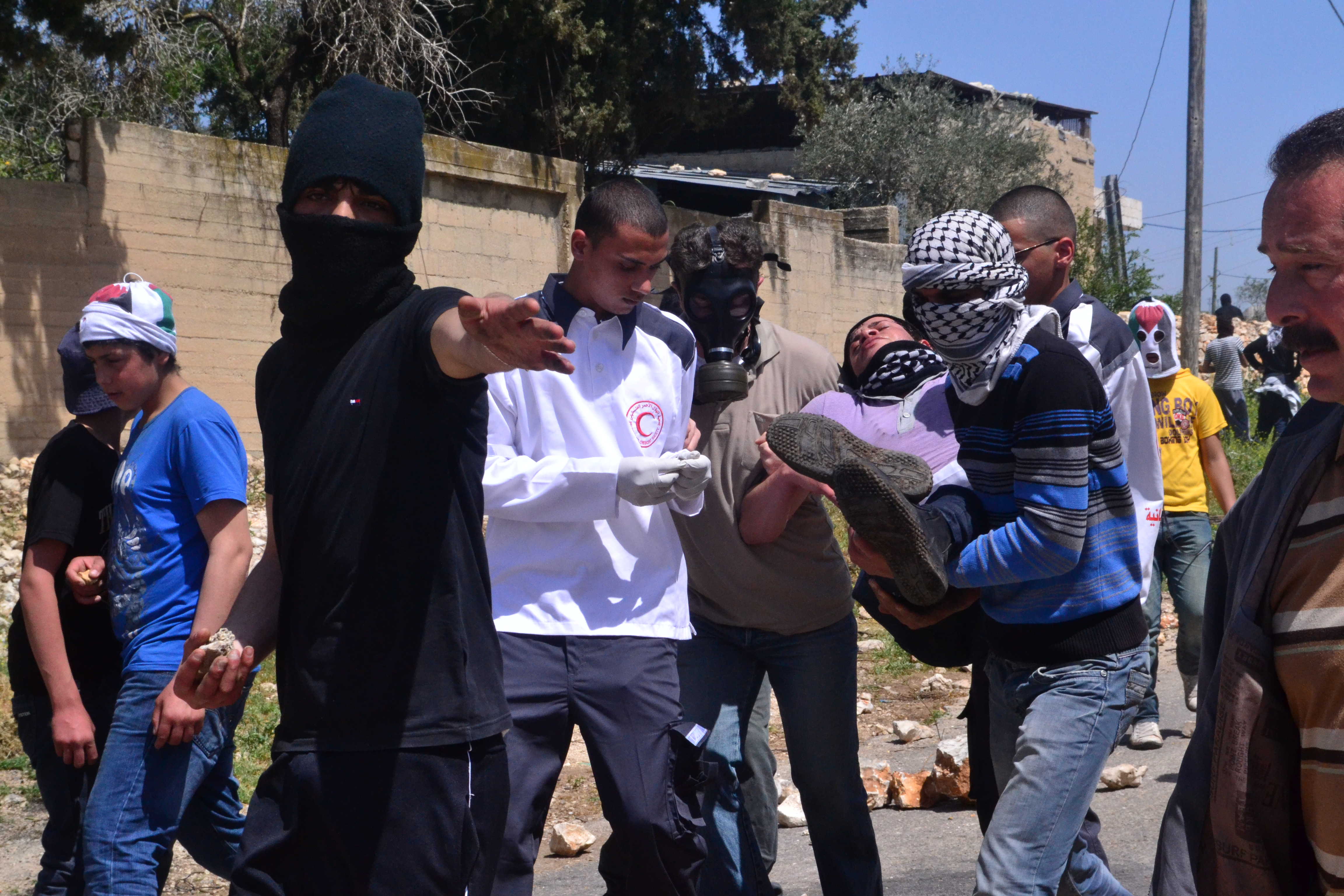
That Friday, it was a game of kids advancing and throwing stones, soldiers dashing forward threateningly with the guns, kids running back, soldiers withdrawing, kids advancing again went on till the main adult procession came up the hill. Tyres had been set alight and were now billowing smoke. The same pattern of ebb and flow was repeated, only now tear gas was being lobbed regularly. Mostly into a field to the side of the demo, but some skittering along the road into the crowd. Men were regularly brought back choking and temporarily blinded and a Red Crescent ambulance zoomed up and down giving aid to the worst affected. One man was hurt more seriously as it seemed his shirt had caught fire and he was burned.

Things quietened down after an hour or so and the procession came back chanting slogans. A quiet enough day we were told. Unlike the previous week there had been no chemically-created “Skunk” water shot from water cannons and no sound bombs, which disorientate and nauseate as well as deafen.

Back in the Abu Ihab house, which is at the outer limit of the village and always caught up in the midst of things, things were now quite calm. The soldiers had left the roof and for once had not cut the television cable. The mother was preparing a huge and delicious meal of chicken, rice, vegetables, pickles, pitta bread, tea and coffee.

Leave a comment

Filed under Human rights, Middle East

Children’s Rights under Occupation

This is a guest post by Jane Harries, a friend and a colleague living in Yanoun where I spent the last few months. An unedited version of this article can be found here.

How do children fare under occupation?  From the children in Yanoun and the surrounding villages we can see there are restrictions here which children in the UK don’t face – lack of facilities such as play areas and swimming pools which we take for granted. Children’s drawings portray guns and tanks, showing the underlying fear and trauma which comes from witnessing armed settlers and army incursions.  One of the testimonies to the success of EAPPI’s protective presence in the village is the fact that the children feel safe to play in front of the International House.

What about the treatment of minors by the occupying power?  We had a glimpse of what this can mean when we visited Bassam Nadar and his son Muhammed in the village of Madama, west of Yanoun, and listened to their story.  Recently, as the villagers’ wheat was getting ready for harvest, settlers came down from the mountain and set fire to the fields.  The villagers went to try to extinguish the flames, including Bassam’s two sons, Mohammed (17 years) and Ahmed (15 years).  They had succeeded in doing so when an army jeep turned up and arrested the two boys, accusing them of starting the fire.  They were taken to Huwara military camp, then to the settlement of Ariel’s police station, then back to Huwara and eventually to Majidu prison in Israel.

Bassam heard of the boys’ arrest through a journalist from Nablus, who had been with them, had photographs to prove their innocence, and intervened on their behalf.  After numerous phone calls, Bassam found out where his sons were and eventually – on the third day – they were released – but on the condition that he went to Ariel police station and paid 2,500 Shekels for each son.  He was advised by a lawyer not to pay, so Bassam went to Ariel police station and told the Israeli police he was unable to do so.  His phone number was taken but – up until the present time, nothing further has happened.

In quiet measured tones Bassam’s eldest son, Mohammed, told us his story in his own words.  He and his brother had been blindfolded and handcuffed whilst being transported between the different sites for interrogation, and nobody informed them – or their family – where they were.  The soldiers had put their feet on his head and joked as he lay on the floor of the jeep.  In Ariel police station his picture and finger prints were taken.  Only on the third day was he able to speak to his father.  When the two brothers were eventually released, this was at the border miles away from their village.  It was with the help of a taxi driver that they were eventually able to make their way home.

This story illustrates a disregard by the Israeli army and police for human rights, even in the case of minors.  Palestinian minors are dealt with under military rather than civilian law. This two-track system of justice which supports discrimination and undermines any rule of law illustrates to the Palestinians that they are second-class citizens and that there is no system of redress.

We can only imagine how children are affected by the fear and violence they experience, either directly or indirectly.  Bassam told us that his younger son is still suffering psychological problems from his experience of being arrested by the Israeli army.  As an occupying power Israel has an obligation to treat civilians humanely and never to discriminate against them. (Article 27, Fourth Geneva Convention). Israel is also a signatory of the United Nations Convention on the Rights of the Child (UNCRC).  For Palestinian children on the ground these obligations may seem far from the reality.

2 Comments

Filed under Human rights, Middle East

24 hours in Hebron

18:00 I arrived in Hebron repeating the simple instruction over in my head “get out of the bus at Happy Bunny Restaurant”. However many times I said it in my head I just couldn’t quite bring myself to mutter these words out loud. Inevitably the time came when the driver turns and questions, “where”? I respond, “Err…Happy…Bunny…restaurant”. He beams a smile, “of course”. I am whisked to my destination and my nights’ accommodation (a house close to the restaurant, not the restaurant itself).

22:00 Stood in the centre of the closed part of the old city in Hebron I look at some 3,000 year old remains of ‘ancient Hebron’. It looks like rocks to me, but I will concede that they look like slightly more useful rocks than the really old ones by my house in the UK (Stonehenge).

We are stood a few meters from one of the settlements in the middle of Hebron and just down the road from a Israeli family who are due to be evicted in the coming weeks (tensions are high). A soldier approaches us and asks where we are going and before I can answer looks over his shoulder and says, “oh the cave”? (or it could have been “grave”, I wasn’t sure). I, possibly foolishly, replied “yeah the crave” (hedging my bets between a cave and a grave). He then radio’s in to see if it is ok for us to go and look at the cave/grave.

After a few minutes of the soldiers having a ‘boy competition’ (defined universally as making a competition out of something that really shouldn’t be a competition, eg – hitting a balloon to each other becomes “can we hit it to each other 100 times with just our left hand” or in this case “who can shine their lazer on their rifles the furthest”) they decide that it is OK to go look at the cave/grave. We smile and walk to the dead end.

25 meters up the road and we see 6 soldiers waiting outside a military base next to the before mentioned settlement. I tried to casually scan where I was as if I of course know exactly where the cave/grave is. One soldier nods his head towards the far corner. Two options present themselves, the first is the military base and the second is a Palestinian families house. My colleague takes control and walks confidently into the Palestinian house where she knows the family. We stop and say our hellos to the family and ask about this cave/grave…apparently it is where someone from the old testament is buried and it is inside the military base. I leave the house still not sure if it is a cave or a grave but figured I had bigger fish to fry. I didn’t have the nerve or inclination to walk back out onto the street so we slump off down the path at the back of the house.

If nothing else it is nice to see the IDF trust us enough to enter into a military base unaccompanied at ten o’clock at night.

On the way home we see three Palestinians being held up at the checkpoint at the top of Shuhada Street. We stop and monitor the situation. If they are held for over 20 minutes we call the Temporary International Presence in Hebron (TIPH) for support before calling the ICRC. Inevitably the soldiers releases the men after 18 minutes. As we pass the soldiers there is an awkward acknowledgement that these were the same soldiers who had just given us permission to enter their base to see the cave/grave. I try to keep it nice and ask “is it ok to go into the ‘crave’ anytime”?. The soldier looks at me alarmed, “you want to go into the grave”?

23:00 – I fall asleep under a purple Disney duvet.

08:00 – We are up at the crack of sparrows to meet a German delegation who want to be shown around Hebron. I stay mainly quiet as my colleague waxes lyrical about Hebron in what I felt to be an impressively neutral manner. We show them around the mainly closed and divided parts of Hebron. There is one street divided by concrete bollards less than a meter high where Palestinians walk one side and Israelis the other. I wondered what on earth this form of division had to do with security.

12:30 –  After everything that could be said about Hebron has been said we left the German’s to make their way pass a checkpoint into the old souq. I see at least three of them tut at the soldier on the way past. I make a conscious note that I need to work on my middle class indignation.

13:00 –  I see a character walking towards me down Shuhada Street. He looks Israeli, but doesn’t look like one of the settlers living in Hebron (he’s smiling to start with). My inner suspicions are aroused though when he asks where we have just been. I pull out the leaflet I picked up by Abrahams grave (although interestingly he was also meant to have been buried in a ‘cave’ – all very confusing) and thrust it into his hands. Triumphant in the fact that I had not only been to a tourist hot spot but I had proof that I had been into the “Jewish half” of the mosque/synagogue/holy site (don’t ask…Jews and Muslims go in separate doors and can see the same grave/cave but from different sides and are separated by bullet proof glass). He looks at it and mutters he hasn’t been there yet. I am a little disappointed but crack on with conversation.

He turns out to be called Michael and lives just to the South of Tel Aviv. Apart from being a bloody nice guy he also enjoyed liberally sprinkling in words like ‘Plato’ and ‘Power Dynamics’ into conversation. In other words, he was my sort of chap.  He described himself as “on the left” of Israeli politics before he rubbished the very concept of ‘left and right politics’ in Israel. He was passionately ‘Jewish’ (and trust me when I say we didn’t use this term lightly, about half of our conversation was on how to define ‘being Jewish’) and to say he was well read was an understatement. About three hours of conversation in the heat of the day later we decide to go and grab some food…he chooses the Gutnick Centre (a Jewish cafe and community centre in the centre of Hebron that is known to the International community as being ‘pro-settlers’).

On the way to lunch Michael wants to walk on the ‘Palestinian side’ of the divided street. I am interested to see what happens so don’t stop him. When we get to the soldier at the top, the soldier tells him he is “lucky to escape with his life”. Michael smiles and we go and drink coffee with some ‘dangerous’ Palestinian shop keepers. We take off our EAPPI jackets in the shop and leave them there before going into the Gutnick centre. This was to avoid provocation but we are also not allowed in wearing the vests. Dangerous pacifist peace workers? We sit down on a table opposite some soldiers and have a nice lunch.

Sometimes the word ‘surreal’ just doesn’t quite cover it.
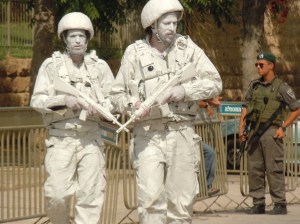
16:30 We walk together after lunch and are about to say our goodbyes to Michael when in the distance we spot two soldiers who were completely covered in white paint. They stride past a ‘normal’ soldier who tries to stop them. The ‘white soldier’ tells him to “check with command, this operation is cleared”. I had no idea what was going on. A soldier stood with the ‘white soldiers’ turns to me and says, “it’s art…it is up to you how you interpret it”. I liked the idea and so walked with a growing crowd of both Palestinians and Israelis. The soldier now turns to me and asks if I have ever been to Jayyus, I say “yes”. He gets his phone out and shows me a picture of myself from one of the day time raids of the village I used to be based in. He smiles and clearly thinks this situation is hilarious. He asks as if reuniting with an old school mate, “how you been keeping dude”? I smile, “yeah good cheers”.

By this point we have walked to the outskirts of one of the settlements. I ask the soldier if it is ok for us to be there and the soldier and Michael respond in unison “of course”. The ‘white soldiers’ are now pretending to search a playground and I watch on in fascination. This was not something I had expected from Hebron but I was enjoying myself.

In a split second however this whole jubilant atmosphere was shattered by the one and only Anat Cohen – a notoriously aggressive settler. She came out of a house and started screaming at me (ignoring the Israelis I was with) and stamping on my ankles. As she screamed at me I felt flecks of her saliva land on my face. I consciously decide not to wipe it off because I don’t want to be accused of ‘raising my hand’. I looked over her tiny angry shoulders to the soldier looking on. He gives me a comic shrug and looks helpless. I say it is OK, and we will go. The four of us (three internationals and Michael) walk off. She (Anat Cohen) follows me pushing me in my back and shouting. The soldier walks on behind and signals to his colleague in the distance to come. The new soldier asks, “did you do anything”? I smiled and said “of course not”. The soldier tuts a knowing tut and we walk for another 200 meters with Anat Cohen following me stamping on my ankles and screaming at me. While the soldier does nothing. When we stop to enter into a ‘Palestinian only’ part of town we finally say goodbye to Michael and Anat Cohen stares at us both and takes our photos.

I feel really sad that someone could feel that much anger and hatred to a stranger that she has never met or spoken to. I feel worse though for anyone that has to put up with her day in day out.

Michael, the soldier, Anat Cohen, the history, the conflict, the division…all just 24 hours in Hebron.

9 Comments

Filed under Middle East, Social comment

From the West Country to the West Bank – an interview with Steve Hynd, in Jayyus, Occupied Palestinian Territory

I was interviewed by Eugene Grant (of Dead Letter Drop fame). Have a read!

“Have I seen awful things? Completely.” Only a few weeks ago, Steve Hynd was observing a protest near Jayyus – a small village in the West Bank, Israel – when the army fired tear gas canisters directly at the crowd as they were running away. One of the three inch-long steel canisters struck a protestor – standing a few feet away from him – in the neck.

For Hynd, the words ‘police tactics’ are a complete misnomer. “Why would you have soldiers stewarding a protest?.” He says such tactics constitute not so much a policing strategy as “an aggressive attack on protest”. Since then, he’s stopped using the term Israeli Defence Force (IDF) – the military wing of the country’s security forces. The phrase, he says, suggests the force is there for defensive purposes, “but I’ve seen it overwhelmingly used for acts of aggression… when you say ‘army’ people understand that armies can be aggressive.”

You can read the full interview here.

Leave a comment

Filed under Beer, Human rights, Middle East

Another crackdown on the protest in Kafr Qaddum

My head started swimming and I couldn’t open my eyes. I could feel broken stones crunch beneath my feet and I knew I was moving away from the protest. For a terrifying 30 seconds I lost track of what was happening. An autopilot sense of self preservation kicked in that my conscious self had little control over. Just as my senses started to return I felt a colleagues hand rest on my lower back and lead me to the side of the street. Here I crouched in the small amount of shade offered by the shop-front from the midday sun. My stomach had tied itself into a knot and my head felt like it had split in two. Only then did I realise that I must have walked away from my colleague who was now stood in front of me with her camera in hand. I glanced up an offered what I hoped was a reassuring smile.

A few minutes earlier I had been stood at the back of a demonstration in Kafr Qaddum, a small village in the West Bank. I was there to monitor the proceedings and reporting on any human rights violations I witnessed. In the minuets preceding I had filmed a number of ‘warning shots’ being fired over the crowd and whiffed the faintest smell of tear gas. I believed I was far enough back though to avoid the worse of what was to inevitably come. I was stood on the side of the street next to a large wall that could also offer me protection, should it have been needed, from any direct fire. My colleague was nearby and I felt in control of situation.

Seconds later the Israeli army fired a volley of tear gas canisters (some directly into the crowd) that filled the streets with a penetrating thick gas. At first I stayed in position as it appeared the soldiers were aiming just for the front of the protest. As the crowd turned to run however, the tear gas landed closer and closer to me. At this point one canister landed a few yards away and filled my lungs with the gas. What happened next is a blur. I remember a man kicking the canister away down the hill but little else.

On the approach to the village earlier that day there were some clear signs that the protest was not going to pass peacefully. The Israeli Army had set up a series of checkpoints cutting off the only main entrance to village. I approached as part of a mini convoy of human rights monitors. I was travelling with others from EAPPI and the Israeli human rights organisation B’Tselem. As we approached the checkpoint it became abundantly clear that international human rights monitors were not being allowed into the village. Later I would find out that the same restrictions were being applied to media outlets.

I already had reasonable suspicion to believe that this week’s protest at Kafr Qaddum was going to witness an escalation of violence on previous weeks. The day before the village had seen 19 of its residents arrested in an IDF raid. “It was a clear illustration of strength aimed to intimidate us and to stop us making protest” one villager suggested. There were reports that a large amounts jewellery had also been stolen during the raid. This combined with the checkpoints only heightened our unease about the protest.

After meeting a series of other journalists, news agencies and human rights monitors who had also been turned away we decided to collectively head across the fields and enter the village “through the back door”. As the representative from B’Tselem put it, “if we do not reach the village today I am sure some very bad things will happen and they will go unreported”.

Sadly, his prediction of violence proved to be true. Both the Israeli Army and boys and young men from the village once again illustrated their willingness to take part in acts of violence against one another. Before being ‘tear gassed’ myself I saw stones the size of my fist being flung through sling shots at the soldiers who then responded with the brutality that I am coming all to use to seeing.

It is important, however distressing these scenes of violence are, that the world hears about them. Today I saw a large number of boys throwing stones before the Israeli Army fired tear gas directly at the crowd as a whole.  The obvious difference in these actions is that one was undertaken by a professional army and the other by young boys in an occupied village.

2 Comments

Filed under Human rights, Middle East, Politics, War

Crossing the separation barrier daily – one day honey, one day onions

Stood squinting into the early morning sun a young Israeli soldier leans against the heavy metal gate that is separating the two of us and sighs. The gate is padlocked closed for what he had described to me earlier as ‘security concerns’. The soldier looks tired, worn down and wanting nothing more than a sit down. Instead he is stood talking to me. I ask him (again) why it is taking so long for the workers to pass through the agricultural gate this morning. He answers me in elaborate, almost performed Arabic, “yaum ‘asal, yaum basal” – “One day honey, one day onions”. He stares at me and meets my eye for as long as the strengthening sun will allow before retreating back to the solitude of the shade.

For the two hours preceding this conversation I had been stood watching frustrated agricultural workers waiting to cross the separation barrier to access their own farmland. The separation barrier is built predominantly through the middle of Palestinian farm land and as such was ruled to be illegal by The International Court of Justice at The Hague (in 2004).

The men are grouped in small circles, one circle lit a small fire out of rubbish and wood they have collected. Others are pacing the width of the road promenading up and down discussing the matters of the world. Others however wait with less patience.

All of the men hand in their permits to one Palestinian who has the unofficial job of keeping the peace and trying to organise what order people will pass in. The men pass in groups of 5 past the first turnstile before entering into a cabin where there papers are checked for what seems like an impossibly long time. One man who was waiting (patiently) nodded to the Palestinian holding the pile of permits and said, ‘He plays cards with those permits. You never know if you will wait 10 minutes or 2 hours”. I asked if there was any favouritism and the man responds, “it is good if we are friends”.

The first few groups of Palestinians emerge from the far side of the checkpoint and go their separate ways to their small plots of land. I look up sporadically to see what the soldiers are doing. There are normally four on duty that I can see (one to check vehicles, 2 to ‘control the crowd’ and one to stand their pointing his gun at people – or this is what I have deduced from previous times). Soldier one (who in previous groups has made an effort to look menacing) is stood in a concrete pillar box resting his chin on his semi-automatic weapon making little effort to keep his eyes open. The second (there to check vehicles) is  sitting with feet up on what I have seen in the past used as a second inspection point (which doubles the speed of transit for the workers trying to cross). The final two spend most of their time talking but occasionally tell the men waiting to take a step or two back.

The four soldiers barely look up as a small fist fight breaks out over what I presumed to be a disagreement about who got to pass through the checkpoint next. The soldiers take a couple of steps closer but allow the men waiting to sort themselves out. One of the Palestinians around the fire looks up and sucks air in through his teeth. For the majority of men waiting, they stand patiently looking out at their land to the west. Staring back at them are the soldiers who wait patiently as the minuets left on their shift slip away.

What was notable about this gate monitoring was the lack of anything specific happening. The Palestinians were not tear gassed nor were the soldiers pelted with stones. There was however a low level lack of respect that materialised itself in different forms depending on what side of the locked gate you were stood. There was a understood sub-text that they were not going to make life easy for each other. This is where the power dynamics shine through.

I noticed the Palestinian men would often pretend not to hear the soldiers when they were giving orders or would take a long time to move when they were asked. The response from the soldiers is no less petty but has far more serious repercussions. As I mentioned the power dynamics between the occupied and the occupiers is not equal.

To illustrate, as the workers leave the cabin where there permits are checked the soldiers normally wave on the next group of five men through the turnstile. Today, for no explicable reasons, they waited until the workers were well clear of the gate before allowing others to come forward. This wasted crucial minuets and added to the feeling of frustration.

These small actions (or sometimes lack of actions) meant that at the end of the two hours (the gates opening times) there were over 50 men (and 40 sheep) still waiting to pass when I left the gate at 9:00am. This has serious repercussions on those who do not make it through (loss of income in a desperately poor society). I have monitored this gate many times before and have seen that proactive friendly soldiers can ensure that all men (and animals) pass through without problem and with minimal delay. Today the soldiers did their jobs, but with the minimal possible effort you can imagine.

The tired soldier at the end said that one day is like honey, while another is like onions. He made this  comment with a certain fatalistic edge to his voice. What today has taught me is that if some days are like honey while others are like onions as the soldier suggests, then it is because of his choosing. Soldiers (often young conscripts) have an extraordinary amount of power and control over ordinary people’s lives. For the men who have to wake in the early hours of the morning clutching their permits to pass to their own land, days are rarely like honey.

1 Comment

Filed under Middle East, Social comment

The last 24 hours – an extract from my diary.

This is a short extract from my diary (with the naughty bits removed) covering the last 24 hours.

18:25 – I get a text message from one of our local contacts asking if I want to play football in the village with some of the other guys. It sounds like a laugh so I pull on my Arsenal shirt (staying neutral in the Barcelona/Real Madrid turf war) and head out. The two guys I meet are wearing jeans, jackets and leather shoes and I wonder whether my tracksuit trousers and football shirt looks a bit eager. This feeling is confounded when we stop and eat freshly made falafel (it’s hard to say no to Palestinian food). We arrive at the pitch (floodlights and all) and I start to get the feeling that something is not quite right.

18:45 – We spend over an hour warming up (I say we, the two guys who I arrive with are sat on the side – of course they are not playing, they’ve just eaten). This warm up is more exercise than I have done for a very long time. Apparently F.C Jayyus take their warm ups (and football in general) very seriously. I try to cover up my inherent lack of ability and my self-created lack of fitness by making jokes. The guys I came with laugh, everyone else looks on with growing concern at the amount of sweat dripping down this English boy’s face.

The coach barks instructions at players and I occasionally hear my name mentioned (that’s right, this village football team has a coach, and he barks). I try my best not to mess up but get the feeling that I am not the foreign super signing that F.C Jayyus had been looking out for.

21:00 – I survived it, just. One shoulder in the face, and only the occasional noticeable mistake and I think I survived my first (and possibly last) training session with F.C Jayyus. I walk off the pitch knowing full well that my legs will be stiff tomorrow but pretending that this sort of exercise is par for the course for me. It was great to meet some new faces in the village and to have a kick around with them – I wonder if that feeling is mutual? Either way, they are eager for me to come back to the coffee shop with them to watch Champions League football. I excuse myself, miming that I have to get up early tomorrow for checkpoint monitoring (I always thought the Jungle Book was hard but this take charades to a whole new level). I walk away from the group feeling proud that I have turned down the chance to watch football in favour of getting to bed on time – perhaps this whole experience is making me grow up.

23:30 – It’s pathetic and I know it. I have to be up in four and half hours but I could not resist watching Arsenal play (second leg trying to come back from a 4-0 first leg deficit against A.C Milan). Arsenal go 3-0 by half time and I am on cloud nine…and then…nothing. We (because when you support a club you are a part of the collective) crash out of the Champions League and any thought of silverware for the season goes out the window with it. To top it off, my home club, Cheltenham Town drop 3 crucial points in the race for League 2 promotion. I go to bed with my mind swarming with football. How can I love something that consistently causes me so much misery?

But anyway, if you’re looking to support Arsenal or Cheltenham Town I came across these useful coupons for Amazon. Take a look!

1:20 – I am awoken (2 hours after I went to sleep – not that I am bitter) with a phone call to say the IDF are in the village making an arrest (possible arrests – plural). After a quick assessment we decide it is too dangerous to be wandering the streets so we decide to monitor the situation from our rooftop staying in mobile contact with others around the village. It is an eerie feeling to see these silhouettes of men on roof tops in the early hours, all whispering reports to each other. It does however work as an informal information network.

2:30 – An hour later we receive confirmation that a local has been arrested. We can see IDF jeeps buzz around the outskirts of the village but only occasionally see them in the village. These late night visits (often not to make arrests) are happening far too often. I go back to bed, my mind now buzzing not with triviality of football, but of the guy who has just been bundled out of his house in the middle of the night – where will he end up, what will happen to him, what (if anything) will he be charged with?

4:55 – Alarms, I hate alarms. It does its job though and I am up to monitor the agricultural gate to the North of the village which open 5:30 – 6:30 every morning. I arrive and the IDF are parked with their headlights on full beam facing straight at where I monitor the gate from. I stand there, centre stage, performing the worst solo performance they are likely to ever see (essentially a tired Englishman staring blankly at them). After a while a small trickle of farmers flow past and I mutter a few good mornings. The Israelis have made a concerted effort to encourage farmers not to use this gate (as the road on the other side runs straight through a bit of land marked for settlement expansion) but still the locals use it. I wander back to the house feeling cold and tired.

08:45 – A Palestinian with an Israeli ID is coming to pick us up and to drive us to the other side of the separation barrier. We pass through the checkpoint and our bags are x-rayed and a sniffer dog sniffs every nook and cranny of the car. The young girl behind the desk has a staring competition with my passport photo (my photo wins every time) and I am asked why I visited Egypt (A: “I was on holiday”…my mind runs through potential comedy answers and I stop myself from laughing by making a sort of snorting noise). She looks at me and waves me through.

09:30 – We meet a local farmer and he walks us around his land showing the problems that they face (settlement expansion, military activity, water rationing etc). Inside a hut on his land we drink sweet tea and point at maps laid out in front of us. He shows us how the access to his land is being controlled (you need to have a permit to access your own farmland), restricted (they have built a massive separation barrier through the middle of his land – twice) and made unreliable (he had been waiting for months to get a permit). Worst of all, it can be taken away at any minute. We are shown his neighbours land which has been literally blown away – it is now a stone quarry providing material for massive ‘settler only’ road upgrading schemes. Areas all around his land have been claimed by the Israeli government as state property (using British mandate laws I should add – sigh…I love the BBC, tea and cake at 4pm and The Beatles but I sometimes struggle to find anything else to be patriotic about and being in Israel/oPT is not helping this).

We are joined during the day by a Dutch delegation who have decided to spend their free time working as unforced free labour on the land. For some this might seem an odd choice for a holiday but I think I ‘get it’. It is beautiful land they are working on and it is rewarding work. At the very least I ‘get it’ more than those fighting for sun beds in Magaluf.

17:00 – After a long day in the sun in the fields this is exactly what I don’t want. I am sat on a concrete bench in the seam zone (the area in between the separation barrier and the Green Line) waiting for a taxi driver who is over 1 hour late staring at the backend of a checkpoint I am not allowed to enter (it is for workers only). When the taxi does show up (with no explanation for the delay) I need to be driven in a huge loop around and through a car terminal. No one checks any of my nooks and crannies on the way back through.


I am currently serving as an Ecumenical Accompanier in the West Bank – follow the hyperlink for more information.

5 Comments

Filed under Human rights, Middle East, Politics, Social comment

Why the left needs to keep the faith

An edited version of this blog was first published on Liberal Conspiracy blog.

‘Politics and religion should not mix’. This is the mantra that is lazily wheeled out by self congratulating lefties as they marvel in their own enlightened wisdom. I come across well meaning social progressives who openly shun the role of faith based organisations as either an evangelical force that should be scorned, or, at best, a tool by which individuals can act out their selfish desire to please the big man upstairs. This lingering stereotype of faith based organisations not only alienates billions around the world who see their faith as their primary moral compass but also pragmatically restricts social movement’s ability to bring about the change they are so desperate to see.

Many, at this stage might assume that I am one of those rather smug Christian types who go around asking people to accept Jesus’ warm love into their hearts – I am not. I am, like many in 21st Century Britain, painfully middle class and going through and an existential crisis as I try to work out ‘what it all means’. I am as unsure about the existence of any deity as you can possibly be. So don’t worry, I am not trying to convert you, and neither do I see this article as my one way ticket to heaven. I am fairly sure that God doesn’t read blogs anyway.

I am however, excited about the truly radical potential of Christianity to bring about social change. All around the world, we can see different denominations working progressively on a range of issues. This could be The Salvation Army offering support to the homeless, The Quakers campaigning for peace or the Catholic Church fighting global poverty.

At this point, the sceptics out there will point to Christianity being used to discriminate against entire communities (LGBT for example) or the Catholic Church and their opposition to contraception. If you, dear reader, were felling particularly pernickety, you might start pointing to George Bush claiming that God told him to invade Afghanistan or wars that have been fought in the name of God. Religion, in many peoples mind is a bringer of war, the perpetrator of hatred and an opium for the ill informed masses.

My response would be to point to the fallibility of all human organisations, including organized religion.  There is nothing inherent within any faith to suggest that it will always work for a positive social agenda, neither is there to suggest it will always cause harm. If we on the left are too smug to engage, we will leave ‘doing God’ to those who want to justify oil wars, invasions or subordinating an entire gender. It is time for us then to throw off the shackles of conformity and acknowledge a very simple truth – Christianity can be really radical!

It has taken me a while to get to a position in my life where I can work comfortably and confidently with people of faith knowing full well that they believe in something that I don’t. When working for Amnesty International, I started to spot the myriad of backgrounds and experiences that had drawn people to become human rights activists. It is clear to me now that somebody’s faith is just one of those reasons. Why are many on the left happy to work with those of faith but not faith based organisations? In the past I have had a pleasure of working for The Quakers, who are just one example of a faith based organisation who are putting their faith into practice to work towards social causes.

I am excited to be (once again) putting this theory into practice. In February I will be heading out to Israel and the Occupied Palestinian Territories with the Ecumenical Accompaniment Programme in Palestine and Israel which is coordinated through the World Council of Churches. This is an organisation bringing different denominations, faiths and backgrounds together to work progressively for a non-violent solution to the conflict. It is an exciting example of a faith based organisation working inclusively with Israelis, Palestinians and the International Community to work towards the end of the occupation and for all in the region to enjoy basic human rights standards.

We on the left need to incorporate faith based groups into all of our work. They unlock the door to millions in the UK and billions around the world. We need to show we are truly inclusive by illustrating that faith can be used positively. If we fail to do this, we run the risk of George Bush and the like becoming the public face of Christianity. There are inspiring people out there from Archbishop Desmond Tutu through to the Archbishop Dr John Sentamu who are working on causes I would be proud to support. All we on the secular left need to do, is show that we can get over these outdated stereotypes of faith based organisations and embrace their progressive potential.

5 Comments

Filed under Human rights, Middle East, Politics, Religion, Social comment