Category Archives: War

How you can help the unaccompanied child refugees in Calais

This slideshow requires JavaScript.

On our doorstep, just two dozen miles from the British coast, is a refugee camp that is being demolished leaving people in the most desperate conditions. There are hundreds of children in these camps, many of whom have a legal right to be in the UK. Due to feet dragging, legal technicalities and lack of political will, their temporary shelters are being demolished and they are being left exposed having to fight not just for their rights, but their very survival.

In the next week or two this camp will be fully demolished. Unless our government acts, unless we act, many of these accompanied children will more than likely just go missing and disappear. This happened before, it is likely to happen again. The thought of the exploitation they will likely face should this happen should be enough to inspire us all into action.

Last week I went with the MEP, Molly Scott Cato, who I work with and visited the camp and met with some of the refugees and volunteers. What I saw was the end result of an uncaring and uninterested government. It was simply awful. A policy to do nothing left vulnerable people with nothing. I saw no government representation, no officials offering support, only volunteers where government agencies should have been.

It is worth noting, that the refugee camp in Calais is not, and never was, actually a refugee camp but just a makeshift camp with refugees in. This distinction is important. The former implies order and support and the latter implies disorder and little sufficient support.

Our government’s limited response to this is in the last few days is shameful. At the last minute they generously offer to accept a fraction of the children they are obliged to support. Too little too late. For too long they have been focusing on building a hugely expensive “security wall”.  Perhaps a wall fits better with this governments fortress Britain mentality, but does little to support the children living in the camp. This whole time, rather than resorting too counterproductive Trump-esque style tactics, the British Government could have been registering the children identified to them by NGOs in the camps, to stop them risking their lives trying to get to the UK illegally.

We now face a ticking clock while the camp is demolished. To stop children disappearing, the UK government must step up and process all children with a legal right to be here. This is either through the Dublin III Regulation which entitles them to be reunited with family members living in the UK or under the Alf Dubs amendment which is supposed to bring the most vulnerable unaccompanied children in Europe to safety in the UK.

There are of course children there who don’t have a legal right to be in the UK and for some it may not be in their best interests to come here anyway. For those the UK government needs to be pushing the French authorities to do more in providing reception facilities to these children so they can go through the appropriate asylum process in France.

Whilst in the camp I heard reports of children being turned away by French authorities when they tried to register to claim asylum. Worse still, I also heard numerous reports of excessive use of violence from the French police. Volunteers talked to me about rubber bullets and tear gas being fired directly into groups leaving some minors with serious injuries.

History will judge our own and the French government’s actions and inaction poorly.

This government behaviour has, to some extent, been mitigated against by an army of volunteers that should be highly commended. Until government steps up to its legal and moral reasonability the goodwill of you, I and volunteers is all some have at the moment. If you have not already I urge you to write to your local MP urging government to act urgently. This cannot wait. There is a sample letter here but more powerfully, you can explain why this is important to you in your own words. Secondly, if you can afford to, please send phone credit to the refugees in the camps. This is crucial all the time but even more so during the up-coming demolition. Lastly, if you have time, volunteer either in the UK or the camps yourself.

This is a moral crisis. Primarily a crisis of government but one that touches on each of us. As Dr Seuss said, “Unless someone like you cares a whole awful lot, nothing is going to get better, it’s not.”

I doubt many in government have read Dr Seuss. But you have, so please act.


Leave a comment

Filed under Human rights, Hynd's Blog, Middle East, Photography, Politics, Social comment, War

Jayyous – one year on

Kate Cargin, who served as a human rights monitor with EAPPI just after me, writes about going back to Jayyous a year after we served there. 

Abu Azzam, welcomed us back to Jayyous like members of his own family and his wife Sehan laid on a lavish meal. I had met Juliane, my team-mate from EAPPI last year, in Jerusalem and the two of us were invited by the current team to stay in our old placement house.

Supper with Abu Azzam. Photo: Per-Ake Skagersten

Photo: Per-Ake Skagersten

Now, as then, the most serious problem for people living in Jayyous is the ‘separation barrier’ or ‘separation fence’, which divides the village from 75% of its agricultural land. All other problems stem from that: increasing poverty, emigration, demonstrations and arrests.

The impact of the fence and accompanying restrictions on the village is profound and life-changing. Farmers have to pass through ‘agricultural gates’ to access their land and permits to do so are often not forthcoming. It is a precarious way to live. Not only are people cut off from their farming income, but because of demonstrations against building the fence many have also been denied permits to work in Israel. Breadwinners and young people emigrate; students are pulled out of university. Regular army incursions with exchanges of stone-throwing and tear gas result in arrests, many of them of children. The prevailing emotion is loss and grief. Jayyous used to be a prosperous place to live. Now it is estimated that up to half its inhabitants receive food aid.

When the fence in this area was completed in 2003, the case for Jayyous was taken to the Israeli high court to contest its route. In September 2009, the Israeli High Court handed down a judgement to reroute the barrier to return some land to the village. Yet the farmers were not represented subsequently when the new route was determined which would return only a third of the farmland to the village. The villagers did not accept this, pointing out that all of the land belonged to them. They organised demonstrations which resulted in many arrests and increased army presence in the village. As Abu Azzam put it ‘We are expected to welcome the return of 2,488 dunums (1 dunum = 1,000 m2) and one underground well to the village. However, more than 5,000 dunums and four underground wells remain behind the fence.’ When the new fence is complete, most of the farmers will still have to pass through agricultural gates and some will even have to take a longer route.

Fence showing re-routing in progress

Photo: Fence showing re-routing in progress

Water is a huge issue in Palestine. While I was in Jayyous, villagers were suffering from a chronic lack of water because the fence cut them off from their main water supply. We had a very small well in our garden with a back-up supply from the next door village of Azzun and were warned not to drink it. There had been an agreement to pipe water from some of Jayyous’s own wells back through the fence. This was to be implemented and financed by the International Red Cross. Like many agreements it was taking its time and nothing happened during our time there. After a shaky start when the settlers destroyed the initial pipes, a pipeline is now established from three wells behind the fence to the Jayyous reservoir. However, the villagers have not been given planning permission to lay electricity cables to run the pump. They have been told to use diesel which would increase the cost eightfold. Currently there is a stalemate.

Israel says that the separation barrier is necessary for security. They claim that it has prevented suicide bombings in Israel (the last suicide bomb in Israel was in 2006). However, we remained sceptical. We were told last year ‘everyone knows where the holes are’. All of our team had seen people going through a hole in the fence near one of the checkpoints. Sometimes soldiers went down to guard the hole and sometimes they did nothing. We were very surprised, returning a year later, to see that the same hole was still in operation and had not been blocked. We were even more surprised to be told by a local man that there are eight holes in this section of the fence.

men detained at checkpoint for attempting to go through a hole in the fence

Photo: Men detained at a checkpoint for attempting to go through a hole in the fence

Nevertheless Jewish Israelis are clearly afraid of their Palestinian neighbours and believe that the fence makes them safer. I saw several manifestations of this fear. Last year, when my daughter came to visit me, the border guards tried to stop her entering the West Bank for her own safety. ‘You will be kidnapped and robbed’ they said. On another occasion, an Israeli woman warned me against getting on an ‘Arab’ bus in Jerusalem. ‘Aren’t you afraid?’ she exclaimed in surprise when I asked why that would be a problem. The fear is undoubtedly genuine but it is cynically manipulated by politicians to justify theft of Palestinian land and in the process all Palestinians are demonised. The sad truth is that the separation barrier will not make Israel more secure and does not bring about the end to fear.

My British MP, a reasonable man, was unimpressed when I pointed out the deviation of the separation fence from the Green Line and told him how it represented the livelihood of an entire village. He described it as a small bump on the map. When people talk about a two-state solution they blithely talk of ‘land swaps’ allowing some settlements to remain and Palestinians to be given land elsewhere. This is what ‘land-swaps’ can look like on the ground. Where else can Jayyousi farmers farm if not on the land next to where they live which their families have farmed for generations?

The settlement outpost caravans, which we used to monitor, have been moved from the area designated for return to Jayyous and are now on land next to Abu Azzam’s largest farm. This land was confiscated in 1988 from the Khaled family when Abdul Latif Mohammed al Khaled went to work in Jordan and the land was classified as owned by an absentee. Planning permission has been granted for 40 new houses to be built there and as with all settlements, the houses will be for Jewish Israelis only.  According to official Israeli data, Palestinians have been given only 0.7 percent of confiscated land in the West Bank; around 38 percent has been allocated to illegal Israeli settlements.  Abu Azzam told us that someone from the settlement council comes down to look at his land every day. On one occasion, he told Abu Azzam’s workers: ‘Tell Sharif (Abu Azzam’s given name) this is our land and the shed is our shed.’

Abu Azzam is a naturally cheerful man but he was more worried than I had seen him before. The Israeli army had given him a map showing the re-routed fence. There were also strange yellow lines marked on it going across his land. He said, ‘I do not know what the lines on the map mean. Are they going to take my land? Have they already confiscated my land and I do not know about it?’ This is not without precedent. Sometimes land is declared forfeit but nothing happens on the ground until some years later.

Remembering also that two sizeable plots of Abu Azzam’s land are still behind the rerouted fence, I asked him if he was afraid that village access to land behind the fence would be more difficult now that some of the land had been handed back.

His answer was to tell me a story about a melon farm which had belonged to his extended family. It was situated between the nearby town of Qalqilya, on the Green Line, and the railway, in what is now Israel. The area was designated as a buffer zone when the 1949 armistice line was drawn up, to be neither Palestinian nor Israeli. At first they were assured that they would be allowed to continue farming; then the Israelis simply sealed it off.

I looked at Abu Azzam and wondered how he could bear it. It has been his life’s work to defend his village’s land. He just shrugged and replied quietly, ‘For the moment, they say they will allow us to go there’.

Kate no longer work as an Ecumenical Accompanier and the views contained in this blog entirely her own.

1 Comment

Filed under Human rights, Middle East, War

On Israeli settlers: “They come down from the hills and get us with dogs and guns”

I have just stumbled across this article that the wonderful Kate Hardie-Buckley wrote after visiting me and my former colleague Emmet Sheerin in Yanoun in the Occupied Palestinian Territories.

I don’t think I shared the article on Hynd’s Blog at the time.

The title, “They come down from the hills and get us with dogs and guns“, might read to some as being as slightly over the top. The fact that I can promise it isn’t says a lot about life in Yanoun.

Anyway, have a read of the article and let me know what you think.

PS – you can also watch Emmet’s video about life in Yanoun.


Leave a comment

Filed under Human rights, Media, Middle East, War

Peace and palliative care in the DRC

This article was first published on the Africa edition of ehospice

Dr Paul Pili Pili is a representative of the Democratic Republic of Congo’s Ministry of Health. But like many people from the DRC, he has been affected by the war, knows people who have died and more than anything, wishes for peace and stability for his country. Steve Hynd from the African Palliative Care Association met up him to find out more.

Leave a comment

Filed under Health, War

From war zone to tourism: the transformation of northern Uganda

The people of Agoro in northern Uganda were some of the worst hit by the Ugandan civil war. As the village slowly recovers, Steve Hynd from the Mountain Club of Uganda visits Agoro to explore the surrounding mountains and what role tourism might have in the regions recovery.

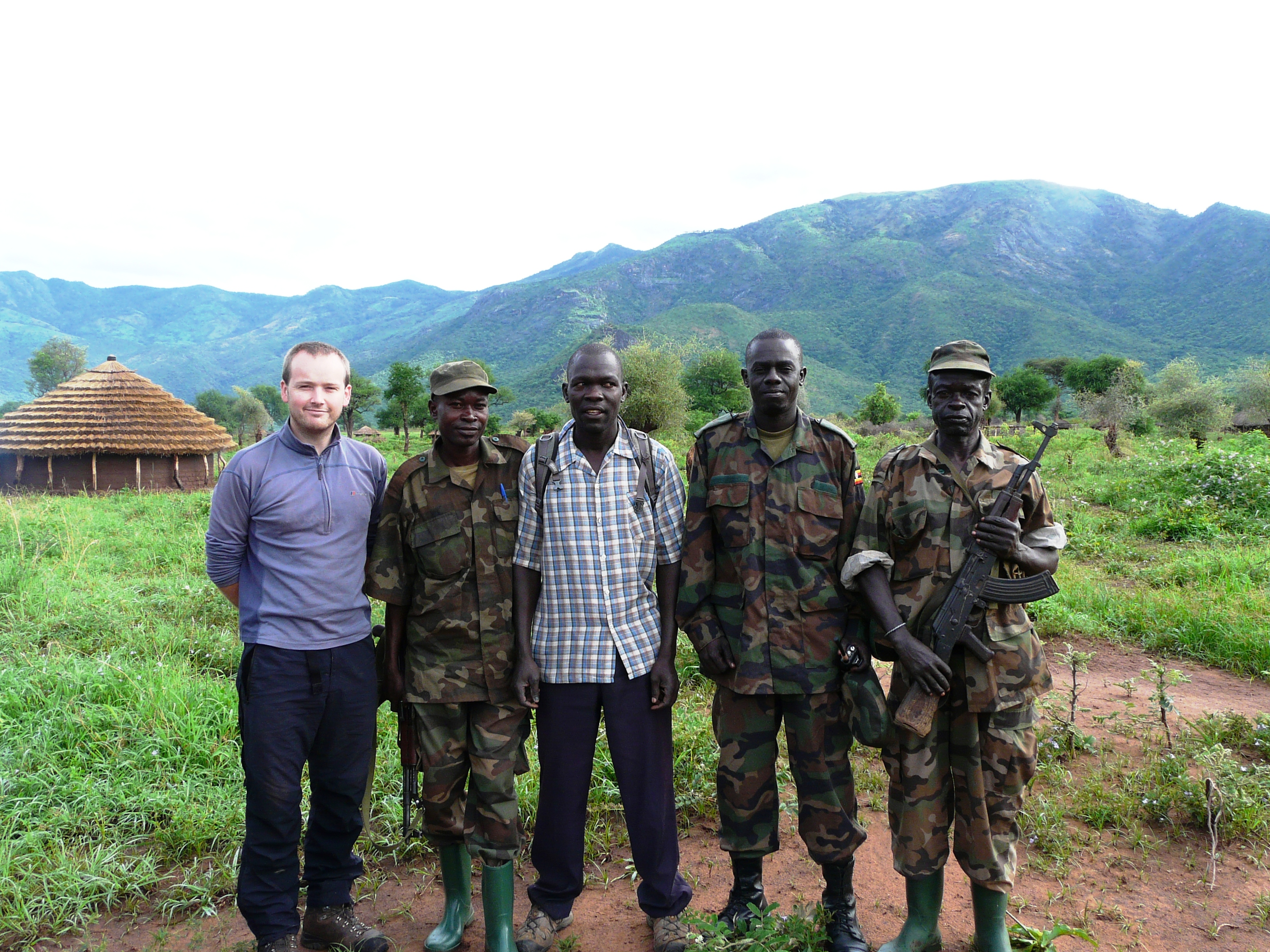
The car pulls up next to two piles of red mud bricks. Behind are a handful of thatched mud huts that mark the edge of the village of Agoro. Ahead, beyond the mud bricks , is another collection of mud huts. The latter are UPDF army barracks. The pile of red mud bricks is the checkpoint into the barracks that cannot be passed until ‘clearance’ has been approved.

A smartly dressed soldier appears and waves the car through. The soldier introduces himself as Lieutenant Everest. Dressed in ironed khakis and polished leather boots Lt Everest stands tall with his chest puffed out. His appearance would have been archetypically military if it wasn’t for his curious grin and unashamed enthusiasm.

When the prospect of climbing the surrounding mountains is mentioned, the aptly named Lt Everest describes in some detail the security challenges. He talks about the landmines that line the border with South Sudan and claimed a UPDF soldier’s life in 2011 and countless other lives during the civil war. He also talks though about the ‘potential’ of armed conflict breaking out from over the border.

The village had been spooked recently by reports that Kony, the wanted Ugandan war lord, is being harboured by Sudan.

The village which is two hour’s drive north of Kitgum, the most northerly town in Uganda, has every reason to be on edge. Agoro has been devastated by 17 years of almost continuous civil and tribal conflicts. Many people have been killed or forced into fighting for rebel factions including Kony’s notorious Lord’s Resistance Army.

Human Rights Watch (HRW) have documented wide spread human rights violations including reports of cutting the lips and breasts off women who dared leave the internally displace people (IDP) camps.  Agoro’s children were also hit particularly hard.

The Lord’s Resistance Army, notorious for its use of child soldiers, operated heavily in the area. One 12 year old child from Agoro told HRW how he was beaten until he agreed to kill a civilian. His experience is sadly not unique.

In light of this very recent history, Lt Everest’s opinion that armed guards were a necessity for any mountaineering expedition had to be taken seriously, despite the relative stability and peace of recent years.

Pub 4Two soldiers, carrying nothing but dust covered AK-47s led the way through the fertile fields in plastic wellington boots with the local guide, Jeffery, following suit. As Jeffery walked he pointed with obvious pride the varied fruit and vegetables that flanked the small path that he was walking.

This pride stems from both the villages new 680 hectare irrigation system and, in contrast, the near starvation that many in the village faced just a few years previously. The International Rescue Committee described Agoro’s recent history saying:

“Most of Agoro’s residents had been driven from their homes into a makeshift camp that grew up around the local trading center. These displaced farmers, with little space or incentive to grow their own food, lived on relief rations provided by the United Nations.”

It is no surprise then when Jeffery takes pride in both being able to walk freely through the fields but also being able to reach up and pick some mangoes from near-by trees.

These agricultural fields sit in the bottom of a valley which is encircled by imposing mountain peaks, the highest of which on the Ugandan side of the border stands at over 2,800 meters.

As the agriculture gives way to uncultivated bamboo forest though, so the path soon disappears. The soldiers though march on insisting that they regularly walk these routes for ‘surveillance’. The pace of the walk drops only occasionally to drink some water or to stand for a nervous few seconds as everyone waits for a snake to slither off.

The higher up the ‘path’ goes, the less apparent the ‘path’ becomes.  So, the last hour before summiting is spent scrambling through thick grass up improbably steep slopes. The soldiers who at the bottom seemed at best bemused about why anyone would want to go to the top of the mountain are now clearly enjoying themselves.

Standing on top of the peak the soldiers explain that we cannot go any further in case the South Sudanese soldiers see us. “It might cause problems” says the younger of the two soldiers as he pulls a cigarette out of his shirt pocket.

As he explains this though, he does not look up to the border of South Sudan but instead he looks out over the plains that stretch for miles out to the south. The plains are dotted by the volcanic mountains that hint at the potential for other walks in the area.

Pub 7Just as the agriculture of the plains is booming in this formally ‘no go’ area of northern Uganda, the potential for tourism is also growing.  The Ugandan Tourism Association has documented the so far mainly untapped tourism potential of northern Uganda. There is no reason to think that Agoro could not be at the heart of this tourism revival.

The village of Agoro has seen an unimaginably difficult couple of decades loosing men and women and children in a bloody conflict. This history requires visitors to be sensitive to such loss, but should not stop them from coming.

As we leave Agoro, we say good bye to Lt Everest and thank him for his help. We pull up at the pile of red bricks that mark the entrance to the army barracks and Lt Everest, now in civilian clothing, beams a smile at us and says, “Tell your friends to visit, they too can be our guests.”

Steve Hynd is a freelance journalist based in Kampala and is a member of the Mountain Club of Uganda

6 Comments

Filed under Outdoors, Travel, Uganda, War

CHILDREN OF PEACE INTERVIEW

This is a copy of an interview I did for charity Children of Peace.  Children of Peace is a UK based charity that works with both Israeli and Palestinian children to build positive relationships for a future generation, whose communities might live and work in peace, side-by-side.

“Steve is a human rights worker who spent five months in 2012 in the occupied Palestinian territories as part of the Ecumenical Accompaniment Programme in Israel and Palestine. He is currently working in Kampala, Uganda.

Sarah Brown (Sarah): Could you tell us what sparked your interest in Israel/Palestine?

Steve Hynd (Steve): A mixture of design and chance is the straight answer.

My sister studied ancient Hebrew at the University of Jerusalem and was living in West Jerusalem in 2001 and experienced first-hand the impact suicide bombers had on the community in which she was living. I was at secondary school when this was happening and it challenged me to think about the conflict. My sister was moved deeply by what she saw, but will openly admit, she only saw one side of the story. This was my very first introduction to the conflict.

Since then I have been actively involved with human rights issues and organisations for a long time. Invariably Israel/Palestine came up – especially during my time at Amnesty International in the aftermath of Operation Cast Lead.

At first though, I chose to work on other issues and countries and took an active interest in countries such as Turkmenistan (described by Freedom House as ‘the worst of the worst’) thinking that there were others with more knowledge and better placed to work on the Israel/Palestine conflict. I thought to myself ‘what could I contribute?’

Only after getting involved with EAPPI, almost by chance, I have come to think that I do actually have a role to play and something to contribute.

Sarah: What made you decide to work with EAPPI?

Steve: I became interested in a model of human rights work that combined impartial monitoring with the concept of ‘protective presence’. This was being practiced by organisations like Peace brigade International (PBI) and the Ecumenical Accompaniment Programme for Israel and Palestine (EAPPI). PBI worked mainly in South America and EAPPI worked in the West Bank. In the end I chose to apply for EAPPI for a range of reasons including being interested in positive examples of faith based organisations – this led me, in many ways by chance, to Israel and the occupied territories.

I had also come across EAPPI as I had previously worked for the Quakers (who coordinate EAPPI in the UK and Ireland) and had heard very positive feedback from people I respected. Before I applied I contacted Symon Hill (author of the No-Nonsense Guide to Religion) who at the time worked at Friends House in London and he had nothing but praise for the organisation.

Sarah: EAPPI has faced some recent criticism. Would you like to comment on that, or, more generally, on the assertion that Israel, as a comparatively accessible and open society, comes in for a disproportionate amount of scrutiny?

Steve: In the lead up to the Church of England synod vote (to endorse the EAPPI) they did come under a lot of criticism. A small amount of which I felt was valid, but a lot I felt was not valid and indeed was often inaccurate or misleading.

As with all conflicts, EAPPI as a human rights organisation challenges some vested interests and gets attacked because of it.

In terms of Israel more generally…

Israel is paradoxical in its human rights record. In one sense, as the question suggests, it is open and free. It consistently does well in terms of press freedoms and is a beacon of hope, in stark contrast to its neighbours, on issues such LGBT rights.

You cannot however, examine Israel’s human rights policy, without looking at their foreign policy and their on-going occupation of the territories and their continued disregard for International Humanitarian Law.

I have no doubt that some people use these violations as a tool to attack Israel – either because of regional politics or because of anti-Semitic values. Equally however, from my experience, most people working on the conflict are doing so because they care passionately about the victims. I know a number of good people working hard for peace that have been lazily labelled ‘anti-Semites’ – this cheapens a very serious problem.

Equally, sometimes the criticisms of human rights organisations are unfounded. For example, Human Rights Watch is often accused of ‘attacking Israel’ and focusing disproportionately on Israel. In reality, Human Rights Watch works on 17 countries in the Middle East and North Africa. Israel accounts for about 15 percent of published output on the region. The Middle East and North Africa division is one of 16 research programs at Human Rights Watch and receives 5 percent of total budget.

I accept that Israel has more focus on it than most other countries (such as Turkmenistan), but I still maintain that we need more focus on these neglected countries rather than less on Israel. In my opinion it is a disgrace how few people care about, or are willing to work for the people in Turkmenistan.

This why, whenever I speak to people about Israel/Palestine I insist that we can all be doing more and working harder.

Sarah: Could you tell us about some moments which most stick in your mind from your time with EAPPI?

Steve: It is hard to pull out a couple of moments. There was not a day that went by where I didn’t hear about how people’s lives were being affected by the occupation.

Perhaps the best place to start would be the occasion when I felt the most hope. I was in Sderot in Israel on the border with Gaza and we met with representatives from the peace group ‘Other Voice’.

Every house in Sderot has a built in ‘safe room’. I was told residents have just 14 seconds to get to it should they hear the warning siren before rockets from Gaza might hit. This is a physical impossibility for many such as Sderot’s elderly residents. People live in fear. Nearly all of Sderot’s residents have been affected by rocket attacks.

Despite this reality, I found people who were looking to work creatively with Palestinians to find a lasting peace. I passionately believe that change needs to come, at least in part, from within Israel. Groups like Other Voice might provide the seeds from which this change grows.

A second example that sticks in my mind highlights the complicity of the Israeli Defence Force in some of what is happening. I was in the village of Urif and settlers had set fire to a large section of Palestinian farmland. When Palestinians went to put the fire out, the IDF fired teargas at them and the settlement security shot a Palestinian in the spine. When Palestinians went to help the man, the IDF continued to fire tear gas at them. The whole time they watched on as the settlers continued to undertake acts of arson.

This is just one of many examples where the IDF were not fulfilling their responsibilities to protect the occupied population!

Sarah: Is there anything which really surprised you in Israel/Palestine? And anything which you have changed your mind about?

Steve: It surprised me quite how the occupation affects every part of life for so many people. Before I went, I understood that terrible things happened. I didn’t understand that not a day would go by in the West Bank without either a demolition, a midnight raid of a village, some arbitrary arrests, detentions, excessive use of teargas, child detention, etc. The reality of everyday life for an ordinary Palestinian shocked me.

I was lucky, and unusual, in that before I went I didn’t hold many preconceptions about the conflict. In that sense I would say that the experience was a steep learning curve for me.

Sarah: Which commentators (journalists, writers or bloggers) on Israel/Palestine would you recommend to someone wishing to learn more about the region?

Steve: This question has a catch in it. One of my biggest gripes is that too many people approach the conflict from a partisan side-taking perspective. If you follow bloggers, journalists and writers, you have to take 90% of them with the assumption that they are pushing an agenda. In light of that, I feel more comfortable naming a few organisations (with the understanding that I might not agree with everything that they say/do)

  • B’Tselem – The Israeli Human Rights organisation.
  • Breaking the Silence – The Israeli organisation of ‘veteran combatants who have served in the Israeli military since the start of the Second Intifada, and have taken it upon themselves, to expose the Israeli public to the reality of everyday life in the Occupied Territories’.
  • Al Hac – Palestinian Human Rights organisation.
  • EAPPI – They provide regular on-the-ground accounts of what is happening.

I would encourage everyone to explore and read on this issue as widely as possible – trying to empathise with what has been written.

Sarah: Can you tell us something about your hopes/fears for the future?

Steve: The same as most people I think – I hope for lasting peace that enables Israelis and Palestinians to live side by side feeling safe and secure.

My fear? That the detrimental spiral of violence and mistrust will continue and people will continue to suffer.

1 Comment

Filed under Human rights, Middle East, War

“This is what occupation looks like” says ex-Israeli soldiers

Breaking The Silence is a group of ex-Israeli soldiers who have taken it upon themselves to “expose the Israeli public to the reality of everyday life in the Occupied Territories”.

Today they put out this important message:

In the past few days thousands of people have seen the image on the right: a Palestinian child in the cross hairs of an Israeli soldier’s gun after the soldier took the photo and uploaded it to his personal Instagram account. It was shared hundreds of times, with many people expressing their discomfort with this absurd show of force where a person can aim a gun at a child just to post a ‘cool’ picture and get many shares.

The image on the left was taken by another Israeli soldier in Hebron in 2003. He later gave us the rights to the photo along with a testimony that were presented in the first Breaking the Silence photo exhibition. The solider in question took the photo using his own personal film camera to keep as a ‘souvenir’.

Both pictures are testaments to the abuse of power rooted in the military control of another people.

Ten years have passed. Technology and media have changed. The distribution of images has changed. But the exaggerated sense of power and the blatant disregard for human life and dignity have remained: this is what occupation looks like.

2 Comments

Filed under Human rights, Middle East, War

A tribute to Marie Colvin

As 2012 slips into the confines of history, I wanted to pay one last tribute to Marie Colvin – one history’s greatest journalists that 2012 so cruelly took from us. I want to ensure that something of her ethos lives on in my writing.

Marie Colvin

Marie Colvin

Marie Colvin is one of the 121 journalists who lost their lives in 2012.  She lost her life in Syria surrounded by the same killings, war crimes and atrocities that she had spent her life reporting as a war correspondent.

She not only did a job that many of us would be unable to do, but she did it without losing a sense of humanity in some of the darkest situations.

Jeremy Bowen described her “big reserves of empathy” – something that is so vital when you spend your time examining the worst humanity has to offer.

In a 2010 speech in Fleet Street Marie described the role of a war correspondent saying:

“Covering a war means going to places torn by chaos, destruction and death, and trying to bear witness. It means trying to find the truth in a sandstorm of propaganda when armies, tribes or terrorists clash…

Despite all the videos you see from the Ministry of Defence or the Pentagon, and all the sanitised language describing smart bombs and pinpoint strikes, the scene on the ground has remained remarkably the same for hundreds of years. Craters. Burned houses. Mutilated bodies. Women weeping for children and husbands. Men for their wives, mothers children.

Our mission is to report these horrors of war with accuracy and without prejudice”

What fascinates and inspires me however is what drove her to then put what she saw down onto paper.

Ingrained in Marie’s writing was a belief, a belief that if the atrocities that she witnessed were recorded and reported then at least there was the potential for action to be taken. Accountability.

If war zones are left without accountability we take nothing into the future except for the loss, anger and desperation which comes to define the bloody aftermath of war.

Marie’s writing acted as a basket to carry the possibility of justice forward. Without accountability, the truth, in all its bloody detail, is left to soak into the cracks of history.

Perhaps part of what drove Marie, and certainly what motivates a lot of my writing and human rights work, is more than just the possibility for action. It is the belief that people care.

In the same speech in 2010 Marie went onto say:

The real difficulty is having enough faith in humanity to believe that enough people be they government, military or the man on the street, will care when your file reaches the printed page, the website or the TV screen”

In 2013, I am going to take these words with me.

I doubt I will find my ways into the war zone of Syria, but I am sure, wherever I end up, there will be human stories to tell. I hope that you, the reader, will also take these words with you.

I do what I do because, like Marie, I trust that you care.

1 Comment

Filed under Human rights, Media, War

As Gaza burns Londoners take to the streets

Hundreds of miles away, families are huddled up inside their houses fearing the next explosion. Across the south of Israel and throughout Gaza, civilians are suffering the anxiety of a war that they cannot escape.  The second day of fighting in Gaza has left a mounting death toll and an unknown number of people with life changing injuries.

This bloodshed seems a long way away from the Israeli embassy in north London. It is though, ultimately why around 1000 people gathered here on a cold November night.

As I approach the planned protest I am met first by a sea of blue and white – mainly in the form of the Israeli flags but also Union Jacks. A few hundred people had gathered to offer support for Israel. I quickly have two leaflets thrust into my hand; one entitled “Defending Israel from Terror” and the other urging me to donate to “Rocket Aid”.

I dither on the pavement as I read the leaflets. Some of the language on the leaflets attracts my attention. The first leaflet states “Operation Pillar of Defence is aimed at removing the threat to Israeli citizens. No innocent civilians will be targeted” and I think about how this aspiration seems to so routinely not be lived up to. Amnesty International has stated that two Israeli airstrikes in the last week alone have failed to distinguish between civilian and military targets and as such constitute a violation of International Humanitarian Law.

My attention though shifts to a woman who is draped in an Israeli flag handing a small child a leaflet whilst saying, “it’s important everyone knows the truth”. I decide that now was not the time to discuss the philosophy of ‘truth’. Instead I start a conversation.

It would be fair to say that we don’t always see eye to eye on every issue. At times though we find common ground, “Israel’s external security threat is not to be underestimated” she says. At times though we had to agree to disagree, “I don’t know what more Israel could be doing to get peace”. I offer her a list. At times I am left speechless by some of her analogies – the bombing of Gaza, she said is like having children “you talk to them and you talk to them but sometimes you just lose your rag”. I bit my lip.

Despite at times finding her views unpalatable, she was friendly and engaging and our conversation attracted other around us. A young Londoner called Harry was hanging around the edge of the protest and soon we were having a good conversation. Harry is a 17 year old student who wants to study International Relations and oozes confidence and intelligence.

I asked Harry why he was there and he responded passionately about schooling and how he thought that every kid should have access to it without being scared of rocket attacks. Indeed, Harry who has family in Israel had none of the anger or angst that can sometimes be found in these situations and I believed him when he said “I’m also here for the Palestinians, I’m here because I want them to be free from Hamas, a terrorist government”.

As I worked my way through the crowd trying to make my way to the much larger “pro-Palestine” demonstration I briefly met a man whose son had gone and joined the IDF, a spokesman for the ZF and a young girl of about 6 who “just wanted there to be peace”- a diverse crowd.

All the time though I kept being distracted by snippets of less guarded conversations in the crowd. “Fuck human rights” “Those Arabs, they would kill each of us if we turned our backs” “Why do Arabs always smell like they’ve shit themselves”. I couldn’t help but to be appalled and I wondered what someone like Harry would have made of some of these comments.

As I made my way through the lines of police between the protests, one stopped me and asked, “Are you one of them?” I gave an oddly constrained answer as if under interrogation and said “I was looking to get into the Palestine demonstration”. To seek clarification the officer asked “Are you Jewish”? I answered honestly, “no”. This seemed to be enough to let me walk freely between the demonstrations.

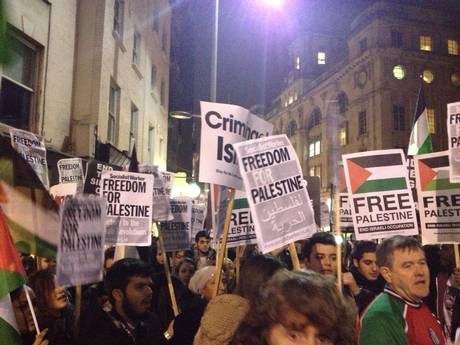
Once through I was met with the swaying force of 1,000 people all shouting and chanting. There were Socialist Worker Party banners everywhere.  Almost immediately someone approached me and said “solidarity brother” and held out his fist. I replicated and we did, what I thought to be, a slightly awkward fist tap (like a high five but with your fist clenched). He looked at me smiled and said, “Yeah fuck the Jews man” and walked off.

With no sense of irony he turned and immediately started talking to a group of Jews who are anti-Zionist and can often be seen on ‘pro-Palestinian’ demonstrations. Language is used and abused but I still found the flippancy in which he muttered the phrase “fuck the Jews” to be deeply disturbing.

A wee scuffle broke out at one point between a young activist called Joe and a portly policeman. I approached Joe afterwards and asked what the problem was. Angrily at first he said, “They won’t let me confront them…the fascist scum. The EDL are down there and these pigs won’t let me through”. He looks through the policeman who is still hovering over us and says, “The Zionists are standing side by side with the fucking EDL”.

I asked around and indeed even went back to check, and couldn’t see any sign that the EDL had been at either demonstration.

All around me the crowd is loud. They chant in slogans that have been used for as long as the occupation and the mass of people seem to move with a collective pulse. The atmosphere is intense and the police numbers grow around the edges of the swelling crowd.

A young man with a scarf around his face sees me making notes and winds his way up to me. He tells me above the ambient noise that he is Indian and this is the reason why he has come here today. “I am here for myself because my country was occupied for hundreds of years. I’m here standing up for myself but also for the Palestinians – the oppressed”.

I ask him if he thinks it will work, if this demonstration will make any difference and he responds simply, “we have to try”. Even though he has a scarf over his face I can see his cheeks lifting and some wrinkles appear in the corner of his eyes. He exudes a sense of optimism.

Just as I finish speaking to him a small fight breaks out and two protestors are taken away by the police whilst chanting defiantly “Free free Palestine, from the river to the sea, free free Palestine”. The whole evening feels electric as if at any moment it could spill over.

After a gradual decline though, the cold takes most people back to their warm houses. Only a handful of anarchists and activist are left. One proclaims proudly “I’m only leaving in handcuffs” to which a policeman responds “did you bring any with you”?

As I arrived back to the warm of my south London flat, I turn on my computer and I am virtually reminded of the reason why we had all trekked across London on this cold November night. The Palestinian news agency, Ma’an News has on its front page a story that is grimly entitled “Teen brothers among 3 killed in Israeli airstrike”.

It states, “An Israeli airstrike killed three Palestinians in the northern Gaza Strip on Thursday evening…bringing the death toll to 19 on the second day of fighting.”

No amount of goodwill on either side will bring back the dead and only the Israeli government and Hamas have the power to stop further bloodshed. Let’s hope the leadership was listening to some of the moderate voices out on the streets of north London  on this chilly November evening.

8 Comments

Filed under Human rights, Middle East, Politics, War

Rockets and war crimes cannot break the Israeli peace movement

At the time of writing, 80 rockets have been launched from Gaza since last night – all aimed at the south of Israel.

The Israeli Defence Force (IDF) spokesman on twitter pointed out earlier that these rockets are not always intercepted.

The latest series of attacks have caused at least 5 injuries. Towns across the south of Israel are, once again, living in fear that a rocket could hit at any moment.

These attacks, due to their indiscriminate nature are a violation of International Humanitarian Law as they fail to distinguish between civilian and combatant. Amnesty International has accused Hamas, who regularly claim responsibility for these rocket attacks, of War Crimes.

These most recent attacks reminded me of my visit to Sderot earlier this year. Sderot is an Israeli town less than a kilometer from the Gaza border with a population of just 24,000 people. Life in Sderot is dictated by the near constant danger of rocket attacks.

Every house in Sderot has a built in ‘safe room’. I was told residents have just 14 seconds to get to it should they hear the warning siren. A physical impossibility for many such as Sderot’s elderly residents.

Town planners have ensured that there are always bomb shelters close by out in the streets. Every bus stop is built to double up as a bomb shelter. As a result, residents of Sderot are never far from shelter nor the reminder that they live in a constant danger.

Nearly all of Sderot’s residents have been affected by rocket attacks. 13 people have been killed in the small town in the last decade alone. The most recent was 35 year old Shir-El Friedman who was killed on the 9th May 2008.

Despite this terrifying reality, I met some within this small community that are actively looking to reach out to those living in Gaza.

I met a representative from ‘Other Voice‘ – a group of Israelis, mainly based in Sderot, who are working to end the circle of violence both in Gaza and Sderot. Their website states:

The Palestinians are also suffering. They, like us, strive for a quiet and peaceful life and for a better future. We believe that only by working together can we reach a long lasting solution. Therefore, our group is in ongoing contact with Palestinians in the Gaza Strip who believe, as we do, in non-violence and mutual respect that will bring about the much anticipated change”.

To meet Israelis living with this constant threat of attack but who were looking to create dialogue rather than conflict was truly inspiring. Too often, across both Israel and the occupied Palestinian territories, I witnessed the exact opposite happening.

The most difficult question I am left with, is that I don’t know how I would respond if I lived under such constant fear! This however only exaggerates my admiration for those like the members of Other Voice.

6 Comments

Filed under Human rights, Middle East, War

Testimony from an IDF soldier living near Qalqiliya

I have written a lot on this blog trying to explain to you what life was like living in Jayyus, a small Palestinian village close to Qalqiliya in the West Bank. Equally, I tried to give the people I met a platform to tell their stories.

Well today I stumbled across this testimoney from an Israeli Lieutenant in the IDF who served close to Qalqiliya over ten years ago. Things have changed a lot since then but I thought you might appreciate this view of Qalqiliya from the eyes of an Israeli serving in the army.

The period this describes is October 2000. You can read the full testimony here.

“I was around Qalqiliya then, which was considered a very friendly town to Israelis. Many Israelis used to go there, shopping for everything, using local garages for repairs, buying stuff, drugs, everyone was hanging out there all the time, and suddenly all at once lots of Palestinians were attacking the checkpoint. A little checkpoint, and all those Palestinians coming along and throwing stones, and armed. You couldn’t even tell where this suddenly fell from.

This happened while you were already an officer?

Right after I was commissioned…Our objective was to lay ambushes on various roads in the area, which are the border line between a Palestinian village and a Jewish settlement. They would simply come down after nightfall and throw stones at a car. The driver – frightened – would move the car and get hit. Our objective was to actually catch them [The Palestinians] before the act.

What do you do to catch them?

Lay an ambush. Our instructions were: anyone seen after 9 PM or so descending towards the road, you shoot. Legs down. Every ambush of this sort goes out with a small marksman rifle.

The instructions were to shoot at anyone arriving on the road without any warning? How did it go?

Think of a road with these steep hills on both sides which do not actually enable strategic control of the road. There are terraces of olive groves, that is the reason for this structure. It was rather logical geographically. This was at the time when the east-west highway was not yet constructed. There was just the old road. The new road simply bypasses all the Arab villages, creates an isolated route. There was none of this back then.

The situation was not weird, it was ridiculous. People shot at anything they saw moving. As a commander on the ground who is not supposed to shoot, you give the order to your soldiers and expect them to understand that if they see someone through their special sights who looks like he’s going to do something, they should shoot him in the legs or lower. In the knees. That was a very clear instruction. And they knew perfectly well how to aim and where to aim, regarding ranges. There are different ranges, after all. If you shoot at a leg you might hit the chest. There are situations where you know exactly what you’re going to hit if you aim here or there as regards the weapon’s deviation. And suddenly after two months of warfare, I don’t even know how long that was, two months of uncertainty, because there actually was uncertainty, what we called ‘waning and waxing tides’, two days calm and then chaos, and wild deployments, everyone in the area would leap at anything, stressed out like crazy.

So lots and lots of people got hurt and died, for no reason. Nothing you could even say they did. They did nothing. And then the army realized it was losing control. I’m talking to you here about a company in training of young soldiers, eight months into their army service. The older companies were even in a rougher spot. They had marksmen rifles so they would simply snipe away with more serious ammunition, not 5.56 but 7.62 caliber. Suddenly the army realized it had a problem. At least, the way I understand it now, they stopped it. They said: no more shooting. You need confirmation to open fire. Suspect arrest procedure. So then this procedure came in for suspect arrest. It didn’t exist until then. No such thing. Suspect arrest procedure went like this: You detect someone, you shoot….

It was a confused time. There were stones hurled, Molotov-cocktails, but no serious terrorist attacks. No targeted alerts. Nothing of the sort. As for intelligence information, it read like this: there is an attempt to enter roads. No one spoke of infiltration into Jewish settlements, soldier kidnappings, nothing targeted.

This instruction was handed down from the top, to shoot anyone approaching the roads after 9 PM?

Yes. It was a clear order, at least in our designated area. Anyone descending from that hill and looking suspicious, with no obvious reason to be there. Look, let’s say at 11 or 10 PM people have no reason to be there. Could be, perhaps they did do something. On the other hand, people at 11 PM don’t have too much reason to travel that road, see? So perhaps people really did try to throw stones, but hitting, I mean I’m talking to you here about kids hitting. Okay, they throw stones inside the village. Or there’s a demonstration in the village. The army tricks them by trying to enter and creating a riot. We knew that every entry of an army jeep into an angry village provokes a riot. That’s what brought them on, really. Not every commander was interested in keeping things quiet.

Some wanted to heat things up. Commanders? Company commanders?

Yes. The battalion commander was moderate, the company commanders were all gung-ho. Really. They were eager to enter and create planned disturbances.

A company commander would come along and say: tonight at 8 PM we’re going in for a provocation? Or during a patrol, he’d suddenly say: ‘Let’s hop in’?

No. It was more like, let’s hop in, make the rounds of the village now”.


This testimony was taken by the organisation “Breaking the Silence

1 Comment

Filed under Human rights, Middle East, War

Scorched earth and shootings, as the Israeli military stand by

This article was originally published on Liberal Conspiracy.

Scorched earth stretched out before me. To my right the fire was still burning across the hillside spreading through olive trees. To my left all that remained was charred black earth.

All around me, men were moving, unable to rest but also unable to access their land to tackle the fire. All they could do was to stand watching as their livelihoods and land burnt.

An hour earlier, 22 year old Najeh al-Safadi had tried to put out the fire on his land and had been shot in the stomach by the private security staff from the overlooking settlement. At the time of writing it is unknown if he will walk again after the bullet damaged his spine.

I was stood with some residents from Urif, a small village in the West Bank close to Nablus. Urif stands on the opposite side of the valley to the illegal settlement of Yitzhar which is described in the New York Times as, “an extremist bastion on the hilltops”.

Violent action from the settlers directed at both the Israeli Defence Force (IDF) and local Palestinians is not uncommon in the area. The International Solidarity Movement reported back in April 2012 that, “that hundreds of villagers [from Urif] have been injured since 2000 [by settlers from Yitzhar], with as many as 40 serious injuries (many of which were gunshot wounds) and one murder”.

Stood on the hillside opposite me, above the one hundred and fifty dunums of burning land but below the settlement of Yitzhar, were a collection of about forty to fifty settlers. A small group of them were still lighting fresh fires, hours after the original fires had been started.

Parked up and stood alongside these settlers were the IDF. The Israeli Army stood by and watched as these crimes unfolded.

A few hours later however, the IDF did intervene. Just as a small number of settlers were on the outskirts of Urif the IDF stepped in. Their contribution? To fire fifty to sixty tear gas canisters at the villagers and international observers who were monitoring the events.

The IDF has said that they, “regard this incident [the shooting] as severe and will thoroughly investigate it”. Between September 2000 to November 2011, B’Tselem sent fifty-five complaints to the Military Advocate General’s Corps regarding cases that raised the suspicion that security forces did not intervene to stop settler violence.

In only five cases was an investigation opened; two of the five were closed without any measures being taken against the soldiers involved. In eighteen cases, no investigation was opened at all. In eleven cases, B’Tselem did not receive any response.

In a flash the ambulances were gone and the only traces that were left of the violence that had just occurred were the smouldering fields and the talk of whether Najeh would make a full recovery.

I left the mayor promising him that I would do what I could to tell the world what I had seen in his village that day.

Leave a comment

Filed under Human rights, Middle East, Politics, War

My mates band, my love life and the security of Israel’s borders

A little more than a few hundred meters of fences and checkpoints mark out the border between Jordan and Israel where the two countries meet at their southern most point. It took me about 10 to 15 minutes to cross this border when entering Jordan last week. On the way back into Israel however it took about two hours. Why? I was told it was because they had ‘serious security concerns’. Never before has the word ‘serious’ been subjected to such a loose definition.

The conversation started off a little tedious. “How long have you been in Jordan for? Who did you visit? Are you carrying any weapons”? These are the sort of questions that always strike me as slightly pointless but are a regular feature of border crossings. In a slightly overly accommodating way I responded to a complete stranger with complete itinerary of my holiday and that no, I was not carrying any weapons.

Very quickly however the conversation started to veer from the ordinary ‘airport style questioning’ to the downright bizarre.  “What’s on your t-shirt?“. I was wearing my Jim Lockey and the Solemn Sun t-shirt (a friend’s band). I explained this to her and she answered, “Are they successful…your mates band?”. She almost spat the word mate. I paused wondering whether she really wanted to hear how successful or not my friend’s band were. As she didn’t break the silence I responded, “Well yes, just recently it has been great, they’ve been signed to a record label I really like and they have just put out an album which has been met with critical acclaim”.

Now taking swabs from every item of clothing in my bag checking for the explosives and drugs I had assured her I didn’t have she says, “give me an example”. I clarify, “you mean, you want an example of the ‘critical acclaim’ my friend’s ban has had?”. She nods. Again, an awkward couple of seconds silence before I say, “Well, Kerrang magazine gave it KKKK (out of 5) while the site Punktastic has described it ‘ a definite contender for album of the year’”. She stares at me blankly. “What’s that a picture of?” she says pointing at the album art from their first record ‘atlases’ that is printed on my t-shirt. “Why would did he chose that picture?”. I answered as honestly as I could, “I don’t really know, I would just be guessing if I answered”. Deadpan again she says, “well guess”. Feeling slightly foolish I again sought clarity, “you want me to guess why a mate of mine that I went to school with chose this picture for his first album?”. Nod. “Really?”. Two nods.  I start to speculate and she continued to stare blankly at me.

This level of conversation lasts for one and half hours. It stretched from the finest detail that I can recall about the Live Music Act (part of my former work), my love life as a 16 year old through to petty details like why my bag had ‘mountain equipment’ written on it when it didn’t look very suitable for mountains. I answered question after question trying to not laugh at the stupidity of it all.

After an hour and half of solid questioning she tells me to stop slouching. I had maybe stared to drift off. She handed back my passport and tells me that I can go now. I smile and walk past a picture of Bill Clinton on the wall – I was sure by this point his eyes followed me across the room.

Walking away past a customs official who didn’t bother to look up from his newspaper I thought to myself that there are two undeniable facts about Israel. One is that it faces an extreme external security threat that means it needs to have secure borders. Secondly is that it’s response to this security threat is often disproportionate. What I experienced coming through the border is a slightly more comic illustration of this disproportionately.

6 Comments

Filed under Middle East, War

Spending the pink pound in Israel

This is a feature piece written for OUT magazine.

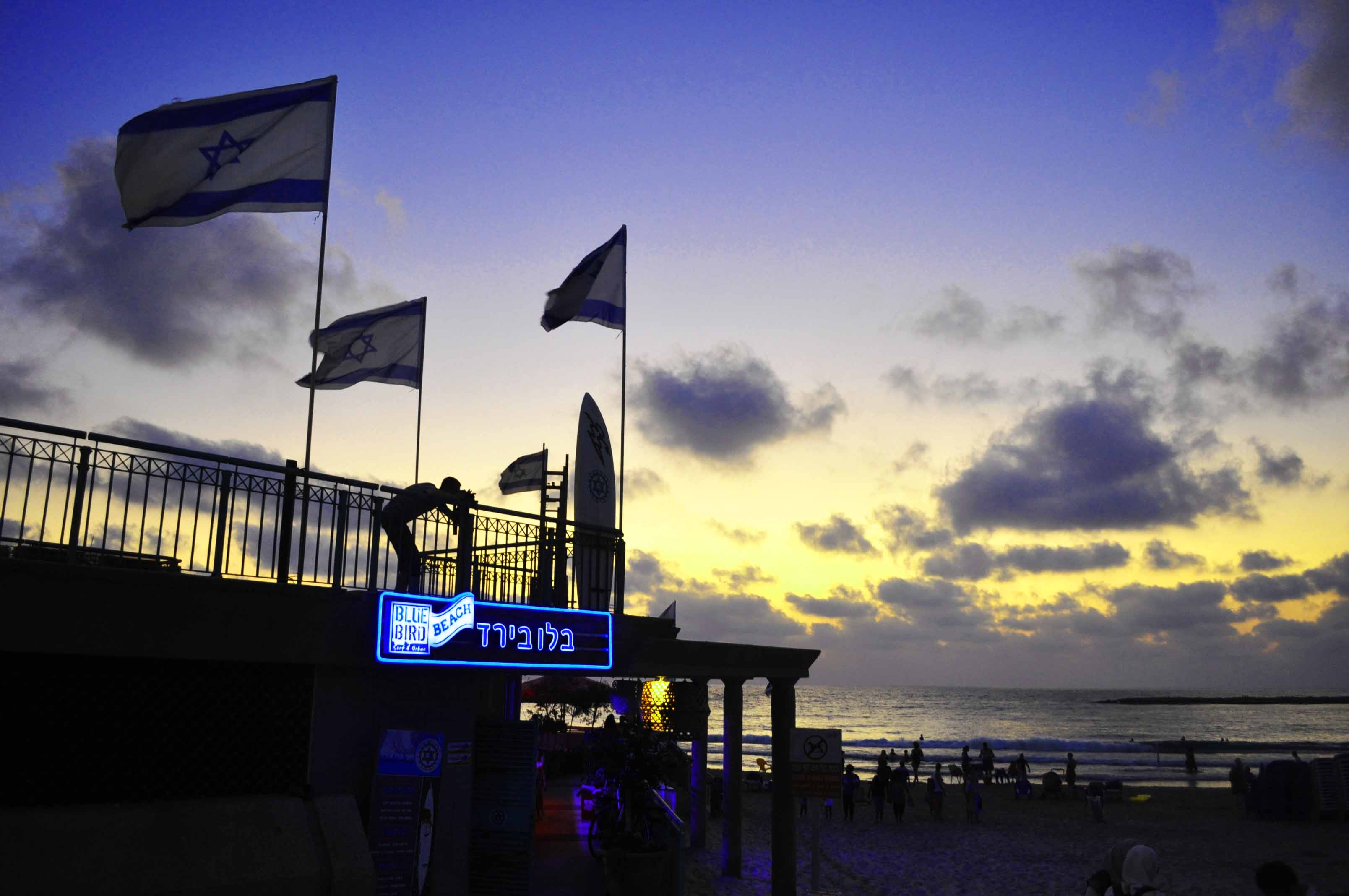
Sat in the evening sun Shaun shifts closer to Paul as the temperature drops in the fading light. I meet the couple sat on a beach in Tel Aviv, Israel. The two men in their mid thirties are on a couple of weeks vacation from their home in south London. I ask them if it is OK to talk to them about the gay scene in Israel and they happily suggest going for beer in the bar a hundred meters away on the beach front.

Sweet smelling smoke fills the air inside the bar as hookah pipes are shared between friends. We are sat with panoramic views of the now silhouetted beach front.  Passing the hookah pipe across the table to where the two men are sat side by side I start the interview by asking them why they chose Tel Aviv for their holiday. Paul exhales a plume of smoke, takes a sip from his beer and jokes, “cheap easy jet flights”. Shaun laughs and adds, “I just love the rub down at the [Ben Gurion] airport” (referring to the notoriously inhospitable welcoming foreigners receive at the airport).

With a smile I try a less subtle approach and asked if it had anything to do with the internationally renowned LGBT scene in Tel Aviv. Paul does not hesitate this time and comments, “We want to holiday somewhere that we feel relaxed and welcome. A friend of mine told me about Tel Aviv and so we thought we would check it out”. As an afterthought, as if recalling a distant memory, he adds, “everything is set up for us here”.

Tel Aviv is a well known destination for ‘gay tourism’. Last year Tel Aviv launched a $90 million campaign to present itself as, “an international gay vacation destination.” Leon Avigad, owner of the gay-friendly Brown hotel, explains the city’s popularity, “We are cosmopolitan, we’re very Western, European and American but on the other hand we’re very much into the Middle Eastern warmth and welcoming, and this combination attracts”.

Our visit to Tel Aviv coincide with the holiday of Pesach (Passover), the celebration of the story in Exodus where the ancient Israelites were freed from slavery in Egypt. As such it is very difficult to buy certain things such as beers and certain breads. I ask Shaun if this has been a problem and he responds with more depth than I was perhaps expecting. “I think it is beautiful that this society can hold onto its traditions and religious celebrations and still be so open minded”. I wondered how much Shaun had ventured much beyond the city since being here.

On cue, they ask me what I am doing in Tel Aviv and I tell them all about EAPPI and they seem genuinely interested. I ask them if they have ever been to the occupied Palestinian territories. Paul responds with a degree of defensiveness in his voice that he assumed he wasn’t allowed, “I thought there was a war there”. I explain to them, the best I can, the problems caused by the occupation and what I have experienced since living there. I elaborate my point about why I think it is bad for both Israelis and Palestinians. There is a more than awkward silence and I begin to worry that I might have pushed the conversation both metaphorically and literally too far from Tel Aviv.

As if reading my mind Paul comments, “all of that seems a long way from here”. I take this opportunity to try and relate what is happening in the conflict to their experiences here in Tel Aviv and ask if either of them have ever heard of the phrase, “pinkwash”. They respond in unison, “no”. I try my best to offer a definition of Pinkwash – the idea that Israel has created a deliberate strategy to conceal their continuing violations of Palestinians’ human rights behind an image of modernity, illustrated through the booming  gay scene. Both men looked troubled at the idea, clearly concerned that “their community” and “their choices” could somehow be linked to the troubles I had just described about the military occupation.

I try to reassure my two new friends and joke with them that they are not responsible for Israel’s occupation. For Paul however this was not enough. Playing with the beer mat in front of him he almost apologetically comments, “I guess we have only seen a part of life here”. I smile and again try to reassure them both that they are meant to be on holiday relaxing, not peacekeeping. They sheepishly smile back.

For many in the LGBT community it is an ethical dilemma whether or not to boycott Israel as a holiday destination. On one hand it is a beacon of LGBT rights in an otherwise very hostile environment. Some Palestinian activists have tried to persuade me that there is a growing gay rights movement in Palestine. If there is I have yet to stumble across it. Netanyahu told Congress last May that the Middle East was “a region where women are stoned, gays are hanged, and Christians are persecuted.” Sadly, this rhetoric may be alarmist but has also an element of truth in it.

On the other hand however Israel is accused by Amnesty International of “ill-treatment and torture of detainees, excessive use of force, the detention of conscientious objectors, and forced evictions and home demolitions” as well as having a “disregard for international law”. For anyone within the LGBT community who is concerned about equal rights and equality there are some clear moral concerns here.

As an LGBT activist who fundamentally believes in an equality of rights, I cannot settle on Israel having a progressive attitude towards LGBT rights whilst routinely violating other rights through the conflict and occupation.  As Haneen Maikay, the director of Al Qaws (a Palestinian gay rights group) recently said in the New York Times, “When you go through a checkpoint it does not matter what the sexuality of the soldier is”. The LGBT community are not separate from the rest of society who suffer from the occupation.

We are now three beers into the conversation and Shaun’s tongue as well as his sense of moral outrage has been loosened, “So what can we do to highlight all this. It’s f***ed up that people can come here and are not told about any of this s***”. Partly through tiredness I decide to avoid the minefield of BDS (boycott disinvestment and sanctions) and instead simply comment that I think it is important to make sure that everyone who comes to Tel Aviv is aware of what is happening just 20 kilometres to the east.

Paul however looks concerned. I have been talking for the last ten minutes and Paul has not spoken. “I don’t know” he says between regular slugs of beer. “there are so many f***ed up countries in the world where you can get hung for just glancing at another guy. It doesn’t feel right to be criticising a country who are opening their arms and welcoming us”. This concern reflects a very real issue within the LGBT community. To criticise Israel is to break an unspoken pact where those working on LGBT issues stand united in their struggle.

The answer to this dilemma presented itself to me in Yad Veshem, the Israeli holocaust museum. Here they have on the wall in large letters the poignant words of Martin Niemöller “First they came for the communists, and I didn’t speak out because I wasn’t a communist. Then they came for the trade unionists, and I didn’t speak out because I wasn’t a trade unionist.  Then they came for the Jews, and I didn’t speak out because I wasn’t a Jew. Then they came for me and there was no one left to speak out for me”.

If the 20th century taught us anything it is that silence can allow terrible things to happen. The LGBT community cannot stay silent while Israel uses its progressive attitude towards LGBT tourism to deflect attention from the continual violations of basic human rights standards in the occupied territories. Equally however, I believe we have to welcome Israel’s pioneering approach towards LGBT tourism, and encourage these attitudes to spread to less hospitable parts of Israeli society.

Stood outside the bar, the air is now cold and so our good-byes are short. As the two men turn to leave Paul says to me that “next time we come, I think we should spend a few nights somewhere in the West Bank”. I smile and say that they definitely should. Parts of Israeli society may be a beacon for LGBT rights in the middle east, but it is also an occupier of another land. To understand Israel, I think you have to visit that other land.

12 Comments

Filed under Human rights, Middle East, Politics, Religion, sexuality, War

Another crackdown on the protest in Kafr Qaddum

My head started swimming and I couldn’t open my eyes. I could feel broken stones crunch beneath my feet and I knew I was moving away from the protest. For a terrifying 30 seconds I lost track of what was happening. An autopilot sense of self preservation kicked in that my conscious self had little control over. Just as my senses started to return I felt a colleagues hand rest on my lower back and lead me to the side of the street. Here I crouched in the small amount of shade offered by the shop-front from the midday sun. My stomach had tied itself into a knot and my head felt like it had split in two. Only then did I realise that I must have walked away from my colleague who was now stood in front of me with her camera in hand. I glanced up an offered what I hoped was a reassuring smile.

A few minutes earlier I had been stood at the back of a demonstration in Kafr Qaddum, a small village in the West Bank. I was there to monitor the proceedings and reporting on any human rights violations I witnessed. In the minuets preceding I had filmed a number of ‘warning shots’ being fired over the crowd and whiffed the faintest smell of tear gas. I believed I was far enough back though to avoid the worse of what was to inevitably come. I was stood on the side of the street next to a large wall that could also offer me protection, should it have been needed, from any direct fire. My colleague was nearby and I felt in control of situation.

Seconds later the Israeli army fired a volley of tear gas canisters (some directly into the crowd) that filled the streets with a penetrating thick gas. At first I stayed in position as it appeared the soldiers were aiming just for the front of the protest. As the crowd turned to run however, the tear gas landed closer and closer to me. At this point one canister landed a few yards away and filled my lungs with the gas. What happened next is a blur. I remember a man kicking the canister away down the hill but little else.

On the approach to the village earlier that day there were some clear signs that the protest was not going to pass peacefully. The Israeli Army had set up a series of checkpoints cutting off the only main entrance to village. I approached as part of a mini convoy of human rights monitors. I was travelling with others from EAPPI and the Israeli human rights organisation B’Tselem. As we approached the checkpoint it became abundantly clear that international human rights monitors were not being allowed into the village. Later I would find out that the same restrictions were being applied to media outlets.

I already had reasonable suspicion to believe that this week’s protest at Kafr Qaddum was going to witness an escalation of violence on previous weeks. The day before the village had seen 19 of its residents arrested in an IDF raid. “It was a clear illustration of strength aimed to intimidate us and to stop us making protest” one villager suggested. There were reports that a large amounts jewellery had also been stolen during the raid. This combined with the checkpoints only heightened our unease about the protest.

After meeting a series of other journalists, news agencies and human rights monitors who had also been turned away we decided to collectively head across the fields and enter the village “through the back door”. As the representative from B’Tselem put it, “if we do not reach the village today I am sure some very bad things will happen and they will go unreported”.

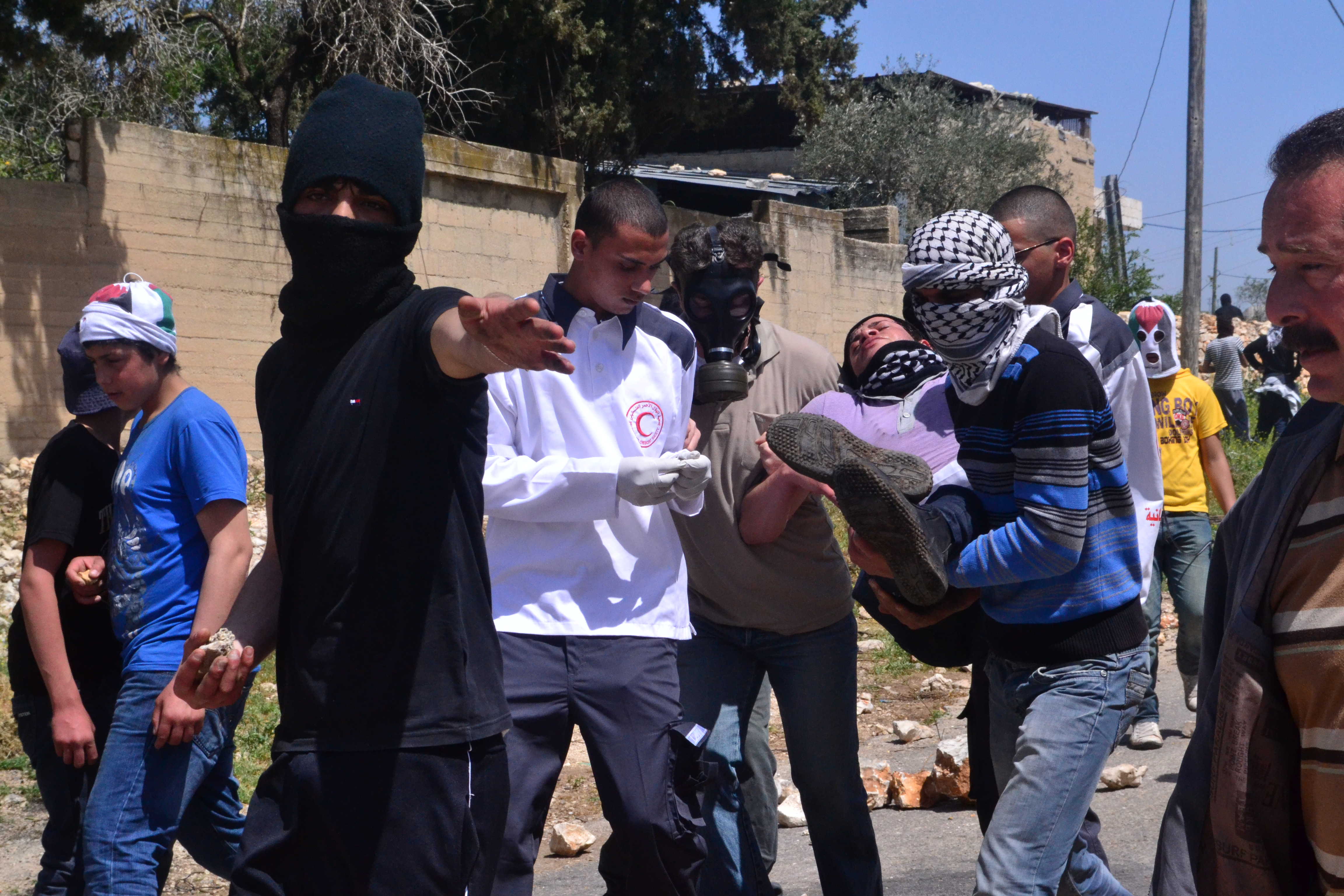
Sadly, his prediction of violence proved to be true. Both the Israeli Army and boys and young men from the village once again illustrated their willingness to take part in acts of violence against one another. Before being ‘tear gassed’ myself I saw stones the size of my fist being flung through sling shots at the soldiers who then responded with the brutality that I am coming all to use to seeing.

It is important, however distressing these scenes of violence are, that the world hears about them. Today I saw a large number of boys throwing stones before the Israeli Army fired tear gas directly at the crowd as a whole.  The obvious difference in these actions is that one was undertaken by a professional army and the other by young boys in an occupied village.

2 Comments

Filed under Human rights, Middle East, Politics, War

Jerusalem is encircled by violence as another Land Day comes and goes under occupation

Stood just outside of the historic Old City in Jerusalem I witnessed scenes of panic as the Israeli army, special forces and police force used rubber bullets, riot horses and sound grenades on Palestinian protesters at this year’s ‘Land Day’ protests.

Meanwhile, resident’s in and around Jerusalem saw violence erupt on their streets. Haaretz reported that, at “Qalandiyah checkpoint [protesters] hurled rocks at soldiers, who responded with stun grenades and tear gas” while Ma’an News reported from Bethlehem that “Israeli forces fired tear gas and rubber bullets at protesters”. Al-Jazeera reported that “over 120 people have been injured at Qalandiyah checkpoint”.

Before any of the protests started news reached those on the streets that the civil authority in Israel has been covertly setting outside land for settlement expansion in the West Bank. A particularly hard report to hear on ‘Land Day’ of all days. Haaretz ran the headline ‘Israel Defense Ministry plan earmarks 10 percent of West Bank for settlement expansion’. This did nothing to calm the tensions.

After the mid-day prayers a few hundred protestors gather outside of Damascus gate in the old city. They were met by a comparable number of soldiers, policemen and special forces. News spread that all men under the age of 40 were banned from entering Al Aqsa mosque. Again, a move that did nothing to ease the tensions. Soon after this, no one was allowed to enter or leave Damascus Gate that leads to  the old city. At this stage, the gathering crowd was peaceful (despite reports coming in about injuries and rioting at Qalandiyah checkpoint).

With a rising noise level the tension also grew. Early on in the protest the occasional plastic bottle was thrown from within the crowd. This acted as justification for the Israeli Army and special forces to go in with a series of heavy handed tactics including charging with riot horses and letting off sound grenades. Throughout the protest I saw the occasional act of violence from a protester (such as a stone being thrown) which was then responded to with disproportionate force imposed on the crowd as a whole.

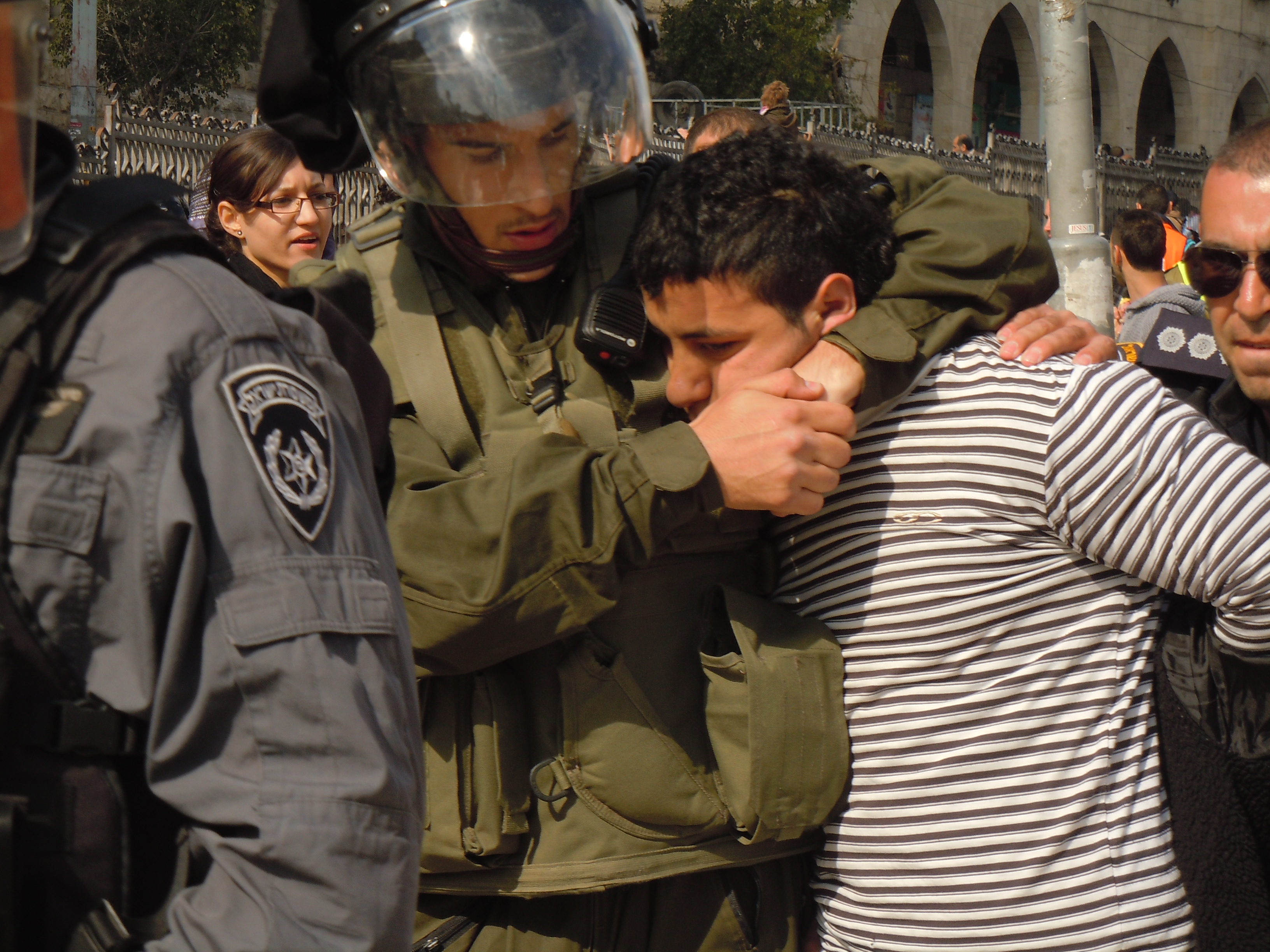
At one stage, I witnessed a Palestinian throw a stone towards a soldier (and miss). The soldier saw who threw the stone, chased after him and fire what I was told was rubber bullets directly at him (they are designed to be fired at the floor to rebound into legs, not directly at a person). On another occasion I saw soldiers beating men who were simply standing, watching and taking photographs. An international who was with me at the protest commented that she saw, “A soldier head butting a protestor in the face using his helmet. Luckily an Israeli policeman was there to pull the soldier away before anything worse happened”. Throughout the protest riot horses were used to charge at protestors who were not showing any visible threat or security concern.

Sadly, I know all too well that this disproportionate use of force at protests occurs all too often throughout the West Bank. A few weeks ago I reported on how the Israeli army breached their own regulations in the way they ‘policed’ a protest at the village of Kafr Qaddum.

I left the protest feeling exhausted. I walked back past ambulance workers treating minor injuries and shop keepers attempting to carry on trading. This Land Day has once again seen injuries, arrests and limitations on the basic right to peacefully protest. Outside of Jerusalem there were reports coming in that a protestor had died in Gaza.

What I saw in Jerusalem was an unnecessary and disproportionate use of violence against an overwhelmingly peaceful protest. This event however is not unique, it remains the impossible reality for those who are attempting to oppose the occupation through non-violent means.

1 Comment

Filed under Human rights, Middle East, Politics, War

Abuse in Qalandia Checkpoint

“You clearly don’t understand f****** Hebrew so let’s try in f****** English – you do not have a permit to enter so why don’t you f*** off back to whatever village you have come from”. My ears pricked up at this sudden harsh use of my mother tongue. I had for the last 15 minutes been sat in the middle of Qalandia checkpoint letting the mix of Arabic and Hebrew wash over me as I waited patiently for the man in front of me to pass through. The Palestinian man who stood with me turned a full 360 degrees looking at the ceiling before breathing heavily and saying to the young soldier on the  other side of the glass, “I understand f****** English, I do have a f****** permit to pass and I would appreciate it if you showed some respect and didn’t use such f****** foul language”. The swelling queue behind me laughed. The young female soldier stared him straight in the eye.

Qalandia checkpoint is on the outskirts of Jerusalem and is one of the largest in the occupied Palestinian territories (oPt). It is not near any border between Israel and the oPt but rather divides the Palestinian cities of Ramallah and Jerusalem. The man in front of me I would later find out was an orthodox Palestinian Christian wanting to go and pray at his church in Jerusalem.

The Palestinian man was at this point demanding to see the young soldier’s supervisor. Both parties were shouting and screaming. They both seemed to hold opposite opinions about this one piece of paper – his permit. Despite the close vicinity of the two, the man was shouting at the top of his voice, “I have a permit to cross 24 hours – why do you not let me through?!”. The soldier on the other side of the glass was matching his volume screaming, “You do not have the right permit so you cannot pass – it is that simple”. At this stage I had no way of telling who was right. Was the man confused about the terms of his permit or was the soldier mistaken? Without marching up and asking to look at the permit I had no way of really knowing. The following series of events however gave me a strong idea.

I had been stood waiting for just under half an hour listening to these two go round and round in their never ending argument. Back and forth with little variation they would shout, “I have a permit”…“no you f****** don’t”. Finally the soldier looked at her colleague and they both started laughing. The man did not. The young soldier (I guess aged between 18 and 20) turned to the man laughing and said, “Fine you can go through…you’re pathetic”. I was taken aback. The man scowled at her, picked up his belongings and turned on his heel to pass through the final turnstile. I watched him enter into the mid-day sun and temporarily out of sight.

I approached the young soldier with my passport in hand and with all the correct visas in place. I was a little worried though that she was going to cause me problems as well. I half smiled at her on my approach to the glass screen. She looked up and asked what my name was and so I nervously responded, “erm…Steve”. She smiled at me and said, “I hope you have a nice stay in Jerusalem, it’s a beautiful city. Sorry about the delay”. She then waved me through without looking at my visa or passport.

Outside, the Palestinian Christian apologised to me saying that he was sorry I had to witness him shouting but “they only listen to me if I shout”. I said it was no problem. I then asked him what the issue was with his permit. He laughed a bitter laugh and said, “nothing, look [he hands me the permit]…Everything is fine, they just do this to make life hard for you”. I folded the permit and handed it back to him. As we were walking towards the bus that would take us to the heart of Jerusalem he turned to me and said, “Can you imagine – every time I want to pray I have to go through this. I sometimes wonder  if this is God testing me”. Sat on the bus I wondered how many people in my parents’ church would still attend if they had to pass through Qalandia checkpoint every Sunday on their way to church.

Thinking back to the soldier in the checkpoint I wondered what had driven her to respond in such a way to this particular man. Was it her own way of escaping the insurmountable monotony of working at a checkpoint? I do not know. All I can say for certain is that today I had another up-close look at the one of the many restrictions on life here and saw an ugly glimpse of the daily struggle that Palestinians face under occupation.

6 Comments

Filed under Human rights, Middle East, War

A revolution is brewing in Palestine

Nestled in amongst beautiful rolling hills you find a small micro-brewery with a revolutionary spirit. The Brewery was established with the intention of supporting the local economy and to use only the finest natural ingredients. This, for those of you who know me, could easily describe Stroud Brewery, my former employer.

Today however, I am describing the only micro-brewery in Palestine – Taybeh Brewery. It is based in the village of Taybeh (aptly meaning ‘delicious’) just outside of Ramallah, the de facto administrative capital of the West Bank.

This may seem an unusual place to stumble across a brewery. When you think of a micro-brewery, Palestine is not the first place to spring to mind. To suggest that brewing might not ‘belong’ in the middle-east is an idea that head brewer Nadim Khoury has evidently heard one too many times; It is near to impossible to leave the brewery without picking up the fact that beer was first brewed in the Middle-East up to 5,000 years ago.

Nadim is a man who is hard to dislike – when he strides into his brewery you can feel his passion, warmth and enthusiasm rush towards you. His big bushy moustache has no chance of hiding his beaming smile as he asks you if you would like a beer – you just know that he wouldn’t mind one himself. Nadim is clearly very proud of his brewery and so he should be. The story he has to tell is truly remarkable.

In 1994 just after the signing of the Oslo Accords, Nadim and his brother David invested some 1.2 million US Dollars into the brewery (all the equipment had to be specially imported). Nadim started this brewery with no more than some home-brew experience. Nadim set up the brewery in his home village of Taybeh determined to support the ‘new’ emerging Palestinian economy. He described people’s attitudes at the time by saying, “people thought I was crazy”. I smiled and he cackled a crazy man’s laugh and started to walk away muttering, “really crazy”.

There are a few very good reasons why anyone other than Nadim might think twice before setting up a brewery in Palestine. Indeed, it has to be noted that Nadim is currently the only person to have taken on the task (with considerable success I might add). He has had to overcome large cultural and religious issues as well as the small issue of living and working under military occupation. I was eager to find out the source of his success.

“It was crucial to get Arafat on board with our vision” Nadim says gleaming at a picture of him shaking hands with Arafat. “With Arafat on board I knew that I could make this work”. The subtext that is never spoken here is clear – with the endorsement of Arafat, overly zealous locals who might have otherwise taken an objection to a brewery opening remained quiet. Today, the majority of people who drink Taybeh beer are Muslims – not Christians, secularists or Jews. I suspect that’s one lingering stereotype that Nadim is happy to have broken.

Taybeh however is a Christian village. I asked Nadim what relations are like with his immediate neighbouring ‘Muslim villages’ and he responded positively highlighting the importance of the brewery to all of the surrounding local economy. “In the 2 days that people from all over the world come here for our ‘Oktoberfest’ local traders sell more of their produce than in all of the rest of year”. Quite a claim – I can see why the locals might have a soft spot for the brewery.

The brewery attracts a wide spread of support from the significant Palestinian Christian population right through to the droves of internationals that make their secular pilgrimage to this site. Israeli activists have also been known to show their support of the brewery.

Life has not always been easy for Nadim or the brewery though. On a number of occasions the brewery has been on the brink of closure due to a terrible mix of dropping demand (during the second intifada for example) and continued restrictions on movement of people and produce (he has to drive the beer for hours to a checkpoint in the south of the West Bank to ‘export’ his beer to Israel). At this point he shows me a cask that he has cut in half – he uses it to illustrate to IDF soldiers what the inside of a cask looks like. Now, whenever his beer passes a checkpoint it has to be weighed (more that 3 kilograms either way and it does not get pass). I don’t think any other brewery in the world faces these sorts of challenges.

As if this story is not remarkable enough, another twist to the tale walks through the door – Nadim’s daughter and now the first ever female Palestinian brewer. She is articulate and shares her father’s passion for brewing. I talk with her about the beer industry in the UK and how it is so dominated by men and ask what challenges she faces here in the West Bank. She answers sincerely saying “some of the older customers prefer to deal with my father but most have got used to it by now”. Another stereotype being chipped away at?

As we leave (with a handful of bottles) I over hear the rest of family (all who have various roles within the business) chatting. One of them is being interviewed by a reporter about a film she produced highlighting the issue of domestic violence in Palestine. Nothing surprises me now. This brewery is breaking down boundaries built up by prejudice. At the same time it is building and laying the foundations for the future. At the heart of whatever the future holds for this region there has to be a stable economy. Taybeh Brewery is busy laying the foundations for this future.

As I wait for a taxi to take me back to the reality of the rest of the occupied territories, I consider how, for me at least, I cannot think of more appropriate way support local people than to raise a glass of Taybeh beer. When people ask what you can do help resist the occupation and help people survive, I reckon this has to be one of the easier asks. Click here and have a beer – cheers!

2 Comments

Filed under Beer, Economics, Middle East, War

A not so peaceful protest

This article was posted on the Liberal Conspiracy blog.

I was stood in the middle of an escalating protest against the Israeli occupation in the village of Kafr Qaddum. The air was thick with tear gas, panic was spreading as people were running in all directions to escape. In this commotion another round of tear gas was fired directly at the crowd. I saw someone meters from me collapse. A man caught him as he was falling and lifted him onto his shoulders. As he tried to escape other men came to help carry him. After a few meters they laid him down on the ground and it became clear he had been shot in the neck by a tear gas canister. This was the second person of the day to suffer this fate.

The former legal advisor for Judea and Samaria, Col. Sharon Afek of the Israeli Defence Force stated in April 2009 that, “direct firing [of tear-gas canisters] at persons is prohibited” and that, “very soon, an explicit and broad directive will be issued that will prohibit the firing of a tear-gas canister directly at a person.” When in July 2011 the Israeli human rights group B’tselem enquired to why they were still recording multiple incidents of tear gas canister being directly at crowds, Major Uri Sagi, of the office of the legal advisor for Judea and Samaria within the IDF stated that, “we have again clarified to the forces…the rules relating to firing of tear-gas canisters at persons, including the prohibition on directly firing a tear-gas canister at a person.”
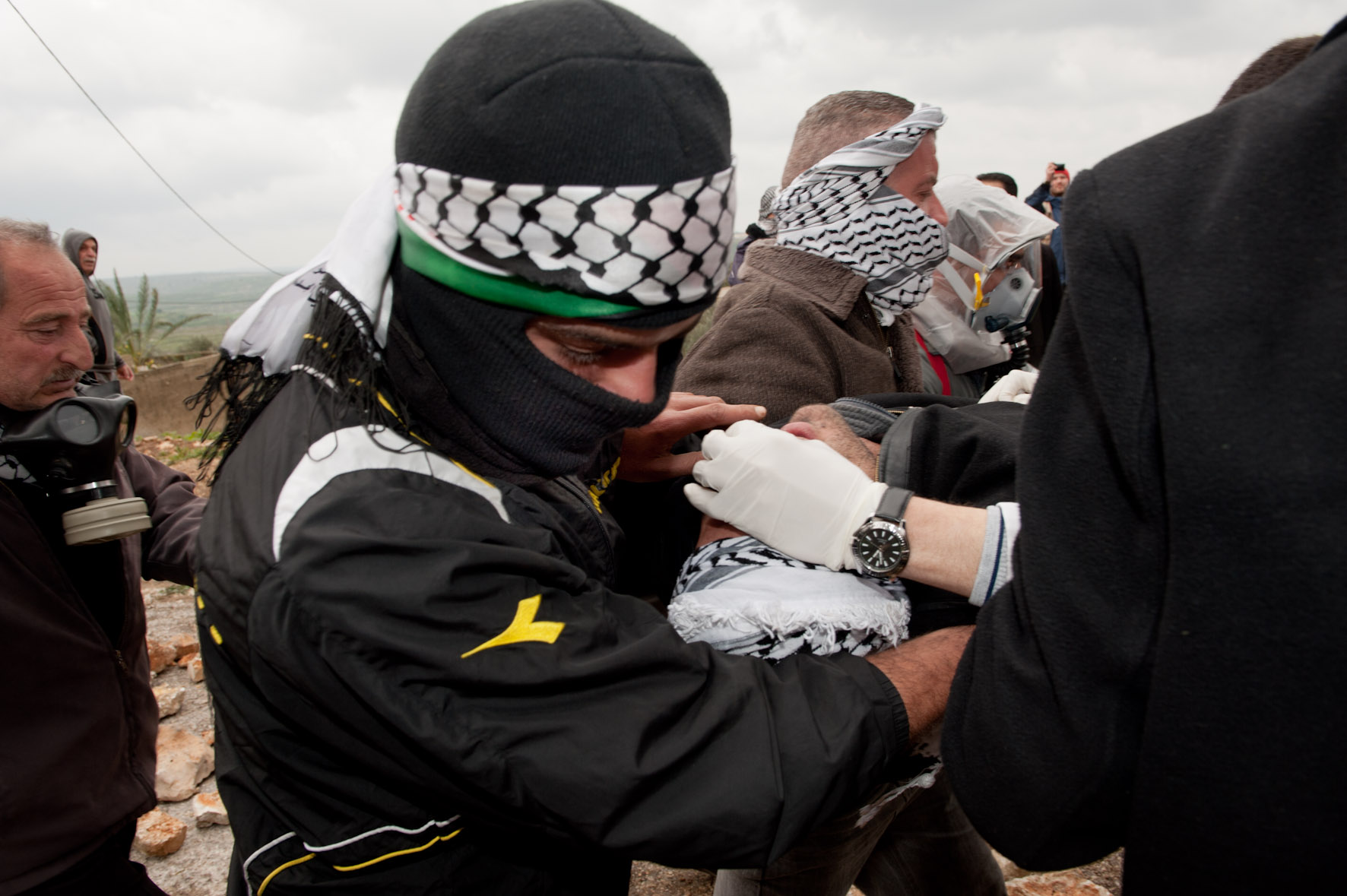
In December 2011 the death of Mustafa Tamimi was caught on camera. He was killed by a tear gas canister fired by an IDF soldier from the back of a jeep just a few meters away. This incident caused international outcry. It was raised by Don Foster MP in a letter to the Foreign and Commonwealth Office and gained wide spread media coverage.

Despite this extensive history I today witnessed another two Palestinian men being hit by IDF fired gas canisters. Despite IDF regulations stating that tear gas must be fired at a 60 degree angle I witnessed them repeatedly firing directly at the crowd. Not only does this violate the IDFs own regulations regarding the use of tear gas, it also violates International Humanitarian Law by failing to distinguish between civilian and combatant.

This however was only one part of the story of what happened at the protest at Kafr Qaddum today. The IDF tactics varied between spraying chemically produced water with a awful smell (aka ‘skunk water’, firing tear gas (at the crowd) and even using dogs to capture protestors towards the front. I was told that this boy had his arm broken by the dog before being arrested. This was the first time I had seen dogs being used at protests – a potentially worrying development.

The protest is organised under the principle of non-violence. Regularly however stones are thrown at the IDF by boys from the village despite men trying to stop them. It was reported that last week that a soldier was hit in the face by one of these stones. This reality that the IDF faces however provides no justification for their continued breach of both IHL and their own regulations. We are collecting too many examples now of the IDF misusing tear gas. It is time for the IDF to start enforcing its own standards and to live up to its obligations under International Humanitarian Law

6 Comments

Filed under Human rights, Middle East, War

No father, no food and an unknown future

When I was at school I did a sponsored fast – nothing was to go between my lips for the entire school day. I was raising money for something, a cancer charity maybe. During the morning break-time I remember pushing a doughnut into my porky little face. I scoffed it down and never told a soul about it. Licking my sausage fingers I can remember not feeling even the slightest crack of guilt.

Today, for this first time since that fateful event, I felt guilty. I felt guilty because stood in front of me in the mid-day sun was Hallah Hattab. Hallah is one week into her hunger strike. She is standing in solidarity with her father, Kifah Hattab who is 3 weeks into his hunger strike in an Israeli prison. Kifah is just one of a number who have chosen to go on hunger strike in recent months in protest of Israel’s continued use of administrative detention.

Hallah Hattab is a beautiful 20 something year old that oozes intelligence and holds herself with a confidence which conceals her age.  She has joined others today outside of the International Red Cross in Tulkarm to protest about the conditions that Palestinian prisoners are being held under. Specifically they are looking to highlight Israel’s on-going use of administrative detention. As the Israeli human rights organisation B’tselem states, “according to international law, administrative detention can be used only in the most exceptional cases, as the last means available for preventing danger that cannot be stopped by less harmful means. Israel’s use of administrative detention blatantly violates these restrictions”.

Both men and women gather on the pavement outside of the International Red Cross building sitting on plastic chairs in large circles. Each person holds a photo or a poster of a loved one who is languishing in an Israeli jail. Each of those attending the protest hold their own story of how someone close to them, a son, a brother or a father have been taken away from them. For Hallah it is her father.

I catch Hallah in between interviews with various local, national and international news agencies and ask her how she is feeling. She has the answer to this question down to a fine art, “I am trying to keep my spirits up, I know what I am feeling is nothing compared to what my father is experiencing, but it is still hard”.  Her hazelnut eyes blink at the end of her sentence and then fix themselves on me, attentive and focused on the interview at hand.

After a few seconds silence I ask Hallah how long she will be willing to carry on her hunger strike for and she responds saying that she will continue for “as long as it takes…I want to support my father”. She says these words with real determination. I wonder how far she will be pushed. Khader Adnan recently went on hunger strike for 66 days and very nearly paid the ultimate price. The undertaking that Hallah has taken on is no small one. I am eager to find out what fuels this fire inside of her but we are interrupted at this moment by someone introducing Hallah’s mother.

Her mother stands with us and insists (in perfect English) that she does not speak very good English.  I wonder whether she is just comparing herself to the English that flows from her daughter. Unlike her daughter she looks tired, both physically as well as mentally exhausted. She may not be on her hunger strike but you can see that the situation is taking its toll on her. When I ask her if she is worried about her daughter however her face lights and up she says that she feels ‘nothing but pride’. I half turn back to Hallah to ask about her studies at university and I catch her mother’s proud smile in the corner of my eye.

Frustratingly Hallah is whisked away as some other news agency is wanting to speak to her. I watch on as she gives another interview in another language. I look at her in admiration. I marvel at all she is doing with no father to support her, no food to sustain her and an unknown future to look to. I wonder if I would be able to do what she is doing and I think back to my pathetic failed attempt to fast for one school day.

On the walk back to the house where I am staying I talk to other EAs about Hallah. One colleague rationalises all that she is doing with the simple comment, “it is just her way of coping”.


1 Comment

Filed under Human rights, Middle East, Politics, War